Blanket sizes: throw, twin, queen and king, with the overhang on each bed
A throw is 50 by 60 inches, a queen blanket 90 by 90 to 100 and a king 108 by 90 to 100. The chart, the overhang on each bed, throws and baby blankets.
The short answer
- Bed blankets: twin 65 or 66 by 90 inches, full 80 to 85 by 90, queen 90 by 90 to 100, king 108 by 90 to 100, California king 104 by 108.
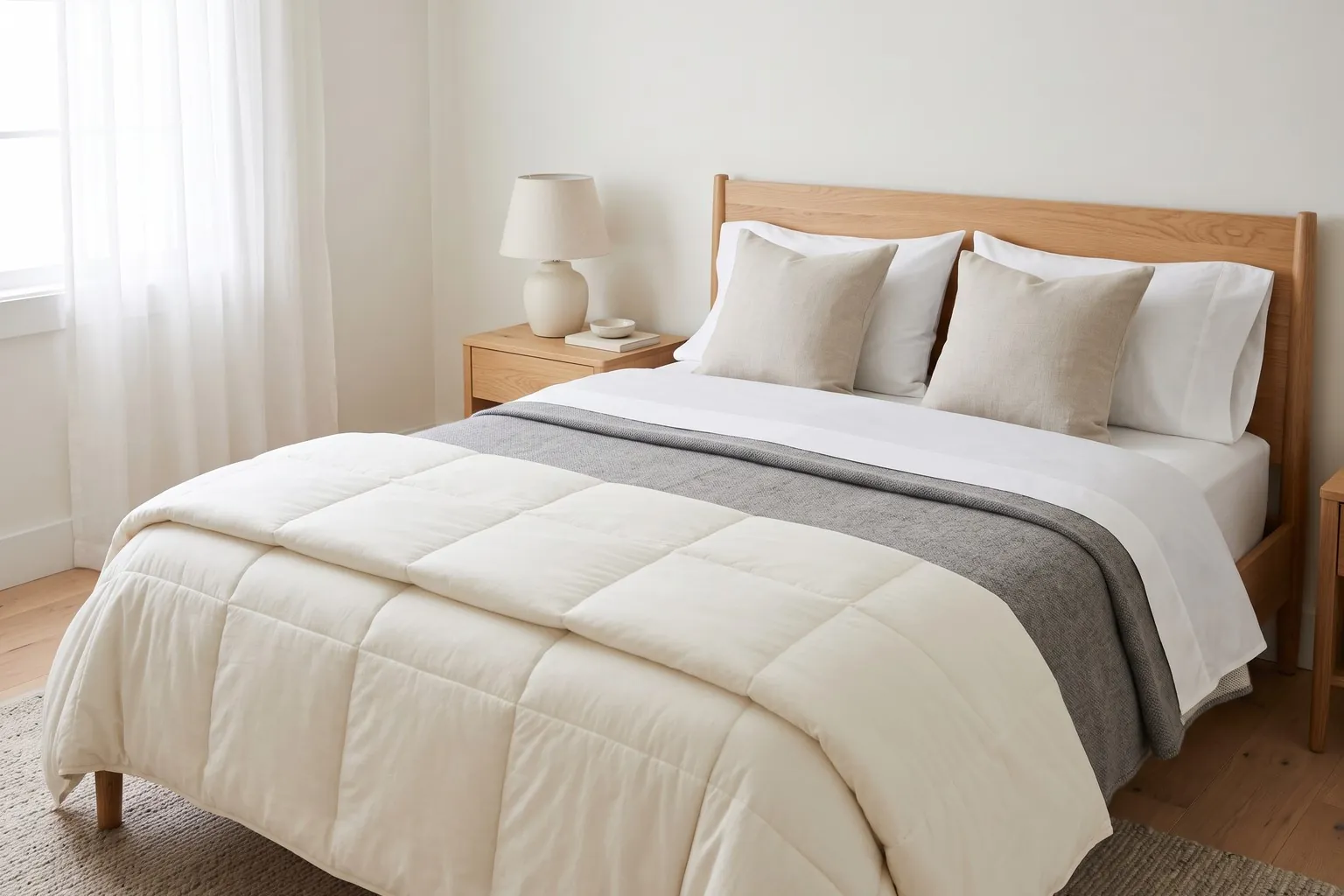
- By our sums a blanket of its own size hangs 13 to 16 inches down each side of the mattress.
- A standard throw is 50 by 60 inches. It is made for a sofa or the foot of a bed, not to sleep under.
- Sizes vary by manufacturer. Check the inches on the label, most of all on a blanket marked full/queen.
- For a baby under one year old, U.S. safety guidance is to keep blankets out of the crib.
In this guide
A blanket is the simplest piece of bedding to size. It has no pocket to fit and no cover to match. It only has to be wider and longer than the bed by enough to stay on it.
This guide gives the chart for bed blankets, works out what each one leaves hanging, and then covers the smaller blankets: throws, afghans and baby blankets. It is one of our guides to bedding sizes.
Bed blanket sizes
Inches, width by length, from four sources.
| Bed | Sleep Foundation | Saatva | Purple | Casper |
|---|---|---|---|---|
| Twin | 65 to 66 by 90 | 65 by 90 | 65 by 90 | 66 by 90 |
| Twin XL | 66 by 95 | |||
| Full | 80 to 85 by 90 | 85 by 90 | 85 by 90 | 80 by 90 |
| Queen | 90 by 90 to 100 | 90 by 100 | 90 by 90 to 100 | 90 by 100 |
| King | 108 by 90 to 100 | 108 by 100 | 108 by 90 to 100 | 108 by 100 |
| California king | 104 by 108 | 104 by 108 | 104 by 108 |
The four agree more closely than the charts for comforters or sheets do. A queen blanket is 90 inches wide everywhere, a king 108. The differences are in the length, 90 or 100 inches, and in the full, 80 or 85 inches wide.
Purple's twin figure is taken from its text. Its chart prints 60 by 90 inches for the same blanket, which matches neither its own text nor the other three sources.
Both the Sleep Foundation and Purple add the usual caution. Sizes are not universal, in the Sleep Foundation's words, and Purple says exact blanket sizes vary based on the manufacturer.
How far a blanket hangs
The sources describe the principle without giving a number for every bed. The Sleep Foundation says standard blankets are designed to fully cover the mattress and then drape over its edges. Purple says bed blankets are usually a few inches wider and longer than the mattress. Saatva gives one worked figure: 13 inches of blanket draped over each side of a twin mattress.
The same subtraction can be done for every size. Here it is with Saatva's chart, and with the California king figure the other sources share. The sums are ours: half the difference in width on each side, and the whole difference in length at the foot, with the blanket pulled level with the head of the mattress.
| Bed | Mattress | Blanket | Over each side | Beyond the foot |
|---|---|---|---|---|
| Twin | 38 by 75 in | 65 by 90 in | 13.5 in | 15 in |
| Full | 54 by 75 in | 85 by 90 in | 15.5 in | 15 in |
| Queen | 60 by 80 in | 90 by 100 in | 15 in | 20 in |
| King | 76 by 80 in | 108 by 100 in | 16 in | 20 in |
| California king | 72 by 84 in | 104 by 108 in | 16 in | 24 in |
So a blanket of the right size hangs 13 to 16 inches on each side. That is enough to cover the side of a mattress up to that thickness, and it leaves 15 to 24 inches at the foot to tuck under or let fall.
Two readings of that table are useful.
The length is where the choice is. A queen blanket 90 inches long leaves 10 inches at the foot of an 80 inch mattress. One 100 inches long leaves 20. If you tuck the blanket in, or fold the top back over the pillows, buy the longer one.
A narrow full is noticeably narrower. At 80 inches wide, as Casper and the low end of the Sleep Foundation's range have it, a full blanket leaves 13 inches a side in place of 15.5.
Throw blanket size
A throw is the small blanket that lives on a sofa. The Sleep Foundation calls 50 by 60 inches the standard size of a throw blanket, and Saatva and Purple give the same figure.
Casper's guide to throws shows the range around that standard.
| Throw | Size |
|---|---|
| Small | 40 by 50 in |
| Standard | 50 by 60 in |
| Large | 60 by 70 in |
| Oversized | 70 by 80 in |
Casper also lists throws of 36 by 50, 40 by 60, 45 by 55 and 45 by 60 inches, and sells one of its own at 50 by 70. Its suggestions by piece of furniture: about 36 by 50 inches for a small armchair, and 50 by 70 across the foot of a California king bed.
What a throw is not is a bed blanket. The Sleep Foundation says throws generally do not fully cover an average sized adult and work well as lap blankets. Casper is firmer: a typical throw is smaller than a bedding blanket and never big enough to cover your entire body for sleep. Saatva sums up the use in a phrase, for a couch or the end of a bed.
The arithmetic agrees. A standard throw is 50 inches wide, which is 12 inches wider than a twin mattress and 4 inches narrower than a full. Laid across the foot of a queen bed the long way, its 60 inches match the width of the mattress exactly, with nothing to hang over either side.
Afghans and lap blankets
Two more names appear in every chart.
- Afghan. The Sleep Foundation, Saatva and Purple give 50 by 65 inches. Casper notes there is no standardized size and that 50 by 65 is simply common. Purple describes it as slightly larger than most throw blankets.
- Lapghan. The Sleep Foundation, Purple and Casper give 36 by 48 inches, and Saatva gives 30 by 40.
Baby blanket sizes
The charts list several small blankets by use. The figures differ between sources more than for any other size, so the table shows them side by side.
| Blanket | Sleep Foundation | Saatva | Purple |
|---|---|---|---|
| Lovey | 12 by 12 in | 12 by 12 in | 12 by 12 in |
| Baby | 14 by 16 in | 14 by 16 in | 14 by 16 in |
| Cradle | 14 by 30 in | 14 by 30 in | 14 by 30 in |
| Preemie | 18 by 24 in | 18 by 24 in | |
| Stroller | 22 to 30 by 30 to 36 in | 22 by 30 or 30 by 36 in | 20 to 30 by 30 to 36 in |
| Receiving | 40 by 40 in | 18 by 18 or 36 by 36 in | 40 by 40 in |
| Crib | 45 by 60 in | 36 by 45 up to 45 by 60 in | 45 by 60 in |
One thing has to be said next to that table. A crib blanket is a size, not a recommendation to put a blanket in a crib.
The U.S. Consumer Product Safety Commission's guidance is short: do not add pillows or blankets to your baby's sleep space. Its rule is bare is best, meaning nothing but a fitted sheet in a crib, bassinet or play yard. The Centers for Disease Control and Prevention says to keep soft bedding, blankets included, out of a baby's sleep area. The American Academy of Pediatrics lists blankets, quilts and comforters among the loose bedding that raises risk, applies its recommendations to babies up to 1 year of age, and suggests a wearable blanket for warmth. It also says not to use weighted blankets for babies.
For sleep, follow the pediatric guidance above, not the size chart.
Twin XL and California king
Two beds are often missing from blanket charts.
Twin XL. Saatva says a twin blanket can also be used on a twin XL bed. The sum shows what that costs: a blanket 90 inches long leaves 10 inches at the foot of an 80 inch twin XL, against 15 on a twin. Casper lists a twin XL blanket of its own size, 66 by 95 inches.
California king. The Sleep Foundation, Purple and Casper all give 104 by 108 inches. Saatva has no California king row, and suggests a king size blanket on the longer side. A king blanket 108 by 100 inches on a California king leaves 18 inches a side and 16 at the foot, by our sum. The mattress itself is described in California king bed dimensions.
Full/queen labels, and going up a size
Purple notes that some queen blankets are marketed as full/queen. On that label the same blanket gives, in its words, slightly less overhang for a queen bed and ample overhang for a thicker full mattress. With a 90 inch blanket, the sum is 15 inches a side on a queen and 18 on a full.
Purple's other suggestion is to go up a size for an oversized fit. Its example is a king blanket on a queen bed, for extra length to tuck or fold, or extra overhang to cover a thick mattress. That is 108 inches on a 60 inch mattress: 24 inches on each side. Measure from the top of the mattress to the floor before you do it.
The Sleep Foundation's advice for a mattress that is itself oversized is to add several inches to each dimension.
Thick mattresses
None of the four sources gives a rule in inches for mattress thickness and blankets. The table of overhangs gives you one. A blanket covers the sides of the mattress when the overhang on each side is at least the thickness of the mattress, measured with any topper on it.
For a mattress 12 inches thick, every standard blanket in the table passes. For one 16 inches thick, the twin, the full and the queen fall short, by half an inch to 2.5 inches, and the next size up is the answer.
Blanket, comforter or quilt
A comforter is filled, and a quilt, in Nectar's description, is a cover with little or no filling. Their sizes are close to a blanket's. A queen blanket is 90 inches wide and a queen comforter 86 to 92, and Nectar's chart gives a queen quilt as 90 by 95 inches.
So a blanket and a comforter made for the same bed cover about the same width. The comforter's chart is in comforter sizes, and the choice between a comforter and a duvet in duvet vs comforter.
Choosing, in four steps
- Start from the bed: twin, full, queen, king or California king. The mattress dimensions are in our chart of bed sizes.
- Read the inches on the label and subtract the mattress. Half the difference in width is what hangs on each side.
- Compare that with the thickness of your mattress. If the overhang is smaller, go up a size.
- Choose the length by what you do with it: 90 inches to lie flat, 100 if you tuck it in or fold it back.
For a sofa, the answer is a throw: 50 by 60 inches, or one of the larger sizes in Casper's list.
Questions people ask
What size is a queen blanket?
90 inches wide and 90 to 100 inches long. The Sleep Foundation and Purple give that range, and Saatva and Casper give 90 by 100.
What size is a king blanket?
108 inches wide and 90 to 100 inches long. A California king blanket is 104 by 108 inches in the Sleep Foundation, Purple and Casper charts.
What is the standard throw blanket size?
50 by 60 inches, according to the Sleep Foundation, Saatva and Purple. Casper lists throws from 40 by 50 up to 70 by 80 inches.
How much bigger than the bed should a blanket be?
By our sums, a standard bed blanket is 27 to 32 inches wider than its mattress, which leaves 13 to 16 inches on each side, and 15 to 24 inches longer.
Is a twin blanket big enough for a twin XL?
Saatva says a twin blanket can be used on a twin XL. A 90 inch blanket leaves 10 inches at the foot of the 80 inch mattress. Casper lists a twin XL blanket at 66 by 95 inches.
Sources
- Blanket sizes 101: a complete guide to styles and dimensions. Sleep Foundation, read November 2026
- Blanket sizes and dimensions guide, with chart. Saatva, read November 2026
- Blanket sizes guide: dimensions, types and comparison chart. Purple, read November 2026
- Throw blanket size chart. Casper, read November 2026
- Quilt sizes and dimensions guide. Nectar, read November 2026
- Safe sleep: cribs and infant products. U.S. Consumer Product Safety Commission, read November 2026
- How to keep your sleeping baby safe: AAP policy explained. American Academy of Pediatrics, read November 2026
- Providing care for babies to sleep safely. Centers for Disease Control and Prevention, read November 2026
Every figure in this guide comes from the sources above, or from arithmetic shown in the text. See our editorial policy.