Duvet vs comforter: one is two pieces, and that changes the washing
A duvet is an insert inside a removable cover. A comforter is one finished piece. How they differ in warmth, size, washing and cost, and how to choose.
The short answer
- A duvet is two pieces: a plain filled insert and a removable cover. A comforter is one piece, with its cover built in.
- The Sleep Foundation, Saatva and Casper all describe duvets as the thicker and warmer of the two. Amerisleep says warmth depends on the fill.
- With a duvet you wash the cover. With a comforter you wash the whole thing, and it may not fit a home machine.
- A comforter is normally used over a top sheet. Many people use a duvet without one.
- A comforter can go inside a duvet cover if the sizes match. Four of the five sources say so.
In this guide
The two words are often used as if they meant the same thing, and the Sleep Foundation says as much. They do not. The difference is a matter of construction, and it is simple enough to state in one sentence.
A duvet comes apart and a comforter does not. This guide follows that one fact through warmth, size, washing and cost. Both are part of our guides to bedding sizes.
The difference in one line
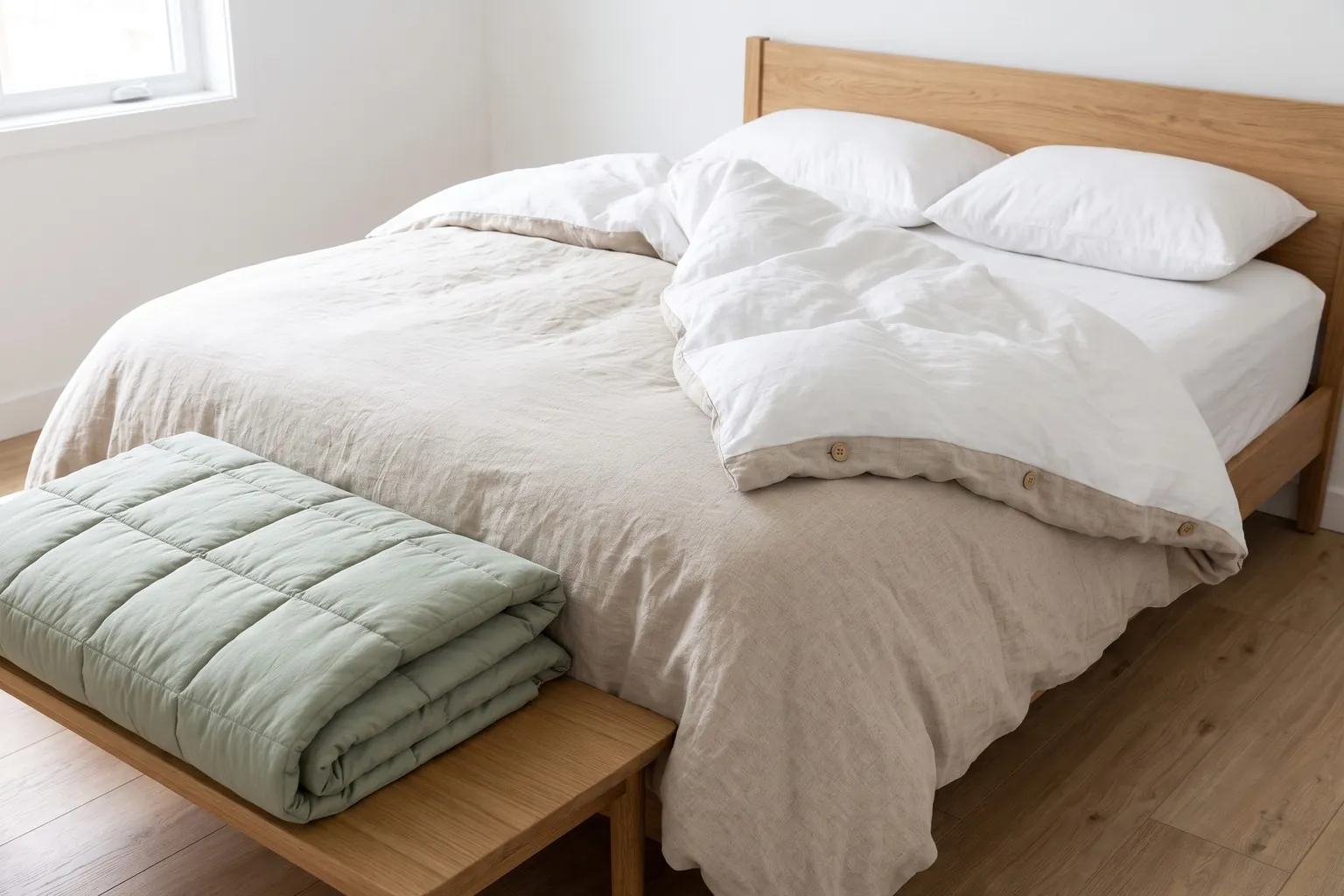
A duvet is two pieces. The Sleep Foundation describes the insert as fill encased in a simple shell of cotton, polyester or a blend, designed to be paired with a duvet cover. Saatva calls it a two piece system: a plain insert, usually white, and a removable protective cover. Casper's image is the clearest: the insert fits into the cover like a pillow in a pillowcase.
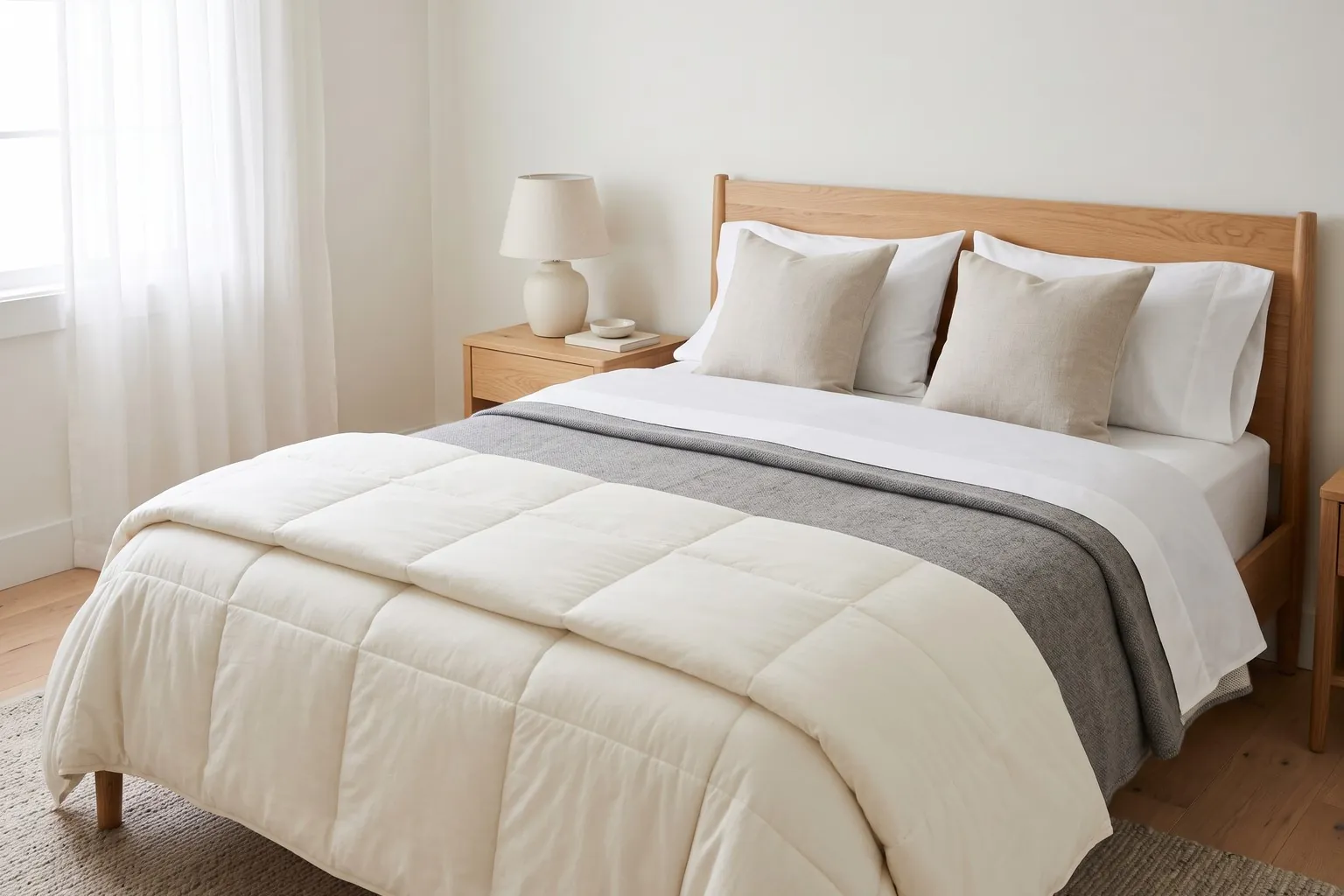
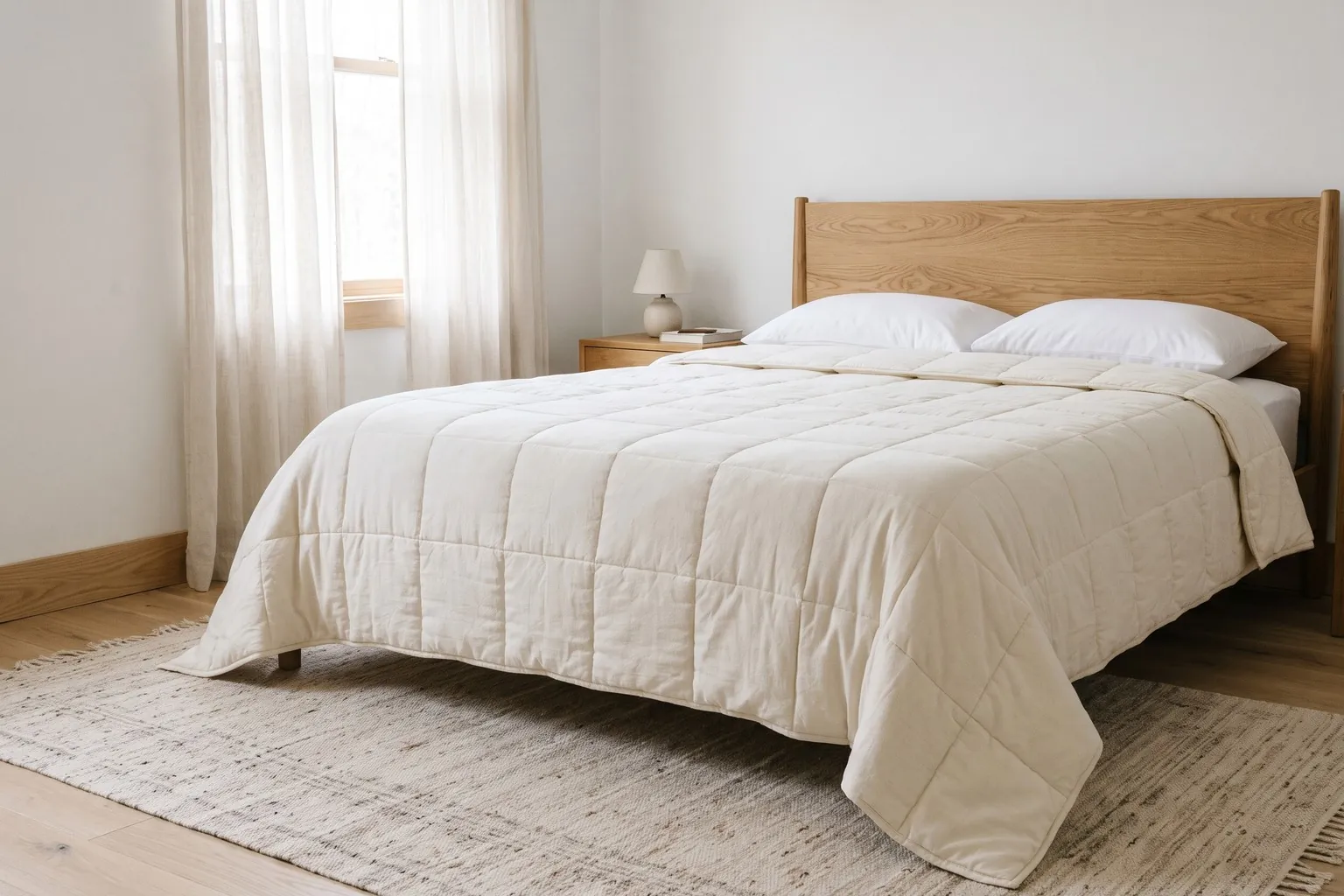
A comforter is one piece. In the Sleep Foundation's words it is constructed to be used as it is, with no need for an additional cover since one is already built in. Saatva defines it as a single piece blanket, filled with down or synthetic stuffing, that does not require a cover. Amerisleep calls it a quilted, fluffy blanket ready to use straight out of the bag.
Side by side
| Duvet | Comforter | |
|---|---|---|
| Pieces | Two: insert and cover | One |
| Outer fabric | The cover, which comes off | Built in |
| Usual look | Insert plain, often white; the cover carries the color | Finished, often sold in a matching set |
| Warmth | Thicker and warmer, in three of four sources | Flatter, with less filling |
| Top sheet | Often skipped | Normally used |
| Washing | The cover, in a home machine | The whole piece |
| Changing the look | Change the cover | Change the comforter |
Each row is explained, with its sources, in the sections below.
How each one is built
The duvet insert. A fabric shell filled with down, feathers, a down alternative, cotton, wool or silk, in the Sleep Foundation's list. Saatva and Amerisleep both describe it as plain and usually white.
The duvet cover. A large fabric envelope. The Sleep Foundation says covers typically fasten to the insert with ties, buttons or a zipper. Casper describes loops on its own inserts, eight of them, or four on a twin, that hold the insert in line inside the cover.
The comforter. One finished piece with the filling stitched in place. Amerisleep and Casper both describe it as quilted, and Amerisleep names box stitching. The fills overlap with the duvet's: Saatva lists down, wool, silk, cotton or a synthetic such as down alternative. Casper and Amerisleep say the usual comforter fill is synthetic.
So the materials are much the same. What differs is whether the outer layer can be taken off.
Which is warmer
Three sources give the same answer.
- Sleep Foundation: duvets tend to be thicker, heavier and warmer than comforters. Comforters often are not as warm or lofty, and may be more comfortable for year round use.
- Saatva: a duvet is typically thicker with extra filling. A comforter is slightly flatter with less stuffing.
- Casper: duvets tend to be loftier and often provide more insulation. Comforters may be lighter.
Amerisleep puts it differently, and its point is worth keeping. Warmth, it says, follows the fill. Fill power measures the loft of a down product, and the higher the fill power, the warmer it is. By that rule, the product matters more than the category.
The recommendations follow the majority. Saatva suggests a lightweight comforter for hot sleepers and a full duvet insert for cold sleepers. Casper says a duvet is a good choice for cold sleepers or winter months and a comforter may suit hot sleepers.
A duvet has one more setting, because it comes apart. The Sleep Foundation notes that some owners use the insert alone. Saatva suggests the opposite for hot sleepers: the cover on its own.
Which is bigger
Casper and Amerisleep both say comforters are usually larger than duvets: a comforter hangs over the sides of the bed, and a duvet fits the mattress more closely. Casper publishes a table of typical sizes with that statement, and Nectar prints the same figures.
| Bed | Duvet | Comforter |
|---|---|---|
| Twin and twin XL | 64 by 89 to 70 by 88 in | 66 by 86 to 68 by 88 in |
| Full | 80 by 89 to 90 by 94 in | 81 by 86 to 84 by 88 in |
| Queen | 88 by 90 to 90 by 94 in | 86 by 96 to 88 by 100 in |
| King and California king | 104 by 90 to 108 by 94 in | 102 by 88 to 110 by 98 in |
Casper calls the table a guideline and says manufacturers may add or subtract a few inches.
Read closely, the table says something narrower than the sentence. On a queen, the duvet is 88 to 90 inches wide and the comforter 86 to 88: the same, within 2 inches. The difference is in the length, where the comforter is 6 inches longer. By our subtraction, either one hangs 13 to 15 inches down each side of a 60 inch queen mattress.
So do not choose between them by size. Choose the type first, then check the inches. The sum for the width you need is in comforter sizes. For a duvet, Saatva's figure is at least 8 to 12 inches wider and longer than the mattress.
Washing: the difference you live with
Here the two pieces matter most.
The duvet. The Sleep Foundation says duvet covers are typically machine washable. Saatva's summary is that only the cover needs regular washing. The insert is another matter: the Sleep Foundation notes that many inserts have special care instructions and that some need dry cleaning or spot cleaning. Casper says an insert may need a large capacity washer or a trip to the dry cleaner.
The comforter. Saatva says the whole piece needs regular cleaning and that it can be hard to fit in a washing machine. The Sleep Foundation says washing one at home may be difficult because it is bulky.
On how comforters should be cleaned the sources do not agree. The Sleep Foundation says some comforters are machine washable. Casper says most are dry clean only, and adds the advice that settles it: read the care instructions. Amerisleep says it depends on the materials.
The practical point is the same in every source. A duvet cover can go in the machine with the sheets. A comforter is a separate job.
The top sheet
A comforter is designed to go over a top sheet, in Casper's words, and the Sleep Foundation says most comforter owners use one as a barrier between them and the comforter.
A duvet changes that. Saatva says no top sheet is required, because the cover is the protective layer. The Sleep Foundation lists not wanting a top sheet among the reasons to choose a duvet, and Casper notes that many people skip it and sleep under only a duvet and its cover, a style it traces to Europe.
If you keep the top sheet, its size is in sheet sizes.
Cost, and how long they last
The sources give a direction and one set of figures.
- Saatva gives the figures. A duvet set, meaning the cover and shams, runs from $60 or $70 to a few hundred dollars, with the insert possibly extra. A comforter runs from $75 to more than $200.
- Casper and Amerisleep say the two can be found at around the same price point, and that a duvet can cost more when its two pieces are sold separately.
- The Sleep Foundation says a comforter may be slightly more affordable up front, and that a duvet could ultimately be the better value.
Before comparing two prices, check what is in the box. Casper's advice is to confirm that the set includes both pieces.
On lifespan, Casper gives the only figure: most comforters last 10 to 15 years with proper care. The Sleep Foundation lists going flat as a drawback of comforters, and says a duvet with good fill in a shell of at least 300 thread count should hold up well.
Can you put a comforter in a duvet cover
Yes, according to four of the five sources. The Sleep Foundation says some comforters can be paired with duvet covers for additional protection. Saatva says a comforter can be used inside a cover for hygiene or for a different look, and Amerisleep says a comforter can serve as the cover's insert. Nectar is alone in saying no.
Casper adds the two conditions that make it work.
- The cover has to fit. A comforter may be slightly bulkier or wider than a standard insert. Amerisleep's rule is a cover the same size as the comforter or up to 4 inches larger.
- It has to be held in place. Casper says to use the interior ties or corner loops.
Insert and cover: matching the sizes
For a true duvet, the rule runs the other way, and two sources state it. Purple says inserts can be up to 2 inches wider and longer than their covers, and that in most cases the two should be the same size. Saatva says the cover should be equal to the insert or two inches smaller.
The Sleep Foundation lists the drawback to watch for here: the insert may shift inside the cover.
Do not rely on the size name for this. Saatva says there are no universal size guidelines for this type of bedding and tells buyers not to rely on mattress size labels. Its chart gives 95 by 98 inches for a queen cover, larger than the range in Casper's table. Measure the insert, then read the dimensions of the cover.
Which to choose
The Sleep Foundation's lists are the most direct.
A duvet, if:
- you want the plusher, loftier of the two;
- you like to change the look of the bed, since a new cover is a new bed;
- you would rather not use a top sheet;
- you want to wash the outer layer at home.
A comforter, if:
- you do not want to put a cover on and take it off;
- you want one finished piece, ready to use;
- you buy bedding as a coordinated set;
- you sleep warm, in Saatva's and Casper's advice.
The Sleep Foundation's table of drawbacks is short and fair. For a duvet: changing the cover can be difficult, the insert may shift, and the cover may have to be bought separately. For a comforter: it may go flat, it is harder to change styles, and it may be difficult to clean.
Where the words come from
The Sleep Foundation, Saatva and Amerisleep all give the same origin: duvet is the French word for down. The Sleep Foundation and Saatva add that duvets originated in Europe and that the comforter is their American counterpart. Saatva notes that European style bedding generally means a duvet.
Whichever you choose, it goes over the same mattress. The widths and lengths are in our chart of bed sizes.
Questions people ask
What is the difference between a duvet and a comforter?
A duvet is two pieces, a filled insert and a removable cover. A comforter is one finished piece with its cover built in. The Sleep Foundation notes the two words are sometimes used interchangeably.
Is a duvet warmer than a comforter?
Usually. The Sleep Foundation says duvets tend to be thicker, heavier and warmer, and Saatva and Casper agree. Amerisleep notes that warmth depends on the fill, so check the product.
Can you put a comforter in a duvet cover?
Yes, in four of the five sources we read. Casper says to make sure the cover fits the comforter and to use the interior ties or corner loops to keep it in place.
Do you need a top sheet with a duvet?
Not necessarily. The cover is washable, and the Sleep Foundation lists skipping the top sheet as a reason to choose a duvet. Comforters are normally used over a top sheet.
Which is easier to wash, a duvet or a comforter?
A duvet, in most cases. The cover comes off and is typically machine washable. A comforter is washed whole, and the Sleep Foundation says its bulk can make that difficult at home.
Sources
- Duvet vs. comforter. Sleep Foundation, read November 2026
- Duvets vs. duvet covers vs. comforters: key differences. Saatva, read November 2026
- Duvet vs. comforter: what's the difference?. Casper, read November 2026
- Duvet vs. comforter: what's the difference?. Amerisleep, read November 2026
- Duvet vs comforter: what's the difference?. Nectar, read November 2026
- Duvet sizes guide: dimensions and size chart. Purple, read November 2026
- Duvet cover sizes and dimensions. Saatva, read November 2026
- Comforter size chart: how to choose the right size. Amerisleep, read November 2026
Every figure in this guide comes from the sources above, or from arithmetic shown in the text. See our editorial policy.