Best wood for outdoor furniture: eleven species by decay, hardness and weight
Teak, white oak, black locust and ipe are rated very durable outdoors. The cedars, cypress and redwood resist decay but dent. Hardness, weight and upkeep compared.
The short answer
- Choose for decay resistance first. Teak, white oak, black locust and ipe are all rated very durable by The Wood Database.
- The cedars, bald cypress and redwood also resist decay, but they are soft: 320 to 900 pounds of Janka hardness against 1,070 for teak.
- Hardness is not durability. Red oak is harder than teak and is rated non-durable to perishable. Use white oak, never red.
- Only the heartwood resists decay. Two woodworking sources say to build outdoor furniture from heartwood alone.
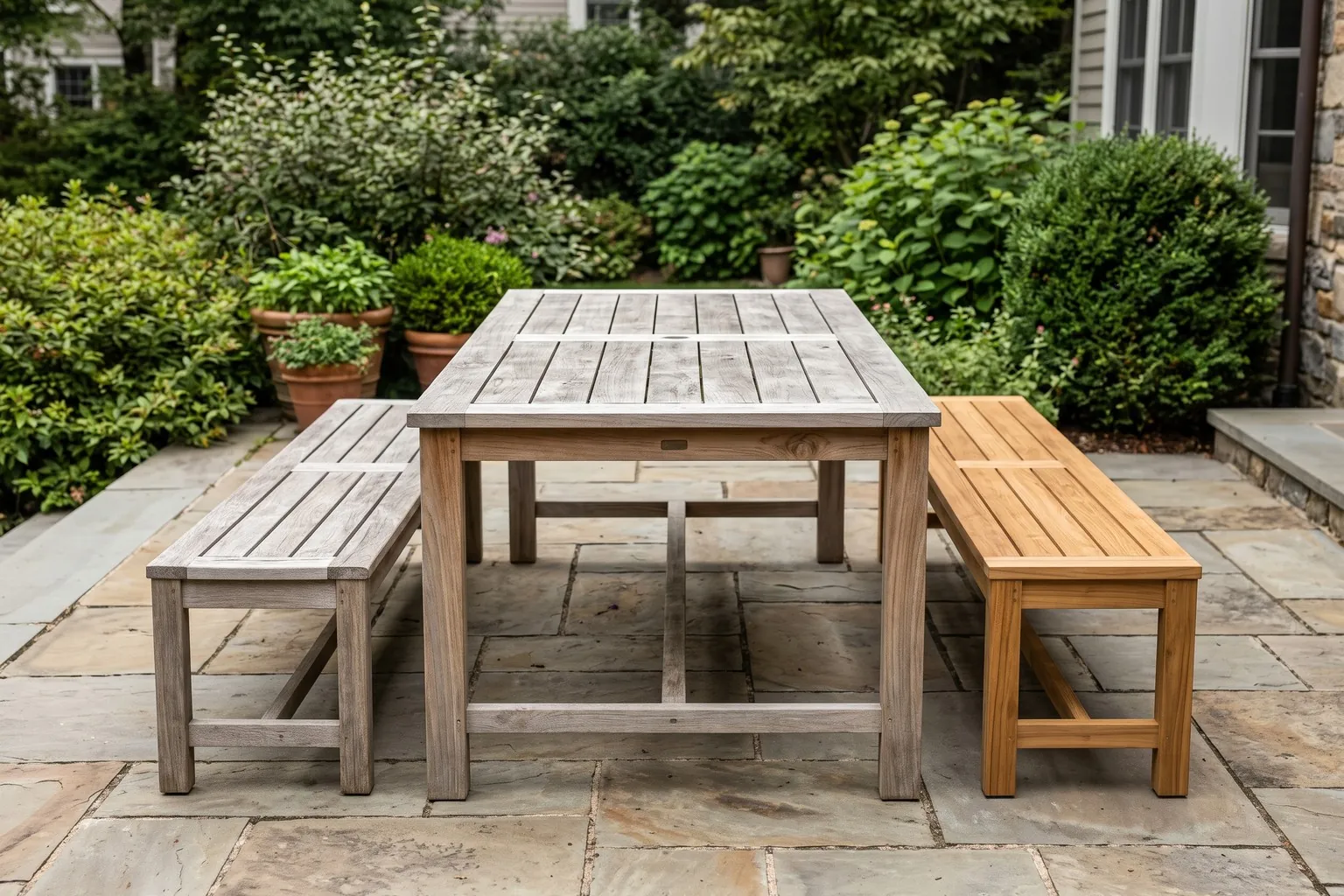
- Left unfinished, these woods turn silver gray. Oil keeps the color and has to be renewed. White oak is the one to paint or seal.
In this guide
Wood left outside has two enemies. Fungi and insects eat it, and daily use dents it. A species can be good against one and poor against the other, and the price follows neither closely.
This guide compares eleven species on three numbers a buyer or a builder can check: the decay rating, the hardness and the weight. The figures come from The Wood Database. The judgments on working and finishing come from woodworkers who build outdoor furniture and say which woods they use.
Decay resistance comes first
A chair that dents is still a chair. A chair whose legs have rotted is firewood. That is the order in which woodworkers choose.
Hank Gilpin, writing in Fine Woodworking about outdoor chairs and benches, names decay resistance as his test and lists five woods he uses outdoors: white oak, black locust, bald cypress, eastern red cedar and northern white cedar. He leaves teak out for one reason, in his words: it is very expensive, so he does not use it.
He adds a rule that applies to every species on any list. Use only the heartwood for outdoor furniture. Heartwood is the older wood at the center of the trunk. The sapwood around it, he writes, is too rich in sugars and other tasty treats. Table Legs Online gives the same advice in its guide to outdoor species: use heartwood rather than sapwood.
The rule matters when buying lumber and when reading a label. A board of a durable species that is mostly pale sapwood does not have the durability the species is known for.
The numbers, species by species
The Wood Database publishes the same set of measurements for each species. Janka hardness is a standard test of how well a wood resists denting, given in pounds-force. The weight is for a cubic foot of dried wood. The decay rating is the database's own wording.
| Wood | Janka hardness | Weight per cubic foot | Decay rating |
|---|---|---|---|
| Ipe | 3,490 lbf | 65.5 lb | Very durable, excellent insect resistance |
| Black locust | 1,700 lbf | 48.0 lb | Very durable, good weathering |
| White oak | 1,350 lbf | 47.0 lb | Very durable |
| Teak | 1,070 lbf | 40.9 lb | Very durable, resistant to termites |
| Eastern red cedar | 900 lbf | 33 lb | Excellent resistance to decay and insects |
| Douglas-fir | 620 lbf | 32 lb | Moderately durable, susceptible to insects |
| Bald cypress | 510 lbf | 32.0 lb | Old growth durable to very durable, younger trees moderately durable |
| Redwood | 450 lbf | 26 lb | Moderately durable to very durable |
| Western red cedar | 350 lbf | 23.0 lb | Durable to very durable, mixed insect resistance |
| Northern white cedar | 320 lbf | 22.0 lb | Durable to very durable, resists termites and powder post beetles |
| Red oak, for contrast | 1,220 lbf | 43.8 lb | Non-durable to perishable, poor insect resistance |
Three things can be read off that table. These are our sums.
- The hard woods are the heavy woods. Ipe is ten times as hard as western red cedar and almost three times as heavy. The same chair in ipe weighs nearly three times what it weighs in cedar.
- Hardness says nothing about decay. Red oak is harder than teak, 1,220 against 1,070, and sits at the bottom of the decay scale. Northern white cedar is the softest wood in the table and is rated durable to very durable.
- Four woods are both hard and very durable: ipe, black locust, white oak and teak. The rest of the durable woods are soft.
The hard and durable four
Teak. The Wood Database calls teak the gold standard for decay resistance. Table Legs Online calls it extremely rot resistant and reasonably dense. AuthenTEAK's guide credits the natural oils in the wood for its weather resistance and says teak will not warp with changes in humidity. The drawback is on every page: The Wood Database says teak is very expensive, and Table Legs Online prices it at roughly 20 dollars per square foot of 1 inch thick material.
White oak. At 1,350 pounds of hardness it is harder than teak, and it is rated very durable. Table Legs Online calls it much stronger and harder than the other woods on its list, and easy to work. It also gives the comparison that matters to a budget: teak can easily cost five times as much as a good grade of white oak. The Wood Database says white oak prices are moderate for a domestic hardwood. One caution from Popular Woodworking: white oak is quite rot resistant, but some find it difficult to work with hand tools.
Black locust. Harder than white oak at 1,700 pounds, and rated very durable with good weathering characteristics. Table Legs Online describes it as one of the strongest and stiffest domestic woods and moderately easy to work. The Wood Database says that in the eastern United States its price is comparable to white oak, and lists fence posts among its uses.
Ipe. The hardest and heaviest wood here by a wide margin. Table Legs Online says it can barely float, and that it is difficult to work and difficult to glue, so mechanical fasteners are the safer option. Homes and Gardens quotes an expert who calls it twice as strong as teak, and notes that furniture prices tend to be high. At that weight it suits a piece that will not be moved often.
The soft and durable woods
The cedars. Three different trees carry the name. Western red cedar is rated durable to very durable and weighs 23 pounds per cubic foot. Northern white cedar has the same rating, and The Wood Database lists outdoor furniture among its uses. Eastern red cedar is much harder than the other two, 900 pounds against 320 to 350, and its resistance to decay and insects is described as excellent.
Table Legs Online sums cedar up as soft, light and easy to work, and adds a practical warning: it holds screws poorly. AuthenTEAK calls cedar affordable and relatively low maintenance, and says it does not last as long as the hardwoods. Popular Woodworking's editor, weighing woods for a set of Adirondack chairs, notes that northern white cedar can be found fairly cheap locally and is quite rot resistant.
Bald cypress. The rating depends on the tree. The Wood Database rates old growth bald cypress durable to very durable, and wood from younger trees only moderately durable. Table Legs Online says its softness is comparable to the cedars and that it weathers to a silver gray if left unfinished.
Redwood. Rated moderately durable to very durable, with lumber from old growth trees tending to be more durable. Table Legs Online describes it as soft and susceptible to dents, dings and chips, and as expensive lumber to source. Homes and Gardens reports one seller's guarantee: 15 years for its California redwood, and 30 years against decay for old growth.
What these woods share is softness. Table Legs Online's warning about redwood, dents, dings and chips, follows from numbers the whole group has in common. In return they are light, and cedar is easy to work.
White oak, not red oak
The two oaks share a name and behave in opposite ways outdoors. The Wood Database rates white oak very durable and red oak non-durable to perishable, and says red oak does not have the level of decay and rot resistance that white oak possesses. Table Legs Online tells builders to avoid red oak outdoors because it is very porous and will not resist water.
If a listing or a lumber yard says only oak, ask which.
Acacia and eucalyptus
Buying guides also recommend two woods that are not in the table: acacia and eucalyptus. We did not read Wood Database figures for these two, so the statements below come from the guides alone.
Table Legs Online calls acacia a thick, strong hardwood with high oil content, resistant to the elements, to rot and to insects, and one of the more affordable options. It adds that sealed acacia is a rich, dark golden brown, and that unsealed acacia can discolor with exposure to water.
Homes and Gardens says eucalyptus has a high oil content that makes it resistant to rot and decay, that it fades to silver if left untreated, and that it is not frost resistant. Properly cared for, the magazine says, eucalyptus products can last up to 25 years. AuthenTEAK is more guarded: eucalyptus is not as durable as teak and is prone to cracking in colder climates, even with a sealant.
Both are described as cheaper than teak. The cold climate warning is the one to weigh if the furniture will stay out through the winter.
Douglas-fir and treated pine
Table Legs Online calls Douglas-fir one of the hardest softwoods commercially available in the United States. Its heartwood is rated only moderately durable, and it is susceptible to insect attack. The Wood Database does not list outdoor furniture among its uses.
Pine appears in outdoor furniture in pressure-treated form. The 8 foot picnic table in our guide to picnic table dimensions is pressure-treated southern yellow pine, and Freedom Room lists pressure-treated pine among the materials its Adirondack chairs come in.
Finish it, or let it go gray
These woods change color in the weather. AuthenTEAK says cedar, eucalyptus, acacia and teak will all weather to a silver gray. Table Legs Online says the same of cedar and cypress.
There are two ways to deal with that.
Let it go. Gilpin's advice in Fine Woodworking is to skip the finish and let the wood weather to its natural gray. This is the low upkeep route.
Keep the color. Table Legs Online says teak needs a coat of oil each year to keep its golden color. AuthenTEAK says penetrating oils take two to three coats for a dark, rich color, and that water-based protectants hold color longer. Homes and Gardens says ipe that has turned silver can be restored with gentle sanding and finishing oil. One of Table Legs Online's contributors uses an all-weather varnish and reapplies it every two to three years.
White oak is the exception among the hard four. Table Legs Online says it should be painted or sealed, because it lacks the oil content of teak or ipe.
A finish is a commitment. The sources that recommend one also give the interval: every year for oil on teak, every two to three years for varnish.
Cost and supply
Prices move, so the sources are better read as an order than as figures.
- Most expensive: teak. The Wood Database says so plainly. Ipe furniture prices also tend to be high, according to Homes and Gardens, though The Wood Database puts ipe lumber in the medium range for an imported tropical species.
- Middle: white oak and black locust, both moderate where they grow. Bald cypress in the middle of the range for domestic woods. Redwood in the middle to upper range as construction lumber.
- Least expensive: western red cedar in construction grades, eastern red cedar in narrow, knotty boards, and Douglas-fir. Northern white cedar is mid range for a domestic softwood and is usually sold in small sizes.
Supply has a second side. The Wood Database reports that ipe was listed in CITES Appendix II in 2024, that coast redwood is on the IUCN Red List as endangered, and that sanctions on imported teak followed the military takeover in Myanmar in February 2021. Homes and Gardens advises checking the FSC credentials of ipe. Jensen Outdoor, for one, describes its ipe chairs as FSC certified timber from Bolivia. For tropical woods, the certificate is part of the specification.
Weight, joints and fasteners
Weight is a real difference between these woods. A cubic foot of western red cedar weighs 23 pounds and a cubic foot of ipe 65.5. A heavy chair is harder to carry in for the winter.
Density also affects assembly. Table Legs Online says ipe is difficult to glue and recommends mechanical fasteners for it. The soft woods have the opposite problem: cedar holds screws poorly. Neither is a reason to avoid the wood. Both are reasons to look at how a piece is put together before buying it.
Choosing, in five questions
- Will it stay out all year? Then choose from the very durable four, or from the cedars. Be careful with eucalyptus where it freezes.
- Will it be dragged and knocked? Hardness matters: white oak, black locust, teak or ipe. Cedar, cypress and redwood dent.
- Will you carry it? Cedar at 22 to 23 pounds per cubic foot, or ipe at 65.5.
- Will you oil it every year? If not, pick a wood that looks right gray, or plan to paint white oak.
- What does the label say? Look for the species by name, white oak and not just oak, heartwood, and a certificate for tropical wood.
Questions people ask
What is the best wood for outdoor furniture?
By decay rating, teak, white oak, black locust and ipe: The Wood Database rates all four very durable. Teak is the most expensive. White oak and black locust are the domestic alternatives, and furniture maker Hank Gilpin uses those two plus cypress and two cedars.
Is cedar good for outdoor furniture?
Yes for decay. Western red and northern white cedar are rated durable to very durable. They are soft, at 320 to 350 pounds of Janka hardness, so they dent, and cedar holds screws poorly.
Can you use oak for outdoor furniture?
White oak, yes: it is rated very durable. Red oak, no: it is rated non-durable to perishable and is very porous.
What is the hardest wood for outdoor furniture?
Ipe, at 3,490 pounds of Janka hardness and 65.5 pounds per cubic foot. It is difficult to work and to glue.
Does outdoor wood furniture need to be sealed?
Not always. Durable woods can be left to weather to a silver gray. Oil or sealer keeps the color and has to be renewed. White oak should be painted or sealed.
Is acacia or eucalyptus as good as teak?
Buying guides describe both as oily and rot resistant, and cheaper than teak. AuthenTEAK says eucalyptus is not as durable as teak and can crack in cold climates.
Sources
- Choosing the right wood for outdoor chairs and benches. Fine Woodworking, read November 2026
- 9 wood species best for outdoor projects. Table Legs Online, read November 2026
- Teak. The Wood Database, read November 2026
- White oak. The Wood Database, read November 2026
- Red oak. The Wood Database, read November 2026
- Black locust. The Wood Database, read November 2026
- Ipe. The Wood Database, read November 2026
- Western red cedar. The Wood Database, read November 2026
- Northern white cedar. The Wood Database, read November 2026
- Eastern red cedar. The Wood Database, read November 2026
- Bald cypress. The Wood Database, read November 2026
- Coast redwood. The Wood Database, read November 2026
- Douglas-fir. The Wood Database, read November 2026
- Choosing the best wood for outdoor furniture. AuthenTEAK, read November 2026
- What is the best wood for outdoor furniture?. Homes and Gardens, read November 2026
- 3 steps to deciding on your best wood for outdoor furniture. Popular Woodworking, read November 2026
Every figure in this guide comes from the sources above, or from arithmetic shown in the text. See our editorial policy.