Adirondack chair dimensions: the seat, the arms and the room each chair takes
A standard Adirondack chair is about 30 inches wide, 36 deep and 38 tall, with a seat 12 to 16 inches off the ground. Eight chairs measured, and the spacing.
The short answer
- A standard Adirondack chair is 28 to 32 inches wide, 32 to 38 inches deep and 36 to 40 inches tall. Those are Patio Kingdom's ranges, and two other guides give close ones.
- The seat is low: 12 to 16 inches at the front edge, against 17 to 19 for a dining chair. It slopes down toward the back.
- The arms are 5 to 7 inches wide and 21 to 25 inches off the ground.
- Give each chair about 3 by 3 feet, 2 to 3 feet between chairs and 3 feet clear in front. A 10 by 10 foot area holds three or four.
- The low seat is the point of the chair and its drawback. Three guides say it is harder to get out of for people with knee, back or mobility trouble.
In this guide
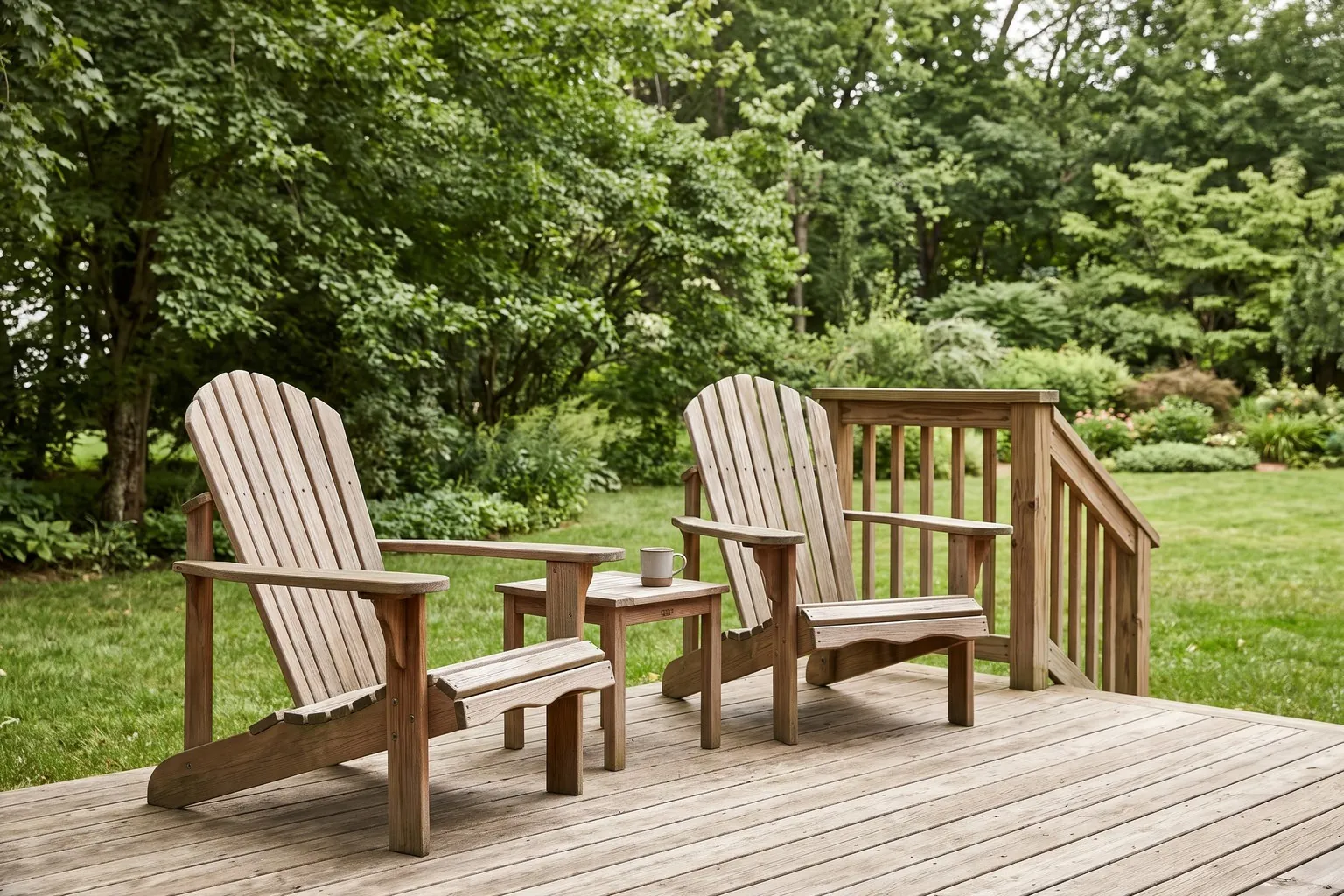
An Adirondack chair is easy to recognize and hard to describe in numbers, because makers do not build it to one size. It is a low seat that tilts back, a tall back, and two arms wide enough to hold a glass. Makers agree on that and differ on the inches.
This guide gives the ranges three sizing guides publish, eight chairs with their listed dimensions, the versions sold as oversized, tall and child size, the room a chair takes on a deck or around a fire, and where the shape came from.
The standard chair
Three guides give ranges for a standard adult chair.
| Dimension | Patio Kingdom | Freedom Room | POLYWOOD |
|---|---|---|---|
| Overall width | 28 to 32 inches | about 27 to 32 | 24 to 33 |
| Overall depth | 32 to 38 inches | about 31 to 40 | 24 to 38 |
| Overall height | 36 to 40 inches | about 35 to 45 | 34 to 44 |
| Seat height, front edge | 12 to 16 inches | about 13 to 15 | not given |
| Seat width | 19 to 22 inches | about 20 to 23 | not given |
| Seat depth | 18 to 21 inches | not given | not given |
| Arm height | 21 to 25 inches | about 22 to 25 | not given |
| Arm width | 5 to 7 inches | not given | not given |
The middle of those ranges is a chair about 30 inches wide, 36 inches deep and 38 inches tall. Patio Kingdom gives the footprint as roughly 30 by 36 inches.
Two things stand out against an ordinary chair. The chair is deep: 36 inches from front to back, twice the depth of a dining chair's seat, because the back leans away from the seat. And it is wide for the seat it offers: a 20 inch seat sits inside a 30 inch chair, because each arm adds 5 inches or more.
The seat is the number that matters
The front edge of the seat is 12 to 16 inches off the ground. Our guide to chair and bench seat height gives 17 to 19 inches for a dining chair and 15 to 18 for a lounge chair. An Adirondack chair sits below both.
The seat also slopes. Freedom Room lists one chair with both figures: the Westminster Teak lounger has a seat 14.5 inches high at the front and 11 inches at the back. That is a drop of 3.5 inches over the depth of the seat: our sums. The hips sit lower than the knees, and the back of the chair leans to match.
No guide we read publishes the angle of the back in degrees. POLYWOOD's buying guide says all Adirondack chairs have reclined backrests and that the amount of lean varies. The 1905 patent for the chair describes the geometry in words: the seat is at almost a right angle to the back, and both are set at an angle to the base. In that first chair, then, the angle between seat and back was close to that of an upright chair, and the whole seat was tipped backward.
That tilt is the comfort of the chair, and it is also the difficulty. Three guides say the same thing.
- Patio Kingdom: low seats are harder to get out of for older adults or people with knee or back trouble.
- Freedom Room: a low seat is harder to get out of, and it suggests a higher front seat edge, or a glider or rocker.
- POLYWOOD: people with mobility concerns may have difficulty getting into or out of these chairs, and upright or elevated chairs may be a better choice.
If anyone who will use the chair has that difficulty, look at the seat height before anything else. Patio Kingdom puts the front seat edge of comfort or tall models at about 15 to 17 inches, which is close to a lounge chair.
Eight chairs, measured
Ranges describe a market. These are single chairs, with the dimensions their sellers list.
| Chair | Width | Depth | Height | Seat |
|---|---|---|---|---|
| LuxCraft Lakeside | 25 inches | 31.5 | 35.5 | 20 inches wide |
| LuxCraft Deluxe | 31 inches | 36.5 | 38 | 23 inches wide |
| LuxCraft Folding | 30 inches | 39 | 38.5 | not given |
| LuxCraft Royal, tall back | 31 inches | 31.5 | 44.5 | not given |
| Westminster Teak lounger | 27 inches | 40 | 38 | 14.5 inches high in front, 11 at the back |
| Fireside Lodge Voyageur, cedar logs | 27 inches | 36 | 48 | not given |
| DuraWeather King Size folding | 33 inches | 33 | 36 | 22 wide, 19 deep, 14.5 high |
| Patio Kingdom folding | 29.5 inches | 35.4 | 35.8 | 20.3 inches wide |
The first six come from Freedom Room's guide, the seventh from DuraWeather's product page and the last from Patio Kingdom.
Width runs from 25 to 33 inches, depth from 31.5 to 40, and height from 35.5 to 48. The spread in height is the back: a tall back or a frame of cedar logs adds 6 to 12 inches above the ordinary 36 to 38.
The DuraWeather listing is the most complete. Besides the seat, it gives arms 20 inches high and 5 inches wide, a weight of 43 pounds and a capacity of 300 pounds. Patio Kingdom's folding chair is rated for 380 pounds.
Oversized, compact, tall and child sizes
Makers sell the same shape in several scales. Patio Kingdom gives figures for each.
| Version | What changes |
|---|---|
| Standard | 28 to 32 inches wide, seat 19 to 22 inches |
| Oversized | 32 to 36 inches wide, up to 24 inches of seat between the arms |
| Compact | 27 to 29 inches wide |
| Comfort or tall | Front seat edge about 15 to 17 inches |
| Child | 20 to 24 inches wide, seat 8 to 11 inches off the ground |
Names vary by brand. DuraWeather calls its 33 inch chair king size. POLYWOOD lists Kids, Grand and Tall versions, the last at counter and bar height, along with folding, rocking and curved back chairs and one with a built-in ottoman. Freedom Room lists folding chairs, rockers and gliders, two-seat chairs and swivel chairs.
Two notes on these. A wider chair takes more deck for the same number of seats: four oversized chairs at 34 inches need 16 inches more in a row than four at 30 (our sums). And a counter or bar height chair has a much higher seat, so the figures in this guide do not describe it. No guide we read gives its dimensions. Check its seat height against the table or rail it is meant for.
The arms
The wide flat arm is as much a part of the chair as the low seat. Patio Kingdom gives 5 to 7 inches of width and a height of 21 to 25 inches off the ground. Freedom Room gives 22 to 25 inches. The DuraWeather chair has arms 5 inches wide and 20 inches high.
The arms were wide from the start. The 1905 patent describes them as of considerable width at their forward ends. Five inches is wide enough to set down a glass.
The arms also set the width of the chair. Take a 20 inch seat, add two 5 inch arms, and the chair is 30 inches wide before any frame: our sums. A narrow chair, such as the 25 inch LuxCraft Lakeside with its 20 inch seat, leaves 2.5 inches a side.
How much room a chair takes
The chair takes more ground than its seat suggests, and the legs of the person in it reach further still.
One chair. Patio Kingdom gives a footprint of roughly 30 by 36 inches. Freedom Room allows about 3 feet by 3 feet per chair.
In front. Patio Kingdom asks for around 3 feet of open space in front of the chair on a deck, and POLYWOOD for three feet of clearance in front. Freedom Room counts 18 to 24 inches of legroom, and 30 to 36 inches where the space in front is a walkway.
Between chairs. Patio Kingdom gives about 2 to 3 feet between chairs. POLYWOOD says two to three feet apart.
In a square. Both Patio Kingdom and POLYWOOD say a 10 by 10 foot area fits three to four chairs.
From those figures, three layouts. These are our sums.
| Layout | Ground it takes |
|---|---|
| Two chairs side by side, 2 feet apart | 7 feet wide, 6 feet deep with the clearance in front |
| Four chairs in a row, 2 to 3 feet apart | 16 to 19 feet wide, 6 feet deep |
| Three or four chairs in a group | about 10 by 10 feet |
A pair of chairs is the common case. Two 30 inch chairs with 24 inches between them are 84 inches across. The 36 inch chair and the 36 inches in front of it make 72 inches of depth. A balcony or landing smaller than 7 by 6 feet will feel tight with two.
Around a fire. Patio Kingdom puts the front edge of the chair about 3 to 4 feet from the edge of the pit. That is the figure in our guide to the fire pit seating area: chairs 3 to 4 feet from a wood fire and 2 to 3 feet from a gas one. The same guide works out that six chairs around a 3 foot wood fire pit need a circle about 16 feet across. An Adirondack chair is 32 to 38 inches deep, so check that circle against the depth of your own chairs.
On a deck with a rail. A low seat puts the eyes low. Our guide to deck railing height gives 36 inches as the minimum height of a guard under the residential code, and 42 in some states. Sit in the chair where it will go before you decide which way it faces.
Weight and what it is made of
POLYWOOD and Patio Kingdom give the same range for the weight of a chair: 7 to 58 pounds, depending on the material. Freedom Room gives about 30 to 60 pounds for the chairs it sells. The DuraWeather king size chair weighs 43 pounds. Its listing describes the material as 95 percent high density polyethylene, with marine grade stainless steel hardware.
Weight decides how much of a chore the chair is to move and to store for the winter, so read it on the listing.
Freedom Room lists the materials its chairs come in: cedar, teak, pressure-treated pine, acacia and eucalyptus, and poly lumber. Jensen Outdoor sells one in solid ipe, which it describes as FSC certified timber from Bolivia with metal joinery. For wood, the species decides how long the chair lasts outdoors and how much it weighs. Our guide to the best wood for outdoor furniture compares them by decay resistance, hardness and weight. Keeping the cushions on them clean is in how to clean outdoor cushions.
Where the shape comes from
The chair is American and a little over a century old. The accounts agree on the outline.
Thomas Lee designed it at his family's summer house in Westport, New York, on Lake Champlain. Hunker dates the idea to 1903. Woodcraft says it took Lee three years, from 1900 to 1903. It was first called the Westport chair.
The first chairs were built from wide boards. Yankee Magazine says the seat and the back were each a single wide hemlock plank. Hunker counts 11 planks in all for the back, the seat, the arms and the leg supports, and gives the wood as probably hemlock, basswood or hickory.
The patent is not in Lee's name. United States patent 794,777, titled simply Chair, was filed on April 1, 1904 by Harry C. Bunnell of Westport, New York, and granted on July 18, 1905. It describes a chair of the bungalow type, for use on porches, on lawns and at camps, built to withstand rough usage and exposure to the weather. The back is formed in one solid piece. Hunker says the Westport chair was produced through the 1920s.
The slatted back came later. In 1938 Irving Wolpin of Lakewood, New Jersey, was granted design patent 109,239 for a lawn chair, filed on February 2 and granted on April 12 of that year, for a term of seven years. Hunker describes the change: a backrest of several narrower slats in place of the single wide plank. Woodcraft says the same of the seat and back slabs. Yankee Magazine puts it in one line: the single plank back of the Westport chair became the back of many slats.
Before you buy, in five checks
- Seat height first. 12 to 16 inches at the front is standard. For anyone who finds low seats hard, look for 15 to 17.
- Seat width, not chair width. The seat is 19 to 23 inches. The chair is about 10 inches wider because of the arms.
- Measure the ground. Allow 3 by 3 feet per chair, 2 to 3 feet between chairs and 3 feet in front.
- Read the weight and the capacity. Listings give both: 43 pounds and 300 pounds for one chair above.
- Check the back. Overall height runs from 35 to 48 inches. Measure it against the window sill or the rail behind the chair.
Questions people ask
What are the dimensions of a standard Adirondack chair?
About 28 to 32 inches wide, 32 to 38 inches deep and 36 to 40 inches tall, with a seat 19 to 22 inches wide. Those are Patio Kingdom's ranges. POLYWOOD gives 24 to 33 wide, 24 to 38 deep and 34 to 44 tall.
How high is the seat of an Adirondack chair?
12 to 16 inches at the front edge, and lower at the back. One teak chair is listed at 14.5 inches in front and 11 at the back. A dining chair seat is 17 to 19 inches.
How wide are the arms of an Adirondack chair?
5 to 7 inches, at 21 to 25 inches off the ground. One poly lumber chair lists arms 5 inches wide and 20 inches high.
How much space does an Adirondack chair need?
About 3 by 3 feet for the chair, 3 feet clear in front and 2 to 3 feet to the next chair. A 10 by 10 foot area fits three to four chairs.
How far should Adirondack chairs be from a fire pit?
Patio Kingdom puts the front edge of the chair about 3 to 4 feet from the edge of the pit. Follow the clearances for your own fire pit and your local rules.
Are Adirondack chairs hard to get out of?
For some people, yes. The seat is low and tilts back. Three sizing guides say it is harder for people with knee, back or mobility trouble, and suggest a higher seat or an upright chair.
Sources
- How big is an Adirondack chair? A simple size guide. Patio Kingdom, read November 2026
- Adirondack chair dimensions and the best wood for Adirondack chairs. Freedom Room, read November 2026
- The complete guide to buying an Adirondack chair. POLYWOOD, read November 2026
- King size folding Adirondack chair. DuraWeather, read November 2026
- Heritage Adirondack chair. Jensen Outdoor, read November 2026
- US patent 794,777, Chair. Google Patents, read November 2026
- US design patent 109,239, Design for a lawn chair. Google Patents, read November 2026
- What's the story behind the Adirondack chair?. Hunker, read November 2026
- Famous furniture: Adirondack chair. Woodcraft, read November 2026
- Adirondack chairs. Yankee Magazine, read November 2026
Every figure in this guide comes from the sources above, or from arithmetic shown in the text. See our editorial policy.