Fire pit seating area: how wide to build a corner for six
Six chairs around a 3 foot wood fire pit need a circle about 16 feet across, 10 feet or more from the house. The sums, the distances and the sources.
The short answer
- Keep the fire pit at least 10 feet from the house, fences, trees and anything that burns. Some local rules ask for 15 feet or more.
- Chairs go 3 to 4 feet from a wood fire, 2 to 3 feet from a gas one.
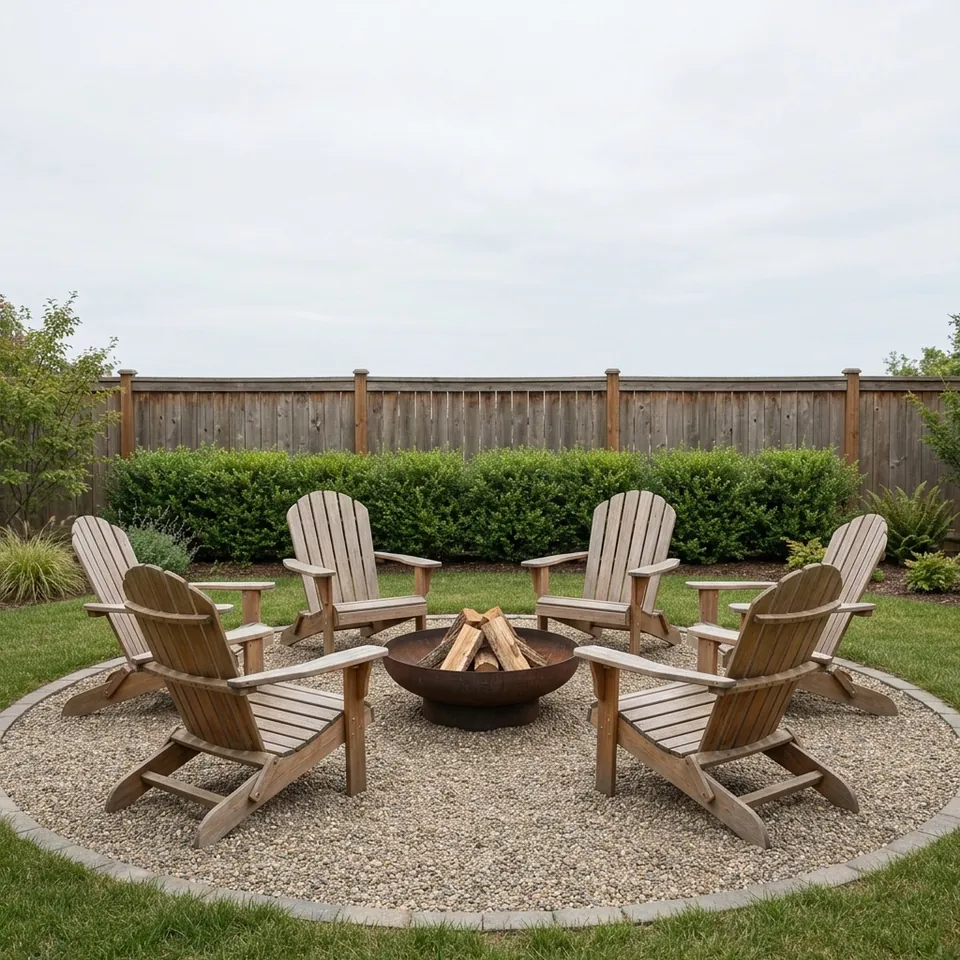
- Six chairs around a 3 foot wood fire pit need a circle about 16 feet across, or about 20 feet with a path behind the chairs.
- Nothing combustible overhead: no branches, no pergola, no string lights.
- Local rules decide. Check with your fire department before you build or buy.
In this guide
A fire pit corner is the simplest outdoor room there is: a fire, a ring of chairs, and enough space between the two. It is also the one where a tape measure matters most, because the distances are about safety before they are about comfort.
This guide gives the distances that fire services and insurers publish, then turns them into the size of the circle you need for four, six or eight people.
How far from the house
The figure repeated by national sources is 10 feet.
- The U.S. Fire Administration's safety message is to keep fire pits, wood piles and propane tanks 10 to 30 feet from your home.
- Travelers, the insurer, says a fire pit should be at least 10 feet from your home, other structures or anything combustible.
- Nationwide says at least 10 feet from your home, fences and trees.
- This Old House quotes its mason, Mark McCullough: at least 10 feet from anything that is combustible, including overhead tree branches.
Treat 10 feet as the minimum and not the target. Local rules can ask for more. In Fairfax County, Virginia, the fire code says portable outdoor fireplaces must not be operated within 15 feet of a structure or combustible material. Houses and townhouses are exempt from that prohibition, but the county still advises against operating one on or under a deck or balcony.
Measure the 10 feet from the edge of the pit, and measure it to everything: the wall of the house, the shed, the fence, the hedge, the deck.
What is overhead
Look up before you choose the spot. The same sources rule out three things above a fire:
- Tree branches. They are named in the This Old House advice.
- String lights and power lines. Travelers says not to set up a fire pit under either.
- A roof or a pergola. A pergola is a structure, and the 10 feet applies to it. If you are planning both, give each its own place: the sizes are in our guide to pergola sizes.
How far to sit
Bob Vila's fire pit safety guide gives the chair distances:
| Type of fire | Chairs from the fire |
|---|---|
| Gas fire pit | 2 to 3 ft |
| Wood burning fire pit | 3 to 4 ft |
The same guide says to keep children 3 to 10 feet from the flames. Wood needs more room than gas because it throws sparks and its heat changes as the fire builds and dies down. A spark screen helps: This Old House calls a screen cover an essential safety feature on any type of pit.
The size of the circle
Now the sum. A seating circle is three rings, one inside the other.
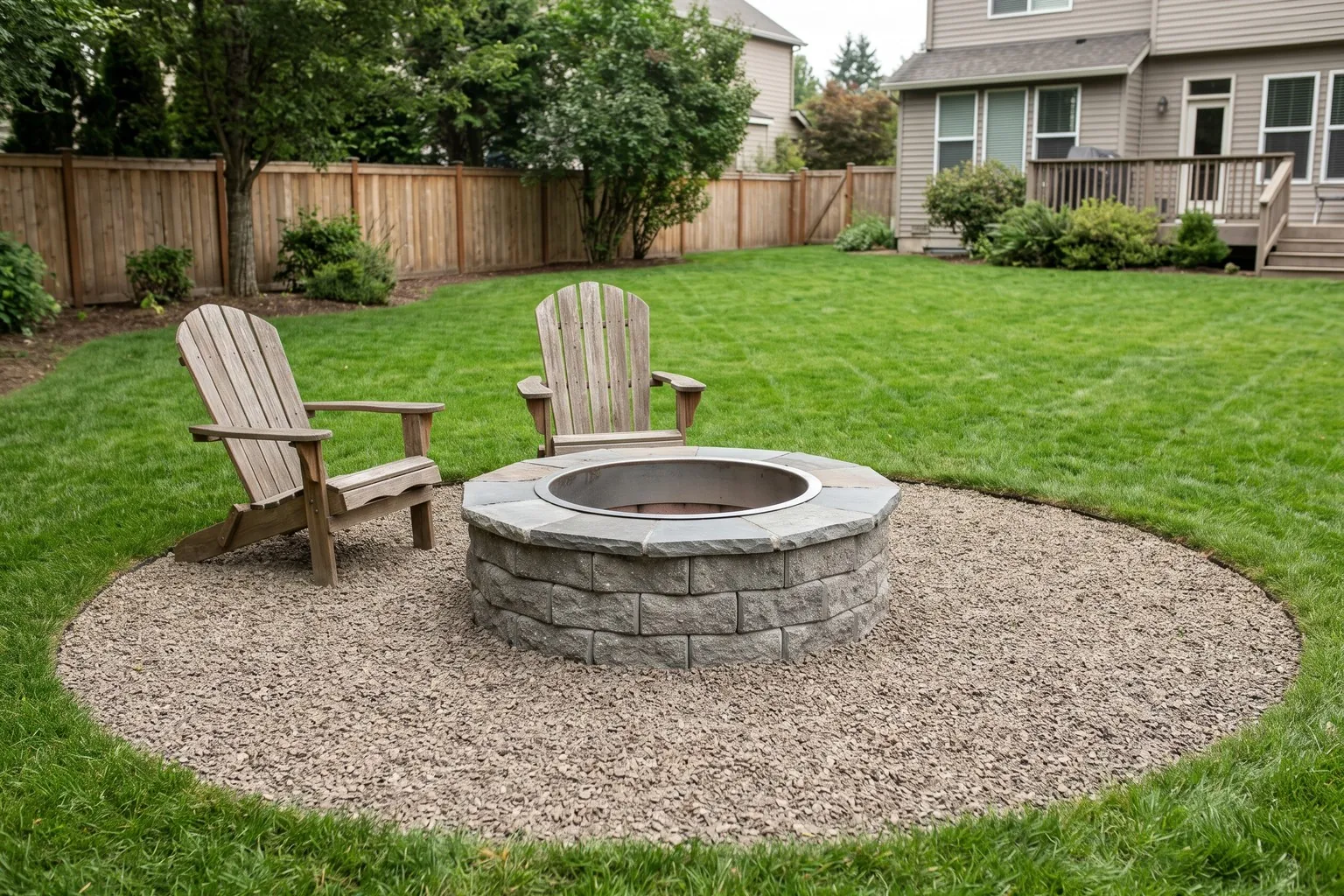
- The pit. Take one 3 feet across: 1.5 feet from the center to the edge.
- The gap. The distance from the edge of the fire to the front of the chairs: 3 to 4 feet for wood. Take 3.5 feet.
- The chairs. Allow 3 feet from front to back for a deep outdoor chair such as an Adirondack, and check the depth of yours.
Add them up: 1.5 plus 3.5 plus 3 gives 8 feet from the center of the fire to the back of the chairs. The circle is 16 feet across.
That is the footprint of the furniture. If you want to walk behind the chairs without stepping on the lawn, add a path of 2 feet all round, and the paved or gravelled area becomes 20 feet across.
| Wood fire, 3 ft pit | Gas fire, 3 ft pit | |
|---|---|---|
| Edge of fire to front of chairs | 3.5 ft | 2.5 ft |
| Circle to the back of the chairs | 16 ft across | 14 ft across |
| With a 2 ft path behind | 20 ft across | 18 ft across |
The same circle for other pit sizes
The method does not change with the pit, only the first number.
| Pit across | Wood fire, to the back of the chairs | Gas fire, to the back of the chairs |
|---|---|---|
| 2.5 ft | 15.5 ft | 13.5 ft |
| 3 ft | 16 ft | 14 ft |
| 4 ft | 17 ft | 15 ft |
Each figure is the width of the pit, plus twice the gap, plus twice the 3 feet of chair. A bigger pit adds less than you might expect, because most of the circle is people and not fire.
How many chairs fit
The front edges of the chairs sit on a ring 5 feet from the center for a wood fire, and that ring is about 31 feet around. Allow 2.5 feet of width per chair.
| Chairs | Width they take | Left over, shared between the gaps |
|---|---|---|
| 4 | 10 ft | 21 ft, about 5 ft between chairs |
| 6 | 15 ft | 16 ft, about 2.5 ft between chairs |
| 8 | 20 ft | 11 ft, about 1.5 ft between chairs |
Six is the comfortable number for this circle: close enough to talk across the fire, with room to get in and out between any two chairs. Eight fit, but only just, and people will have to turn sideways to leave. For eight, move the chairs back half a foot or choose a larger pit.
Leave one gap wider than the others, on the side people arrive from. A circle with no way in gets a chair dragged out of place every evening.
What goes underfoot
The surface under and around the pit should not burn. Travelers advises a fire proof base for the unit, especially on a wood deck, and Nationwide says to make sure the ground is even so the fire cannot escape the pit. Gravel, stone and concrete pavers all do the job. Dry grass and bark mulch do not.
This Old House is specific about it: station the pit on a level surface of stone, concrete or brick, and unless the owner's manual says otherwise, do not put it on grass, on a wood deck or on an enclosed porch. Level matters as much as material. A pit on a slope can tip, and a bowl that tips empties its fire onto the ground.
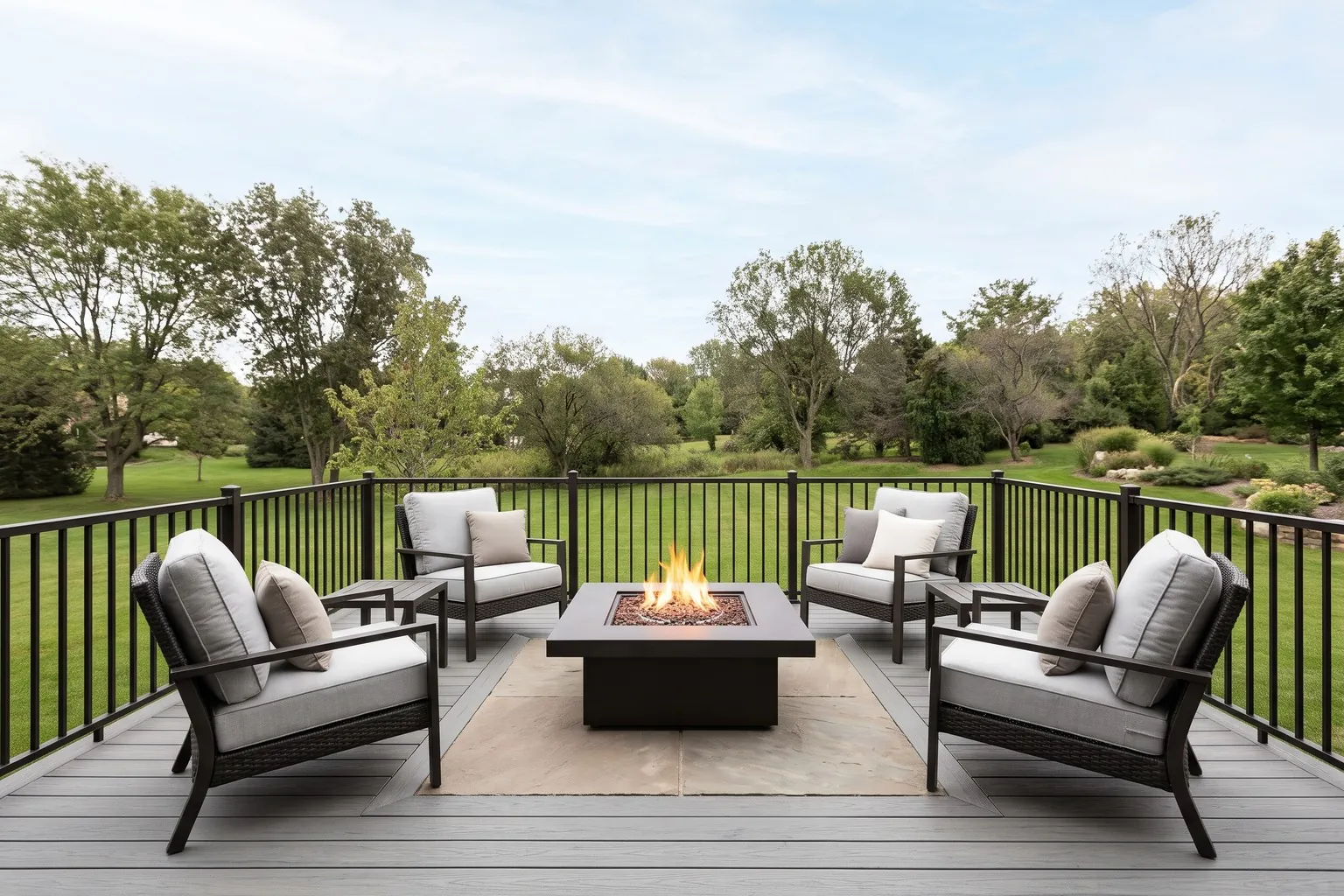
A deck raises its own questions: the pad under the pit, the weight, and what is overhead. They are in our guide to a fire pit on a deck.
Bob Vila's guide suggests clearing a circular area of at least 5 feet around the place where the fire will be. In our circle that covers the whole gap between the pit and the chairs.
If you build the pit yourself, Nationwide warns against smooth river stones, which can hold moisture and burst when heated. Use dry, rough stones.
How high the sky has to be
The distance sideways is the one everybody measures. This Old House adds a distance upward: to avoid setting light to overhanging branches, it calls for at least 21 feet of clearance above the pit, and says never to place one under a covered patio or low limbs. Sparks rise and drift, so look at where they would travel, not only at what is straight above.
Bob Vila's guide gives a second reason to stay in the open, and it applies to gas as much as to wood. A fire under an overhang or in an enclosed space lets smoke and carbon monoxide build up. In open air the gas disperses. Under a roof with walls it does not.
Wood, gas or propane
The fuel decides how close people sit and how much there is to manage. This Old House sets out the main types:
- Wood burning. The traditional choice, and the one that needs the most care: the right wood, and a way to stop sparks.
- Natural gas. Cleaner and easy to control, but it needs a gas line fitted and maintained properly.
- Propane. Portable and convenient. The tank needs careful handling and has to be stored in a cool place outdoors.
With gas, the chairs can come a foot closer and there are no sparks to plan for, which is why the gas circle in our table is 2 feet narrower. The 10 feet from the house still applies.
If you burn wood
Three rules from the sources keep a wood fire inside the pit.
- Short logs. This Old House says logs should be no longer than three quarters of the diameter of the pit. In a 3 foot pit that is 27 inches. Longer logs stick out and shed sparks past the rim.
- Dry, seasoned wood, cut at least six months earlier. Travelers and Bob Vila both warn against construction lumber: plywood, pressure treated wood and pallets contain resins and chemicals that give off toxic smoke.
- No accelerants. Never lighter fluid, gasoline or kerosene. Nationwide's advice is to start with dry kindling that stays within the edge of the pit.
And one for the woodpile: Travelers says to keep stacked firewood at least 30 feet from the fire pit and from the house. It is easy to plan a perfect circle and then stack a winter's wood beside it.
What to keep within reach
Every source lists the same three things, and asks for one of them close by before the fire is lit: a fire extinguisher, a bucket of water, or a garden hose that reaches.
To put a wood fire out, Nationwide describes the method: douse it with water, then gently stir and spread the ashes so they cool, and leave only when they are cool to the touch. With gas or propane, turn the supply off fully before you go indoors. Travelers puts the rule simply: do not leave a fire unattended.
The checklist, in one place
Before you buy the pit or lay the gravel, stand on the spot with a tape measure and check each line.
| Check | Figure |
|---|---|
| House, fences, sheds, trees, anything that burns | 10 ft or more from the edge of the pit, more if your town says so |
| Branches, lines and roofs overhead | Nothing above. This Old House gives 21 ft of clearance |
| Ground | Level, and stone, gravel, concrete or brick |
| Chairs | 3 to 4 ft from a wood fire, 2 to 3 ft from gas |
| Circle for six, 3 ft pit | 16 ft across for wood, 14 ft for gas |
| Firewood stack | 30 ft from the pit and the house |
| Water or an extinguisher | Within reach before lighting |
| Local rules | One call to the fire department |
Wind and the last check
Choose a spot sheltered from strong wind, and do not light the pit on a windy evening: This Old House advises against using it when winds exceed 10 to 15 miles per hour. Seat people upwind, so the smoke goes the other way.
Then make the call that decides everything else. Open burning rules are local, and they change with the season. A town can limit the size of a pit, require a permit, or ban wood fires in dry months. Your fire department will tell you in two minutes.
If you plan to build the pit yourself, the materials and the steps are in our guide to the DIY fire pit.
Questions people ask
How far should a fire pit be from a house?
At least 10 feet from the house and from anything that burns, including fences, trees and sheds. Some local rules ask for 15 feet or more, so check with your fire department.
How far should chairs be from a fire pit?
3 to 4 feet from a wood burning fire pit and 2 to 3 feet from a gas one.
How big should a fire pit seating area be?
About 16 feet across for six chairs around a 3 foot wood fire pit, measured to the back of the chairs. Allow about 20 feet if you want a path behind them.
Can you put a fire pit under a pergola?
Fire safety sources say to keep a fire pit at least 10 feet from structures and away from anything combustible overhead. A pergola is a structure, so place the fire pit away from it.
Can a fire pit go on a wood deck?
Travelers advises a fire proof base under the unit on a wood deck. Read the maker's instructions and check your local rules first.
Sources
- Keep fire pits, propane tanks away from your home. U.S. Fire Administration, read November 2026
- Portable fireplaces. Fairfax County Fire Marshal, Virginia, read November 2026
- Fire pit safety tips. Travelers, read November 2026
- Fire pit safety tips. Nationwide, read November 2026
- Fire pit safety. This Old House, read November 2026
- Fire pit safety. Bob Vila, read November 2026
Every figure in this guide comes from the sources above, or from arithmetic shown in the text. See our editorial policy.