Fire pit on a deck: what is safe on wood and composite, and what is not
A wood-burning fire pit does not belong on a wood or composite deck. A gas pit made for decks can, on a pad that extends 24 inches past it. Clearances and weight.
The short answer
- A wood-burning fire pit on a wood or composite deck is the case every source warns against. Sparks and embers land on a floor that burns or scars.
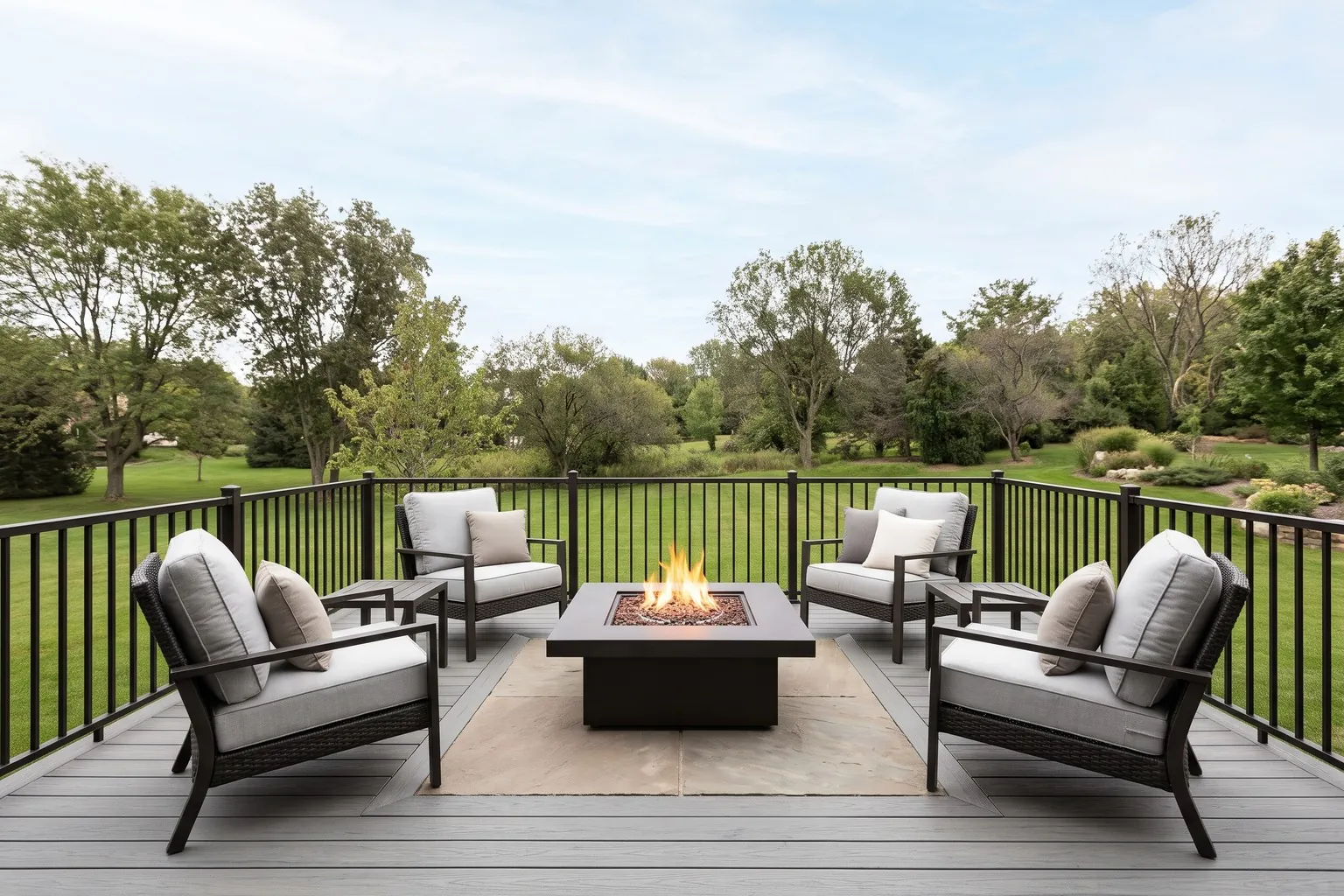
- A gas or propane fire pit made for decks is the kind sources accept, used by its manual and where local rules allow.
- Put a non-combustible base or a rated pad under it, extending at least 24 inches past the pit on all sides.
- An insurer's rule for any fire pit is 10 feet from the house and anything combustible. On a deck 12 feet deep, no position is 10 feet from both the wall and the railing: our sums.
- Nothing overhead: no pergola, covered patio, string lights or branches. Check the weight with a contractor or a structural engineer.
In this guide
A fire on a deck stands on a floor of wood, or of a wood and plastic blend, with the house wall and the railing close by. That is the whole difficulty.
The sources accept one kind of appliance on a deck and warn against the rest. This guide sorts out which is which, from an insurer, a home guide, a decking maker and three sellers, whose advice we label as theirs. The manual of the appliance and your local fire code outrank all of them.
Wood fire on a deck
Start with the fire most people picture: logs in a steel bowl. The sources do not disagree about it.
- Hunker: almost no community will allow a wood-burning fire pit to be positioned on a wood deck.
- Woodland Direct, which sells fire pits: most wood burning fire pits are not safe for wooden decks, and one should not be installed on a deck unless it has been approved by the manufacturer and your city code.
- Travelers, the insurer: placing a fire pit on a wooden deck can be dangerous due to the risk of heat and embers.
- Decks.com: wood fires create embers, sparks and smoke, and codes may require a gas fire pit on a deck in place of one that burns wood.
The reason is the two things a wood fire sends out. Embers fly, and Trex describes what one does when it lands: it creates a burn mark on a wood or composite deck that cannot be removed. The other is heat, which is what the base described below is there to stop.
One seller states the only exception we found. Fire Pit Surplus says a wood-burning pit is approved for a deck only if its manual explicitly gives a clearance below the unit of 0 inches for combustible surfaces, and that every other wood-burning model is prohibited on a deck. In other words: unless the maker of the pit says in writing that it may stand on a combustible floor, it may not.
Gas and propane
The fire the sources accept on a deck is gas.
Hunker's wording: the safest type of fire pit is a gas or propane fueled pit manufactured specifically for use on a deck. Woodland Direct says gas fire pits can typically be installed safely on combustible decks. Blazing Embers, another seller, gives the reason: propane does not throw embers.
Three conditions come with that.
Made for it. Hunker's wording is manufactured specifically for use on a deck. The manual says whether the unit may stand on a combustible surface, and what it needs under and around it.
Installed by its manual. Woodland Direct says to check the manufacturer's requirements and your city's codes, and to hire a gas professional to do the job.
On a pad. Fire Pit Surplus describes the combination that works on most decks: a gas or propane model with legs, a fire pit mat underneath, and correct clearances.
The fire table is one form of it. Trex, which makes decking, offers its own fire pit tables.
What goes under it
Every source that allows a fire pit on a deck puts something between the two.
| Source | What it asks for |
|---|---|
| Woodland Direct | A non-combustible base or high-temperature fire pit mat that extends out at least 24 inches |
| Hunker | Fire bricks, pavers or a commercially produced fire mat, extending at least 24 inches past the perimeter of the pit |
| Travelers | A fire pit pad or heat shield designed for this purpose |
| Decks.com | A protective barrier between the fire pit and the decking |
Twenty-four inches is the figure two of them share. For a pit 30 inches across, that is a pad 78 inches across, six and a half feet: our sums. The pad is much bigger than the pit, and it has to be planned into the deck like a piece of furniture.
Woodland Direct says what the base is for: it prevents radiant heat transfer and stray sparks from damaging the deck boards or causing a fire. It says most homeowners opt for concrete or natural stone slabs. The words that matter in Travelers' sentence are designed for this purpose. By that wording an ordinary outdoor rug does not qualify: our reading.
Composite, PVC and vinyl
The sources treat composite with the same caution as wood.
Decks.com gives the instruction: if you have a composite deck, refer to the decking manufacturer for best practices. Trex, a manufacturer, warns that an ember leaves a burn mark that cannot be removed on composite as on wood. Woodland Direct says vinyl is likely to crack when exposed to excessive heat.
Fire Pit Surplus goes further, with figures we could not check against a decking maker: composite decking softens at 176 degrees Fahrenheit, and the base of a fire pit can transfer 200 to 400 degrees to the surface below. Take the numbers as one seller's. The conclusion it draws from them: on composite, a rated heat mat is required, not optional.
A damaged composite board cannot be sanded back, as our guide to the best decking material explains.
Clearances: measure the deck
Here the sources give numbers, and the numbers settle most cases.
| Source | From the house and anything that burns | Around the pit | Overhead |
|---|---|---|---|
| Travelers | at least 10 feet | not stated | not under string lights or power lines |
| Hunker | at least 10 feet, including house walls, deck railings and branches | not stated | no overhanging branches |
| Woodland Direct | 20 to 25 feet from the house, in most cases | at least 3 feet on each side | 6 feet above |
| Fire Pit Surplus | 10 feet from the house | 3 feet on all sides | not stated here |
| Decks.com | vegetation at least 15 feet away | not stated | no low-hanging trees |
Now measure an ordinary deck against them. A deck 12 feet deep, attached to the house: a pit 10 feet from the wall is 2 feet from the outer railing. Hunker counts the railing among the things to stay 10 feet from. No position on that deck satisfies the rule: our sums.
That is the arithmetic behind the advice against wood fires on decks. For a gas appliance made for decks, the figures that count are the ones in its manual: Woodland Direct says to check the manufacturer's requirements and your city's codes before installation. If the manual says nothing about combustible surfaces, ask the maker before the unit goes on a deck. Where the manual and a local rule differ, ask the fire department which applies.
Our guide to the fire pit seating area lays out the same distances on the ground, where they are easy to meet.
Overhead
Travelers lists what a fire pit must not sit under: string lights and power lines. It adds that large flames may ignite nearby structures like a pergola, and that a covered patio is generally not a safe place for one. Woodland Direct asks for 6 feet clear above the pit.
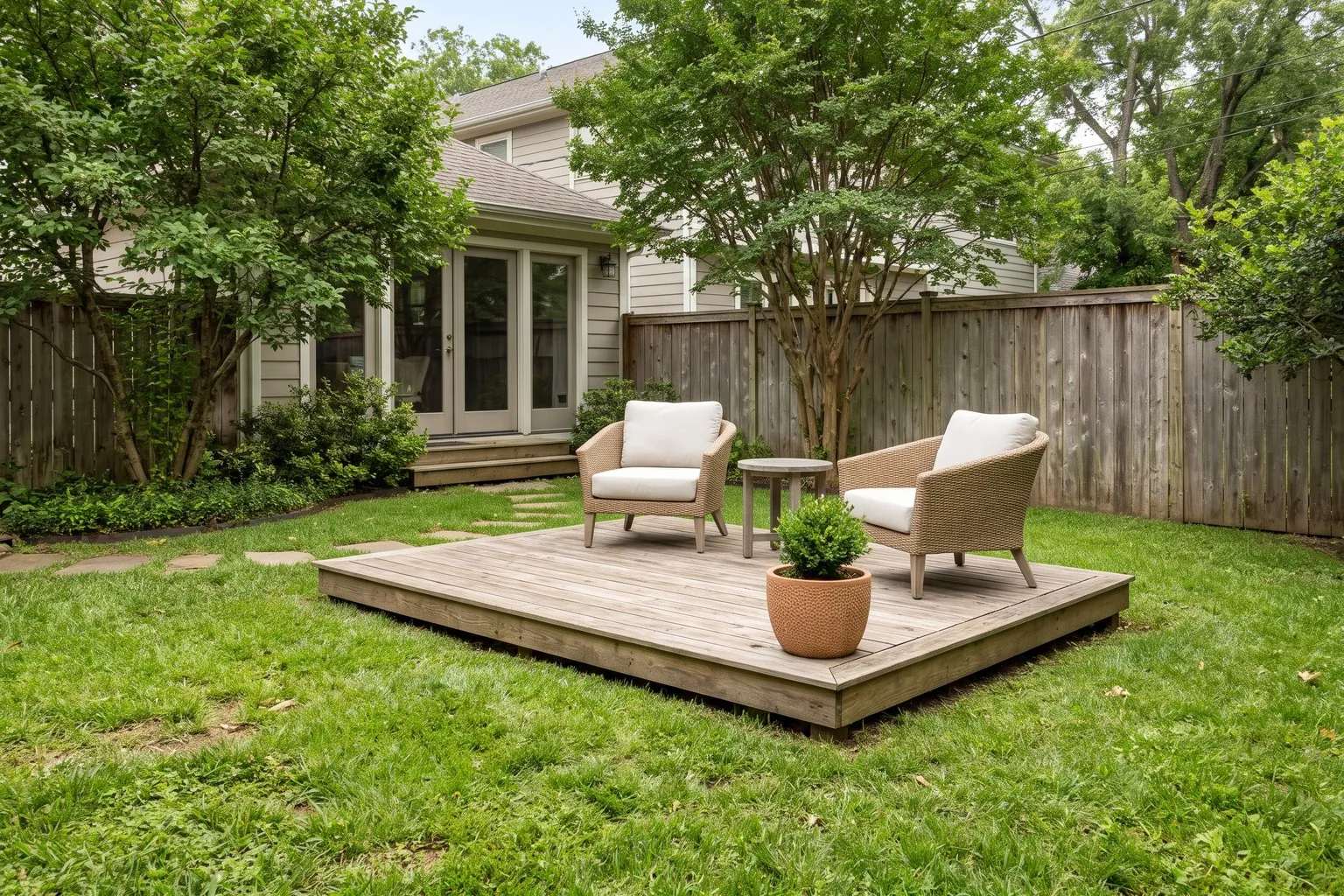
On a deck that excludes the covered end, the space under a pergola and the space under an overhanging tree. If you are planning a pergola on a deck and a fire feature on the same deck, they go at opposite ends.
Weight
A fire pit is a concentrated load on a floor designed for people.
Fire Pit Surplus says fire pits can weigh 150 to 300 pounds, and that older deck structures may not support that load. Woodland Direct says simply that fire pits can be heavy, and to check with a structural engineer. Decks.com says to check with a contractor or structural engineer.
For scale, in our sums: a 300 pound pit on a round base 3 feet across puts about 42 pounds on each square foot under it. The standard deck tables assume 40 pounds per square foot of live load over the whole deck, and people will be sitting around the pit. A masonry fire pit is not something to build on a deck without an engineer: the American Wood Council's deck guide says decks supporting large concentrated loads are beyond its scope. Our guide on how to build a deck explains those tables.
Using it
Travelers publishes the habits that apply to any fire pit. They matter more on a deck.
- Wind. Avoid starting a fire in windy conditions. Fire Pit Surplus sets a number for decks: never above 15 miles per hour.
- Screen. On a wood fire, a metal screen cover keeps sparks contained.
- Water. Keep a full fire extinguisher, a bucket of water or a hose within reach.
- Attention. Do not leave a fire unattended.
- Out. Use water or sand to put the fire out thoroughly.
- Furniture. Hunker says to move deck furniture out of the way before lighting.
Rules, and the insurer
Three sets of rules can apply, and Travelers names them: state laws, local ordinances and permit requirements, and homeowners association rules. It adds no-burn alerts, which suspend fires on certain days. Hunker notes that in drought areas any open flame may be illegal during the dry months.
Then the policy. Travelers suggests asking your insurance agent whether owning a fire pit affects your homeowners insurance. Decks.com says you may be required to disclose the flame. A call before buying costs nothing.
The better place for a wood fire
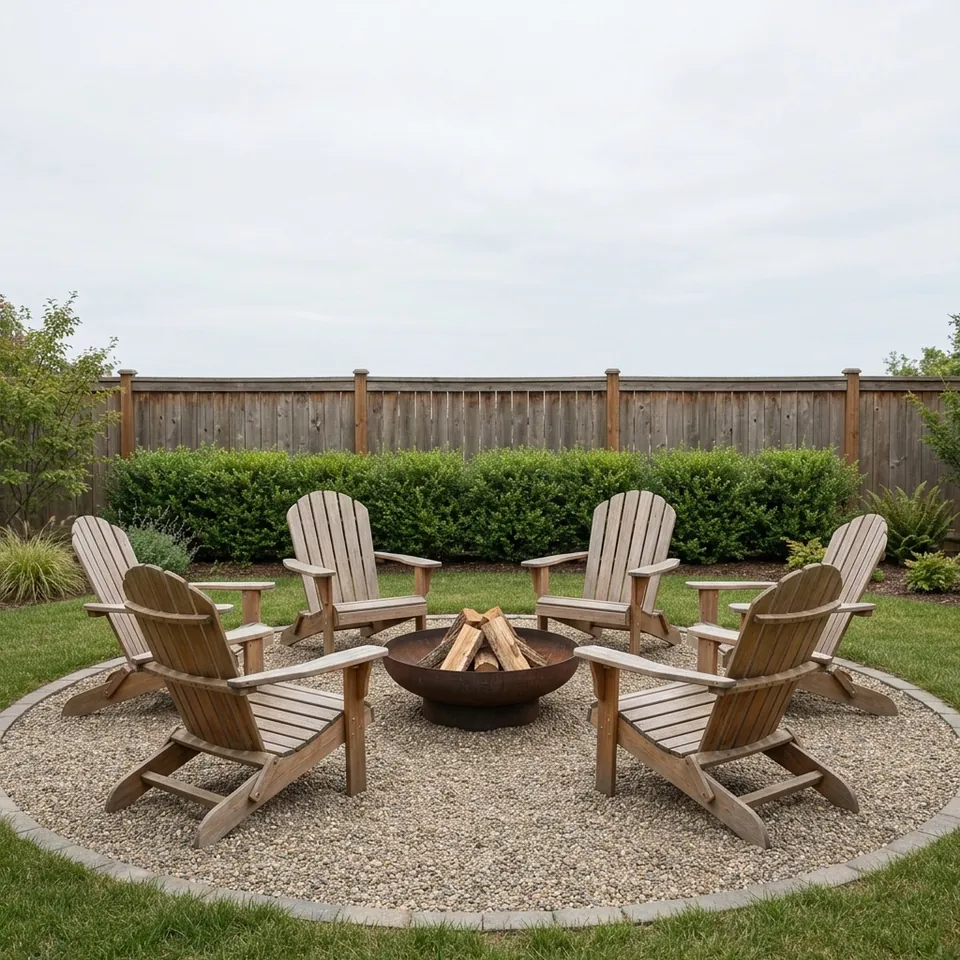
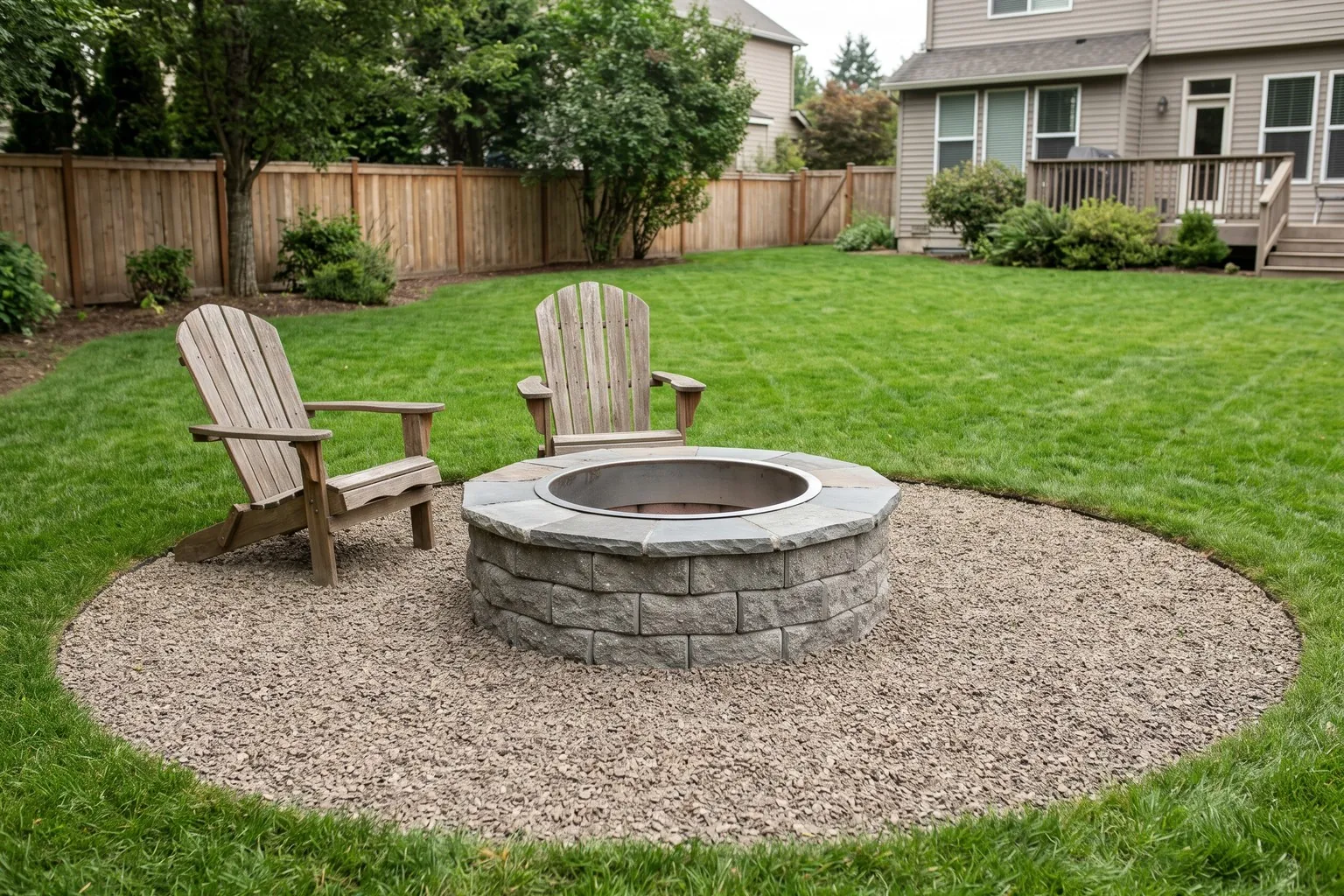
If what you want is a wood fire, the place for it is the ground, away from the deck.
A fire pit 10 feet or more from the house, on gravel or stone, with chairs around it, satisfies the rules that a deck cannot. Our guide to the fire pit seating area gives the layout, and the DIY fire pit guide builds one. The deck then keeps a gas fire table, or nothing, and both are simpler.
Before you buy, in six checks
- The manual. Does it say the unit may stand on a combustible surface? If it does not, ask the maker before buying.
- The fuel. Gas or propane. Wood only with the maker's written approval and the city's.
- The pad. Non-combustible, 24 inches past the pit on every side.
- The clearances. The manual's, measured to the house, the railing and the furniture.
- Overhead. Open sky.
- The deck and the rules. Weight checked with a builder or engineer. Fire code, association and insurer asked.
Questions people ask
Can you put a fire pit on a wood deck?
A gas or propane fire pit made for use on a deck, yes, on a non-combustible pad and by its manual. A wood-burning fire pit, no, unless its manufacturer and your city both approve it. Hunker says almost no community allows one.
Can you put a fire pit on a composite deck?
Only a unit its maker approves for combustible surfaces, on a rated heat mat. Composite scars from embers, and one seller warns that heat softens it. Ask the decking manufacturer, as Decks.com advises.
What do you put under a fire pit on a deck?
A non-combustible base, pavers, fire brick or a fire pit mat made for the purpose, extending at least 24 inches past the pit on all sides.
How far should a fire pit be from the house?
At least 10 feet from the house and anything combustible, according to Travelers. Woodland Direct gives 20 to 25 feet in most cases. A gas appliance made for decks follows the clearances in its manual.
Is a propane fire pit safe on a deck?
It is the kind sources accept, because propane does not throw embers. It still gives off heat, so it needs a pad under it, clear space around it and nothing overhead.
Can a fire pit go under a pergola or a covered deck?
No. Travelers says a covered patio is generally not safe for a fire pit and that flames may ignite structures such as a pergola. Keep it under open sky.
Sources
- Outdoor fire pit safety tips. Travelers, read November 2026
- Can you put a fire pit on a deck?. Hunker, read November 2026
- Deck fire pit ideas. Decks.com, read November 2026
- Are fire pit tables worth it?. Trex, read November 2026
- Can I put a fire pit on my wood deck?. Woodland Direct, read November 2026
- How to safely use a fire pit on a deck. Fire Pit Surplus, read November 2026
- Fire pit on wood deck: safety tips, best options and setup guide. Blazing Embers, read November 2026
- Prescriptive Residential Wood Deck Construction Guide, DCA 6. American Wood Council, copy published by the Town of Geneseo, New York, read November 2026
Every figure in this guide comes from the sources above, or from arithmetic shown in the text. See our editorial policy.