Pergola vs gazebo: the roof is the difference, and the rest follows
A pergola has an open roof and gives partial shade. A gazebo has a solid roof and keeps off rain. Shape, floor, size, cost, permits and upkeep, side by side.
The short answer
- The roof is the difference. A pergola has an open or slatted roof. A gazebo has a solid one.
- A pergola gives partial shade and almost no shelter from rain. A gazebo keeps off both sun and rain.
- A gazebo stands alone, is often six or eight sided, and often has a raised floor. A pergola is usually rectangular, can attach to the house, and stands on a patio you already have.
- Pergolas usually cost less. One engineering firm gives $2,000 to $6,000 for a pergola and $5,000 to $9,000 for most gazebos with labor.
- Permit rules are local and often turn on size. Maplewood, Minnesota, asks for a building permit for either one above 200 square feet.
In this guide
The two words are used as if they meant the same thing, and shops do not help: light frames with fabric tops are sold under both names.
They are different structures with different jobs. One question separates them, and it is the first thing to decide: do you want to sit under the sky, or under a roof?
The difference in one line
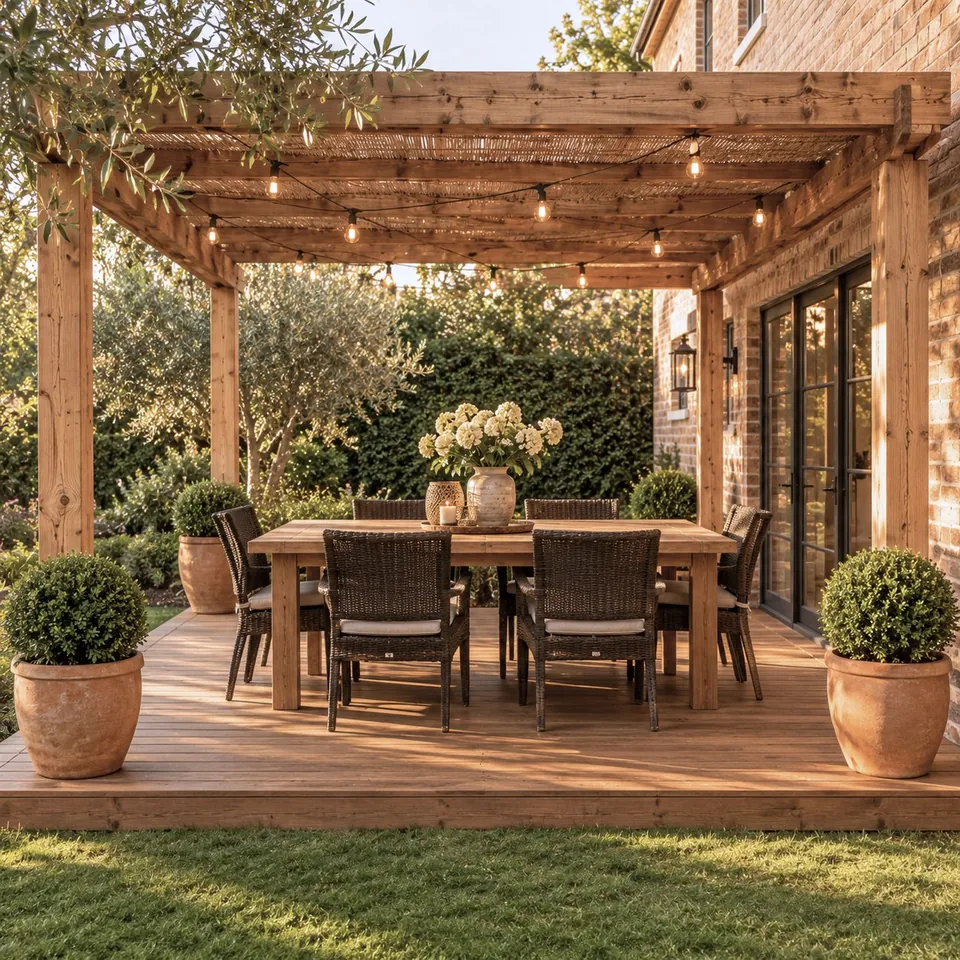
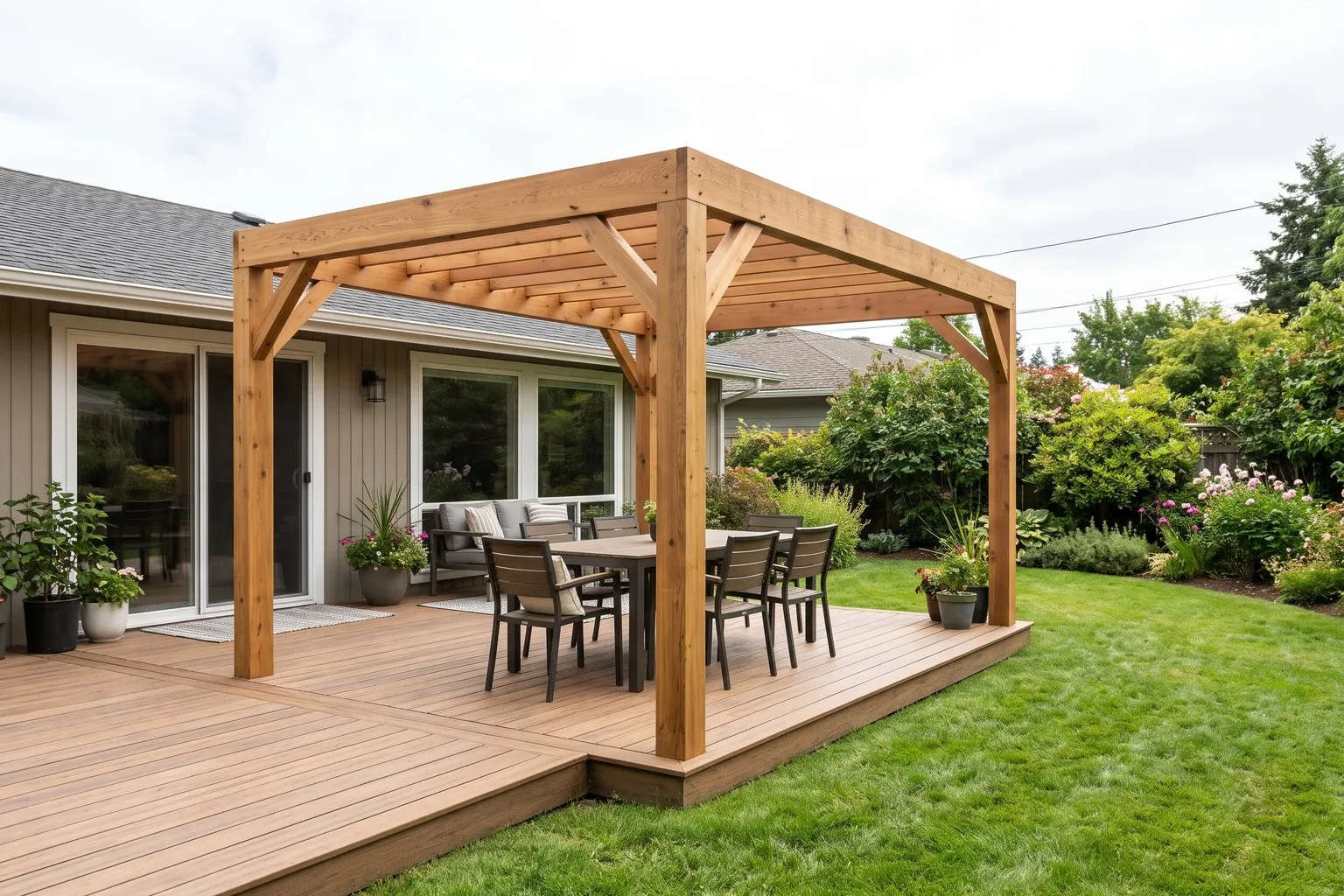
A pergola is an open frame. Bob Vila describes its roof as an open grid of beams, rafters and purlins. O'Keefe Built, a deck builder, defines a pergola as an open frame structure with a slatted or louvered roof.
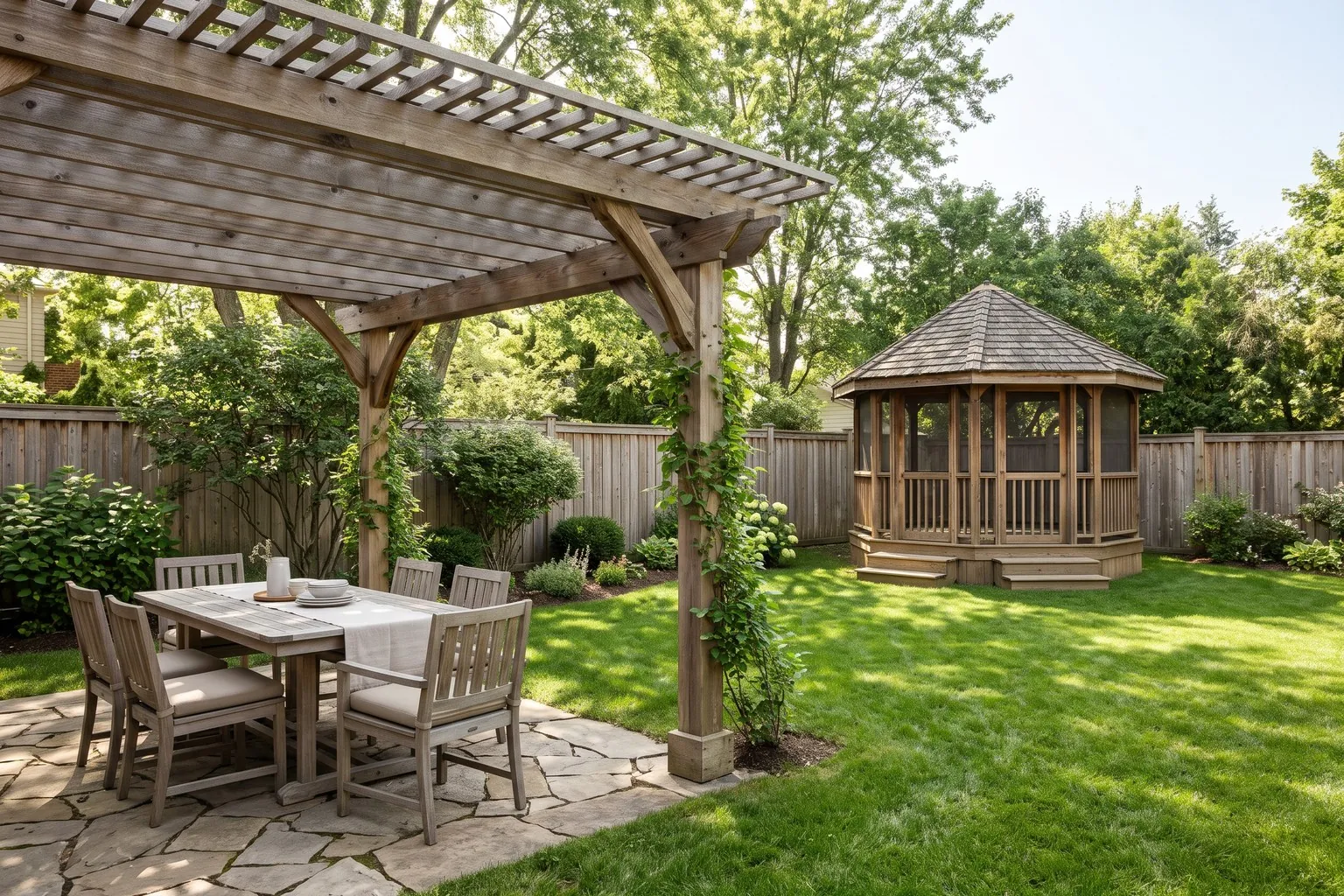
A gazebo is a small roofed building with open sides. O'Keefe Built defines it as a freestanding structure with a solid roof. Complete Building Solutions, a structural engineering firm, puts the contrast in capitals in its own guide: a gazebo has a fully enclosed roof, and the roof of a pergola is not enclosed.
Everything else about the two follows from that.
Side by side
| Pergola | Gazebo | |
|---|---|---|
| Roof | Open grid, slats or louvers | Solid, complete cover |
| Sun | Partial shade | Full shade |
| Rain | Negligible protection | Sheltered |
| Shape | Usually rectangular or square | Often six or eight sided, also square or rectangular |
| Floor | Stands on a patio, a deck or the lawn | Often its own floor, slightly raised |
| Attached to the house | Often | No, it stands alone |
| Typical size | 8 by 8 to 12 by 12 ft | 10 by 10 to 20 by 20 ft |
| Built by the owner | Often | Rarely |
| Cost | Usually lower | Usually higher |
The roof, rain and floor rows are Bob Vila's wording. The shapes are from Complete Building Solutions and from Gill Construction, a Texas builder. The sizes are O'Keefe Built's. Bob Vila's own table rates a pergola as friendly to do it yourself building and a gazebo as not.
Shade and rain
A pergola filters. O'Keefe Built describes it as cutting the harshest midday sun. Complete Building Solutions says pergolas provide only partial protection from the elements, and Bob Vila is blunter about rain: a pergola provides negligible protection.
A gazebo shelters. O'Keefe Built says it is designed to block sun, rain and wind, and Gill Construction calls it full protection from sun and rain.
There is a price for the roof, and it is paid on hot days. Gill Construction points out that under a pergola heat can escape through the open roof, so a pergola can feel cooler. Under either structure the sides are open and air moves freely.
Two things blur the line.
Covers. A pergola can be given a fabric cover. Bob Vila notes that fabric covers can last several years but tear relatively easily.
Louvers. O'Keefe Built lists the motorized louvered pergola as its own category: a roof of slats that close. Closed, it behaves like a roof. It is still sold and built as a pergola.
Shape, floor and where each stands
A pergola belongs to a place that already exists. Bob Vila says it usually sits on an existing patio, another hard surface or the lawn, and that pergolas often use an existing wall as one side. Gill Construction notes that a pergola can attach to the house or stand free. Complete Building Solutions adds that most have four posts.
A gazebo makes its own place. Bob Vila calls gazebos stand alone structures, often with a finished floor that is slightly raised, and often with built in benches. Gill Construction says many sit on a concrete slab, a deck or a raised floor.
That difference decides where each one goes. A pergola goes against the house, over the patio outside the kitchen door, as an extension of the rooms inside. A gazebo goes out in the garden, as somewhere to walk to.
Size
O'Keefe Built gives the usual ranges: 8 by 8 to 12 by 12 feet for a pergola, and 10 by 10 to 20 by 20 feet for a gazebo.
For a pergola the size comes from the furniture under it, and our guide to pergola sizes works through the footprints: a dining table for six, a sofa set, a hot tub.
For a six or eight sided gazebo the size on the label is the distance across, and the floor inside is smaller than the same figure squared. For an eight sided gazebo measured from one flat side to the opposite one, the area is about 83 percent of the square. These are our sums.
| Eight sided gazebo, across | Floor area | A square of the same width |
|---|---|---|
| 10 ft | 83 sq ft | 100 sq ft |
| 12 ft | 119 sq ft | 144 sq ft |
| 14 ft | 162 sq ft | 196 sq ft |
| 16 ft | 212 sq ft | 256 sq ft |
So a 12 foot octagon holds about what a 10 by 12 foot rectangle does. A round table suits it better than a long one.
Cost
No two yards cost the same, and only one of the sources we read puts figures on both. Complete Building Solutions gives these, without a date.
| Pergola | Gazebo | |
|---|---|---|
| Typical cost | Around $2,000 to $6,000 to build | $5,000 to $9,000 for most, with labor |
| By area | Usually $30 to $60 a square foot | |
| Kits | Closer to $3,000 | |
| Custom | Upward of $30,000 |
Applying the area figure to common pergola sizes, by our sum:
| Pergola | Area | At $30 to $60 a square foot |
|---|---|---|
| 10 by 10 ft | 100 sq ft | $3,000 to $6,000 |
| 10 by 12 ft | 120 sq ft | $3,600 to $7,200 |
| 12 by 12 ft | 144 sq ft | $4,320 to $8,640 |
| 12 by 16 ft | 192 sq ft | $5,760 to $11,520 |
The other sources agree on the direction and give no figures. Bob Vila says pergolas are often less expensive to build than gazebos. Gill Construction says pergola cost is usually lower, and that an attached pergola can cost less than a freestanding one. O'Keefe Built says a gazebo typically represents a larger investment.
The reason is in the first table. A gazebo is a roof, a floor and often benches. A pergola is posts and beams.
Permits and rules
Rules are set by your town, and the same structure can be exempt in one place and need two permits in the next.
What the rules usually look at. Complete Building Solutions explains that gazebos and pergolas are often defined as accessory structures, with limits on how many square feet they can cover and how tall they can be. It adds that not all municipalities require building permits.
A real example. The City of Maplewood, Minnesota, states its rule in one sentence: gazebos and pergolas larger than 200 square feet require a building permit. It also asks for a site plan showing the distances to property lines and other buildings, and a separate permit for any electrical work.
Against that line, by our sums: a 10 by 12, a 12 by 14 and a 12 by 16 are all under 200 square feet. A 14 by 16 is 224 and a 16 by 16 is 256. An eight sided gazebo 16 feet across, at about 212 square feet, is just over.
A solid roof can change the answer. O'Keefe Built, writing about Colorado, says solid roofs over roughly 100 square feet often require a permit whatever the foundation, that Denver requires both a zoning permit and a building permit, and that Douglas County exempts open roof pergolas from the same review. Those are one builder's notes on its own area. They show how much the rule can vary within a single state.
Setbacks and associations. Bob Vila reminds readers that local codes set minimum setbacks from the property line. O'Keefe Built notes that approval from a homeowners association is required in many communities.
The order of work is always the same: call the building department before you order a kit.
Snow, wind and upkeep
A solid roof carries what lands on it. O'Keefe Built gives the design snow load on Colorado's Front Range as a minimum of 30 pounds per square foot for a gazebo, and notes that a pergola is often exempt from snow load design when its roof stays at least half open. Gill Construction says gazebo roofs handle wind and sometimes carry snow loads. In a region with real winters, that is an argument for a properly engineered gazebo or for an open pergola, and against a light roofed kit.
Upkeep follows the material more than the type.
- Wood. Gill Construction says wood structures need staining or sealing to prevent rot. O'Keefe Built says cedar and redwood need periodic staining, every one to two years at altitude.
- Metal and vinyl. O'Keefe Built says aluminum and vinyl last the longest with the least upkeep, and that aluminum or steel needs a rinse and a wash with mild soap once a year.
- The roof. Gill Construction notes that leaves and debris collect on a gazebo roof. An open pergola lets them fall through, onto your table.
Their cousins
A few neighboring words, as the sources define them.
- Pavilion. Similar to a gazebo, in Gill Construction's definition, but usually larger and more open.
- Patio cover. Attached to the house, with a solid roof. O'Keefe Built separates it from a pergola by exactly that: it attaches directly to the home.
- Canopy. A lightweight cover that provides shade.
- Pop up gazebo. Bob Vila lists seasonal and pop up gazebos, the folding frames with fabric tops, as a category of their own.
Which one, for what
| You want to | Look at |
|---|---|
| Eat outside the kitchen door | Pergola. Gill Construction lists outdoor dining and patio extensions among its uses. |
| Cover an outdoor kitchen and a table | Pergola, per O'Keefe Built |
| Grow wisteria or grapes overhead | Pergola. Bob Vila notes climbers can be trained up the supports. |
| Sit outside when it rains | Gazebo |
| Shelter a hot tub | Either. Complete Building Solutions lists a hot tub cover as a pergola use, and O'Keefe Built a hot tub under a poolside gazebo. |
| Make a destination in the garden, or host an event | Gazebo. Complete Building Solutions mentions weddings. |
| Build it yourself | Pergola |
One thing neither should cover is a wood fire. Our guide to the fire pit seating area explains why: nothing combustible belongs over a fire pit, and a pergola or a gazebo counts as a structure to keep 10 feet away.
Before you decide
- Rain or no rain. If you want to use it in the rain, it is a gazebo or a louvered pergola.
- Attached or apart. Against the house, a pergola. Out in the garden, either.
- What stands under it. Measure the furniture and add 3 feet all round.
- The area, and your town's limit.
- The material, and how often you are willing to stain it.
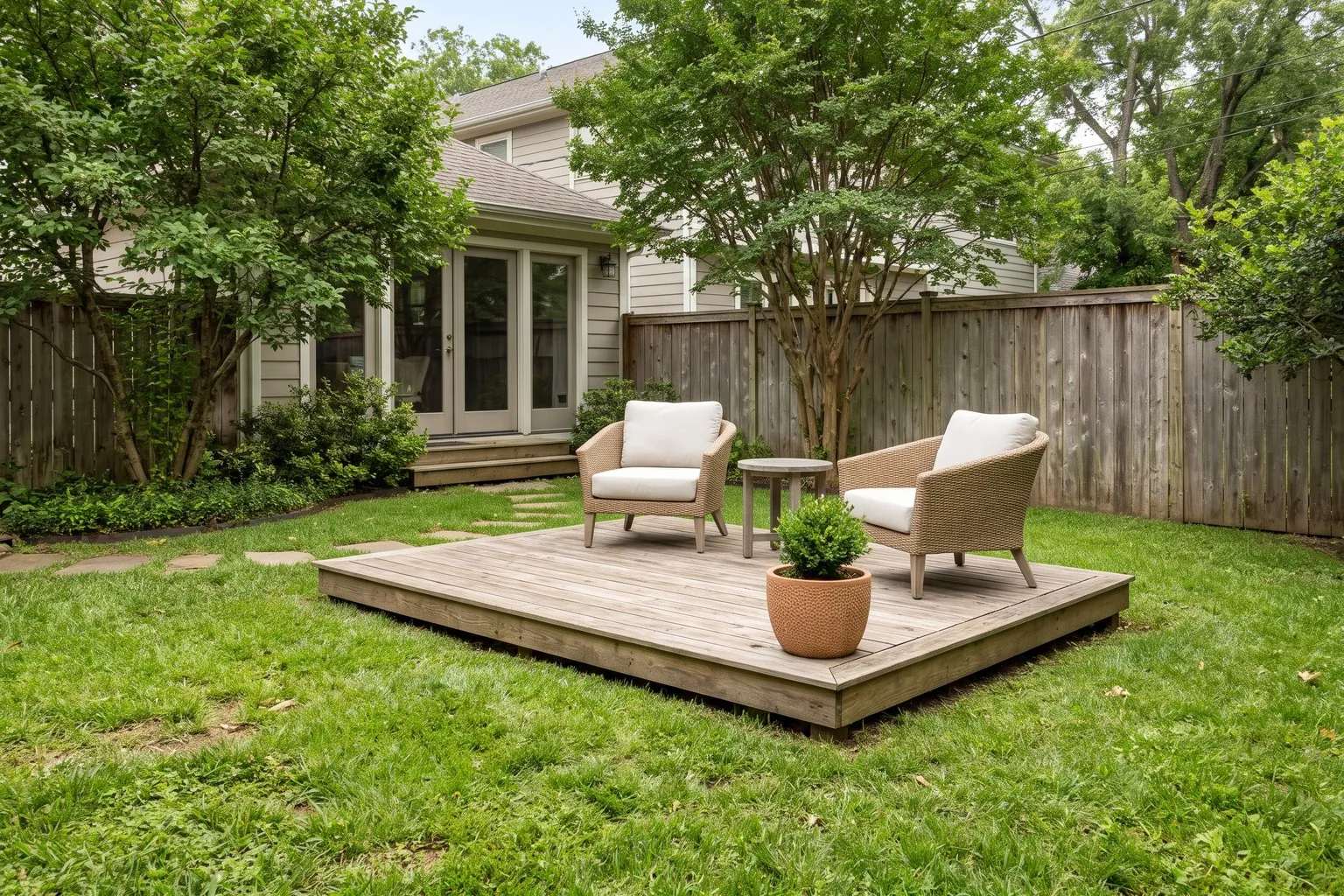
If the pergola is going over a deck, the deck comes first: see our guide to the floating deck.
Questions people ask
What is the difference between a pergola and a gazebo?
The roof. A pergola has an open or slatted roof and gives partial shade. A gazebo has a solid roof and shelters you from sun and rain.
Which is cheaper, a pergola or a gazebo?
Usually a pergola. Complete Building Solutions gives around $2,000 to $6,000 for a pergola and $5,000 to $9,000 for most gazebos with labor.
Does a pergola keep rain off?
Hardly. Bob Vila says a pergola provides negligible protection from rain. A fabric cover or a louvered roof helps.
Do I need a permit for a pergola or a gazebo?
It depends on your town. In Maplewood, Minnesota, either one needs a building permit above 200 square feet. Call your building department before ordering.
Can a pergola be attached to the house?
Yes. Bob Vila notes that pergolas often use an existing wall as one side. A gazebo is a stand alone structure.
Sources
- The differences between pergolas and gazebos, explained. Bob Vila, read November 2026
- Pergola vs gazebo: what you need to know. Complete Building Solutions, read November 2026
- Pergola vs gazebo: key differences. O'Keefe Built, read November 2026
- Pergola vs gazebo: differences, cost, pros, cons and how to choose. Gill Construction, read November 2026
- Gazebo or pergola, building permit requirements. City of Maplewood, Minnesota, read November 2026
Every figure in this guide comes from the sources above, or from arithmetic shown in the text. See our editorial policy.