Bassinet vs crib: a few months against a few years
A bassinet holds a baby up to 15 to 20 pounds, for 3 to 6 months. A crib works from birth to about age 3. Sizes, limits, room sharing and what each costs.
The short answer
- A bassinet is a small bed for the first months. Most have a weight limit of 15 to 20 pounds and are outgrown between 3 and 6 months.
- A crib can be used from birth until a child climbs out or nears 35 inches tall, usually between 18 months and 3 years.
- A bassinet's sleep space runs from 28 by 15 to about 41 by 22 inches in current models. A full-size crib is 28 by 52 3/8 inches inside.
- The American Academy of Pediatrics accepts both, and recommends sharing a room for at least the first 6 months.
- A bassinet is not required. Chicco, Babylist and Amerisleep all say a baby can sleep in a crib from the first night.
In this guide
A bassinet and a crib do the same job at different scales. Both are safe places for a baby to sleep when they meet federal standards. The bassinet is small, light and temporary. The crib is large, fixed and lasts for years.
So the choice is less about which is better than about a calendar and a floor plan: how long each one serves, and where it has to stand. The crib's own measurements are in our guide to crib size.
The difference in one paragraph
The Consumer Product Safety Commission defines a bassinet or cradle as a small bed designed primarily to provide sleeping accommodations for infants, on legs or on a stationary, wheeled, rocking or swinging base. Chicco describes it as a small, portable sleep space for newborns and young infants, raised to about waist height. A crib, in Chicco's words, is a sturdy, stationary sleep space designed for long term use by newborns, infants and toddlers.
Side by side
| Bassinet | Crib | |
|---|---|---|
| Sleep space | 28 by 15 to 41.5 by 22 in, by model | 28 by 52 3/8 in, by federal rule |
| Weight limit | Usually 15 to 20 lb | None published in our sources |
| Used until | 3 to 6 months | 18 months to 3 years, or about 35 in tall |
| What ends it | Rolling over, or pushing up on hands and knees | Climbing out |
| Moves around | Yes: light, often on wheels | Rarely, once assembled |
| Stands | Beside the parents' bed | In its own place, in any room |
| Federal standard | 16 CFR part 1218 | 16 CFR part 1219 |
| Bedding | A fitted sheet only | A fitted sheet only |
The sections below give the sources for each row.
Size: the numbers
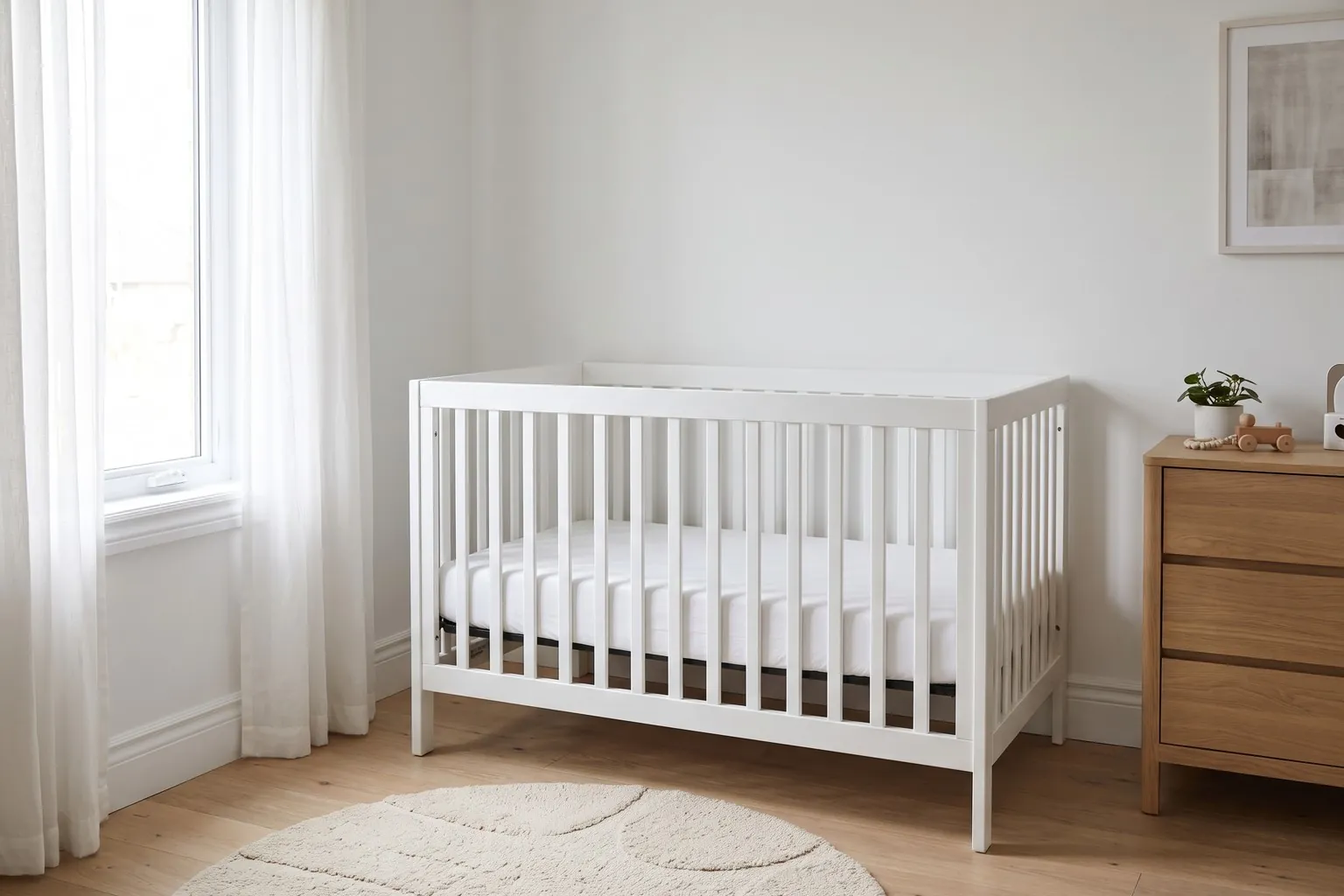
A crib has one size. The Consumer Product Safety Commission sets the interior of a full-size crib at 28 inches wide by 52 3/8 inches long, each within 5/8 inch.
None of the guides we read gives a standard size for a bassinet. What exists is the sleep space each maker publishes. Babylist lists it for the models in its 2026 roundup.
| Bassinet | Sleep space | Weight limit |
|---|---|---|
| Chicco LullaGo Anywhere | 28 by 15 in | Up to 20 lb |
| Delta Children babyGap Whisper | 28 by 17 in | Up to 25 lb |
| Halo BassiNest Swivel Sleeper 3.0 | 30 by 17 in | Up to 20 lb |
| Maxi-Cosi Iora | 32 by 20 in | Up to 20 lb |
| Happiest Baby Snoo | 35.75 by 19 in | 0 to 6 months |
| Newton Baby Bassinet and Bedside Sleeper | 41.5 by 22 in | Up to 20 lb |
Set against a crib mattress of 28 by 52 inches, which is 1,456 square inches, the smallest of those sleep spaces is 420 square inches and the largest 913. By our division, a bassinet gives a baby between about 30 and 60 percent of the surface of a crib.
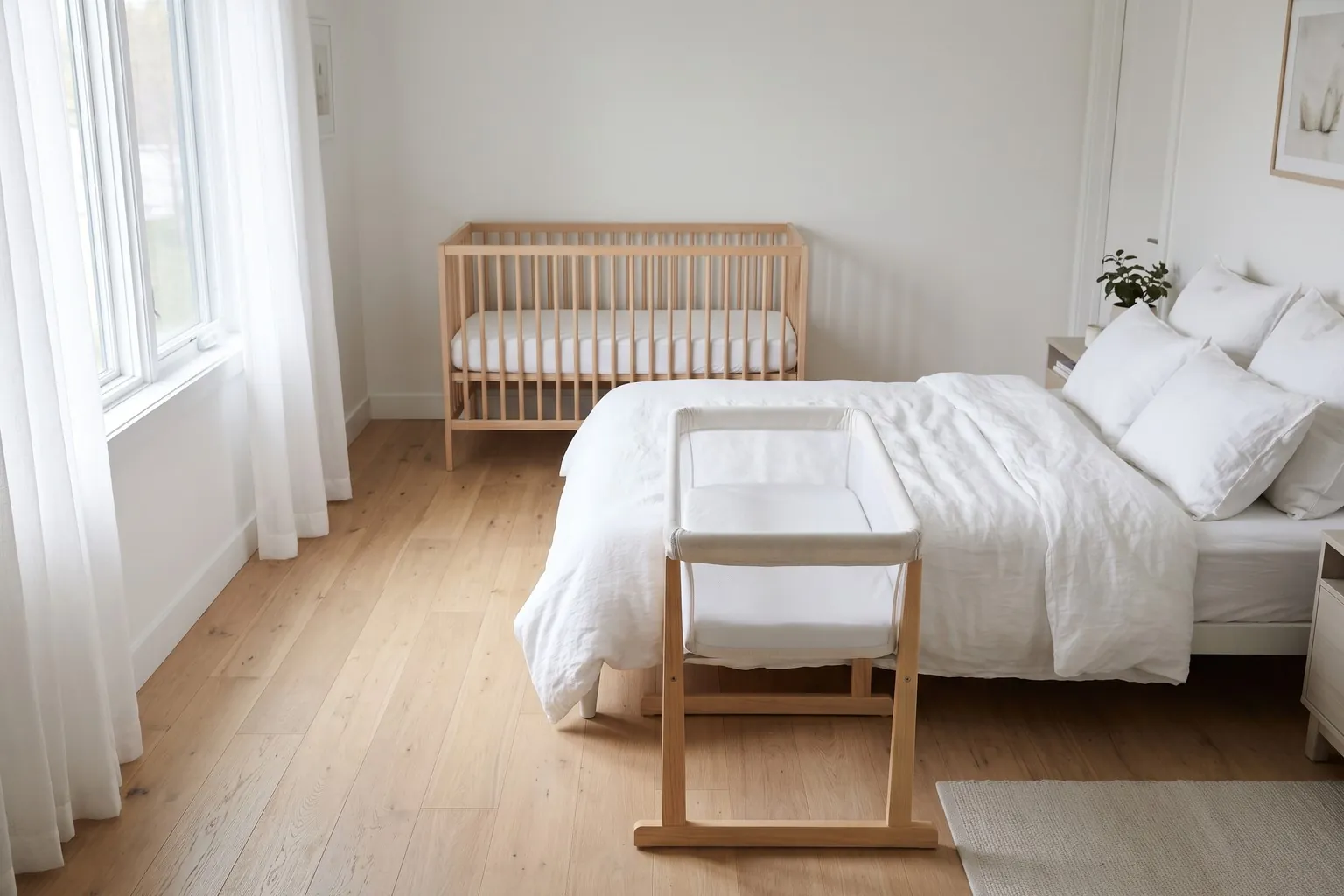
That is the point of it. Babylist quotes a pediatric sleep consultant on the other side of the comparison: a crib is really such a large space for a tiny newborn. And the small footprint is what lets a bassinet stand where a crib often cannot. Chicco puts it simply: unlike cribs, they are small enough to fit next to your bed.
Put one model against the crib to see the difference in a bedroom. The Halo's sleep space is 30 by 17 inches. A crib's is 52 3/8 by 28. The crib is 22 inches longer and 11 inches wider before either frame is counted, which is the difference between something that stands beside the bed and something that needs a wall of its own.
How long each one lasts
The bassinet: three to six months. The sources agree closely.
| Source | Weight limit | Typical age to move on |
|---|---|---|
| Chicco | Most have a 15 to 20 lb limit | Between 3 and 6 months, and never past 6 |
| Newton | 15 to 20 lb maximum | Around four months |
| Amerisleep | Usually up to 15 to 20 lb | Between 4 and 6 months |
| WebMD | 10, 15 or 20 lb, depending on the maker | In 2 or 4 months |
| Babylist | Varies by model | Around three to six months |
The limit that counts is the one printed on your bassinet. In Babylist's list it runs from 15 pounds for the bassinet level of a Graco play yard to 25 for one Delta model.
The crib: about three years. Newton notes that a crib can be used from birth on. At the other end, Chicco gives typically between 18 months and 3 years old, and Amerisleep gives from birth until 35 to 40 inches tall, usually around age 3. WebMD's version is the practical one: until your baby learns to climb out of it.
The signs that end the bassinet
Weight is only one of the limits, and usually not the first one reached. Every source names a movement.
- WebMD: stop when your baby starts rolling over or pushes up on hands and knees.
- Chicco: when the baby can roll over, push up on hands and knees, or pull up on the sides, the bassinet is no longer a safe sleeping option.
- Newton: as soon as your little one starts rolling over or sitting up.
- Amerisleep: rolling over, pushing up on hands and knees, or sitting up.
Chicco adds the rule that settles any doubt. A baby who pushes up on hands and knees should move to a crib or play yard even if still within the weight limit.
The reason is the shape. A bassinet is shallow. Babylist notes the risk of falling out of a shallow bassinet compared with a deeper crib, and Newton lists the bassinet's smaller size and high center of gravity as a potential tipping hazard.
Room sharing changes the calendar
The American Academy of Pediatrics recommends sharing a room with the baby for at least the first 6 months. It says room sharing can decrease the risk of sudden infant death syndrome by as much as 50 percent.
Put that next to the bassinet's lifespan and a gap appears. If the bassinet is outgrown at four months, as Chicco and Newton both give as typical, there are two more months of recommended room sharing with no bassinet to do it in.
So the real question is what stands in the parents' bedroom from month four to month six. There are three answers in the sources.
- The crib, in the bedroom. It needs about 10 square feet of floor for its sleeping space alone, plus its frame.
- A mini crib. Babylist gives the usual size as 20 to 25 inches wide and about 34 to 40 inches long, and says many mini cribs last until around two or three years old.
- A play yard. Newton calls it a safe option for room sharing, and the Academy lists it among the acceptable sleep spaces.
If your bedroom takes a full-size crib beside the bed, the bassinet is a convenience. If it does not, the bassinet or the mini crib is how the six months get done.
Do you need a bassinet at all
No, and the sources say so directly. Chicco: a bassinet isn't required, and newborns can sleep in a crib as long as safe sleep guidelines are followed. Babylist calls it not something you absolutely need. Amerisleep notes that many families choose to start with just a crib from day one.
What a bassinet buys is convenience in the first weeks.
- Reach. Chicco describes it as raised to about waist height. Newton makes the point for parents recovering from a cesarean birth, who may not be able to lean over the side of a crib.
- Movement. Amerisleep notes that bassinets often have wheels or are lightweight, while cribs rarely move once assembled. Babylist lists the Chicco LullaGo at about 12 pounds.
- Floor. It fits beside the bed, where a crib often does not.
What each one costs
Our sources give prices for bassinets and mini cribs, and only a direction for cribs.
- Bassinets. The models in Babylist's 2026 list run from about $100 to $600, with one smart bassinet at $1,995. HALO lists its own from $199.99 to $399.99.
- Mini cribs. Babylist's list runs from $129.99 to $674.
- The comparison. Chicco says bassinets are usually cheaper up front, and HALO says they are typically less expensive than cribs. Newton lists the other side of the ledger among the bassinet's drawbacks: used only for a few months, and not cost effective.
A bassinet does not replace a crib. Whatever it costs is added to the price of the crib that follows it.
Safety is the same for both
The rules for the sleep space do not change with its size.
- A product that meets the standard. The Academy accepts a crib, bassinet, portable crib or play yard that meets the safety standards of the Consumer Product Safety Commission. The standard for bassinets and cradles is 16 CFR part 1218, and for full-size cribs 16 CFR part 1219.
- Flat. The Academy says any surface that inclines more than 10 degrees is not safe for sleep, and the Commission's guidance for bassinets sets the sleep surface at 10 degrees or less.
- Firm. The Academy asks for a firm, flat surface that does not indent when the baby lies on it.
- Bare. The Commission's phrase is bare is best: nothing but a fitted sheet, in a crib, bassinet or play yard alike.
The fit of a crib mattress, which the rules treat in detail, is covered in crib size.
Which to choose
A bassinet first, if:
- the parents' bedroom has no room for a crib beside the bed;
- you want the baby at arm's reach and at waist height in the first weeks;
- you want a sleep space that moves from room to room.
A crib from the start, if:
- the bedroom takes a crib, or the nursery is where the baby will sleep;
- you would rather buy one bed than two;
- you want the piece that lasts until the move to a real bed.
A mini crib, if:
- the room is small and you want more than six months from what you buy.
Whatever you choose, the next bed is years away. When it comes it is usually a twin, measured in twin bed dimensions.
Questions people ask
What is the difference between a bassinet and a crib?
Size and time. A bassinet is a small, portable bed used for the first 3 to 6 months, usually up to 15 to 20 pounds. A crib is 28 by 52 3/8 inches inside and is used from birth to about age 3.
How long can a baby sleep in a bassinet?
Until the weight limit on the bassinet, usually 15 to 20 pounds, or until the baby rolls over or pushes up on hands and knees, whichever comes first. Chicco says never past 6 months.
Can a newborn sleep in a crib?
Yes. Chicco says newborns can sleep in a crib as long as safe sleep guidelines are followed, and the American Academy of Pediatrics lists the crib among the acceptable sleep spaces.
Is a bassinet safer than a crib?
Neither is ranked above the other in the American Academy of Pediatrics' guidance. Both are acceptable when they meet federal standards and are used bare, on a firm, flat surface.
How big is a bassinet?
There is no standard. The sleep spaces in Babylist's 2026 list run from 28 by 15 inches to 41.5 by 22 inches, against 28 by 52 3/8 inches for a full-size crib.
Sources
- How to keep your sleeping baby safe: AAP policy explained. American Academy of Pediatrics, read November 2026
- Bassinets and cradles business guidance. U.S. Consumer Product Safety Commission, read November 2026
- Full-size baby cribs business guidance. U.S. Consumer Product Safety Commission, read November 2026
- Safe sleep: cribs and infant products. U.S. Consumer Product Safety Commission, read November 2026
- When can I move my baby from bassinet to crib?. WebMD, read November 2026
- Bassinet vs. crib: everything you need to know. Chicco, read November 2026
- How long can a baby sleep in a bassinet?. Chicco, read November 2026
- Do I need a bassinet?. Chicco, read November 2026
- Bassinet vs. crib: what's the difference. Newton Baby, read November 2026
- Bassinet vs crib vs cradle. Amerisleep, read November 2026
- How long can a baby sleep in a bassinet?. Babylist, read November 2026
- The best bassinets of 2026. Babylist, read November 2026
- 9 best mini cribs of 2026. Babylist, read November 2026
- Newborn bassinet safety tips. HALO, read November 2026
Every figure in this guide comes from the sources above, or from arithmetic shown in the text. See our editorial policy.