Crib size: 28 by 52 inches inside, and why every full-size crib matches
A full-size crib is 28 by 52 3/8 inches inside, by federal rule. The mattress that fits it, mini crib sizes, the gap to check, and when a child outgrows it.
The short answer
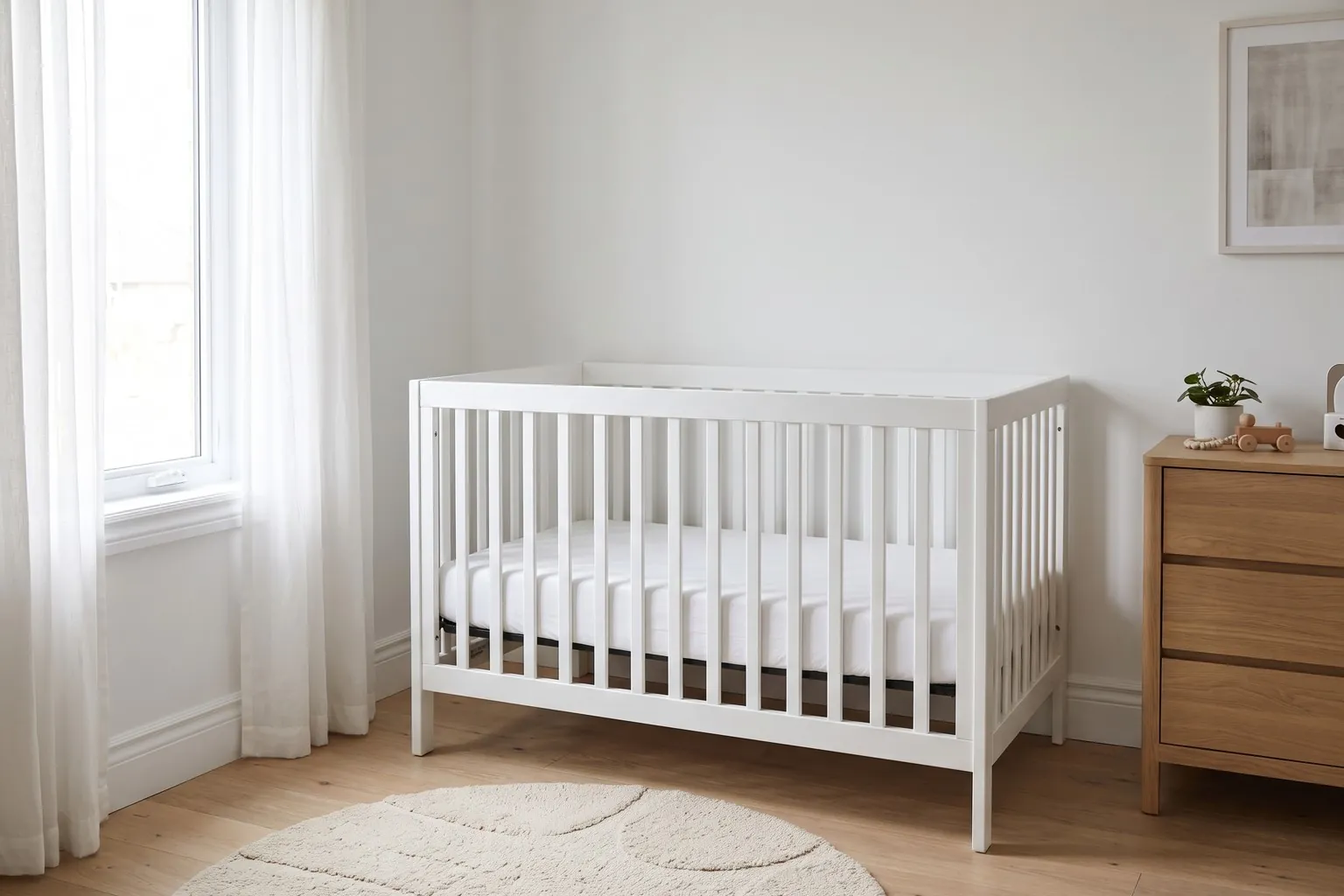
- A full-size crib measures 28 inches wide and 52 3/8 inches long on the inside, each within 5/8 inch. The Consumer Product Safety Commission sets that size in federal rule.
- The mattress sold for it is called 28 by 52 inches. The Sleep Foundation gives the minimum as 27 1/4 by 51 5/8 inches.
- Saatva and Newton give 6 inches as the maximum thickness of a crib mattress.
- A mini crib is usually 24 by 38 inches. Its size is not standardized, so it has to be sold with its own mattress.
- The Sleep Foundation's markers for leaving the crib: climbing out, or a height near 35 inches.
In this guide
Most furniture sizes are conventions. The crib is the exception. In the United States its inside dimensions are written into federal regulation, which is why crib mattresses are sold in one standard size.
This guide gives those dimensions, the mattress that goes with them, the smaller cribs that follow other rules, and the measurements that tell you when the crib has been outgrown.
The size of a full-size crib
The Consumer Product Safety Commission, the federal agency that regulates cribs, defines a full-size crib by its interior.
| Inches | Centimeters | Allowed range | |
|---|---|---|---|
| Interior width | 28 | 71 | 27 3/8 to 28 5/8 in |
| Interior length | 52 3/8 | 133 | 51 3/4 to 53 in |
The figures and the tolerance, plus or minus 5/8 inch or 1.6 centimeters on each dimension, are the Commission's. The range in the last column is our arithmetic. The regulation adds where to measure: at the level of the mattress support.
In feet, the inside of a crib is 2 feet 4 inches by a little under 4 feet 4 1/2 inches. That is the sleeping space, not the piece of furniture. The frame, the posts and any drawer or changing shelf make the outside larger, and no rule fixes those.
Why every full-size crib is the same size
The rule is 16 CFR part 1219, the federal safety standard for full-size baby cribs. Its text sets the interior dimensions above and applies to new and used cribs alike. The compliance date written into it is June 28, 2011, with child care facilities and public accommodations following on December 28, 2012.
Two practical things follow.
- A crib is either full-size or it is not. A crib whose interior falls outside the range is, in the Commission's vocabulary, a non-full-size crib, and it comes under a different rule. Those are covered below.
- The date matters for a secondhand crib. The standard dates from 2011. A crib older than that was built to earlier requirements. Amerisleep's advice is to avoid secondhand cribs manufactured before 2011.
The crib mattress
Because the crib is standard, so is the mattress. It is sold as 28 by 52 inches, and three sources describe it slightly differently.
| Source | Crib mattress |
|---|---|
| Saatva, Newton | Approximately 28 by 52 in |
| Sleep Foundation | At least 27 1/4 by 51 5/8 in |
| Nectar | 27 by 51 in |
The Sleep Foundation presents its figure as the minimum needed to comply with safety standards, and attributes it to the Commission. The round 28 by 52 is the name of the size. The smaller figures describe how far below it a real mattress can be.
Two more numbers complete the picture.
- Thickness. Saatva says a crib mattress should be no more than six inches thick, and Newton gives the same limit.
- Its own standard. Crib mattresses have a federal rule of their own, 16 CFR part 1241, which the Commission's guidance says applies to mattresses manufactured after August 15, 2022.
Firmness is part of that picture as well. The American Academy of Pediatrics asks for a firm, flat sleep surface, and defines firm as one that does not indent when the baby is lying on it.
The fit that matters: the gap
A crib mattress is not judged like an adult's, by comfort. It is judged by how closely it fills the crib.
The sources give three ways to check.
- Friction. The Sleep Foundation says the mattress should slide in with a slight amount of friction, leaving very little space around the perimeter.
- Two fingers. Its test uses two fingers: you should not be able to squeeze more than that between the mattress and the crib frame, at the sides or in the corners.
- One inch. Saatva's version: push the mattress against one side, and the gap on the opposite side should measure less than one inch.
The arithmetic shows how little room there is. A mattress 27 1/4 inches wide in a crib exactly 28 inches wide leaves 3/4 inch in total. Centered, that is 3/8 inch on each side. Pushed to one side, it is 3/4 inch on the other, inside Saatva's limit.
The American Academy of Pediatrics states the principle without numbers: use a mattress designed for your specific crib, and one that fits tightly.
Mini cribs and portable cribs
Anything smaller or larger than the standard interior is a non-full-size crib. The Commission's definition is by measurement: an interior longer than 55 inches or shorter than 49 3/4, or wider than 30 5/8 inches or narrower than 25 3/8. A portable crib, in its vocabulary, is one that folds or collapses without being taken apart.
The mini crib is the common case. The Sleep Foundation, Saatva and Nectar all give the same typical size, 24 by 38 inches. At 24 inches wide it is under the Commission's 25 3/8 inch threshold, so it falls in the non-full-size category.
Here the rules change, because the size does not.
- No standard size. Nectar notes that mini crib sizes are not regulated and can differ slightly from one brand to another.
- Sold with the mattress. For that reason the Commission requires that non-full-size cribs be sold with the mattress included. The American Academy of Pediatrics' advice applies with full force here: a mattress designed for your specific crib.
- A stricter gap. For these cribs the Commission's requirement is a gap of no more than 1/2 inch at any point with the mattress centered, and no more than 1 inch with it pushed to one side.
Babylist's 2026 roundup shows how much the category varies. It describes a mini crib as generally 20 to 25 inches wide and about 34 to 40 inches long, and the outside dimensions it lists for individual models run from about 32 to 40 inches in length. It adds two things worth knowing before buying one: many mini cribs last until around two or three years old, and the mattresses they come with are often fairly thin.
The rule for these cribs is 16 CFR part 1220.
How much room a crib takes
The sleeping space of a full-size crib is 28 by 52 3/8 inches, which is about 10 square feet of floor. By our comparison with the beds that come later:
| Sleeping surface | Compared with a full-size crib | |
|---|---|---|
| Mini crib | 24 by 38 in | 4 in narrower, 14 in shorter |
| Full-size crib | 28 by 52 3/8 in | |
| Twin bed | 38 by 75 in | 10 in wider, about 23 in longer |
A crib mattress of 28 by 52 inches has 1,456 square inches. A twin has 2,850, by Purple's figure, so a crib is about half a twin.
Plan the room with the outside of the crib, not these figures. The outside dimensions are on the product page of each model, and they are the ones to put against the wall. Leave room to stand at the long side and lower the baby in.
Where the crib goes matters as much as its size for the first months. The American Academy of Pediatrics recommends that parents share a room with the baby, without sharing a bed, for at least the first 6 months. That often means finding these 10 square feet in the parents' bedroom first. A smaller sleeper for those months is compared in bassinet vs crib.
Crib sheets, and nothing else
A crib takes one piece of bedding. Purple and Saatva both list the crib fitted sheet at 28 by 52 inches, the size of the mattress, and neither chart lists a flat sheet for a crib.
That matches the safety guidance. The Consumer Product Safety Commission's rule of thumb is bare is best: nothing but a fitted sheet in a crib, bassinet or play yard, with no pillows or blankets added. The American Academy of Pediatrics says to use a fitted sheet only, and lists pillows, quilts, comforters, mattress toppers and blankets among the items to keep out. Its recommendations apply to babies up to 1 year of age.
So the bedding sizes that fill our other guides stop at the crib rail. The chart for the beds that come after is in bedding sizes.
One measurement on the frame belongs here too. Chicco gives the spacing of crib slats as no more than 2 3/8 inches apart.
When a child outgrows the crib
No source gives a weight for this. They give a height and a behavior.
| Source | When to move on |
|---|---|
| Sleep Foundation | When the child climbs out or tries to, or is approaching 35 inches tall with the rail at chest level or lower |
| Sleep Foundation, citing the American Academy of Pediatrics | Most commonly between 18 months and age 3 |
| Amerisleep | From birth until 35 to 40 inches tall, usually around age 3 |
| Chicco | Typically between 18 months and 3 years old |
| Saatva | An expert it quotes suggests waiting until at least three, unless the toddler is climbing out |
Thirty five inches is the number to remember, and climbing overrides it. A child who can get a leg over the rail has outgrown the crib whatever the tape says.
From crib to toddler bed to twin
The crib mattress has a second life. The Sleep Foundation says toddler beds are sized the same as a standard crib, so in most cases the crib mattress becomes the toddler mattress. Saatva and Nectar say the same, and Saatva notes that standard crib mattresses fit directly into convertible crib frames.
After that the next standard size is the twin, 38 by 75 inches. It is 23 inches longer than the crib mattress, so measure where it will stand before the move. The numbers are in twin bed dimensions, the choice between a twin and a full in full vs twin, and the stacked versions in bunk bed dimensions.
Before you buy, in five checks
- The crib is sold as full-size, or it is a mini crib that comes with its own mattress.
- If the crib is secondhand, it was made after June 2011.
- The mattress is firm, no more than 6 inches thick, and labeled for a full-size crib.
- With the mattress in place, you cannot fit more than two fingers between it and the frame at any point.
- You have the outside dimensions of the crib, and a fitted sheet of 28 by 52 inches is the only thing going in it.
Questions people ask
What is the standard size of a crib?
A full-size crib is 28 inches wide and 52 3/8 inches long inside, each within 5/8 inch. The Consumer Product Safety Commission sets those dimensions in 16 CFR part 1219.
What size is a crib mattress?
It is sold as 28 by 52 inches. The Sleep Foundation gives a minimum of 27 1/4 by 51 5/8 inches, and Saatva and Newton give a maximum thickness of 6 inches.
What size is a mini crib?
Usually 24 by 38 inches, according to the Sleep Foundation, Saatva and Nectar. The size is not standardized, so federal rules require a non-full-size crib to be sold with its mattress.
How much gap is allowed between a crib mattress and the crib?
Very little. The Sleep Foundation's test is that no more than two fingers fit between the mattress and the frame. Saatva gives less than one inch with the mattress pushed to one side.
When should a child move out of a crib?
When they climb out or try to, or as they approach 35 inches tall, according to the Sleep Foundation. It cites the American Academy of Pediatrics for the most common age, between 18 months and 3 years.
Sources
- Full-size baby cribs business guidance. U.S. Consumer Product Safety Commission, read November 2026
- 16 CFR 1219.1: scope, compliance dates and definitions. Code of Federal Regulations, Cornell Legal Information Institute, read November 2026
- Non-full-size baby cribs. U.S. Consumer Product Safety Commission, read November 2026
- Crib mattresses business guidance. U.S. Consumer Product Safety Commission, read November 2026
- Safe sleep: cribs and infant products. U.S. Consumer Product Safety Commission, read November 2026
- How to keep your sleeping baby safe: AAP policy explained. American Academy of Pediatrics, read November 2026
- What size is a crib mattress?. Sleep Foundation, read November 2026
- Crib mattress dimensions. Saatva, read November 2026
- Crib mattress size guide. Nectar, read November 2026
- Bassinet vs. crib. Newton Baby, read November 2026
- Bassinet vs. crib: everything you need to know. Chicco, read November 2026
- Bassinet vs crib vs cradle. Amerisleep, read November 2026
- Twin vs. full: key differences. Purple, read November 2026
- Bed sheet sizes and dimensions guide. Purple, read November 2026
Every figure in this guide comes from the sources above, or from arithmetic shown in the text. See our editorial policy.