Bunk bed dimensions: the height, the ceiling and the 5 inch rule
A standard bunk bed is about 70 inches tall and needs 30 to 36 inches above the top mattress. Sizes by mattress, the federal guardrail rule and the ceiling sum.
The short answer
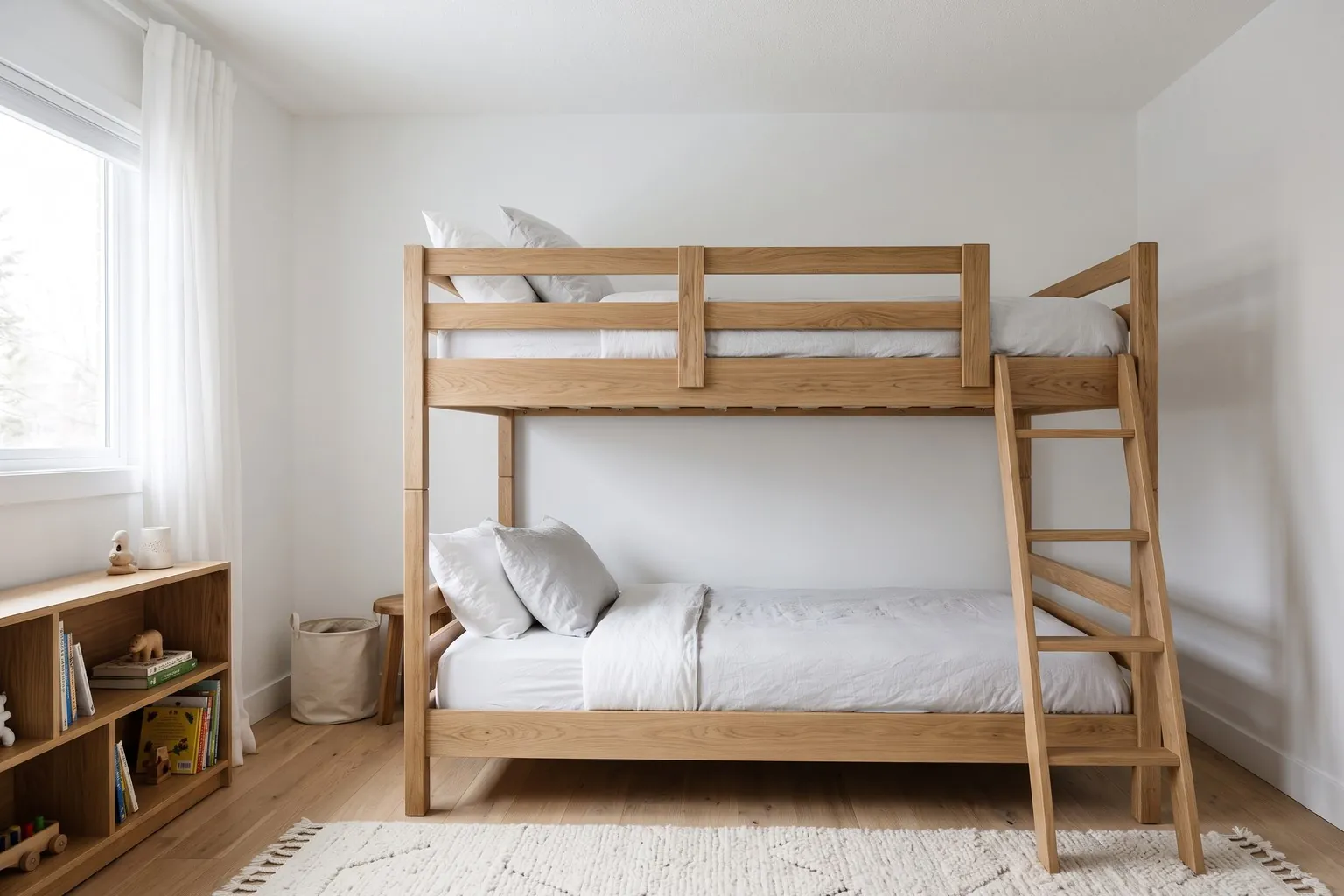
- Amerisleep puts a standard bunk bed at around 70 inches tall, a low one at around 55 and a triple at more than 90. Maxtrix sells bunks from 61.5 inches.
- Leave 30 to 36 inches between the top of the upper mattress and the ceiling. By Maxtrix's method, a 70 inch bunk with a 6 inch mattress leaves 36 under an 8 foot ceiling.
- The footprint is the mattress: 38 by 75 inches for a twin, 54 by 75 for a full, plus the frame and the ladder.
- Federal rule: the guardrail must rise at least 5 inches above the top of the upper mattress. A thicker mattress takes that margin away.
- Children under 6 should not sleep in the top bunk.
In this guide
- What counts as a bunk bed
- The sizes: the mattress decides the footprint
- How tall a bunk bed is
- The ceiling: 30 to 36 inches above the top mattress
- Low ceilings and triple bunks
- The guardrail rule, and what it does to the mattress
- Between the bunks
- Who sleeps on top
- The floor around it
- The mattresses and the bedding
- The other way to fit two beds: a trundle
- Before you buy, in six checks
A bunk bed is measured in three directions, and the one people forget is up. The footprint is little bigger than a single bed. The height is another matter: it has to fit under the ceiling with room for a child to sit up, and the top mattress has to sit low enough behind its rail.
This guide gives the three sets of numbers, with the federal rules that govern the last one.
What counts as a bunk bed
The definition is in federal regulation. A bunk bed is a bed in which the underside of any foundation is over 30 inches from the floor. The foundation is the base the mattress rests on.
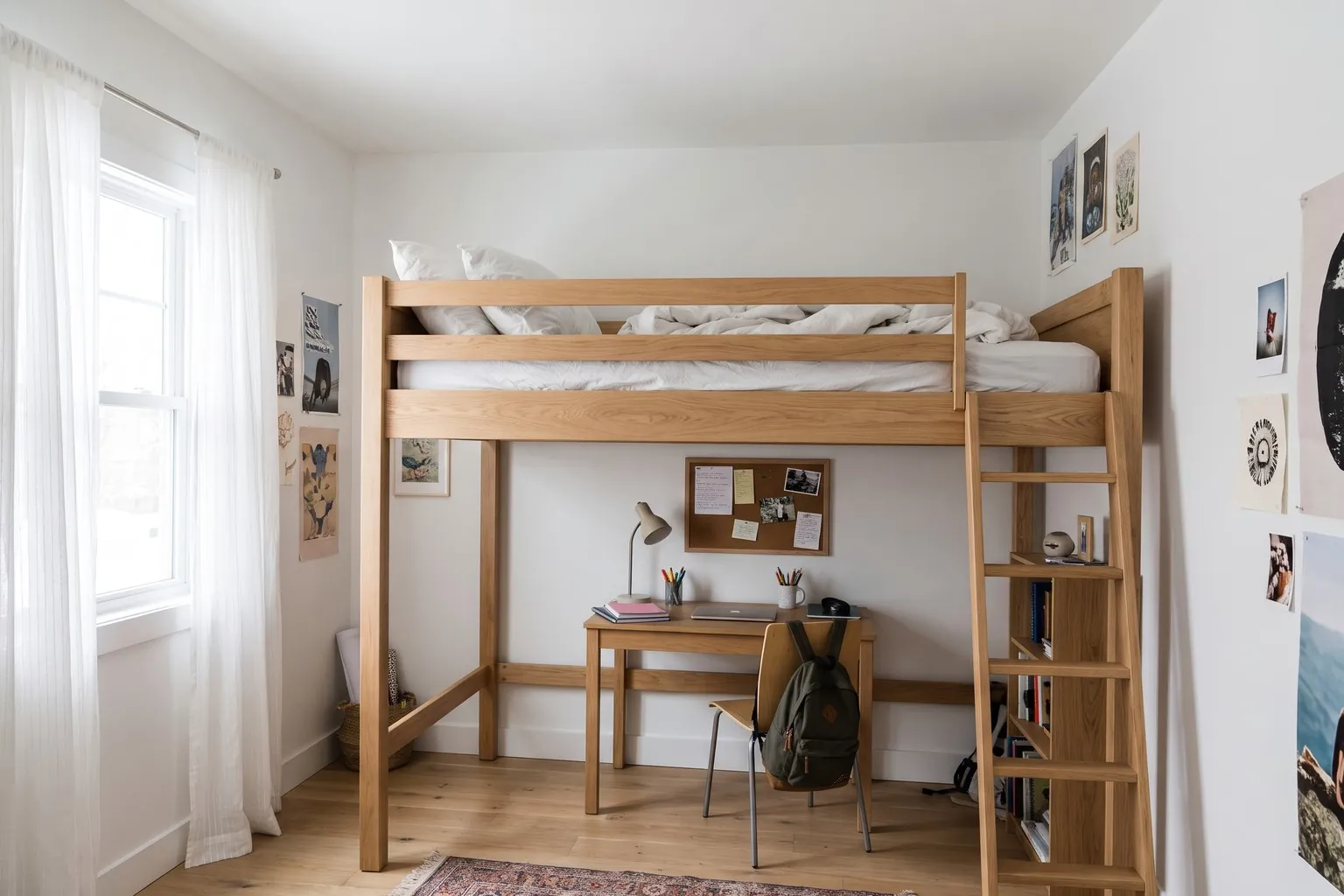
That wording is broader than two beds stacked. By it, a single raised bed with a desk under it is a bunk bed too, which is why the rules below also matter for a loft bed.
Two rules apply, according to the Consumer Product Safety Commission: 16 CFR part 1513 for children's bunk beds and part 1213 for adult ones, alongside the industry standard ASTM F1427.
The sizes: the mattress decides the footprint
Bunk beds are named by the mattresses they take, top first. Amerisleep notes that a standard bunk can hold two twins, two twin XLs, or a twin over a full or larger. Purple calls the twin the standard mattress size for bunk beds and adds that some lower bunks are built for a full.
| Bunk bed | Top mattress | Bottom mattress | Widest mattress |
|---|---|---|---|
| Twin over twin | 38 by 75 in | 38 by 75 in | 38 in |
| Twin XL over twin XL | 38 by 80 in | 38 by 80 in | 38 in |
| Twin over full | 38 by 75 in | 54 by 75 in | 54 in |
| Full over full | 54 by 75 in | 54 by 75 in | 54 in |
| Twin XL over queen | 38 by 80 in | 60 by 80 in | 60 in |
The mattress dimensions are Amerisleep's. It adds one limit: a king is only ever the bottom bunk.
The frame is larger than the mattress. For an ordinary bed, Purple gives 2 to 5 inches more in width and in length, and a bunk has posts and a ladder or a staircase besides. The outside dimensions are on the product page of each model, and they are the ones to mark on the floor.
How tall a bunk bed is
There is no standard height, only typical ones.
| Type | Overall height | Source |
|---|---|---|
| Low or shorty bunk | Around 55 in | Amerisleep |
| Low bunk | 61.5 in | Maxtrix, its own model |
| Medium bunk | 5 in more than its low bunk | Maxtrix |
| Standard bunk | Around 70 in | Amerisleep |
| Triple bunk | Can be over 90 in | Amerisleep |
Seventy inches is 5 feet 10. Under an 8 foot ceiling that leaves 26 inches above the top of the frame, which matches Maxtrix's own description: about 25 inches from the top of the guardrail to an 8 foot ceiling on its high bunks.
But the frame is not where the sleeper is. The number that matters is measured from the mattress.
The ceiling: 30 to 36 inches above the top mattress
Amerisleep gives the rule: there should be between 30 and 36 inches of clearance between the top of the mattress on the top bunk and the ceiling.
To find it for a given bed you need the height of the mattress, and Maxtrix publishes a method for its beds. Take the overall height of the bed and subtract 16 inches: that is where the mattress rests. Add the thickness of the mattress. Subtract the result from the height of the ceiling.
Maxtrix's own example is a bed 71 inches tall with a 5 inch mattress under an 8 foot ceiling, which gives 36 inches of headroom. Here is the same sum for other cases. The arithmetic is ours, by Maxtrix's method, and the 16 inches is Maxtrix's figure for its own frames: check it on any other brand.
| Bed height | Top mattress | Headroom under 8 ft | Headroom under 9 ft |
|---|---|---|---|
| 61.5 in | 6 in | 44.5 in | 56.5 in |
| 66.5 in | 6 in | 39.5 in | 51.5 in |
| 70 in | 6 in | 36 in | 48 in |
| 70 in | 8 in | 34 in | 46 in |
| 71 in | 5 in | 36 in | 48 in |
Two readings.
An 8 foot ceiling works for a standard bunk, with a thin mattress. Maxtrix says most of its beds are compatible with standard 8 foot ceilings. The table agrees: 36 inches with a 6 inch mattress, the top of Amerisleep's range. Every inch of mattress comes straight off the headroom.
Amerisleep's 100 inches is the cautious version of the same sum. It asks for ceilings 8 feet 4 inches high. With those 4 extra inches a standard bunk keeps more than 36 inches even with an 8 inch mattress.
Measure your ceiling where the bed will stand, not in the middle of the room. A sloped ceiling or a beam over the top bunk changes the answer.
Low ceilings and triple bunks
The same sum covers the two extremes. The arithmetic is ours, again by Maxtrix's method and with a 6 inch mattress.
- A low bunk of 55 inches, Amerisleep's figure for a shorty, puts the top of the upper mattress at 45 inches. Under a 7 foot ceiling that leaves 39 inches, which makes it the height for a low room.
- A triple bunk of 90 inches puts it at 80 inches. To keep 30 inches above that, the ceiling has to be 110 inches: 9 feet 2. Maxtrix does not publish a figure for its triple bunks and refers buyers to its design team.
The guardrail rule, and what it does to the mattress
This is the part of a bunk bed that federal rule fixes in inches. The requirements are in 16 CFR 1513.3, and the Consumer Product Safety Commission summarizes them.
- Two guardrails. The upper bunk needs at least two, with at least one on each side.
- One of them continuous. The rail next to a wall, or on the side opposite the ladder, must run from end to end. Any gap at its ends must not exceed 0.22 inches.
- The other may stop short, for the ladder, by no more than 15 inches from the nearest end of the bed.
- Five inches above the mattress. The tops of the guardrails must be no less than 5 inches above the top of the mattress. The regulation specifies that this is measured with a mattress of the maximum thickness the manufacturer allows.
- The ends too. The head and foot of the upper bunk must rise at least 5 inches above the mattress for at least half the distance between the corner posts.
The last words of the fourth rule are the ones to notice. The 5 inches are measured from the mattress, so they depend on which mattress you put there.
Take a frame whose top is 16 inches above the base the mattress rests on, the figure in Maxtrix's method, and suppose the rail reaches that top. The subtraction is ours.
| Top mattress | Rail above the mattress |
|---|---|
| 5 in | 11 in |
| 6 in | 10 in |
| 8 in | 8 in |
| 11 in | 5 in, the legal minimum |
| 12 in | 4 in: too thick |
The Commission requires the bed to be marked with the proper size and thickness of the mattress, and Amerisleep's advice is to follow the bed maker's limits. Totally Home Furniture lists the maximum for three of its models: 7, 8 and 11 inches.
So a thin top mattress is doing two jobs at once. It keeps the rail high, and it keeps the ceiling far.
Between the bunks
The sleeper below needs headroom too, and here the sources are thinner. Hunker's guide gives a minimum of 30 inches between the top of the lower mattress and the bottom of the platform above. Maxtrix notes only that its low bunks offer the least space between the two beds.
The lower mattress has more freedom. Amerisleep says there is no specific guideline for it and gives 8 to 10 inches as the usual thickness. Every inch you add there comes off the space between the bunks.
Who sleeps on top
On age the sources agree. Amerisleep says children under 6 should not sleep on the top bunk. Hunker gives the same threshold and attributes it to the Consumer Product Safety Commission: no child under 6 in a bed more than 30 inches above the floor.
Maxtrix matches the height of the bed to the child: its low bunk for around 6 years old, its medium for around 8 and its high for around 10.
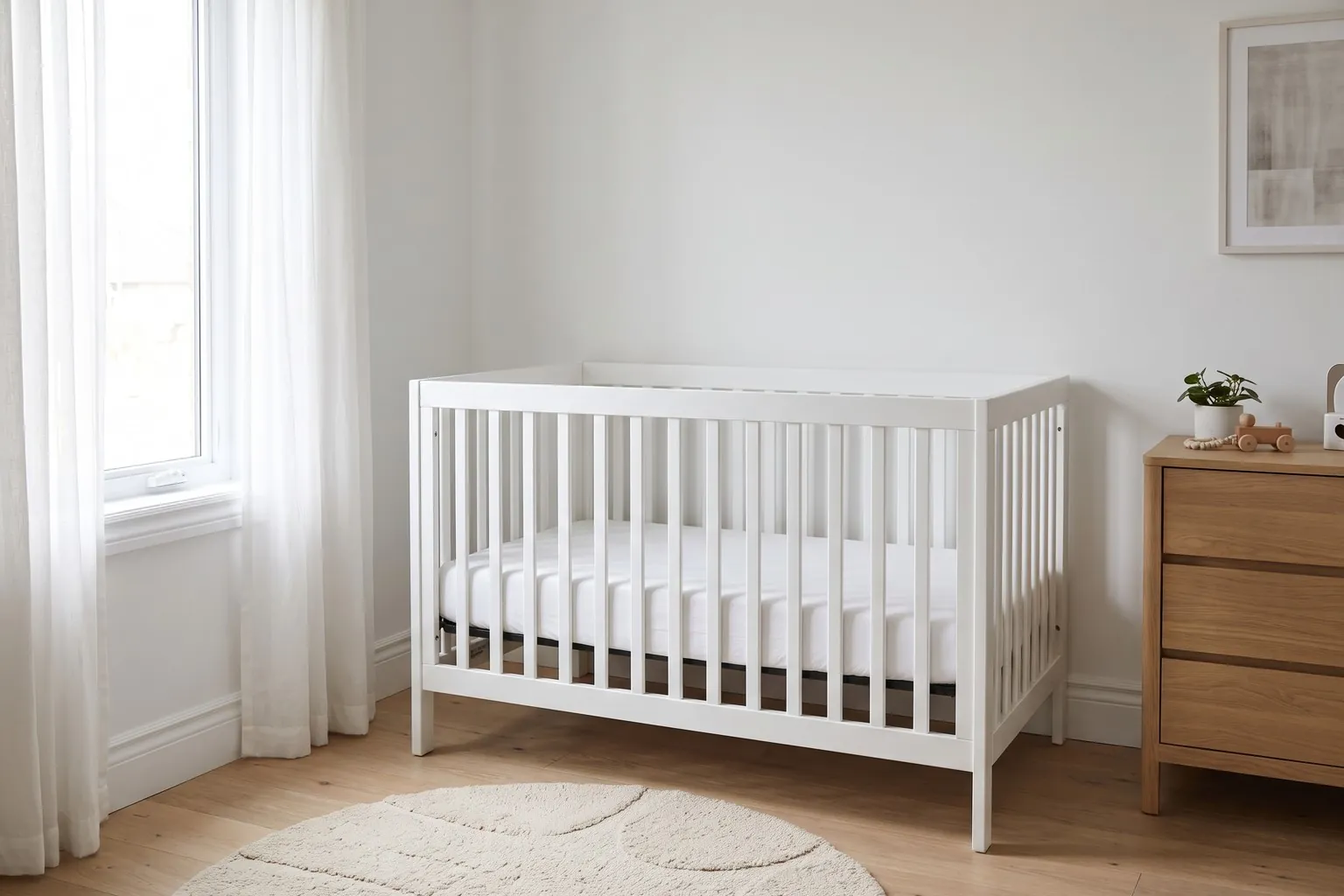
For a child not yet ready for either bunk, the bed before this one is measured in crib size.
The floor around it
A bunk bed takes the floor of one bed, plus what its ladder needs. Three clearances are worth checking.
- The ladder side. Mattress Miracle allows 2 feet of clearance on the ladder or stairs side. A staircase with drawers needs its own depth on top of the bed's.
- What is overhead. Totally Home Furniture relays Health Canada's advice to place the bed away from ceiling fans, windows and cords.
- The length. A twin XL or queen bunk is 80 inches long before the frame: 6 feet 8 inches.
In a small room the usual comparison is with two separate beds. Two twins side by side with a 24 inch gap between them are 100 inches wide, by our addition. A twin over twin bunk is 40 to 43, going by Purple's figure for a twin frame.
The mattresses and the bedding
Bunk mattresses are ordinary sizes, bought thinner. A twin top bunk takes a twin fitted sheet, 39 by 75 inches, and a twin XL takes its own. Because the top mattress is thin, a standard pocket is enough.
The sizes are in sheet sizes and comforter sizes, and the mattresses in twin bed dimensions and full vs twin.
The other way to fit two beds: a trundle
A trundle stores the second bed underneath instead of on top. Saatva defines it as a bed frame that houses a second mattress underneath a standard bed.
Size. Usually a twin. The Sleep Foundation says the trundle is typically twin, and trundle beds usually come in twin or full. Nectar gives an average of 38 by 75 inches and 4 inches tall; Puffy, a twin of about 39 by 75 and a full of about 54 by 75.
Two kinds. A roll-out or drawer trundle stays low, near the floor; Saatva calls it the most popular. A pop-up trundle rises to the height of the main bed (Saatva, Sleep Foundation, Nectar, EachNight), making two twins side by side, 76 inches wide by our sum. Nectar suggests a bridge pad for the gap, and wheel locks. The Sleep Foundation says pop-ups may not hold as much weight.
The mattress. Thin: less than 8 inches, 6 to 8 for the lower bed (Saatva); generally no more than 8 (Sleep Foundation); typically 6 to 8 where a standard twin can be 10 or more (Puffy). Puffy warns that exceeding the maximum can stop the trundle from working. No box spring is needed (Saatva, Puffy). Our guide to mattress thickness gives the low profiles.
Under the main bed. Puffy: at least 8 to 12 inches of clearance. Nectar: around 14 to 16. EachNight: at least 16. Measure from the floor to the frame before buying.
Weight and use. About 250 pounds for most (Saatva, Nectar, EachNight). The Sleep Foundation says trundles are not typically designed for everyday use; Nectar calls them a poor choice for older adults and people with back problems; Saatva says adults may be comfortable for a few nights.
Cost. The Sleep Foundation's range: $75 to $600, about $250 on average, with a trundle-only bed under $100.
The floor in front. None of the sources gives a figure. By our sums, a twin trundle rolled out takes about 39 inches of floor in front of the bed, plus a path beside it: about 5 to 6 feet in all.
Before you buy, in six checks
- You know the ceiling height at the exact spot, and what hangs from it.
- Bed height, less the drop to the mattress base, plus the mattress, leaves 30 to 36 inches under the ceiling.
- The top mattress is no thicker than the maximum marked on the bed.
- With that mattress in place, the rail stands at least 5 inches above it on both sides.
- The child who will sleep on top is at least 6.
- You have the outside dimensions of the frame, ladder included, and 2 feet clear on the ladder side.
Questions people ask
How thick can a trundle mattress be?
Usually no more than 8 inches, 6 to 8 being typical. Check the trundle's own limit: a thicker mattress can stop it sliding under the bed.
How tall is a bunk bed?
Amerisleep puts a standard bunk bed at around 70 inches tall, a low one at around 55 inches and a triple at more than 90. Maxtrix sells a low bunk at 61.5 inches.
How high does the ceiling need to be for a bunk bed?
High enough to leave 30 to 36 inches above the top mattress. Maxtrix says most of its beds work under a standard 8 foot ceiling, and Amerisleep recommends 8 feet 4 inches.
What are the dimensions of a twin over twin bunk bed?
Each bunk takes a twin mattress, 38 by 75 inches. The frame is a few inches larger each way, plus the ladder, and a standard one is about 70 inches tall.
How thick should a top bunk mattress be?
No thicker than the bed's label allows. Federal rule requires the guardrail to rise at least 5 inches above the top of the mattress, so a thicker mattress reduces that margin.
At what age can a child sleep in the top bunk?
From 6. Amerisleep says children under 6 should not sleep on the top bunk, and Hunker attributes the same limit to the Consumer Product Safety Commission.
Sources
- What is a trundle bed?. Saatva, read November 2026
- Best trundle beds. Sleep Foundation, read November 2026
- What is a trundle bed?. Nectar, read November 2026
- Trundle mattress guide. Puffy, read November 2026
- Trundle bed guide. EachNight, read November 2026
- Bunk beds business guidance. U.S. Consumer Product Safety Commission, read November 2026
- 16 CFR 1513.2: definitions. Code of Federal Regulations, Cornell Legal Information Institute, read November 2026
- 16 CFR 1513.3: requirements. Code of Federal Regulations, Cornell Legal Information Institute, read November 2026
- Bunk bed mattress size guide. Amerisleep, read November 2026
- Bed and child height. Maxtrix Kids, read November 2026
- Ceiling height. Maxtrix Kids help center, read November 2026
- Determining the height of a loft bed. Hunker, read November 2026
- Low, mid or high loft bed: how to pick the right height. Totally Home Furniture, read November 2026
- Loft beds in Canada: types, sizes and configurations. Mattress Miracle, read November 2026
- Twin vs. full: key differences. Purple, read November 2026
- Bed frame sizes: dimensions guide and sizing chart. Purple, read November 2026
Every figure in this guide comes from the sources above, or from arithmetic shown in the text. See our editorial policy.