Bookcase dimensions: height, depth, shelf spacing and how far a shelf can span
Bookcases run 30 to 84 inches tall, 24 to 48 wide and 10 to 12 deep. Shelf spacing by book type, how far a 3/4 inch shelf can span before it sags, and anchoring.

The short answer
- Standard bookcases are about 30 to 84 inches tall, 24 to 48 inches wide and 10 to 12 inches deep. A full-height unit for an 8 foot ceiling usually stands 72 to 80 inches.
- Depth follows the books: about 8 inches for paperbacks, 10 to 12 for most hardcovers, 12 to 16 for art books and records.
- Shelves are usually 8 to 12 inches apart, with about an inch of clearance above the tallest book.
- A shelf of 3/4 inch plywood carries a full load over about 32 inches without visible sag. Particleboard manages about 26. A cleat along the edge or a thicker board goes further.
- Anchor any tall bookcase to the wall. One seller's rule starts at about 30 inches tall.
In this guide
A bookcase is sized from the inside out. The books set the depth and the space between shelves. The shelf material sets how wide each bay can be before it bends. The height is whatever is left: the room, the reach, and the ceiling.
Closets have their own guide, closet dimensions. This guide gives the overall sizes by type, the shelf depth and spacing for each kind of book, the spans that shelf materials can carry, and the safety rule for tall units. Our sources are two home publications, a reference site, a furniture design reference, a woodworking magazine, a woodworkers' forum and three sellers, including the product page of one of IKEA's bookcases.
Overall sizes, by type
| Type | Height | Width | Depth | Source |
|---|---|---|---|---|
| Low | 24 to 36 in | 30 to 60 in | 9 to 12 in | FUFU&GAGA |
| Medium | 36 to 60 in | 24 to 48 in | 10 to 12 in | FUFU&GAGA |
| Tall | 60 to 84 in | 24 to 48 in | 10 to 16 in | FUFU&GAGA |
| Narrow | 60 to 80 in | 15 to 24 in | 10 to 12 in | FUFU&GAGA |
| Corner | 60 to 80 in | about 30 in per side | FUFU&GAGA |
Two other sources give the overall range. WoodBin, a reference on furniture design standards, says bookcases are generally no higher than 84 inches, that small ones are usually 30 to 42 inches high, and gives widths of 24 to 48 inches. Hernest, a seller, sorts heights into low at 24 to 30 inches, medium at 30 to 48, standard at 60 to 72 and tall at 72 to 84 and more.
Under an 8 foot ceiling, FUFU&GAGA says full-height bookcases usually stand 72 to 80 inches tall, and that a single unit is most often 30 to 36 inches wide.
For a known reference: IKEA lists its BILLY bookcase at 31 1/2 inches wide, 11 deep and 79 1/2 tall, with one fixed and four adjustable shelves and a maximum load of 66 pounds per shelf.
Depth: by the books
| Books | Shelf depth | Source |
|---|---|---|
| Paperbacks and novels | about 8 in | FUFU&GAGA |
| Paperbacks | 5 in deep, on shelves 8 in tall | This Old House |
| Paperbacks and novels | 6.5 in | Dimensions.com |
| Standard hardcovers | 8 in deep, on shelves 10 1/2 in tall | This Old House |
| Standard books, most hardcovers | 10 to 12 in | FUFU&GAGA, Dimensions.com, This Old House |
| Art and coffee-table books | 11 in deep, on shelves 15 in tall | This Old House |
| Large art books, binders, files | 12 to 16 in | FUFU&GAGA |
| Records and large formats | 14 in | Dimensions.com, WoodBin |
Read together: 10 to 12 inches is the general-purpose figure, given by This Old House, Dimensions.com and WoodBin alike. A shelf for paperbacks alone can be much shallower. Art books and records need 12 to 16.
Spacing: how far apart the shelves are
WoodBin's general rule: shelf spacing ranges from 7 to 15 inches, and 8 to 12 is common. FUFU&GAGA gives the same 8 to 12 for most books, with about an inch of clearance above each row.
By kind of book, FUFU&GAGA's table:
| Books | Book height | Shelf height |
|---|---|---|
| Mass-market paperbacks | about 7 in | 8 to 9 in |
| Trade paperbacks and novels | 8 to 9 in | 10 in |
| Standard hardcovers | 9 to 10 in | 11 to 12 in |
| Binders and files | 11 to 12 in | 12 to 13 in |
| Large art and coffee-table books | 12 to 15 in | 14 to 16 in, or lay them flat |
WoodBin's table adds other things that live on shelves: children's books at 8 inches, magazines at 12, photo albums at 13, record albums at 13 with 14 inches of depth, and large hardcovers at 15.
How many shelves. None of the sources fixes a number. By our sums, a 72 inch bookcase with 11 inch spacing and 3/4 inch shelves holds six rows of hardcovers, with a little to spare for the base. Adjustable shelves, like the BILLY's four, let the spacing follow the books.
How far a shelf can span
This is the dimension that decides the width of a bookcase, and it comes from the shelf, not from the books.
WoodBin publishes spans with no noticeable sag, for shelves 10 inches deep carrying 20 pounds per square foot:
| Shelf | Span without visible sag |
|---|---|
| 3/8 in glass | 18 in |
| 3/4 in particleboard | 26 in |
| 3/4 in plywood | 32 in |
| 3/4 in plywood with one 1 1/2 in cleat | 42 in |
| 3/4 in plywood with two cleats | 48 in |
| 3/4 in yellow pine | 36 in |
| 1 in yellow pine | 48 in |
| 3/4 in red oak | 44 in |
| 1 in red oak | 52 in |
Its summary: for most shelves made from 3/4 inch stock, a practical span is 30 to 36 inches.
This Old House gives the same story in weight, for a 3 foot shelf of 1 by 12: solid oak holds up to 313 pounds without sagging more than a quarter inch, hardwood plywood about 129 pounds without significant sag, and MDF only 87 pounds before sagging a quarter inch.
A woodworkers' forum on WOODWEB gives the practitioners' view, which is not a standard but agrees: one cabinetmaker's limit for 3/4 inch plywood shelves is 32 inches, and another laminates two layers of plywood with a 1 1/2 inch nosing for any shelf over 34 inches.
FUFU&GAGA draws the link to the width of a bookcase: it says 30 to 36 inches is the most common width because it keeps each shelf short enough to resist sagging, and it puts vertical dividers every 30 to 36 inches in wider units.
How much sag is too much
WoodBin gives the threshold: the eye notices a deflection of 1/32 inch per running foot, so a fully loaded 3 foot shelf, carrying 70 to 80 pounds, should sag no more than 3/32 inch. Fine Woodworking's Sagulator article sets its limit at 0.02 inch per foot, and says anything more means compromises.
The same article gives the rules that let you trade one dimension for another:
- Shorten the span by a fifth, and the shelf is about twice as stiff.
- Double the span, and it sags eight times as much.
- Double the thickness, and it sags an eighth as much.
- Double the depth, and the sag is halved.
Span is the strong lever: small changes in width matter far more than small changes in depth. That is our reading of the four rules side by side.
The weight of books
WoodBin: a fully loaded bookshelf carries 20 to 25 pounds per running foot. FUFU&GAGA: a full 30 inch row of hardcovers can weigh roughly 25 to 40 pounds, depending on the size and the paper. This Old House plans art book shelves for up to 30 pounds per foot.
Compare that with what a shelf is rated for. FUFU&GAGA says most wood shelves in its range are rated at 20 to 33 pounds, and glass shelves around 11. IKEA rates the BILLY's shelves at 66 pounds. By our sums, a 30 inch row of hardcovers at 25 to 40 pounds is within a 66 pound rating and can exceed a 33 pound one.
Making a shelf stronger
WoodBin lists the ways, and the other sources repeat them:
- Shorten it, or add a vertical support. This Old House adds dividers to keep longer shelves from sagging and splitting.
- Add a cleat: a strip 1 to 2 inches wide fixed to the front or back edge. WoodBin's table shows what one 1 1/2 inch cleat does to plywood: from 32 inches to 42.
- Fix the back: screw the back of the case to the back edges of the shelves.
- Go thicker, or change material: red oak spans further than plywood, which spans further than particleboard.
For the case itself, WoodBin's answer to racking is a 1/4 inch plywood back, rabbeted and tacked to the shelves.
Anchoring
A bookcase is tall and shallow. Every source that discusses tipping says to fix it to the wall.
| Source | Rule |
|---|---|
| FUFU&GAGA | anchor any bookcase taller than about 30 inches, citing the CPSC's Anchor It campaign; anchor slim units, which are more top-heavy |
| Hernest | wall anchoring for units above 60 inches especially |
| Dimensions.com | always secure to the wall with brackets, or straps and wall anchors |
| This Old House | anchor built-ins to wall studs and the floor |
| IKEA, on the BILLY | "Tipping hazard": the product must be securely anchored |
IKEA adds two practical points: the brackets come with the bookcase but the wall fixings are sold separately, and you need enough space between the top of the unit and the ceiling to fit them. By our reading, that is one more reason a full-height unit under an 8 foot ceiling stops at 72 to 80 inches.
Hanging shelves and stepback units
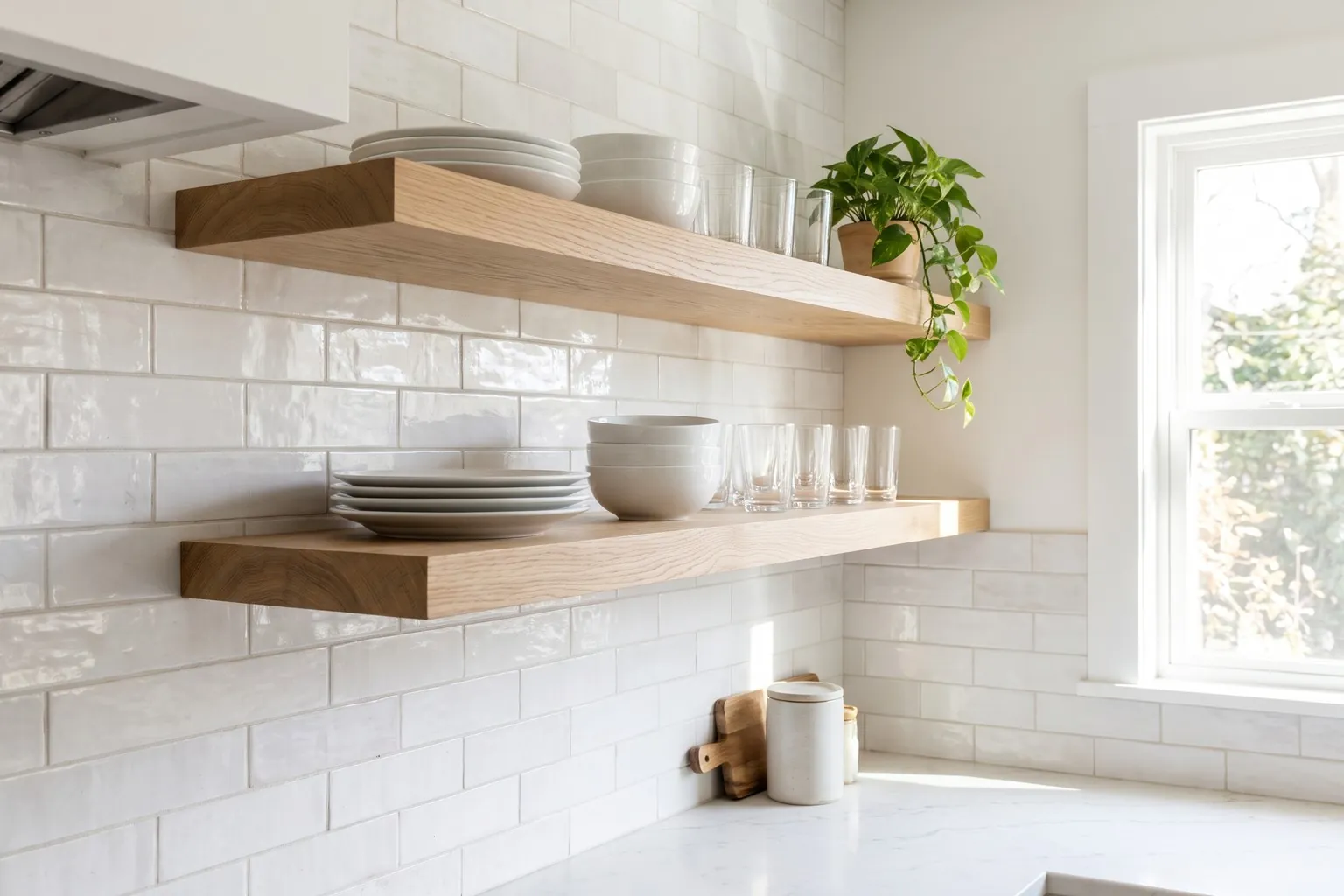
Shelves fixed to the wall with hidden brackets have their own guide: floating shelves.
WoodBin gives two related forms.
| Form | Dimension | Figure |
|---|---|---|
| Hanging shelves | height of the unit | 30 to 42 in |
| bottom above the floor | 36 to 54 in | |
| depth | 6 to 16 in | |
| width | 24 to 36 in | |
| Stepback cabinet | overall height | 72 to 84 in |
| base cabinet height | 30 to 36 in | |
| base cabinet depth | 15 to 25 in | |
| shelf depth above | 10 to 13 in | |
| width | 36 to 48 in |
In WoodBin's figures a stepback is a bookcase on a deeper base cabinet, 15 to 25 inches deep against 10 to 13 for the shelves above, which keep the usual book depth.
A wall of books, worked through
Take a wall 12 feet long, 144 inches, under an 8 foot ceiling. These are our sums from the figures above.
- Width: four units 36 inches wide, each shelf within the 30 to 36 inch span that 3/4 inch stock carries.
- Height: 72 to 80 inches each, leaving room above for the wall anchors.
- Rows: six rows of hardcovers at 11 inch spacing in a 72 inch unit.
- Shelf length: 24 shelves of 3 feet, 72 feet of books, carrying 1,440 to 1,800 pounds at 20 to 25 pounds a foot.
That last figure is the load the case, its anchors and the floor carry together: our reading.
Before you buy or build, in six checks
- Sort the books: paperbacks, hardcovers, art books, records. That sets the depth.
- Set the spacing: the tallest book of each row plus about an inch.
- Limit the span: about 32 inches for 3/4 inch plywood, 26 for particleboard, more with a cleat.
- Check the rating per shelf against 20 to 25 pounds per foot of books.
- Leave room at the top to fit the wall anchors.
- Anchor it, the day it is set up.
Questions people ask
What are standard bookcase dimensions?
About 30 to 84 inches tall, 24 to 48 inches wide and 10 to 12 inches deep. A full-height unit for an 8 foot ceiling usually stands 72 to 80 inches.
How deep should a bookshelf be?
10 to 12 inches for most books. About 8 inches is enough for paperbacks, and art books and records need 12 to 16.
How far apart should bookshelves be?
Usually 8 to 12 inches. Paperbacks take 8 to 10, standard hardcovers 11 to 12, and large art books 14 to 16.
How long can a bookshelf be without sagging?
About 32 inches for 3/4 inch plywood, 26 for particleboard and 44 for 3/4 inch red oak, under a full load. A cleat along the edge takes plywood to about 42.
How much weight does a bookshelf hold?
A full shelf carries 20 to 25 pounds per running foot. One popular bookcase is rated at 66 pounds per shelf.
Do bookcases need to be anchored to the wall?
Yes. Sellers and home guides advise anchoring tall bookcases, and one seller's rule starts at about 30 inches tall.
Sources
- Bookcase basics: a guide to built-in shelving. This Old House, read November 2026
- Bookcases. Dimensions.com, read November 2026
- Shelves. WoodBin, read November 2026
- Engineer shelves with the Sagulator. Fine Woodworking, read November 2026
- Span limits for plywood shelving. WOODWEB, read November 2026
- Bookcase dimensions guide. FUFU&GAGA, read November 2026
- Height of a bookcase. Hernest, read November 2026
- BILLY bookcase. IKEA, read November 2026
Every figure in this guide comes from the sources above, or from arithmetic shown in the text. See our editorial policy.