Floating shelves: how deep, how high, how far apart, and what they hold
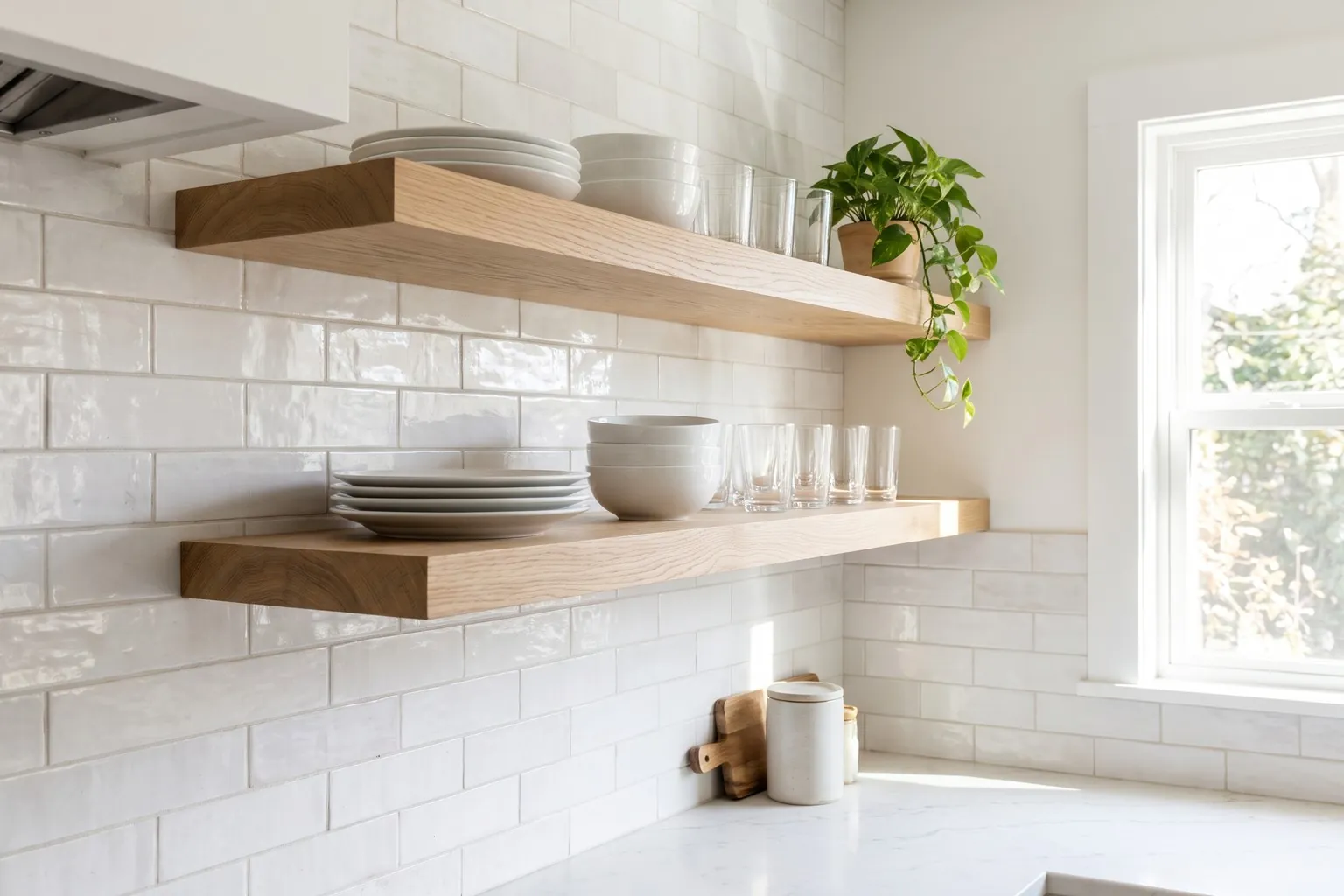
Floating shelves run 6 to 12 inches deep, hang 18 to 24 inches above a counter and 10 to 12 above a sofa, and hold about 45 to 50 pounds per stud.
The short answer
- Floating shelves are usually 6 to 12 inches deep: 6 to 8 for decor and bathrooms, 8 to 10 for books, 10 to 12 for kitchen dishes.
- Above a counter, sources put the first shelf 16 to 24 inches up. Above a sofa, about 10 to 12 inches over the back cushion.
- Space shelves about 10 to 18 inches apart, 12 if unsure, with 2 to 3 inches above the tallest item.
- A shelf maker rates its brackets at about 45 to 50 pounds for every stud they are fixed to. A 3 foot shelf on two studs holds about 100 pounds.
- Fix to studs or blocking. The makers and sellers warn against drywall anchors for anything but light decor.
In this guide
A floating shelf has no visible bracket, which is its appeal and its constraint. The support is hidden: steel rods in a bracket, in Shelfology's design, or a wooden cleat, in Family Handyman's, fixed to the wall. The whole load hangs on how that support is fixed.
This guide gives the depths by room, the heights above counters, sofas and beds, the spacing between shelves, and what a shelf can hold and why. For freestanding shelving, see our guide to bookcase dimensions.
Our sources are a floating shelf maker, Shelfology; a hardware retailer, Van Dyke's Restorers; a furniture seller, Ashdeco; and Family Handyman. The makers give the most figures, and we say so where it matters.
Depth: by the room
| Use or room | Van Dyke's | Shelfology | Ashdeco |
|---|---|---|---|
| Small decor, frames, candles | 6 to 8 in | 6 to 8 in, display wall | |
| Bathroom | 5 to 8 in | 6 to 8 in | 4 to 6 in above a sink |
| Books and display | 8 to 10 in | ||
| Living room | 8 to 10 in | 10 to 12 in | 8 to 10 in |
| Kitchen dishes and bowls | 10 to 12 in | 10 to 12 in | 8 to 10 in |
| Bedroom | 8 to 12 in | 6 to 8 in above a bed | |
| Office | 8 to 12 in | 6 to 8 in | 8 to 10 in above a desk |
| Entryway | 5 to 8 in | capped at 8 in |
Shelfology sums it up: depth runs a standard 6 to 12 inches. For books it adds that a shelf should not need to be deeper than 10 inches, since most books are less than 9 inches deep.
Ashdeco gives two reasons to stay shallow. In high-traffic areas such as hallways and entryways, it caps depth at 8 inches. Above a bed, it keeps to 6 to 8 inches so nothing falls on your face while you sleep.
Why deeper is not better
Shelfology puts it in capitals: deeper is not always better. Its reason is mechanical: deeper shelves hold less weight, because depth acts as a lever arm. Its advice: do not get a shelf deeper than you need. Van Dyke's says the same, that a deeper shelf places more leverage on the wall support.
So choose the depth from the deepest thing that will sit on the shelf, not from the look. That is our summary of the two makers' rule.
Height: what is below it
| Above | Height | Source |
|---|---|---|
| A kitchen counter | 18 to 24 in above the countertop | Van Dyke's |
| A counter | 16 to 24 in of clearance | Shelfology |
| A sofa | 10 to 12 in above the back cushion | Van Dyke's |
| A sofa back or console | about 10 in | Shelfology |
| A bed | about 16 in above the mattress or headboard area | Van Dyke's |
| A toilet | high enough to lift the tank lid, often 10 to 24 in above the tank | Van Dyke's |
| Nothing: a shelf on its own | 4 to 5 ft from the floor, eye level | Van Dyke's, Shelfology |
Over a desk, Van Dyke's gives no figure but a test: the bottom shelf must be high enough not to crowd your workspace.
Ashdeco adds a caution for living rooms: avoid heavy shelves directly above seating.
Spacing between shelves
| Source | Spacing |
|---|---|
| Van Dyke's | about 10 to 18 in apart; start with 12 if unsure |
| Shelfology | 10 to 15 in apart |
| Ashdeco | 12 to 16 in, top to bottom |
Van Dyke's gives the method behind the number: measure the tallest item and add 2 to 3 inches. Its figures by use:
| On the shelf | Spacing |
|---|---|
| Small decor | 8 to 12 in |
| Books, bowls, mugs, dishes | 12 to 15 in |
| Mixed decor | 10 to 16 in |
| Tall vases, plants, pitchers | 18 to 24 in |
| Kitchen shelves | 15 to 21 in |
| Living room, stacked | 12 to 16 in |
| Near a bathroom mirror or towel bar | at least 8 to 10 in |
Length, and the studs
Wall studs set the length. Shelfology and Van Dyke's both give the usual spacing: 16 inches apart, and 24 inches in some homes.
Shelfology's rules:
- A shelf should cross at least two studs, and ideally three on anything over 4 feet.
- A kitchen shelf about 3 feet long crosses two studs.
- For shelves longer than 36 inches, the bracket needs additional rods. Over 50 inches it recommends at least four rods, over 70 inches at least five.
Ashdeco lists typical lengths by room: 18 to 24 inches above a bathroom sink, 24 to 36 in a kitchen or entryway, 36 to 48 in a living room, 36 to 60 above a desk and 36 to 72 above a bed.
By our sums, a shelf 36 inches long on studs 16 inches apart always crosses two studs and, placed well, three. A shelf 24 inches long may cross only one. Find the studs before choosing the length.
What a shelf holds
Shelfology's figure is the one the others build on: about 45 to 50 pounds for every wall stud the bracket is attached to. Each rod in its brackets handles roughly 45 to 50 pounds. A 3 foot shelf on two studs can safely support about 100 pounds, and its 34 inch bracket with three rods upwards of 135. Across its range, shelves hold anywhere from 25 to well over 300 pounds.
Two other figures from the same maker are worth knowing. Generic prong brackets start giving out above about 30 pounds. And its planning loads per foot of shelf, which it labels estimates: books and media about 18 pounds, dishes and glassware about 12, decor and plants about 5.
Ashdeco's quick reference by fixing:
| Fixing | Capacity, per Ashdeco |
|---|---|
| Directly into a wood stud | 50 to 100 or more lb per shelf |
| Toggle bolts in drywall | 30 to 50 lb per anchor, use two or more |
| Plastic expansion anchors | 10 to 20 lb: avoid for floating shelves |
Family Handyman's own built shelf, 72 inches long on a wall cleat lag-screwed into the studs, holds about 50 pounds.
Put the figures together for a 3 foot shelf of books, by our sums: 3 feet at 18 pounds is 54 pounds of books, within the 100 pounds of two studs and above the 30 at which generic brackets give out.
Studs, blocking and anchors
The makers and sellers put the same rule first.
- Shelfology: always drill into studs; the weight rating is based on proper installation. Drywall alone will not hold real weight. Installing on blocking gives maximum capacity. Where the bracket is not fixed to something solid along its length, flex and sag can occur.
- Shelfology again: no anchor fully makes up for a missed stud. Where there is no stud, use heavy-duty toggle bolts rated for the load.
- Van Dyke's: drywall anchors alone may only be appropriate for very light decorative use.
- Ashdeco: if the instructions say one toggle bolt, use two.
Ashdeco covers the other walls: plaster needs a masonry bit and patience; brick and concrete need masonry anchors and a hammer drill.
The shelf itself
Thickness. Van Dyke's: about 1.5 to 2.5 inches gives a balanced look. Shelfology offers 1.5 to 2.5 inches and notes that a thicker shelf needs a taller bracket. Family Handyman's shelf is 2 1/2 inches thick and 11 deep.
Material. Shelfology recommends white oak, walnut and maple, and does not recommend MDF, which bows under sustained load. Ashdeco says bathrooms and kitchens will warp MDF within a year.
Weight of the shelf. A solid shelf is a load in itself. Shelfology gives an example: a white oak shelf 1.75 by 14 by 84 inches tops 60 pounds on its own.
Building one yourself
Family Handyman documents a simple build, rated for beginners and a full day's work, at a cost of $200 to $250. The shelf is 72 inches long, 11 deep and 2 1/2 inches thick, built from 1/2 inch plywood covered with wood veneer. It slides over a wooden cleat about 1 1/2 by 1 3/8 inches and 70 3/4 inches long, fixed to the studs with 4 inch lag screws, and is screwed to the cleat from above. Check the cleat for level after the first lag screw.
The magazine rates that shelf at about 50 pounds, half of what a maker's steel bracket on two studs carries. The comparison is ours, and it shows what the hidden hardware is worth.
Three walls, worked through
These are our sums from the figures above.
Kitchen. First shelf 18 to 24 inches above the counter. Van Dyke's spaces kitchen shelves 15 to 21 inches apart, so a second shelf sits 33 to 45 inches above the counter. Depth 10 to 12 inches for plates.
Living room, over a sofa. Our sofa sizes guide gives an overall sofa height of 30 to 36 inches. Add 10 to 12 inches above the back, and the first shelf sits 40 to 48 inches from the floor. A second one 12 to 16 inches higher sits at 52 to 64, around the 4 to 5 foot eye level the sources give for a shelf on its own. Depth 8 to 10, and nothing heavy above heads.
Bedroom, over a bed. About 16 inches above the mattress or headboard area, by Van Dyke's, and 6 to 8 inches deep, by Ashdeco.
Cats, and other live loads
Ashdeco has a rule for shelves that a cat will use: make sure each shelf is rated for at least twice the cat's weight. By our sum, a 12 pound cat needs a shelf rated for 24 pounds, which rules out plastic anchors at 10 to 20.
Checking it
Ashdeco's maintenance rule: every six months, give each shelf a firm tug. And on the consequences: a 40 pound shelf falling from 6 feet can cause real injury.
Before you buy, in six checks
- Choose the depth from the deepest item: 6 to 8, 8 to 10, or 10 to 12 inches.
- Find the studs and mark them: 16 inches apart in most walls.
- Choose the length to cross at least two studs, three over 4 feet.
- Set the height: 18 to 24 inches above a counter, 10 to 12 above a sofa.
- Space the shelves at the tallest item plus 2 to 3 inches, about 12 if unsure.
- Check the load: about 45 to 50 pounds per stud, never drywall alone for books or dishes.
Questions people ask
How deep should floating shelves be?
Usually 6 to 12 inches: 6 to 8 for decor and bathrooms, 8 to 10 for books and living rooms, 10 to 12 for kitchen dishes. Deeper shelves hold less, because depth acts as a lever.
How high should floating shelves be above a counter?
About 18 to 24 inches above the countertop, by one retailer's figure, or 16 to 24 inches by a shelf maker's.
How far apart should floating shelves be?
About 10 to 18 inches, or 12 if unsure. Measure the tallest item and add 2 to 3 inches.
How much weight can a floating shelf hold?
About 45 to 50 pounds for each stud it is fixed to, by one maker's rating. A 3 foot shelf on two studs holds about 100 pounds. Drywall anchors alone suit only light decor.
How high should a floating shelf be above a couch?
About 10 to 12 inches above the back cushion. One furniture seller advises against heavy shelves directly above seating.
Can you hang floating shelves without studs?
Only for light loads. Use heavy-duty toggle bolts rated for the load, two or more per shelf. A shelf maker says no anchor fully makes up for a missed stud.
Sources
- How much weight can a floating shelf hold?. Shelfology, read November 2026
- Floating shelf depth guide. Shelfology, read November 2026
- 9 tips for planning your floating shelf project. Shelfology, read November 2026
- How deep should floating shelves be?. Van Dyke's Restorers, read November 2026
- How far apart should floating shelves be?. Van Dyke's Restorers, read November 2026
- Floating shelves guide. Ashdeco, read November 2026
- How to build simple floating shelves. Family Handyman, read November 2026
Every figure in this guide comes from the sources above, or from arithmetic shown in the text. See our editorial policy.