What is a credenza? How it differs from a sideboard and a buffet
A credenza is a long, low storage cabinet, about 25 to 30 inches high. How it differs from a sideboard and a buffet in height, legs and use, with sizes.
The short answer
- A credenza is a long, low storage cabinet. Ali Guler, a furniture maker, gives 25 to 30 inches high, 18 to 24 deep and 60 to 80 wide.
- It is the lowest of three related pieces. The same maker puts a sideboard at 30 to 36 inches high and a buffet at 34 to 38, on taller legs.
- The word is Italian and related to credence. The credenza was where food was tasted for poison before it was served.
- Shops use the three names loosely. Castlery says there is no strict difference between a sideboard and a buffet in modern usage, so buy by the measurements.
- In a dining room, allow about 36 inches between the edge of the table and the cabinet, and 42 to 48 where people walk behind the chairs.
In this guide
Credenza is one of those furniture words that people meet on a product page and quietly look up. It sounds specific, and it sits beside two other words, sideboard and buffet, that seem to mean the same thing.
They nearly do. All three are long cabinets that stand against a wall and hold things behind doors. The differences are in the height, the legs and the room each was made for, and they are worth knowing because they decide whether the piece fits under your window, behind your sofa or beside your table.
The short definition
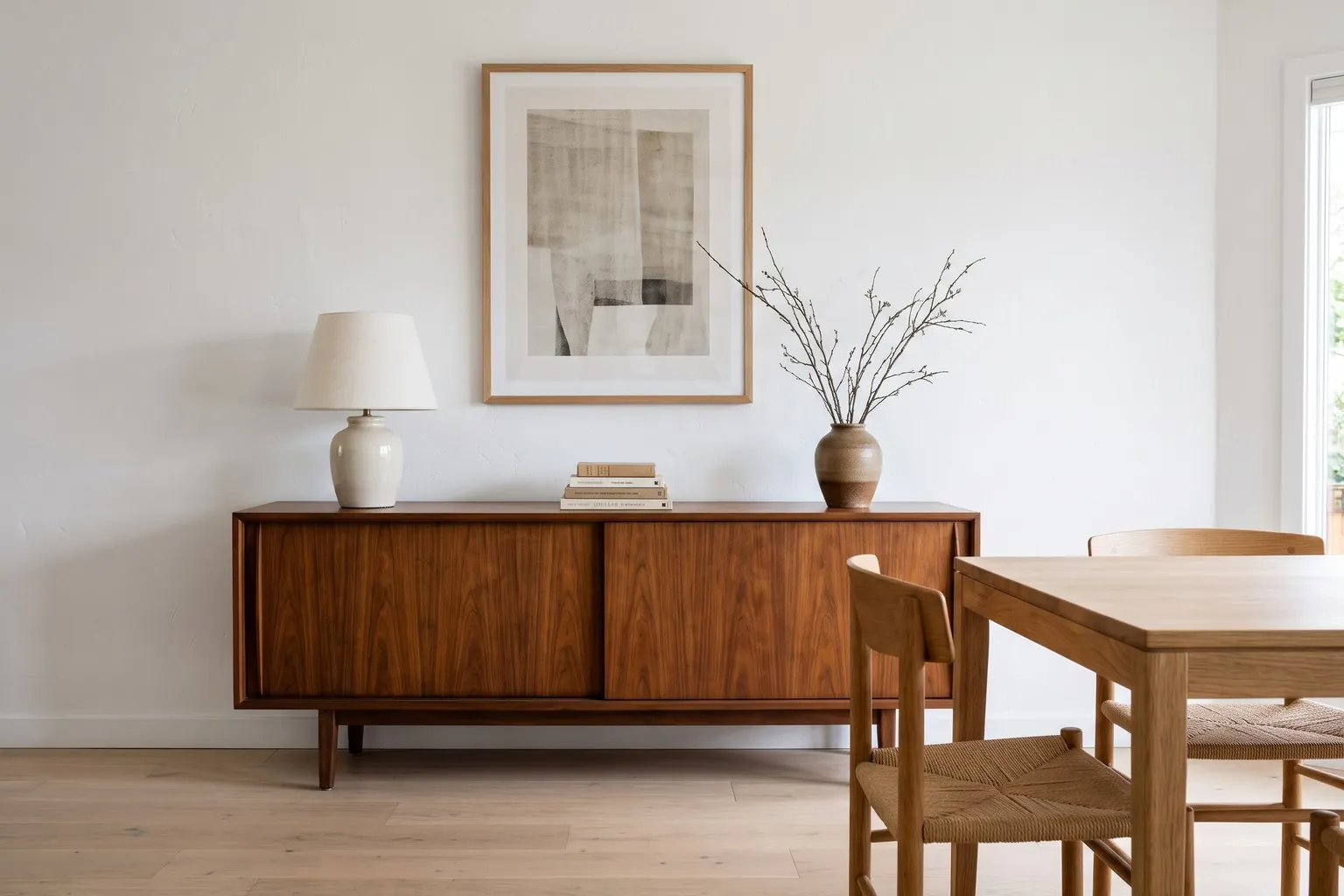
A credenza is a long, low cabinet.
Homes and Gardens asked several designers for theirs. Sandro Chiavaro, a woodworker and cabinet maker, calls it a short legged decorative storage piece for plates and other dinnerware. Designer Kathy Kuo says a credenza usually has a combination of shelves and drawers behind cabinet doors, and that it is usually wide, though not very tall or deep, so that it can sit against a wall.
The article sums up the difference from its neighbors in one line: credenzas are typically lower to the ground, with shorter legs, than the slightly taller sideboard or buffet.
Two furniture sellers add detail. Ali Guler describes a credenza as typically having sliding doors, or no legs at all. BEL Furniture describes the midcentury version most people picture: a long horizontal shape, clean fronts and tapered legs.
Where the word comes from
The name has a better story than most furniture.
Laurel Crown, a furniture maker, explains that credenza is an Italian word, related to the English word credence, and that the first form of the piece appeared in 14th century Italy. Its job was to hold dishes that were tested for poison before being served to a lord. The word moved from the act of testing to the place where the testing happened.
Chiavaro tells Homes and Gardens the same story: the word referred to where a servant would taste food to make sure it was safe before the nobles ate, and it is rooted in the middle ages and in the idea of believing and trusting. Ali Guler gives the Italian root as credere, to believe.
So a credenza was a table of trust before it was a cabinet. Laurel Crown notes that it can display food as well, but that display was not its original purpose.
Credenza, sideboard, buffet
Ali Guler's workshop publishes dimensions for all three, which makes the differences easy to see.
| Credenza | Sideboard | Buffet | |
|---|---|---|---|
| Height | 25 to 30 in | 30 to 36 in | 34 to 38 in |
| Depth | 18 to 24 in | 16 to 22 in | 16 to 20 in |
| Width | 60 to 80 in | 48 to 72 in | 48 to 66 in |
| Legs | None, or a very low base | Tall, thin legs | |
| Doors | Sliding doors are common | ||
| Usual place | Office, living room, media wall, behind a sofa | Dining room, living room, entryway | Dining room |
| Origin, per Ali Guler | Medieval Italian courts | 18th century England | French dining tradition |
The dimensions, the legs, the doors and the origins in this table are Ali Guler's. The buffet's usual place is Laurel Crown's.
Other sources draw the same lines with different words.
Height. Castlery says sideboards and buffets stand at waist height or slightly higher, and credenzas are usually lower. BEL Furniture says many dining buffets and sideboards are roughly 30 to 36 inches tall.
Legs. Laurel Crown reduces the difference between a sideboard and a buffet to one thing, the length of the legs. Short legs or none suggest a sideboard. Longer legs suggest a buffet. Chiavaro agrees from the other side: a buffet is taller and has longer legs, and is otherwise very similar to a sideboard. He describes a sideboard as a monolithic storage unit that runs from the floor to counter height.
Room. Laurel Crown says buffets are almost always used in the dining room, and Castlery traces the word sideboard to the side of a dining room. The credenza is the one that travels. Castlery lists dining rooms, offices and hallways for it, and Helen Pett of Arteriors tells Homes and Gardens that it fits in living rooms, hallways or even offices.
Inside. Homes and Gardens notes that drawers tend to be particular to a credenza, while Kuo describes sideboards and buffets as more of a cabinet of shelving for dishes and linens. Laurel Crown adds that credenzas are more likely to have glass in the doors, and that some have marble or stone tops.
Length. Castlery says credenzas are often larger and longer than sideboards or buffets, which matches Ali Guler's widths.
Why the names overlap
Having drawn the lines, every source then admits that shops ignore them.
Castlery says the difference between a buffet and a sideboard has no strict definition in modern usage. Kuo calls the three very similar. BEL Furniture warns that the idea of a buffet being taller than a credenza is not a rule you can rely on, and that modern sideboards do not follow the traditional definition consistently.
The two sources that give depths even disagree with each other. Castlery says sideboards are typically the shallower piece. Ali Guler's figures make the credenza the deepest and the buffet the shallowest.
The practical conclusion is simple. Use the three words to search, and then ignore them. What you are buying is a height, a depth and a width. A 32 inch high cabinet sold as a credenza will behave like a sideboard in your room.
And a hutch
A hutch is a different thing. BEL Furniture defines it by what it adds: upper shelves or cabinets on top of the lower cabinet, giving more storage without increasing the footprint. A credenza, a sideboard and a buffet all stop at the top surface. A hutch keeps going up the wall.
Where a credenza goes
Its low height is what makes a credenza useful in rooms where a taller cabinet would not fit.
- Dining room. The original use. The top is a serving surface and the inside holds dishes. BEL Furniture notes that serving height is often around counter height, which is the height of a sideboard or a buffet more than of a low credenza, so for serving, the taller piece is easier.
- Living room, under a television. Ali Guler says credenzas are popular in living rooms as media consoles. BEL Furniture's answer to whether one can hold a television is sometimes, but verify the width, the depth, the ventilation and the weight capacity.
- Home office. Ali Guler names printer stations. A credenza of 25 to 30 inches stands at or just below the height of a standard desk, so the two line up along a wall.
- Behind a sofa. One of the placements Ali Guler lists. Coleman Furniture gives the height of a sofa as 30 to 36 inches, so a credenza of 25 to 30 inches sits below the top of the back and does not show from the front.
- Hallway. Named by both Castlery and Pett.
Sizing one for a dining room
A cabinet on the dining room wall takes floor from the space behind the chairs, and that is where the mistakes are made.
BEL Furniture gives the clearances. Allow roughly 36 inches from the edge of the table to the cabinet for basic movement. Allow 42 to 48 inches where people walk behind seated diners or where the cabinet doors have to open.
That turns into a sum for the width of the room: the depth of the cabinet, the gap, the width of the table, and 36 inches on the far side, which is the clearance in our guide to dining table size. These are our sums, for a table 40 inches wide.
| Cabinet depth | Gap between table and cabinet | Room width needed |
|---|---|---|
| 18 in | 36 in | 130 in (10 ft 10 in) |
| 18 in | 42 in | 136 in (11 ft 4 in) |
| 18 in | 48 in | 142 in (11 ft 10 in) |
| 14 in | 36 in | 126 in (10 ft 6 in) |
BEL Furniture works a similar example: a room 12 feet wide, a 40 inch table and a sideboard 18 inches deep. By our sum that leaves 86 inches to share, or 43 inches on each side of the table, which is inside the comfortable range. Its advice if the path feels tight is a shallower cabinet, 14 inches deep.
The doors matter here too. BEL Furniture points out that sliding doors need less space to operate, at the cost of reaching only part of the cabinet at a time. In a narrow dining room, a credenza with sliding doors can stand where a buffet with hinged doors could not be opened.
Sizing one for a living room
Three measurements decide it.
Height. Against a dining table of 28 to 30 inches, a credenza is level with the table or lower, and a buffet is clearly higher. Under a window, measure to the sill and stay below it. Behind a sofa, stay below the top of the back.
Width. Ali Guler's 60 to 80 inches makes the credenza the longest of the three. Measure the wall between the door frames, the corners and the radiators.
Depth. At 18 to 24 inches by the same figures, a credenza is as deep as a small desk. In a hallway that is a lot. Compare it with the width of the passage, and keep 36 inches clear to walk past.
Doors, drawers and what goes inside
Emily Henderson's advice in Homes and Gardens is the place to start: check that the piece is large enough to hold what you plan to store in it. That means measuring the things, not guessing. The tallest serving dish and the widest platter decide the shelf height and the inside depth.
BEL Furniture sorts storage by type. Drawers suit flatware, napkins and linens. Doors with shelves behind them suit dishes and bowls. A piece with both, which is how Kuo describes a credenza, covers a dining room. In an office the same split works for paper and for equipment.
Kuo's own list of what to weigh is the size, the design style, and the quality of the craftsmanship.
Before you buy
- Decide the job: serving, storage, a television, a printer. That sets the height.
- Measure the wall, and the things that go inside.
- In a dining room, check the gap to the table: 36 inches at least, and 42 to 48 if people pass behind the chairs.
- Choose sliding doors where the space in front is tight.
- For a television, check the width, the depth, the ventilation and the weight the top will carry.
- Search all three words. The piece you want may be listed under any of them.
Under a television, the width and height follow the screen: see our guide to TV stand size. In the bedroom, the low piece of drawers is a dresser, and its names overlap the same way: see chest of drawers vs dresser.
Furniture names are easier in families. The words for seating are sorted in our guides to types of chairs and types of sofas.
Questions people ask
What is a credenza?
A long, low storage cabinet with doors, and often drawers, that stands against a wall. Ali Guler gives its size as 25 to 30 inches high, 18 to 24 deep and 60 to 80 wide.
What is the difference between a credenza and a sideboard?
Mostly height. Homes and Gardens says credenzas are typically lower to the ground, with shorter legs. Ali Guler puts a credenza at 25 to 30 inches and a sideboard at 30 to 36.
What is the difference between a sideboard and a buffet?
The legs. Laurel Crown says short legs or none suggest a sideboard and longer legs a buffet. Castlery adds that there is no strict difference in modern usage.
Where does the word credenza come from?
From Italian, related to the English word credence. Laurel Crown traces the piece to 14th century Italy, where it held dishes that were tasted for poison before being served.
Can you put a TV on a credenza?
Sometimes. BEL Furniture says to verify the width, the depth, the ventilation and the weight capacity first.
Sources
- What is a credenza? Designers explain. Homes and Gardens, read November 2026
- Sideboard vs buffet vs credenza: what's the difference?. Castlery, read November 2026
- Differences between buffets, sideboards and credenzas. Laurel Crown, read November 2026
- Sideboard vs buffet vs credenza: what's the difference?. Ali Guler Furniture Workshop, read November 2026
- Buffet vs. sideboard vs. credenza: what is the difference?. BEL Furniture, read November 2026
- Your easy guide to couch dimensions. Coleman Furniture, read November 2026
Every figure in this guide comes from the sources above, or from arithmetic shown in the text. See our editorial policy.