Full vs twin: 16 inches wider, the same length, and what that costs in floor
A full bed is 54 by 75 inches and a twin 38 by 75: 16 inches wider, no longer. Who each one suits, the room each needs, the price gap and the twin XL.
The short answer
- A twin mattress is 38 by 75 inches and a full is 54 by 75. The full is 16 inches wider and exactly as long.
- Both are 6 feet 3 inches long. Purple marks the twin as unsuitable over 6 feet and the full as possibly too short. For height, the size to look at is the twin XL, 80 inches long.
- A full gives one sleeper 42 percent more surface. Shared by two, it gives each 27 inches, 11 less than a twin alone.
- Published minimum rooms: 7 by 9.5 or 10 feet for a twin, and 9 by 9.5 up to 10 by 10 feet for a full.
- The price gap is small: $200 to $300 at Casper and Amerisleep on the models we compared, $500 at Purple.
In this guide
This is the comparison for a room with one sleeper in it. A twin is the smallest standard bed and a full is the next one up in width. They are the same length, so they take the same stretch of floor from head to foot. The whole difference is 16 inches across.
So the question is narrow, and it has a narrow answer: whether the sleeper wants those 16 inches more than the room does. Both beds are set among the others in our chart of bed sizes.
The two sizes, side by side
| Twin | Full | |
|---|---|---|
| Width | 38 in | 54 in |
| Length | 75 in | 75 in |
| In feet | 3 ft 2 in by 6 ft 3 in | 4 ft 6 in by 6 ft 3 in |
| Surface | 2,850 sq in | 4,050 sq in |
| Sleepers | 1 | 1, or 2 at 27 in each |
The dimensions and the surfaces are Purple's, and Saatva and Amerisleep give the same dimensions. Casper's guide lists the full at 53 inches wide. The Better Sleep Council and the other three give 54, and that is the figure we use.
Sixteen inches, and nothing else
Width is the only thing that changes, so it is worth being exact about what it buys.
For one sleeper, 16 inches is a great deal. The surface goes from 2,850 to 4,050 square inches, which by our division is 42 percent more bed. Saatva describes the full as the size for solo sleepers who want a little more room to move around, and Purple as wide enough to sprawl.
For two, it is not enough. Saatva and Casper both do the division: in a full, each person has about 27 inches. That is 11 inches less than one person has in a twin. Purple's verdict is that two people may fit and find it somewhat uncomfortable, and Casper's that it works if they do not mind sleeping in close quarters.
For height, it is nothing at all. Both mattresses are 75 inches long, 6 feet 3 inches. Purple marks the twin as not suitable for sleepers over 6 feet and says the full may not be long enough for them either. Casper puts the practical limit for a twin lower, at adults over 5 feet 10. A full does not fix a bed that is too short.
Here is the mattress left beyond the sleeper's height, by our subtraction, on the 75 inches of a twin or a full and on the 80 inches of a twin XL.
| Sleeper's height | Left over on 75 in | Left over on 80 in |
|---|---|---|
| 5 ft 6 in | 9 in | 14 in |
| 5 ft 10 in | 5 in | 10 in |
| 6 ft | 3 in | 8 in |
| 6 ft 2 in | 1 in | 6 in |
Choose by the sleeper
| Sleeper | Twin | Full |
|---|---|---|
| A child moving out of a crib | Yes: Purple, Casper and Amerisleep all name it | Yes, as a bed to grow into, in Casper's words |
| A teenager | Purple includes teenagers. Casper calls it too small for them | Yes, in all four sources |
| A single adult | In a very small bedroom, per Saatva | Yes: Casper calls it ideal for single sleepers |
| A couple | No | Not for most couples long term, per Purple |
| Anyone over 6 feet | No | No: see the twin XL below |
| Guests | A guest bed, per Amerisleep | A popular choice for guest rooms, per Casper |
The sources disagree about the teenager and the twin. Casper lists among the twin's drawbacks that kids may grow out of it in a few years. If the bed has to last from age 6 to 18, that is the case for the full.
Two uses belong to the twin alone. Purple calls it the standard mattress size for bunk beds, and Saatva names bunk beds and daybeds among its uses. The stacked version is measured in bunk bed dimensions.
Choose by the room
The published minimum rooms differ by source.
| Source | Twin | Full |
|---|---|---|
| Purple, twin vs full | 7 by 9.5 ft | 9 by 9.5 ft |
| Purple, bed frame sizes | 7 by 10 ft | 9.5 by 10.5 ft |
| Saatva | 7 by 10 ft | 10 by 10 ft |
| Casper | Works best in 10 by 10 ft or smaller | Fits best in 10 by 12 ft or larger |
Casper's figures are a preference and the others a minimum, which explains the gap. The subtraction shows what each minimum leaves. These are our sums: the room, less the mattress, with the head against a wall.
| Wall the head is on | Twin, centered | Twin, against the side wall | Full, centered |
|---|---|---|---|
| 7 ft | 23 in each side | 46 in beside it | 15 in each side |
| 8 ft | 29 in each side | 58 in beside it | 21 in each side |
| 9 ft | 35 in each side | 70 in beside it | 27 in each side |
| 10 ft | 41 in each side | 82 in beside it | 33 in each side |
At the foot, both leave the same: 39 inches in a room 9.5 feet deep and 45 in one 10 feet deep, since both are 75 inches long.
Three things come out of the table.
A full needs an 8 foot 6 inch wall to be walked around. That is 54 inches plus 24 on each side, the clearance the Sleep Foundation suggests: 102 inches. A twin needs 7 feet 2 inches for the same. That is in line with the published minimums, which put a full in a room 9 or 10 feet wide and a twin in one 7 feet wide.
Against a wall, the comparison changes. A single sleeper does not need both sides. Pushed against the side wall, a twin needs 5 feet 2 inches of width and a full 6 feet 6. A full fits a 7 foot room that way, with 30 inches beside it.
What you give up is floor, not wall. In a 9 foot room a twin against the wall leaves 70 inches of open floor beside it. A full against the same wall leaves 54. For a child's room, those 16 inches are the play space.
Two children, one room
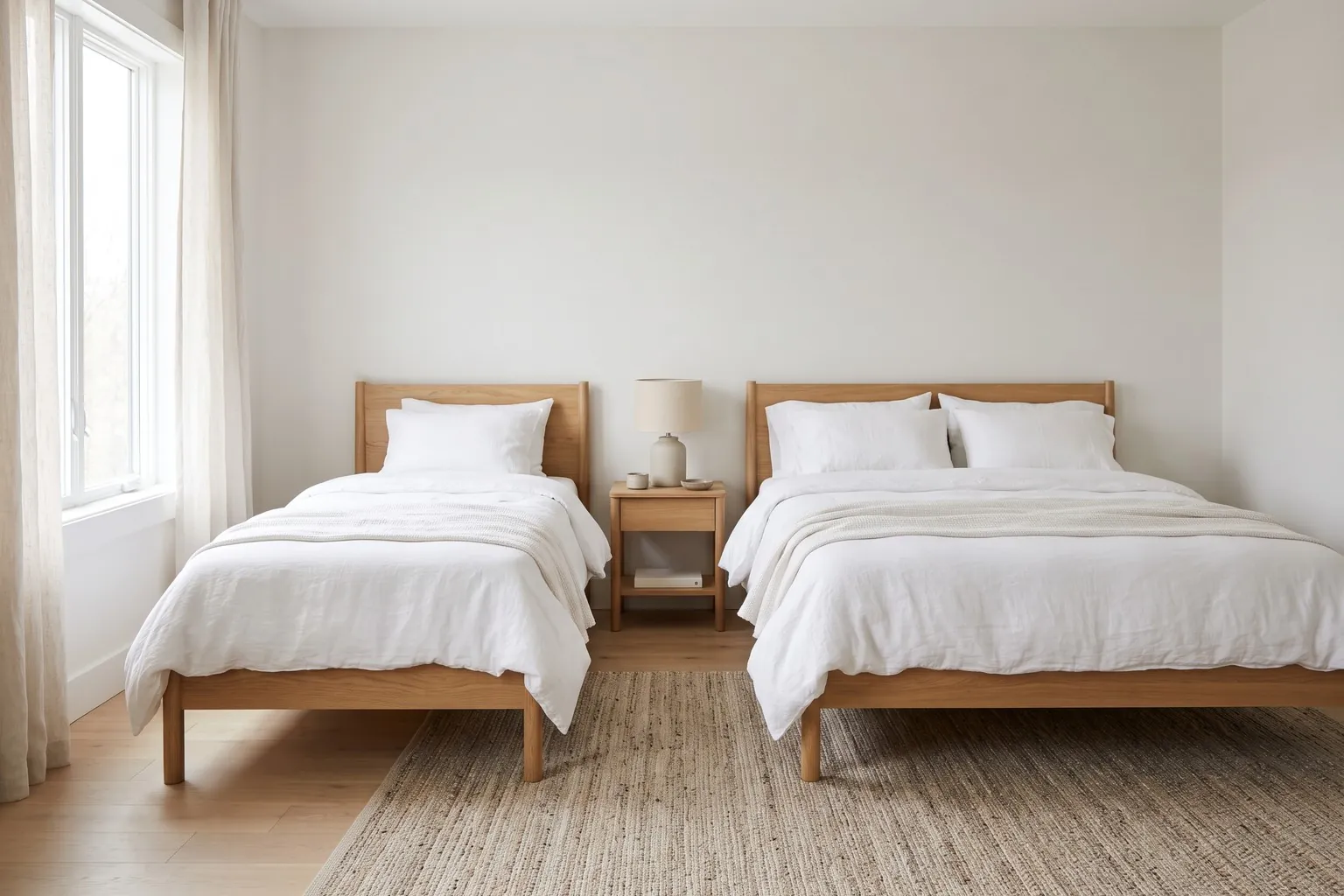
The usual question in a shared room is two twins or one full.
Purple says a full is roomy enough for two children, and puts the limit at about 10 years old. Saatva suggests two twins for siblings. The floor decides between them. Two twins against opposite walls with 24 inches between them need 100 inches of wall, by our addition: 8 feet 4. One full against a wall with 24 inches beside it needs 78 inches: 6 feet 6.
So one full saves 22 inches of wall and lasts until the older child is about 10. Two twins cost the wall and last until they leave home. A bunk bed takes the floor of one twin and solves it a third way.
The twin XL, the third option
A twin XL is 38 by 80 inches: the width of a twin and the length of a queen. Against a full, Purple puts it this way: 16 inches narrower and 5 inches longer.
That makes it the answer to a different question. The full is for a sleeper who wants width. The twin XL is for one who needs length. Casper recommends it for taller teenagers or adults who live in small spaces, and Purple, Casper and Amerisleep all note that it is the common size in college dormitories. The numbers are in twin bed dimensions.
There is a full XL as well, 54 by 80 inches. Purple warns that it is not as widely available and that its accessories may need a custom order.
The frames
The frame adds to both. Purple gives the outside dimensions.
| Mattress | Frame, per Purple | |
|---|---|---|
| Twin | 38 by 75 in | 40 to 43 by 77 to 80 in |
| Full | 54 by 75 in | 56 to 59 by 77 to 80 in |
Add the difference to the sums above before deciding. A frame at the top of the range takes another 2.5 inches from each side and 5 from the foot. The full list is in bed frame sizes.
One practical difference appears on moving day. Saatva lists the twin as easy to move, and Casper lists the full as not as easy.
The price gap
Three makers publish prices for both sizes of the same mattress.
| Maker and model | Twin | Full | Difference |
|---|---|---|---|
| Casper, The One | $749 | $949 | $200 |
| Casper, Dream Hybrid | $1,495 | $1,795 | $300 |
| Amerisleep, AS2 | $1,299 | $1,499 | $200 |
| Amerisleep, AS3 | $1,499 | $1,699 | $200 |
| Purple, its starting prices | $699 | $1,199 | $500 |
The differences are our subtraction, and the prices are those printed on each maker's page when we read it in November 2026. Casper's own summary is that the price difference is relatively small.
The mattress is not the whole bill. Casper notes that twin sheets are typically cheaper than full size sets and that full bed frames and bases cost more than twin ones. Purple says the same of sheets, comforter sets and mattress pads.
The bedding
The two beds share nothing that is fitted. A twin fitted sheet is 39 by 75 inches and a full is 54 by 75. The comforters differ by about 10 inches of width: 66 by 86 inches for a twin and 76 by 86 for a full, in Purple's chart. Pillows are the one thing in common: a full takes two standard pillows and a twin takes one.
The charts are in sheet sizes and bedding sizes.
The short answer
Choose the twin if:
- the room is under 9 feet wide and the bed cannot go against a side wall;
- the sleeper is a child, and the floor matters more than the mattress;
- two beds have to share the room, or the bed is a bunk or a daybed;
- you move often.
Choose the full if:
- the sleeper is a teenager or an adult, sleeping alone;
- the room is 9 or 10 feet wide, or the bed can stand against a wall in a narrower one;
- the bed has to last through adolescence;
- it is a guest room.
Choose neither, and take a twin XL, if the sleeper is over 6 feet tall.
If the choice is between a full and the next size up, it is worked through in full vs queen. The full on its own is in full size bed dimensions.
Questions people ask
What is the difference between a full and a twin bed?
Width. A twin is 38 by 75 inches and a full is 54 by 75 inches: 16 inches wider and the same length. The full has about 42 percent more surface.
Is a full bed big enough for two people?
Only just. Saatva and Casper both note that each person gets about 27 inches. Purple says two people may fit and find it somewhat uncomfortable.
Is a full longer than a twin?
No. Both are 75 inches long, which is 6 feet 3 inches. For more length the size is a twin XL or a full XL, both 80 inches long.
What size room do you need for a full bed?
Purple gives 9 by 9.5 feet as a minimum and Saatva 10 by 10. By our sums a full needs an 8 foot 6 inch wall to leave 24 inches on each side.
Is a full much more expensive than a twin?
Usually $200 to $500 more for the same mattress, on the models we compared at Casper, Amerisleep and Purple. Sheets and frames also cost a little more.
Sources
- Twin vs. full: key differences and mattress size comparison. Purple, read November 2026
- Twin vs. full: what's the difference?. Saatva, read November 2026
- Twin vs. full: mattress size and comparison guide. Casper, read November 2026
- Twin vs. full: what's the difference?. Amerisleep, read November 2026
- Bed frame sizes: dimensions guide and sizing chart. Purple, read November 2026
- Mattress sizes. Better Sleep Council, read November 2026
- Mattress sizes and bed dimensions guide. Casper, read November 2026
- California king vs. king. Sleep Foundation, read November 2026
- Comforter sizes and chart. Purple, read November 2026
- Bed sheet sizes and dimensions guide. Purple, read November 2026
- Pillow sizes. Sleep Foundation, read November 2026
Every figure in this guide comes from the sources above, or from arithmetic shown in the text. See our editorial policy.