Chest of drawers vs dresser: the difference, the sizes and the tip-over rule
A dresser is wide and low, 30 to 36 inches high with two or three columns of drawers. A chest is tall and narrow, 40 to 60 inches. Sizes and the tip-over rule.
The short answer
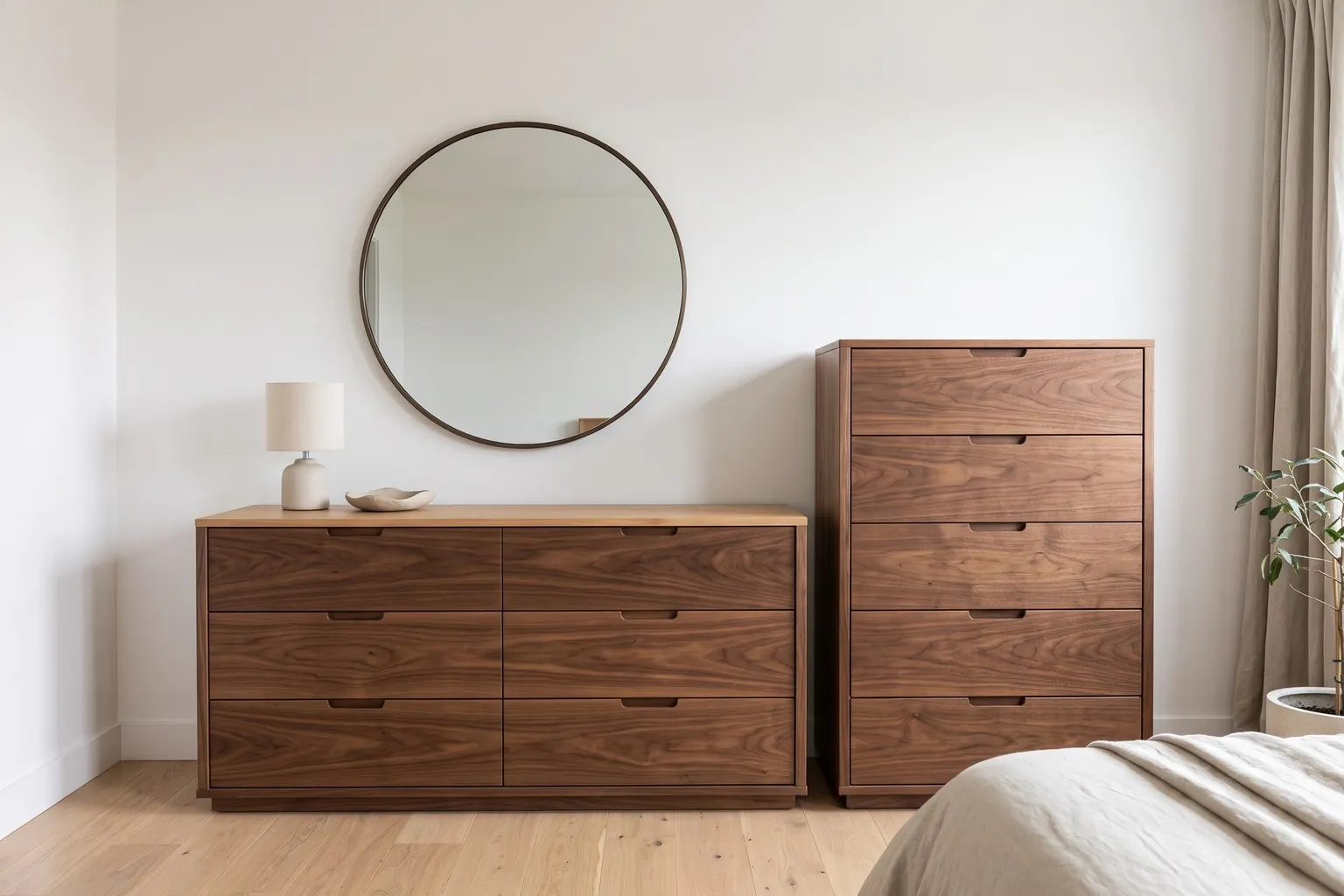
- A dresser is wide and low: about 30 to 36 inches high and 48 to 72 wide, with two or three columns of drawers and a top that takes a mirror.
- A chest of drawers is tall and narrow: about 40 to 60 inches high and 30 to 40 wide, with one column of drawers.
- Both are 15 to 24 inches deep. Plan 30 to 36 inches of open floor in front to pull out the drawers.
- The names overlap. One reference site treats dresser, chest and bureau as interchangeable.
- Since September 1, 2023, a federal rule sets stability tests for both, and an anti-tip device must come in the box. Anchor it to the wall.
In this guide
A dresser and a chest of drawers hold the same things in the same way: drawers, in a wooden case, in a bedroom. What separates them is shape. One spreads its drawers across a wall, the other stacks them up.
This guide gives the definitions as the trade uses them, the dimensions of each, the related pieces, how to choose between them by the room, and the federal safety rule that has applied to both since 2023. For the long low cabinet of the dining room, see our guide to what a credenza is.
Our sources are a reference site of dimensioned drawings, three furniture sellers, and the U.S. Consumer Product Safety Commission. The sellers give the definitions and most of the sizes. The commission gives the rule.
The difference, in the sources' words
| Source | Dresser | Chest of drawers |
|---|---|---|
| Hernest, a seller | wide and low, with a broad top that works well with a mirror; two or more columns of drawers | taller and narrower, stacking storage vertically to use less floor space |
| Upstate Amish Furniture Gallery | multiple columns of drawers, for horizontal storage | wide drawers stacked on top of each other, for vertical storage |
| Tip Top Furniture | a wide, low-profile storage piece | a tall, narrow, vertical unit |
| Dimensions.com, a reference site | traditionally includes an attached top mirror | only drawers |
Dimensions.com adds the caution that keeps this from being a rule: dressers are also known interchangeably as chests or bureaus. In a listing, read the dimensions, not the name.
The sizes
| Source | Dresser | Chest of drawers |
|---|---|---|
| Hernest, height | 30 to 36 in | 40 to 60 in |
| Hernest, width | 48 to 72 in | 30 to 40 in |
| Hernest, depth | 18 to 22 in | 15 to 20 in |
| Tip Top, height | 30 to 40 in, waist-high | 40 to 60 in, chest-high |
| Upstate Amish, height | not given | about 50 to 60 in, its own chests |
| Dimensions.com, all dressers | 30 to 50 in high, 30 to 74 wide, 18 to 24 deep |
Hernest calls its figures planning ranges rather than fixed standards. Dimensions.com's wide ranges cover both shapes under one name, which is consistent with its point that the names are used interchangeably.
Read together: a dresser stands about waist high and is wider than it is tall. A chest stands about chest high and is taller than it is wide. Both are roughly the same depth.
Drawers
Tip Top Furniture counts them. A dresser has 6 to 9 wider, shallower drawers, often in two or three columns. A chest has 4 to 6 deeper, narrower drawers, stacked in a single column.
Hernest gives the layouts the same way: a dresser usually has 2 to 3 columns, a chest usually 1 vertical column.
Upstate Amish's own pieces show the range in practice: an 8-drawer tall dresser with two columns of four drawers, 60 inches wide; a dresser with two columns of two or three drawers and three smaller drawers across the top; and low dressers of six and seven drawers.
The rest of the family
The sellers name several pieces between and beyond the two.
| Piece | What it is | Source |
|---|---|---|
| Double dresser | generally wider, often with two groups of drawers | Hernest |
| Tallboy | a particularly tall chest | Hernest |
| Lingerie chest | narrower, with smaller drawers for underwear, socks and accessories | Hernest |
| Lingerie dresser | looks like a narrow chest of drawers but is the same height | Upstate Amish |
| Gentleman's chest | drawers combined with a cabinet or a hanging section | Hernest |
| Bachelor's chest | a smaller, narrower drawer piece | Hernest |
| Bureau | originally a chest of drawers, sometimes with a slanted top used as a writing surface | Tip Top |
Tip Top dates the chest of drawers to 17th-century Europe, as a tall, compact unit for storing linens.
Which one, by the room
The wall. Hernest puts a dresser on a long empty wall, and a chest on a narrow wall, in a corner or in a closet alcove. Tip Top says the same, and adds a pair of chests flanking a window.
The mirror. The dresser is the one for a mirror above the storage. Upstate Amish gives the reason: the low height of a dresser is ideal for supporting a large mirror. Hernest says you can hang a mirror over a chest, but the proportions are less convenient.
The top. The broad top of a dresser is a surface. Upstate Amish lists makeup and jewelry boxes on it. It also notes that a dresser can work in a living room.
The reach. Hernest: a dresser's drawers are generally easier to reach because they sit lower, while a chest puts more of its storage at waist height or above. Tip Top says the top drawers of a chest often stand over 44 inches high.
The floor. Hernest: a chest stacks storage vertically to use less floor space. Here are two pieces from the middle of the ranges, by our sums:
| Piece | Width by depth | Floor |
|---|---|---|
| Dresser | 60 by 20 in | about 8.3 sq ft |
| Chest of drawers | 36 by 18 in | 4.5 sq ft |
The chest stands on about half the floor and holds its drawers in height instead.
Choosing, by situation
Put together, the sellers' advice sorts the choice by room.
| Situation | Piece | Source |
|---|---|---|
| A long, empty wall | Dresser | Hernest, Tip Top |
| A mirror over the storage | Dresser | Upstate Amish, Hernest |
| A narrow wall, a corner, an alcove | Chest | Hernest, Tip Top |
| Both sides of a window | A pair of chests | Tip Top |
| A small room | Chest | Tip Top |
Tip Top puts a number on the small room: in rooms smaller than 12 by 12 feet, it says, a chest saves around 4 square feet. Our two examples above differ by about 3.8 square feet, which agrees.
Many bedrooms take both. Upstate Amish notes that many of its sets also include lingerie dressers or armoires, and that each of its dressers has a mirror in the matching style. With two pieces, the dresser takes the long wall and the mirror, and the narrow piece goes where the wall is short: our reading of the placements above.
The space in front
A piece of drawers needs room for the drawer, and for you in front of the open drawer.
| Source | Open space in front |
|---|---|
| Hernest | around 36 inches, a useful planning target for movement and drawer access |
| Tip Top | at least 30 inches |
Tip Top's method for checking it is a good one. Outline the piece on the floor with painter's tape, then pull the tape out to simulate opening the drawers.
So a dresser 20 inches deep, with 30 to 36 inches in front, takes 50 to 56 inches of the room's depth from the wall: our sums.
Hernest's other measuring advice is about the way in: measure doorways, hallways and stairwells before ordering.
The tip-over rule
A chest or a dresser is a box with drawers that slide out, and the federal stability rule tests what happens when the drawers are open and weight goes on them.
The U.S. Consumer Product Safety Commission's rule comes from the STURDY law, enacted in 2022. It is codified at 16 CFR part 1261 and applies to clothing storage units manufactured after September 1, 2023.
What it covers. A clothing storage unit is a free-standing piece of furniture with drawers or hinged doors, meant for storing clothing, typical of bedroom furniture, that meets all of these thresholds:
- a height of at least 27 inches;
- a mass of at least 30 pounds;
- an enclosed storage volume of at least 3.2 cubic feet.
The commission's examples include chests, chests of drawers, drawer chests, armoires, chifferobes, bureaus, door chests and dressers. Excluded are bookcases and entertainment furniture, office and dining room furniture, and jewelry armoires.
What it tests. Among the requirements the commission lists:
- a clothing load of 8.5 pounds per cubic foot of storage volume;
- a horizontal force of 10 pounds applied at the highest hand-hold, no higher than 56 inches, for 10 seconds;
- on carpet, a 60 pound test weight hung on the front of an open drawer or door for 30 seconds;
- interlocks, where fitted, tested at 30 pounds of force for 5 seconds, and not allowed to depend on an extra step by the owner.
What comes in the box. An anti-tip device meeting the ASTM F3096 standard must be packaged with the product, and the unit must carry warning labels.
The 60 pound weight on an open drawer is the test that stands for a child climbing it: that is our reading of why it hangs on the front of the drawer.
Anchoring
The rule puts the device in the box. Installing it is up to you.
Hernest says tall furniture should be anchored, especially in homes with children or pets, points to the commission's Anchor It campaign, and says to install the anti-tip hardware as soon as the furniture is placed. Tip Top recommends anchoring any large furniture to the wall.
A piece made before September 2023, or bought secondhand, may predate the rule. Anchoring is the part of the protection you can add to any piece: our reading.
Buying one that lasts
The sellers' buying advice, each in its own words:
- Joinery. Hernest: dovetail joints are commonly associated with better-built case furniture.
- Slides. Hernest: soft-close slides reduce slamming and make drawers quieter.
- Wood. Hernest recommends kiln-dried wood, and says veneer against solid wood should not be treated as a simple good versus bad choice. Upstate Amish builds in solid maple, oak, walnut, hickory and cherry. Tip Top argues for solid wood over particleboard or MDF, which it says can sag.
Before you buy, in six checks
- Measure the wall: long and empty for a dresser, narrow or a corner for a chest.
- Measure the depth plus 30 to 36 inches in front, with painter's tape on the floor.
- Check the height of the top drawer against who will use it.
- Read the dimensions, not the name: dresser, chest and bureau are used interchangeably.
- Check the date of manufacture and the anti-tip device in the box.
- Anchor it to the wall the day it arrives.
Questions people ask
What is the difference between a dresser and a chest of drawers?
Shape. A dresser is wide and low, about 30 to 36 inches high with two or three columns of drawers. A chest of drawers is tall and narrow, about 40 to 60 inches high with one column.
What are standard dresser dimensions?
About 30 to 36 inches high, 48 to 72 inches wide and 18 to 22 inches deep, according to one seller. A reference site gives a wider spread: 30 to 50 high, 30 to 74 wide, 18 to 24 deep.
How tall is a chest of drawers?
Usually 40 to 60 inches. Its top drawers often stand more than 44 inches off the floor.
How much space do you need in front of a dresser?
Sources give 30 to 36 inches of open floor, enough to pull out the drawers and stand in front of them.
Do dressers have to be anchored?
Dressers and chests manufactured after September 1, 2023 must pass federal stability tests and come with an anti-tip device. Installing it is up to you, and sellers advise anchoring tall furniture.
Is a chest or a dresser better for a small bedroom?
A chest, by the sellers' advice: it stacks storage vertically and stands on about half the floor. One seller says it saves around 4 square feet in rooms smaller than 12 by 12 feet.
Is a bureau the same as a dresser?
The names overlap. One reference site uses dresser, chest and bureau interchangeably. Historically a bureau was a chest of drawers, sometimes with a slanted writing top.
Sources
- Clothing storage units: business guidance. U.S. Consumer Product Safety Commission, read November 2026
- Dressers and chests. Dimensions.com, read November 2026
- Chest vs dresser: how to choose the right bedroom storage. Hernest, read November 2026
- Chest vs dresser: comparing bedroom storage cabinets. Upstate Amish Furniture Gallery, read November 2026
- Dresser vs chest of drawers. Tip Top Furniture, read November 2026
Every figure in this guide comes from the sources above, or from arithmetic shown in the text. See our editorial policy.