TV stand size: how wide, how tall, and how far from the sofa
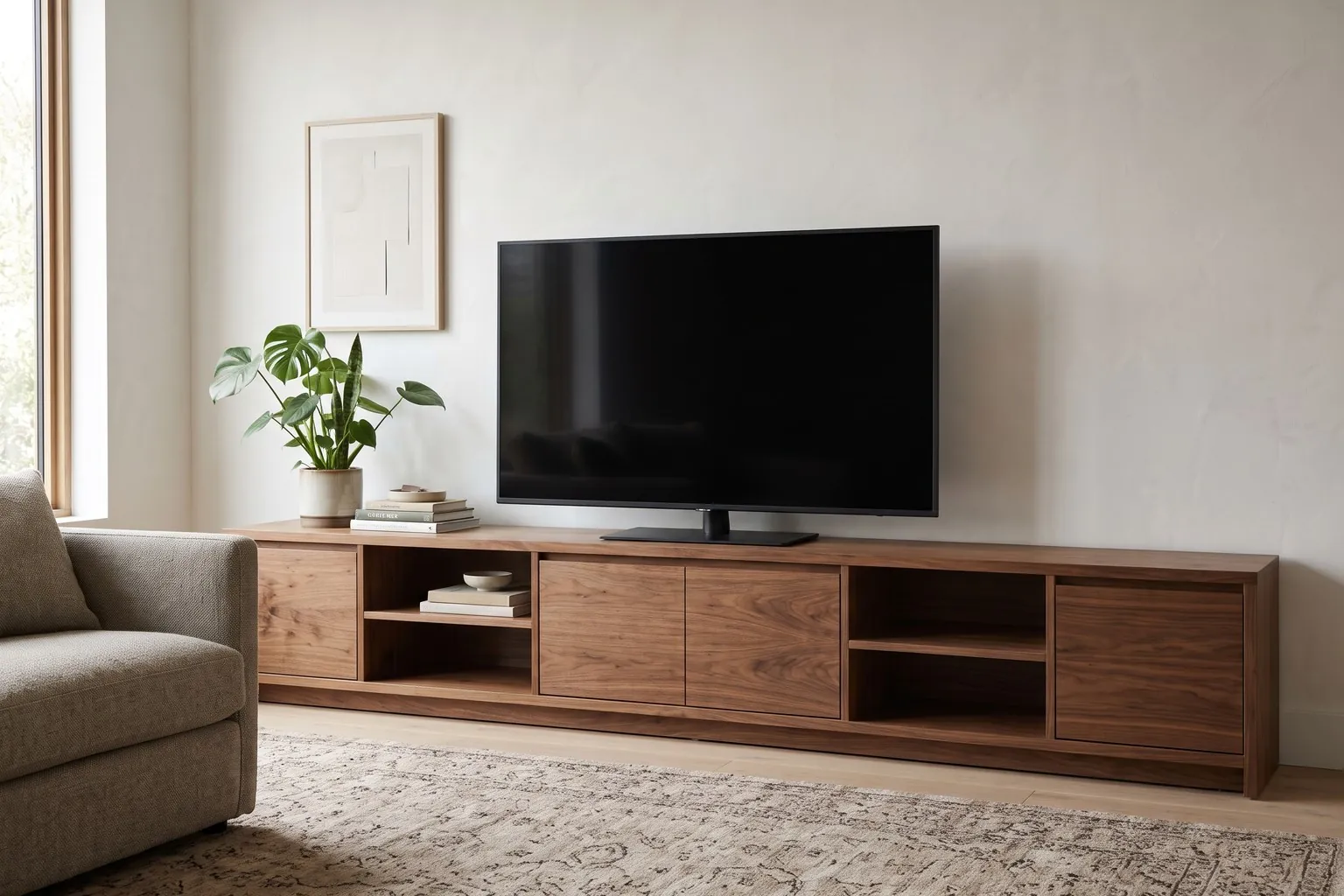
A TV stand should be a few inches wider than the TV on each side and low enough to put the screen's center near seated eye level. Width by TV size, height, depth.
The short answer
- Measure the TV's real width, edge to edge. The size on the box is the diagonal.
- Make the stand wider than the TV: about 3 inches on each side by two sources, 4 to 6 by another. For a 65 inch TV, sellers give at least 57 to 70 inches.
- Set the height so the center of the screen is at or just below seated eye level, about 42 to 48 inches from the floor with a standard sofa. That puts the top of the stand about 18 to 30 inches up.
- Depth: about 10 to 14 inches holds a TV, more with a soundbar or a console.
- Sit about 1.5 to 2.5 times the screen's diagonal away, by one seller; twice, by another.
In this guide
- First, the TV's real width
- Width: wider than the TV
- The wall behind it
- Height: the center of the screen at eye level
- Working out the height
- Depth and weight
- How far from the sofa
- Cables, air and the back
- Three TVs, sized
- Credenza, console or TV stand
- Open or closed
- A 65 inch TV, worked through
- Before you buy, in six checks
A TV stand has two jobs. It has to hold the TV safely, which sets its width and depth. And it has to put the screen where the eyes are, which sets its height.
This guide takes them in that order, with the figures from an electronics retailer, three furniture sellers, IKEA and a technology site. For the long low cabinet that often does this job, and the names it goes by, see our guide to what a credenza is.
First, the TV's real width
A TV is sold by its diagonal. SlashGear makes the point: the advertised size only takes into account the diagonal measurement. So measure the TV itself, from one end of the frame to the other. Abt Electronics says the same: measure from the left edge of the frame to the right.
That width, not the number on the box, is what the stand is sized from. Our reading of Abt's example below: a 65 inch TV that needs a stand of at least 57 inches is a TV about 51 inches wide.
Width: wider than the TV
| Source | How much wider |
|---|---|
| Abt Electronics | about 3 inches on either side |
| SlashGear | about 3 inches from each edge of the stand |
| Castlery | 4 to 6 inches beyond each side of the screen |
| Plank+Beam | at least 2 to 6 inches wider than the TV |
| IKEA, citing interior designers | at least 1.25 times the TV's width |
The reason, in SlashGear's words: a stand that is too small risks the TV tipping over for lack of support.
Plank+Beam translates the rule into a table by TV size:
| TV size | Stand width, at least |
|---|---|
| 32 in | 34 to 36 in |
| 43 in | 44 to 50 in |
| 50 in | 50 to 55 in |
| 55 in | 54 to 60 in |
| 65 in | 63 to 70 in |
| 75 in | 72 to 80 in |
| 85 in | 80 to 90 in |
IKEA's version, in centimeters:
| TV size | Stand width | In inches, our conversion |
|---|---|---|
| 32 to 43 in | around 70 to 120 cm | about 28 to 47 in |
| 50 to 55 in | 120 to 180 cm | about 47 to 71 in |
| 60 to 65 in | at least 160 cm | at least 63 in |
| 70 in and up | at least 180 cm | at least 71 in |
For a 65 inch TV the sources run from Abt's at least 57 inches to Plank+Beam's 63 to 70. SlashGear sorts stands into compact, 42 to 60 inches long; medium, 55 to 70; and large, 70 or more.
The wall behind it
Plank+Beam gives a second width rule, for the room rather than the TV: the stand should be at least two-thirds as wide as the wall behind it. And it asks for at least 2 to 3 feet of open space around the stand.
The two rules can disagree. On a wall 12 feet long, two-thirds is 96 inches, much wider than a 65 inch TV needs. Our sums. In that case the stand can be wider than the TV rule asks, which leaves room for speakers or decor.
Height: the center of the screen at eye level
Every source sets the height from the eyes, not the floor.
| Source | Rule |
|---|---|
| Plank+Beam | center of the screen at seated eye level; top of the stand 20 to 30 inches off the floor |
| Abt Electronics | center of the screen at or just below eye level; 44 inches is a safe eye level if you do not measure |
| Castlery | center of the screen about 42 to 48 inches from the floor in most living rooms |
| IKEA | center at or slightly below eye level; stands about 45 to 65 cm high, about 18 to 26 inches |
Castlery ties the height to the sofa:
| Seating | Stand height | Center of the screen |
|---|---|---|
| Standard sofa, seat about 17 to 18 in | 18 to 24 in | 42 to 48 in |
| Low sofa, seat about 14 to 16 in | 14 to 18 in | 38 to 44 in |
| Floor seating, cushions | 8 to 14 in | 30 to 38 in |
Working out the height
Abt's method: take your seated eye level, subtract half the height of the TV, and the answer is the stand height. Its example: a TV 34 inches tall has its middle at 17 inches; 44 minus 17 is about 27 inches, give or take an inch or two.
SlashGear's method starts the same way, from the floor to your eye level where you will sit, but then subtracts the whole height of the TV. That puts the top of the screen, not its center, at eye level, and gives a lower stand. The center rule is the one the other four sources use: our comparison.
By our sums, with Abt's 44 inch eye level:
| TV height | Half | Stand height |
|---|---|---|
| 28 in | 14 in | about 30 in |
| 34 in | 17 in | about 27 in |
| 40 in | 20 in | about 24 in |
| 48 in | 24 in | about 20 in |
The larger the TV, the lower the stand, which is why a big screen on a tall cabinet ends up too high. That last remark is our reading of the table.
Depth and weight
IKEA gives the depth: about 26 to 35 centimeters, roughly 10 to 14 inches, is usually enough for a TV and a few decorative items. With a soundbar, a console or speakers, a deeper stand gives more room; IKEA's own range runs from 26 to 49 centimeters, about 10 to 19 inches.
Castlery adds a check for the room: measure the distance between the wall and the sofa, since the stand's depth comes out of it.
On weight, Abt says only that capacity varies by model. Read the rating on the product page and compare it with the TV's weight, plus whatever else will sit on top.
How far from the sofa
| Source | Viewing distance |
|---|---|
| Plank+Beam | about 1.5 to 2.5 times the TV's diagonal |
| Abt Electronics | double the diagonal |
Plank+Beam's table:
| TV size | Distance |
|---|---|
| 32 in | 4 to 5 ft |
| 43 in | 5 to 6 ft |
| 50 in | 6 to 7 ft |
| 55 in | 7 to 9 ft |
| 65 in | 8 to 11 ft |
| 75 in | 9 to 12 ft |
| 85 in | 10 to 13 ft |
Abt's example: a 60 inch TV at 120 inches, 10 feet. Our sofa sizes guide reports Castlery's similar rule for the television, 1.5 to 2.5 times the size of the screen.
Cables, air and the back
- Cables. Abt suggests open shelving, or holes or clips in the back. Plank+Beam and Castlery mention cord pass-throughs and cutouts.
- Air. Plank+Beam mentions ventilation slots to keep electronics cool. Castlery calls open shelving great for airflow.
- The back. For a stand that floats in the room, Abt says to make sure it has a finished back.
- A wall-mounted TV. Castlery notes that the space below still carries visual weight, so the cabinet under a mounted TV is still part of the composition.
Three TVs, sized
Our sums from Plank+Beam's width and distance tables and Castlery's height for a standard sofa.
| TV | Stand width | Stand height | Viewing distance |
|---|---|---|---|
| 55 in | at least 54 to 60 in | 18 to 24 in | 7 to 9 ft |
| 65 in | at least 63 to 70 in | 18 to 24 in | 8 to 11 ft |
| 75 in | at least 72 to 80 in | 18 to 24 in | 9 to 12 ft |
The stand gets wider with the TV, and the room deeper. The height stays roughly the same, because it follows the sofa and the eyes.
Credenza, console or TV stand
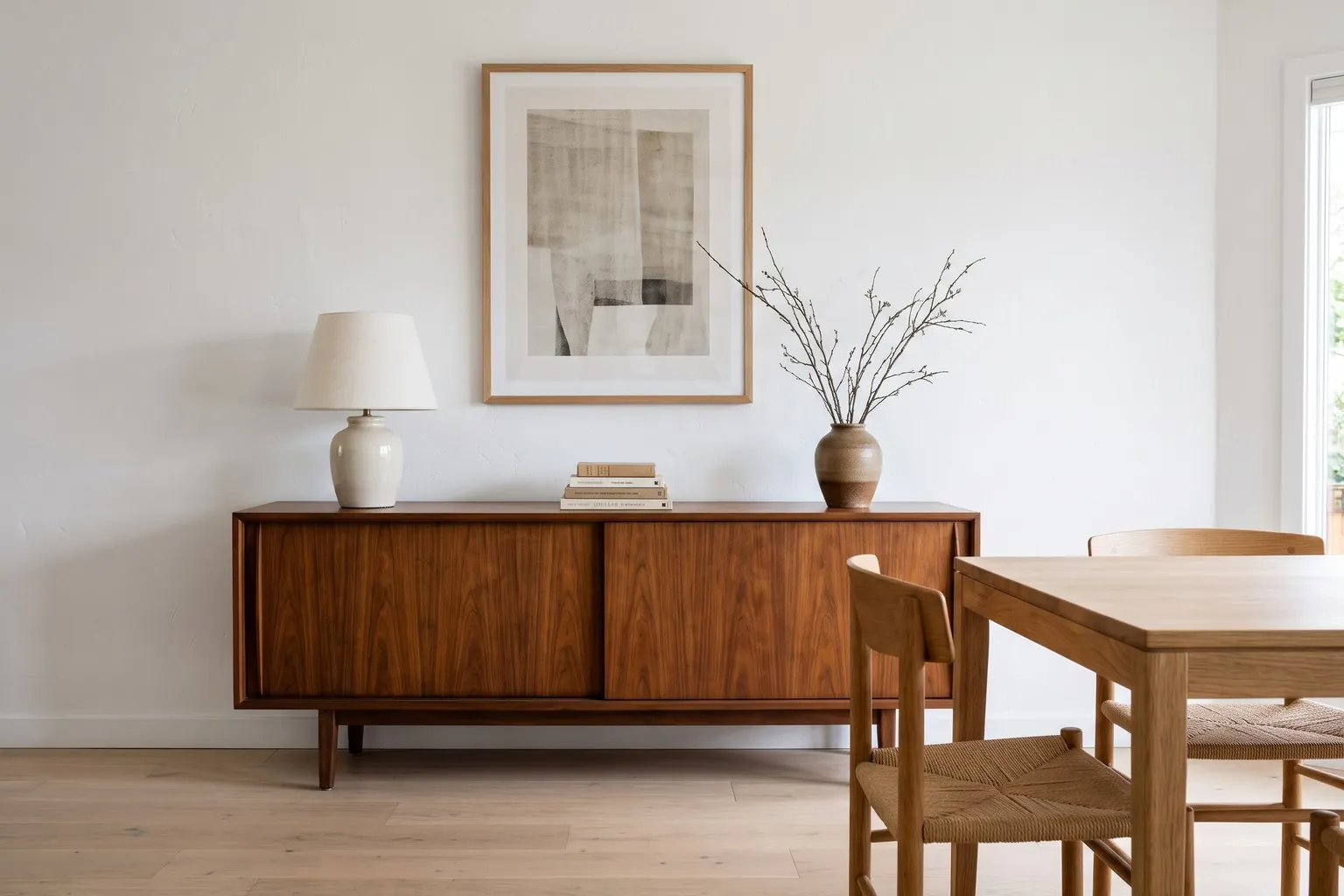
A long low cabinet under a TV is sold under several names. Our guide to the credenza gives the figures of Ali Guler, a furniture maker: 25 to 30 inches high, 18 to 24 inches deep and 60 to 80 inches wide. The height sits at the top of the 18 to 30 inch range the TV sources give, so with a large TV on a credenza, check the center of the screen against your eye level with Abt's method above. Those widths cover the stands for TVs from about 55 to 75 inches in the table above, and the depth is more than IKEA's 26 to 35 cm, so a credenza takes a soundbar and a console easily. Our comparison of the two guides.
The credenza guide adds two checks that apply to any TV stand: under a window, keep the top below the sill; and leave 36 inches clear to walk past.
Open or closed
The sources describe what each design does.
- Open shelving: easy cable routing, by Abt; great for airflow and for gaming setups or sound systems, by Castlery.
- Closed storage: keeps things out of sight; for electronics inside, look for ventilation slots, which Plank+Beam mentions, and holes or clips in the back for cables, which Abt mentions.
- Pass-throughs: cord openings in the back, in Plank+Beam's and Castlery's lists.
A 65 inch TV, worked through
Our sums from the figures above, for a TV about 51 inches wide and, say, 30 inches tall.
- Width: at least 57 inches by Abt's rule; 63 to 70 by Plank+Beam's table.
- Height: 44 minus 15 is 29 inches by Abt's method; 18 to 24 by Castlery's table for a standard sofa. The two differ; measure your own eye level.
- Depth: 10 to 14 inches, more for a soundbar.
- Distance: 8 to 11 feet by Plank+Beam, about 10 feet by Abt.
Before you buy, in six checks
- Measure the TV's width, edge to edge.
- Add 3 to 6 inches each side for the stand.
- Measure your seated eye level and subtract half the TV's height.
- Check the depth against the TV's feet, a soundbar, and the space to the sofa.
- Check the weight rating against the TV and everything on the stand.
- Check the distance from the sofa: about 1.5 to 2.5 times the diagonal.
Questions people ask
How wide should a TV stand be?
Wider than the TV itself: about 3 inches each side by two sources, 4 to 6 by another, or at least 1.25 times the TV's width by IKEA's designers. Measure the TV edge to edge, not its diagonal.
What size TV stand for a 65 inch TV?
At least 57 inches by one retailer, 63 to 70 by a furniture seller, and at least 160 cm, about 63 inches, by IKEA.
How tall should a TV stand be?
Tall enough to put the center of the screen at or just below seated eye level, about 42 to 48 inches from the floor. That usually means a stand 18 to 30 inches tall.
How do you calculate TV stand height?
Measure your seated eye level, subtract half the TV's height. With a 44 inch eye level and a 34 inch tall TV, the stand is about 27 inches.
How deep should a TV stand be?
About 10 to 14 inches holds a TV and a few items, by IKEA's figures. Choose deeper for a soundbar, a game console or speakers.
Can a TV be wider than its stand?
The sources advise against it. SlashGear says a stand that is too small risks the TV tipping over for lack of support. Choose a stand wider than the TV, or mount the TV on the wall.
Should the TV stand match the length of the sofa?
None of our sources ties the two. One seller relates the stand to the wall behind it instead: at least two-thirds of the wall's width, with 2 to 3 feet of open space around it.
How far should a TV be from the sofa?
About 1.5 to 2.5 times the screen's diagonal, by one seller, or twice the diagonal by another. A 65 inch TV sits about 8 to 11 feet away.
Sources
- TV stand buying guide. Abt Electronics, read November 2026
- How big should my TV stand be?. Plank+Beam, read November 2026
- How to choose a TV stand. Castlery, read November 2026
- TV stand size guide. SlashGear, read November 2026
- Ideal TV stand dimensions. IKEA, read November 2026
Every figure in this guide comes from the sources above, or from arithmetic shown in the text. See our editorial policy.