Closet rod height: 66 inches for one rod, 40 and 80 for two
Hang a single closet rod at 66 inches, double rods at about 40 and 80, and a long-hang rod at 70 to 78. Heights for children, the shelf above, and the reach limit.
The short answer
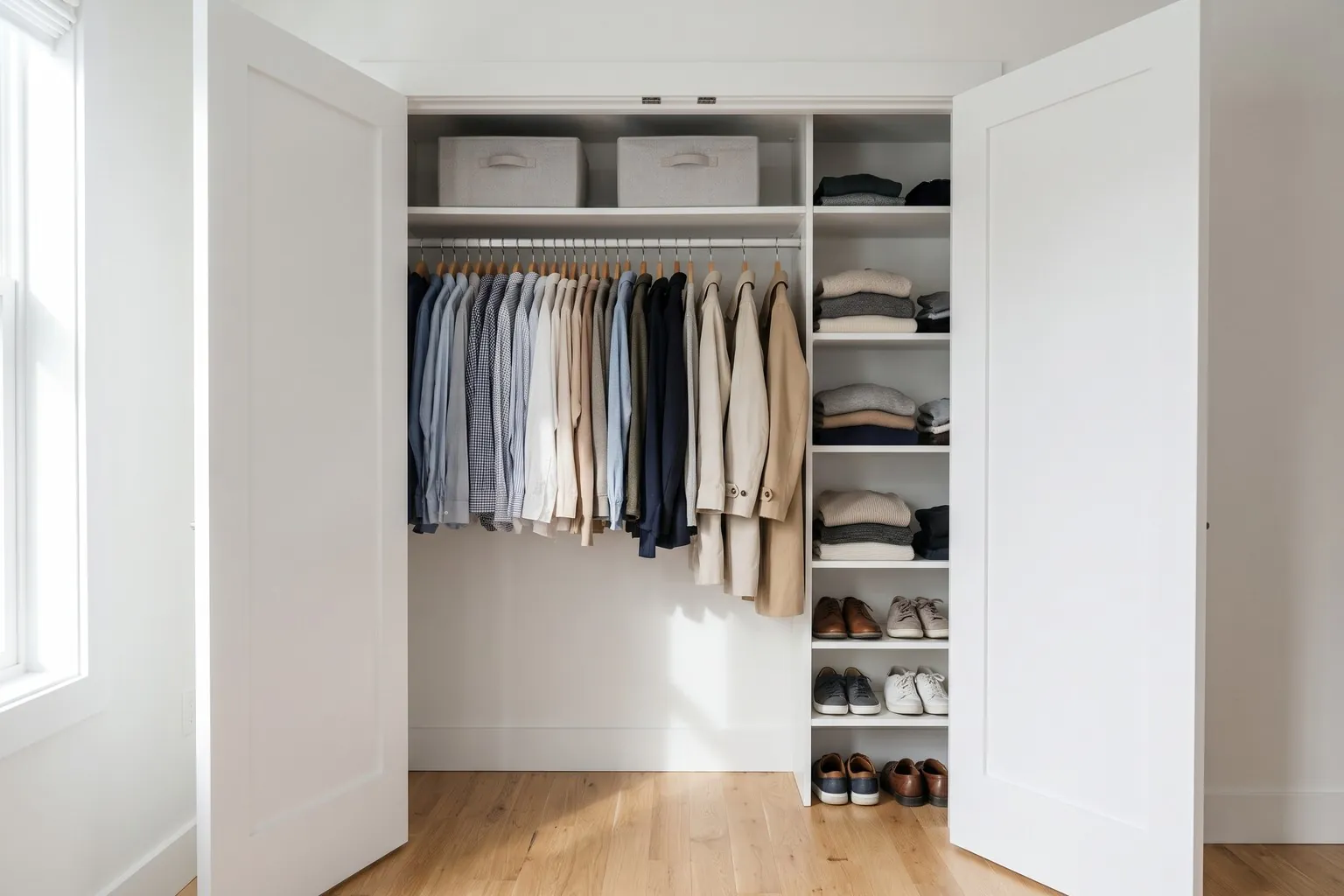
- A single closet rod hangs at about 66 inches from the floor, measured to the center of the rod. Sources give 66 to 70.
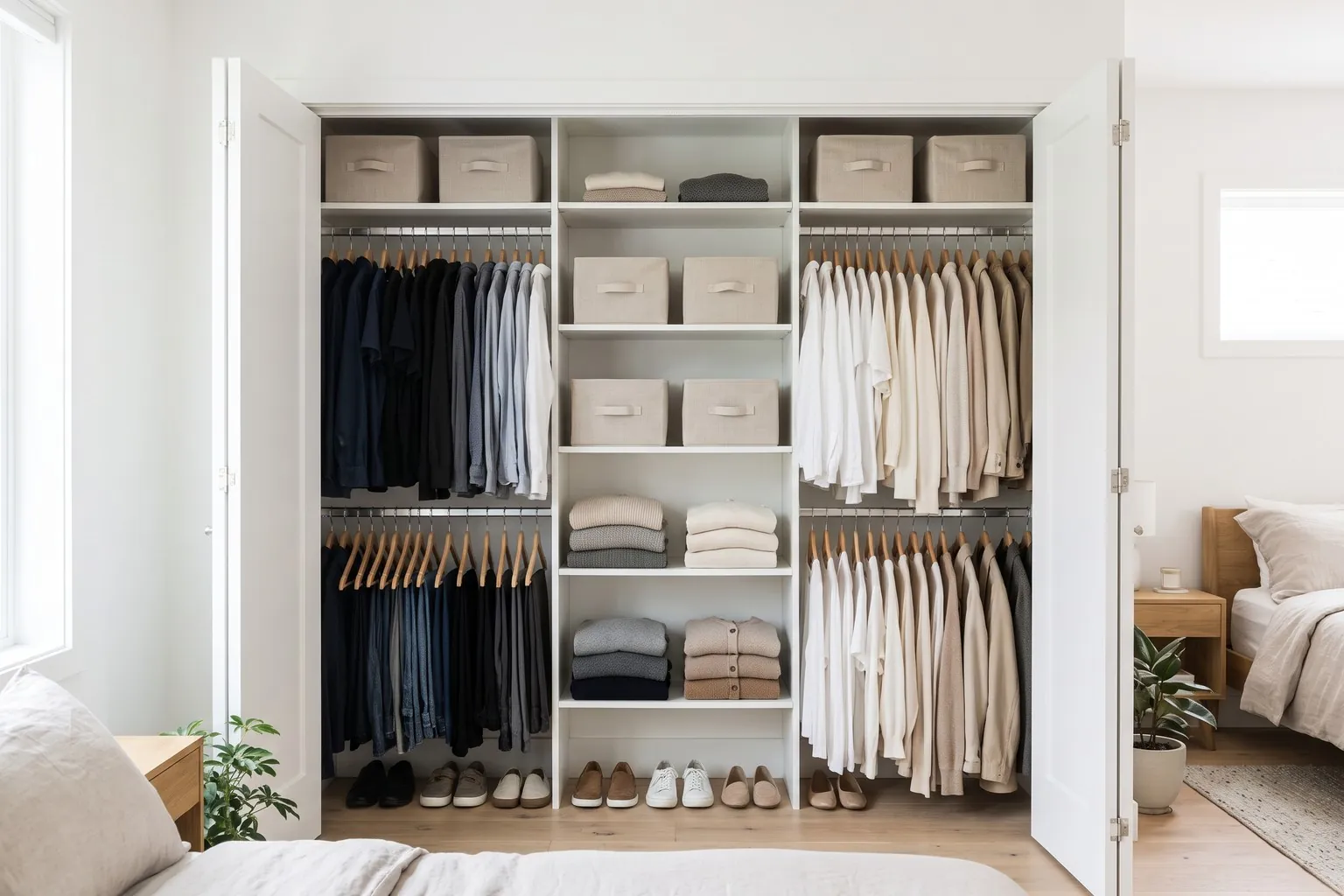
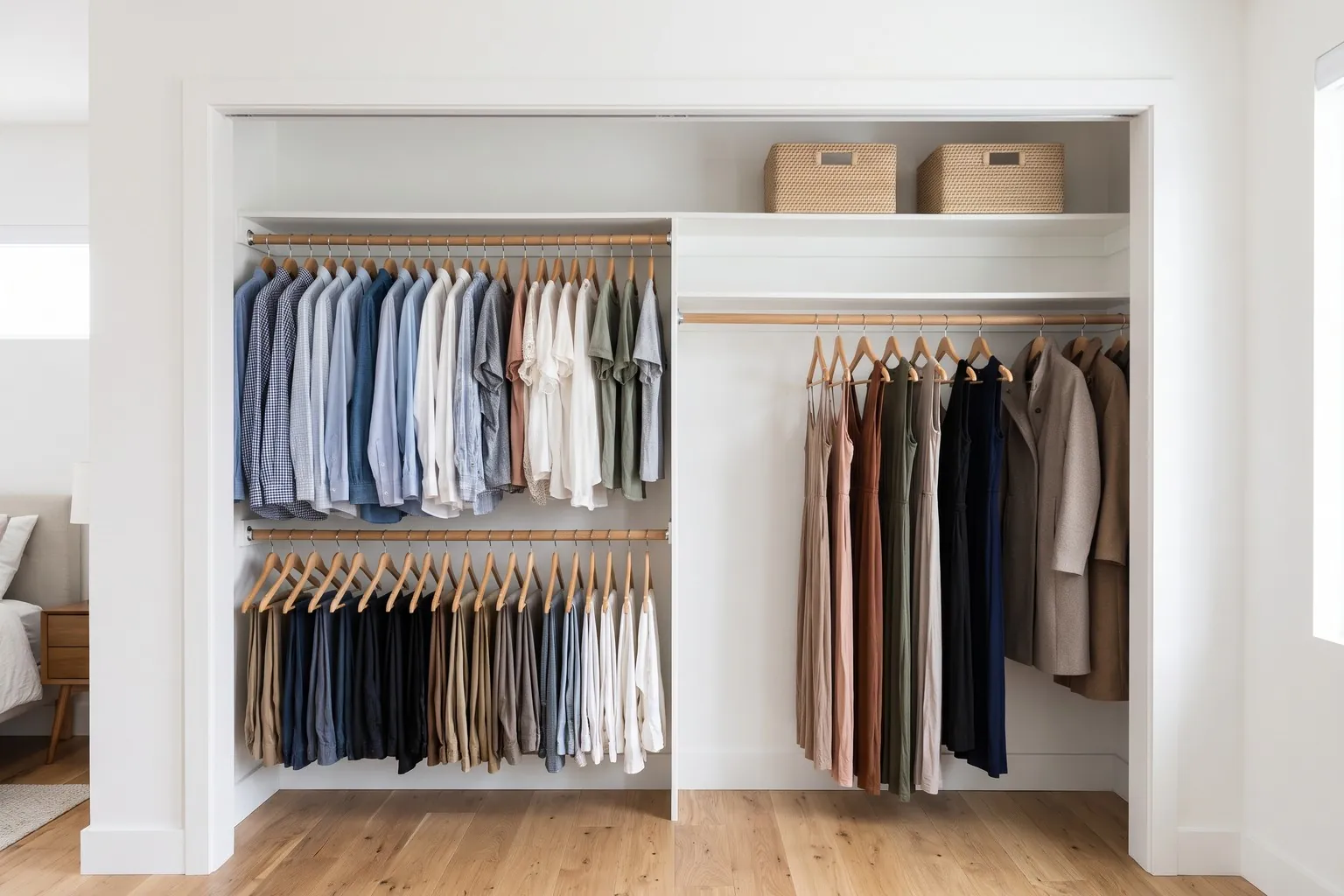
- Double rods go at about 40 inches and 80 inches. Each tier then has 36 to 40 inches of hanging space, which is what shirts and folded trousers need.
- Long dresses and coats need 60 to 70 inches of hanging space, so a long-hang rod sits at 70 to 78 inches.
- Keep the rod 12 inches from the back wall and at least 2 inches below the shelf above it. A rod spans 4 to 5 feet without support.
- For children, 30 to 36 inches up to age 6 and 40 to 48 inches from 7 to 12. The accessibility standard puts the limit of reach at 48 inches.
In this guide
- The three standard heights
- Where the number is measured to
- Why 40 and 80: the clothes
- Where the hem ends up
- Long hanging
- The shelf above the rod
- Distance from the wall, and span
- Children's closets
- Reach, and the accessibility standard
- Fitting the heights to the people
- One wall, planned
- Before you drill, in six checks
A closet rod has one dimension that people ask about, and it decides how much the closet holds. Hung at one height, a wall takes one row of clothes. Hung at two, it takes two rows, and the closet has doubled without growing an inch.
This guide gives the heights four sources publish, the garment lengths those heights come from, and the smaller numbers around the rod: the shelf, the wall, the span. The closet itself, its depth and its width, is in our guide to closet dimensions. Sorting and putting the clothes back by reach is in how to organize a closet.
The three standard heights
| Rod | Taskrabbit | Classy Closets | John Louis Home | Create More Space |
|---|---|---|---|---|
| Single | about 66 inches | 66 to 68 inches | not given | 66 to 70 inches |
| Double, upper | about 80 inches | 80 to 84 inches | 80 to 82 inches | 80 to 84 inches |
| Double, lower | about 40 inches | 40 to 42 inches | 40 to 42 inches | 40 to 42 inches |
| Long hang | 70 inches | 72 to 78 inches | not given | 66 to 72 inches |
The agreement is close. One rod: 66 inches, or a little more. Two rods: 40 and 80, with the sources adding up to 2 inches to the lower one and up to 4 to the upper. Long clothes: 70 and up.
John Louis Home gives one reason to go to the top of the range: it suggests raising the upper rod of a pair to 84 inches for taller adults.
Where the number is measured to
A rod has thickness, so it matters which part of it the figure refers to. Taskrabbit measures from the floor to the middle of the rod. Classy Closets measures to the rod centerline.
Classy Closets also says which floor: the finished floor. In a closet that is about to get carpet or new flooring, that is the floor after the work, not before.
Why 40 and 80: the clothes
The heights are garment lengths with a margin.
| Clothes | Hanging space they need | Source |
|---|---|---|
| Shirts, blouses, folded trousers | 36 to 40 inches | Taskrabbit |
| Suits and sport coats | about 44 to 46 inches | Create More Space |
| Dresses and coats | 60 to 70 inches | Taskrabbit |
| Full-length coats and gowns | up to 68 to 72 inches | Create More Space |
Now the double rod explains itself. Put the lower rod at 40 inches and a shirt, which needs 36 to 40, clears the floor. Put the upper rod 36 to 40 inches above the first and it lands at 76 to 80: our sums. That is close to the sources' 80 to 84 inches. John Louis Home states the same rule as a single figure: at least 36 inches between the two rods.
It also shows what double hanging cannot hold, in our reading of the figures. A suit jacket at 44 to 46 inches is longer than the space between the rods. It fits on the lower tier only if the lower rod is raised, and on the upper tier only by brushing the clothes below. A closet with many jackets needs a section set a few inches wider apart, or a single rod.
Where the hem ends up
Subtract the length of the clothes from the height of the rod and you get where the hem hangs. These are our sums, from the two tables above.
| Rod at | Clothes | Hem above the floor |
|---|---|---|
| 66 inches, single | Shirts, 36 to 40 inches | 26 to 30 inches |
| 66 inches, single | Suits, 44 to 46 inches | 20 to 22 inches |
| 66 inches, single | Dresses and coats, 60 to 70 inches | 6 inches, down to the floor |
| 40 inches, lower | Shirts, 36 to 40 inches | 0 to 4 inches |
| 80 inches, upper | Shirts, 36 to 40 inches | 40 to 44 inches |
| 84 inches, upper | Shirts, 36 to 40 inches | 44 to 48 inches |
| 72 inches, long hang | Dresses and coats, 60 to 70 inches | 2 to 12 inches |
| 78 inches, long hang | Gowns, 68 to 72 inches | 6 to 10 inches |
Three things show in that table.
Under a single rod at 66 inches, shirts leave more than 2 feet of empty wall below them. That is the space the second rod uses.
With the upper rod at 80 and the lower at 40, the longest shirts on the upper tier end exactly at the lower rod. At 84, they end 4 inches or more above it. That may be why three of the four sources carry the upper rod to 82 or 84: the remark is ours.
And a dress that needs 70 inches touches the floor from a rod at 66. That is the case for a long-hang section.
Long hanging
Long-hang sections sit higher than a single rod: 70 inches at Taskrabbit, 72 to 78 at Classy Closets, 66 to 72 at Create More Space. Taskrabbit gives 70 inches for dresses in a walk-in closet, and 66 to 70 for coats.
The top of the range is for gowns and full-length coats, which Create More Space measures at up to 68 to 72 inches of hanging length. Between 70 and 72 inches, three of the four sources overlap.
A long-hang section holds one row of clothes where a double section holds two. It costs rod length, so it is worth keeping to the width the long clothes need.
The shelf above the rod
Where there is a shelf over the rod, the gap between them has a minimum. Classy Closets gives it: at least 2 inches of clear space between the top of the rod and the shelf. John Louis Home hangs the rod 2 inches below the shelf.
So the shelf follows the rod. Above a single rod at 66 inches, the shelf sits a little under 70. Above an upper rod at 80 to 82, it sits at about 84. In a room with an 8 foot ceiling, 96 inches, that leaves about a foot of storage above the shelf. Those are our sums. Our closet dimensions guide reports the same arrangement from the other direction: designers who set the shelf at 84 inches or more and hang the bar 2 inches below it.
Where there are several shelves, Taskrabbit spaces them about 12 to 16 inches apart.
Distance from the wall, and span
Two more numbers hang a rod correctly.
From the back wall: 12 inches. Classy Closets says about 12 inches, and John Louis Home says at least 12. The reason is the hanger. Our closet dimensions guide starts from it: a hanger is 17 to 19 inches wide, and a rod 12 inches from the wall in a closet 24 inches deep leaves room for the clothes at the back and at the front.
Between supports: 4 to 5 feet. Taskrabbit says a rod can span 4 to 5 feet without support. Beyond that, plan a support in the middle.
Children's closets
A child cannot use a rod at 66 inches, and a closet set up for a child of 4 is wrong for the same child at 10. Taskrabbit and Classy Closets give the same heights.
| Age | Rod height |
|---|---|
| 3 to 6 | 30 to 36 inches |
| 7 to 12 | 40 to 48 inches |
The federal accessibility standards publish reach figures for children, and they are worth setting beside those heights.
| Age | High reach | Low reach |
|---|---|---|
| 3 and 4 | 36 inches | 20 inches |
| 5 to 8 | 40 inches | 18 inches |
| 9 to 12 | 44 inches | 16 inches |
For the youngest children the two agree: a rod at 30 to 36 inches is within a high reach of 36. For the older group they do not quite. The top of the companies' range, 48 inches, is above the 44 inches the standards give for ages 9 to 12, and above the 40 inches they give for ages 5 to 8. For a child who has to reach the rod alone, the lower half of each range is the one the reach figures support. The comparison is ours, and the reach figures come from a standard written for accessibility: measure what your own child reaches before you drill.
John Louis Home suggests starting a child's closet with rods at 30 and 60 inches. That puts 30 inches between the two rods, against the 36 it asks for in an adult closet. By the reach table, a child of 5 reaches the lower one and not the upper.
Reach, and the accessibility standard
For a wheelchair user, or anyone who cannot reach overhead, the standard heights are too high. The ADA Standards give the limit as a reach range, in section 308. Section 811 applies it to storage: storage elements must comply with at least one of those reach ranges.
| Reach | Maximum height |
|---|---|
| Forward or side reach, nothing in the way | 48 inches |
| Forward reach over an obstruction more than 20 inches deep | 44 inches |
| Side reach over an obstruction 10 to 24 inches deep | 46 inches |
The low limit is 15 inches. So accessible storage lives between 15 and 48 inches from the floor.
The obstruction figures matter in a closet, where the reach is often over something: a hamper, a shoe rack, a set of drawers. The standard limits those too. A forward reach over an obstruction goes no deeper than 25 inches, and a side reach is over an obstruction no higher than 34 inches.
John Louis Home applies the range directly: a rod can be lowered to 48 inches. Look at what that does to the clothes table. A rod at 48 inches gives 48 inches of hanging, enough for shirts, trousers and jackets, and not for long dresses. The lower rod of an ordinary double hang, at 40 inches, is already inside the range. In a shared closet, that is the tier to give to the person who needs it.
We use the ADA Standards here as a measured statement of what can be reached, not as a rule a private closet has to meet.
Fitting the heights to the people
The published heights are ranges, and the people using the closet decide where to land in them.
- Taller adults: John Louis Home raises the upper rod of a pair to 84 inches.
- Shorter reach: the low end of each range, which is 66 inches for a single rod and 80 for an upper one.
- A wheelchair user: 48 inches at most, as above.
- Children: 30 to 36 inches, then 40 to 48, with the reach table as a check.
One wall, planned
Take a reach-in closet 6 feet wide with an 8 foot ceiling. These are our sums from the figures above.
| Section | Width | Rods | Holds |
|---|---|---|---|
| Double hang | 4 feet | 40 and 80 inches | shirts, trousers, skirts: 8 feet of rod |
| Long hang | 2 feet | 72 inches | dresses and coats: 2 feet of rod |
| Shelf | full width | at about 84 inches | a foot of storage under the ceiling |
That is 10 feet of rod on a 6 foot wall, against 6 feet for a single rod straight across. Each rod is 4 feet long or less, inside the span Taskrabbit allows without support.
Before you drill, in six checks
- Sort the clothes into short, jacket length and long, and measure the longest of each on its hanger.
- Lower rod at 40 to 42 inches, upper rod at least 36 inches above it.
- Long section at 70 to 72 inches, higher only for gowns and full-length coats.
- Measure to the center of the rod, from the finished floor.
- Twelve inches from the back wall, 2 inches under the shelf.
- A support in the middle of any rod longer than 4 to 5 feet.
Questions people ask
What is the standard height for a closet rod?
About 66 inches from the floor to the center of the rod for a single rod. The four sources we read give 66 to 70 inches.
How high should double closet rods be?
The lower rod at 40 to 42 inches and the upper at 80 to 84 inches, with at least 36 inches between them. Each tier then holds shirts and folded trousers.
How high should a closet rod be for long dresses?
70 to 72 inches for most, and up to 78 for gowns and full-length coats. Dresses and coats need 60 to 70 inches of hanging space.
How far should a closet rod be from the back wall?
About 12 inches. That keeps hangers, which are 17 to 19 inches wide, clear of the wall in a closet 24 inches deep.
How much space is needed between the closet rod and the shelf?
At least 2 inches between the top of the rod and the shelf, according to Classy Closets.
How high should a closet rod be for a child?
30 to 36 inches for ages 3 to 6 and 40 to 48 inches for ages 7 to 12. The federal reach figures for children top out at 44 inches.
How long can a closet rod be without a center support?
4 to 5 feet, according to Taskrabbit.
Sources
- Here's the right shelf and closet rod height. Taskrabbit, read November 2026
- Closet rod height for homeowners. Classy Closets San Diego, read November 2026
- Closet rod height for two rods. John Louis Home, read November 2026
- Closet rod height and hanging space planning. Create More Space, read November 2026
- ADA Accessibility Standards, chapter 3, section 308. U.S. Access Board, read November 2026
- ADA Accessibility Standards, chapter 8, section 811. U.S. Access Board, read November 2026
Every figure in this guide comes from the sources above, or from arithmetic shown in the text. See our editorial policy.