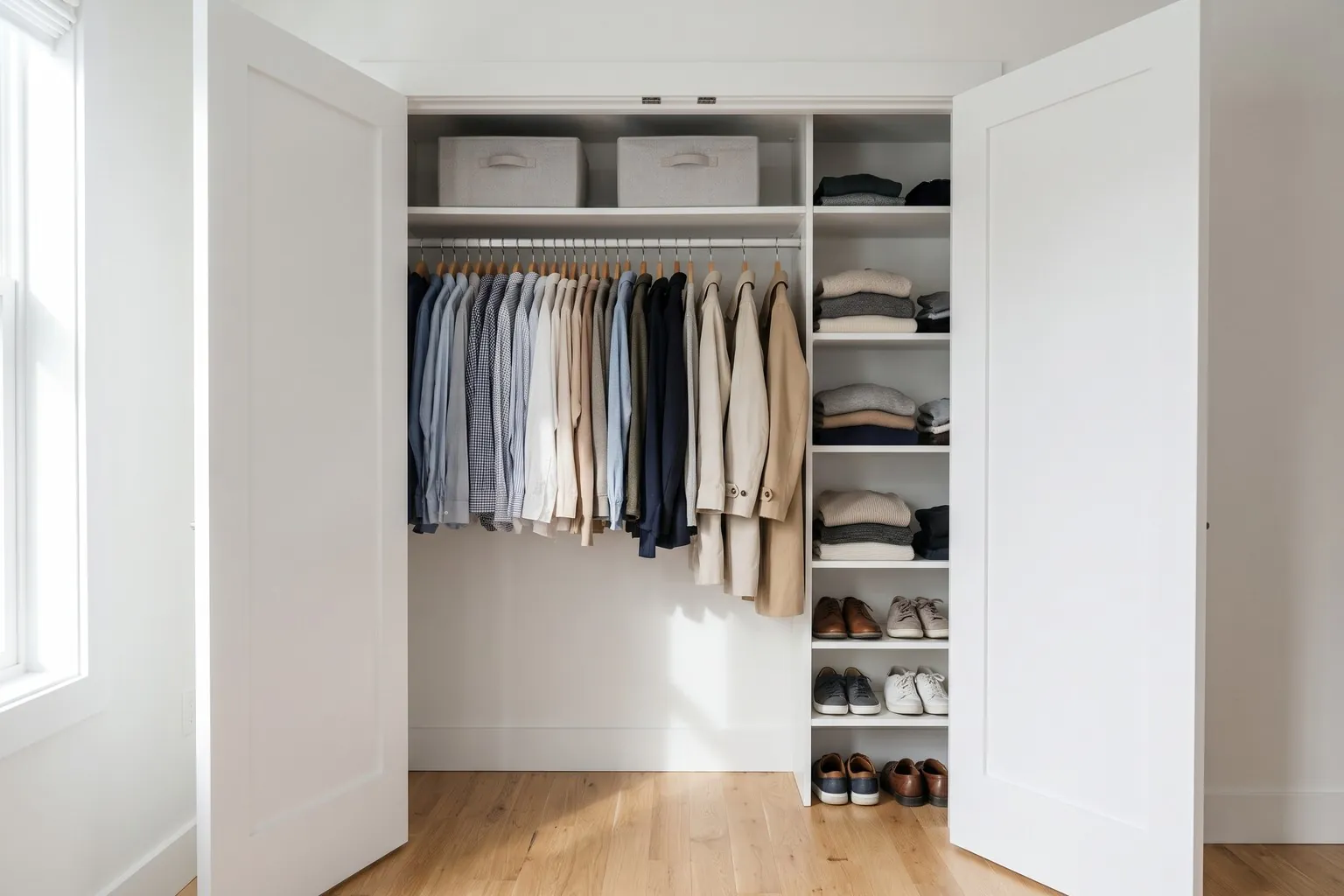
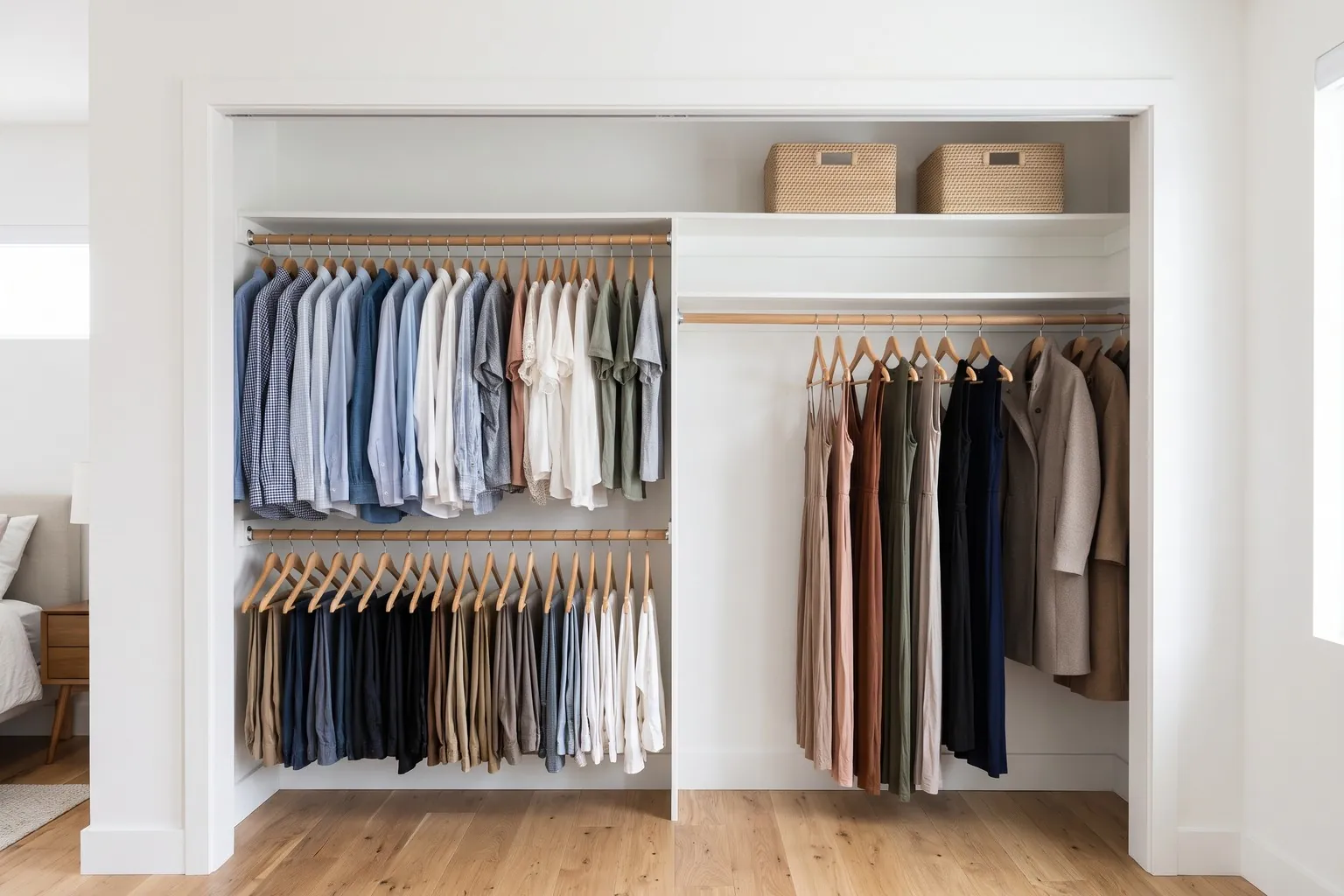
How to organize a closet: empty it, sort it, then put it back by reach
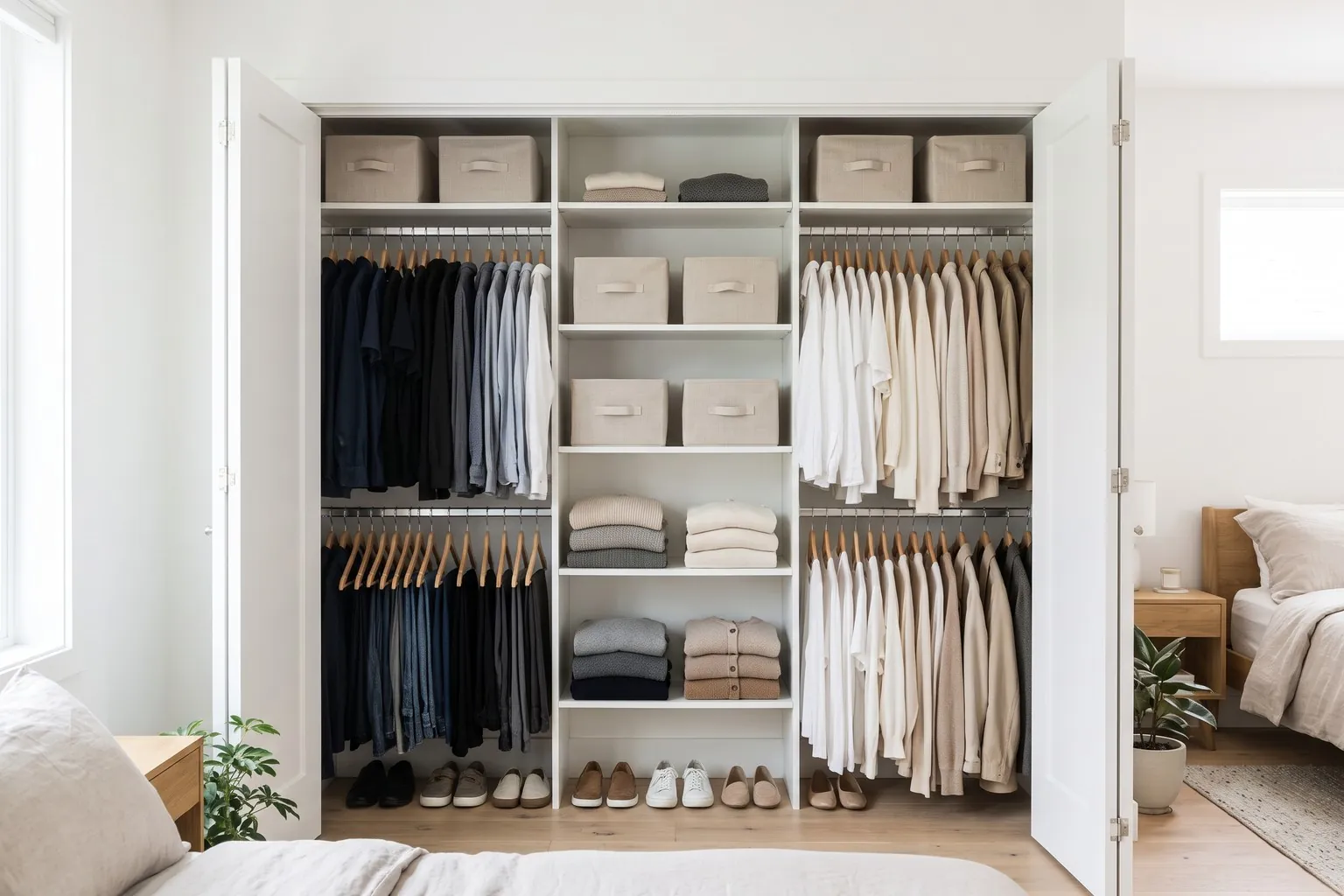
Empty the closet, sort by category, keep what fits and was worn this year, then put it back by reach: everyday at eye level, off-season on the high shelf.
The short answer
- Most organizers start by emptying the closet completely. One prefers smaller sessions: one shelf, drawer or rod at a time.
- Sort by category first, then decide item by item: keep, donate, sell or discard, with a maybe pile you revisit at the end.
- The time rule quoted most often is a year: an item not worn in that time can go. One organizer allows several years.
- Put things back by reach: everyday pieces at eye level, off-season pieces on the high shelf. The accessible reach range, in our rod guide, is 15 to 48 inches from the floor.
- Fold knits, T-shirts, sweatshirts and jeans; hang blouses, jackets, skirts, dresses and coats. Matching slim hangers fit more on the rod.
In this guide
Organizing a closet is two jobs. The first is deciding what stays. The second is putting it back so that the things you wear most are the easiest to reach. Six articles from four publishers, quoting more than a dozen organizers and stylists, agree on the order of the work. They differ on the details: how many piles, how long an unworn item gets, how often to start again.
This guide follows the order they share, gives their rules side by side with who said what, and adds the heights from our own closet guides. How deep and wide a closet should be is in our guide to closet dimensions; where to hang the rods is in closet rod height.
Step 1: empty it
Most of our sources begin with an empty closet. Eryn Donaldson, a professional organizer quoted by Bob Vila: "Clearing everything out allows you to see the full scope of your belongings and the space you have to work with." Real Homes starts the same way, and two organizers quoted by Homes and Gardens, Jamie Hord of Horderly and Jane Fern of The Spark Joy Collective, both pull everything out first.
There is a second approach. Homes and Gardens says there are two: split the closet into categories, or tackle it all in one go. Linda Samuels, a certified organizer quoted by Livingetc, prefers small sessions, one shelf, drawer or rod before the next area, because a smaller job is easier to start.
Two practical points while the closet is empty. Mimi Bogelund, quoted by Homes and Gardens, suggests sorting where there is good daylight or other good lighting. Bob Vila suggests cedar blocks to protect clothes from pests.
Step 2: sort by category
Before deciding anything, group like with like. Bob Vila lists tops, bottoms, dresses, shoes and accessories. Victoria Bance, an organizer quoted by Homes and Gardens, goes finer: jackets, tops, pants, jeans, dresses, skirts, socks and underwear.
Within each category, Donaldson separates items by season or by how often they are worn. Real Homes adds a split that pays off later: one pile for what goes on hangers and another for what goes in drawers.
Step 3: decide, item by item
The piles. The sources name them differently:
| Source | Piles |
|---|---|
| Real Homes | keep, throw away, store |
| Livingetc | keep, donate, and a maybe pile you revisit at the end |
| Victoria Bance, in Homes and Gardens | keep, donate, sell, let go |
| Bob Vila | the 12-12-12 method: 12 items to recycle or throw away, 12 to donate, 12 to return to the closet |
Kiera Malowitz, an organizer quoted by Livingetc, warns about the sell pile: if selling would take a while to get the items out of your home, consider donating instead.
The time rule. How long can an item go unworn?
| Source | Rule |
|---|---|
| Real Homes | it no longer fits, or you haven't worn it in over a year |
| Gill Gudgeon, in Homes and Gardens | not worn for at least a year: the likelihood is that it won't be |
| Homes and Gardens | the question to ask: have you worn it in the last year? |
| Eryn Donaldson, in Bob Vila | it doesn't fit, or hasn't been worn in several years |
So three of four sources set the line at a year. Donaldson's several years is the lenient end.
Fit and condition. Bogelund keeps an item only if it is one size either way of your current size. Malowitz lets go of anything torn, holed, stained or ruined, and Real Homes says the same of anything stained or damaged. Erica Ball, a stylist quoted by Homes and Gardens: never hang anything that needs to be steamed or tailored, thinking you will get to it later.
The questions. When the rules do not settle it, the organizers ask:
- When did I last wear this? Would I buy it again in a store? Why did I buy it in the first place? (Livingetc)
- Do I have something better or similar? (Jamie Hord)
- Does it fit, do I wear it, do I need it? (Real Homes)
Malowitz adds a last pass for duplicates. Her example: 20 black T-shirts, and whether you really need that many.
Sentimental pieces. Homes and Gardens suggests limiting yourself to one storage box for the pieces you cannot part with. Gudgeon is blunter: take the sentiment out of the process.
Step 4: clear the hangers, check the rods
Before anything goes back, Samuels removes the surplus hangers. Empty hangers, she says, are bulky and make the clothes harder to reach. Removing them instantly makes room.
Which hangers. Laura P. Barker, a closet curator quoted by Homes and Gardens, recommends matching slim hangers: they fit more in the space and give it a boutique feel. The same article says velvet hangers keep clothes in place in a tight spot, and Bance uses velvet slimline hangers for the same reason. For more on one rod, Donaldson suggests cascading hangers to maximize rod space, and Courtney Finley of Organized Designs calls layered hangers the best bet for a tight spot.
The rods. Bob Vila's step is to check that the rods are easy to reach and, in a tiered system, properly spaced. It gives no heights. The heights from our closet rod height guide:
| Rod | Height to the center | Clothes it suits |
|---|---|---|
| Single | about 66 in | shirts and suits; long dresses come close to the floor |
| Double, upper and lower | about 80 and 40 in | shirts and folded trousers, 36 to 40 in of hanging each |
| Long hang | 70 to 78 in | dresses and coats, 60 to 70 in long |
Felice Cohen, a small-space writer quoted by Homes and Gardens, suggests a drop-down bar to double the vertical hanging space.
Step 5: put it back by reach
This is the step the organizers agree on most. Donaldson: everyday items at eye level; special-occasion and seasonal pieces on higher or lower shelves. Vicky Silverthorn of You Need A Vicky makes the same point about cocktail dresses that are barely worn: they should not take up the main space.
| Zone | Height | What goes there | Source |
|---|---|---|---|
| High shelf | about 84 in, by our closet guides | off-season clothes in a bin or box; shoes worn only occasionally | Barker; Homes and Gardens |
| Eye level | everyday items | Donaldson | |
| Higher or lower shelves | special-occasion and seasonal pieces | Donaldson | |
| The reach range | 15 to 48 in | what a child or a seated person needs to reach | our rod guide |
The 15 to 48 inch band is the reach range of the accessibility standard, which our rod guide cites. In a shared closet, the lower rod of a double hang, at about 40 inches, already sits inside it: that is the tier to give to the person who needs it.
Use the height you have. Nicole Gabai of B. Organized, quoted by Homes and Gardens: use all your vertical space, and where there is a large gap at the top or bottom of the closet, add shelves or stacking boxes.
Step 6: hang or fold
| Hang | Fold | |
|---|---|---|
| Courtney Finley, in Homes and Gardens | blouses, tops, jackets, skirts and dresses, especially delicate ones such as silk | T-shirts, thick knits and sweatshirts that don't crease when rolled or file folded |
| Homes and Gardens | coats, suits, blouses and dresses | wool and cashmere: never hang them |
| Bob Vila | bulky sweaters, jeans, workout gear and shorts |
Homes and Gardens adds that folding is in general the most space-saving way to store clothes, and that sweaters and chunky knits on hangers can snag or stretch.
On the shelf. California Closets, quoted by Homes and Gardens, sorts folded items by weight, then by color, and keeps stacks about four or five high, so that each pile slips between the shelves. Our closet dimensions guide gives the spacing: shelves about every 12 inches for folded clothes, 10 to 12 for shoes, and 24 where boots stand, on shelves 14 to 16 inches deep.
In the drawer. Emma George of Declutter with Emma stores T-shirts, sweaters and jeans on shelves or in drawers with the file folding method. Homes and Gardens keeps everyday socks and underwear at the front, and folds bras one cup into the other.
Step 7: arrange within each zone
By type. Kyra Blades of Neptune gives each kind its area: shirts, trousers, dresses. Bob Vila's example goes further, with short sleeves on one rod and long sleeves on another.
By color. Brenda Scott of Tidy My Space hangs dark or heavy items on the left and lighter ones on the right, after Marie Kondo. Homes and Gardens quotes Kondo's site: lines that slope upward are said to make people feel more at peace.
Shared closets. Real Homes suggests closet dividers to separate clothing types, and says they work well in a shared closet.
Labels. Donaldson labels bins and shelves, so that everything has a designated place.
Off-season storage
Real Homes suggests summer and winter piles, storing one season at a time. Barker keeps only the pieces in season in the closet and puts the rest on a high shelf in a bin or box, after cleaning them. Wool and cashmere go into breathable bags of linen or cotton, by Homes and Gardens. When the closet is full, Alexandra of Clairrow looks outside it: nightstand drawers or under-the-bed storage.
Keeping it organized
The reverse hanger. Laura Pearson, an organizer quoted by Homes and Gardens: turn every hanger backward at the start of a season, and turn each one the right way when you wear and wash the item. Whatever is still backward at the end of the season is a candidate to let go.
One in, one out. Gill Gudgeon's policy: each new piece replaces one.
How often. Pearson reviews every few months. Donaldson sets a reminder for a seasonal refresh every few months. Malowitz says there is no right or wrong answer: it depends on the space and the lifestyle. Livingetc's writer suggests once a year for someone who buys little.
In seven steps
- Empty the closet, or one shelf, drawer or rod at a time.
- Sort by category, then by season or use.
- Decide: keep, donate, sell, discard, or maybe. Not worn in a year, not your size, damaged: let it go.
- Clear the spare hangers; switch to matching slim ones; check the rod heights.
- Put back by reach: everyday at eye level, off-season up high.
- Hang or fold by fabric; stacks four or five high.
- Keep it up: reverse hangers, one in one out, a review every few months.
Questions people ask
What is the first step to organizing a closet?
Most organizers empty it completely, to see everything you own and the space you have. One prefers working one shelf, drawer or rod at a time.
How long should I keep clothes I don't wear?
Three of four sources we read set the line at a year: an item not worn in that time can go. One organizer allows several years.
What should go on the top shelf of a closet?
Off-season clothes, in a bin or box, and shoes you wear only occasionally. Everyday pieces go at eye level.
Which clothes should be folded and which hung?
Fold T-shirts, sweaters, sweatshirts, jeans and anything wool or cashmere. Hang blouses, jackets, skirts, dresses, suits and coats, especially delicate fabrics such as silk.
What hangers save the most space?
Matching slim hangers, by one closet curator; velvet ones keep clothes in place. Cascading hangers maximize rod space, by another organizer.
What is the reverse hanger trick?
Turn every hanger backward at the start of a season and turn each one back when you wear the item. Whatever is still backward at the end of the season can probably go.
How high should closet rods be?
About 66 inches for a single rod, about 40 and 80 for double rods, and 70 to 78 for long dresses and coats, measured to the center of the rod.
How often should you reorganize a closet?
Organizers suggest every few months, at the change of season. One says there is no right answer, and a light buyer may only need once a year.
Sources
- How to organize your closet for a total wardrobe makeover. Bob Vila, read November 2026
- How to declutter a closet. Livingetc, read November 2026
- How to declutter your wardrobe (and keep it tidy). Real Homes, read November 2026
- How to organize a small closet with lots of clothes. Homes and Gardens, read November 2026
- Organizing clothes: 10 ways to refine your style. Homes and Gardens, read November 2026
- 8 closet decluttering tips to steal from professionals. Homes and Gardens, read November 2026
Every figure in this guide comes from the sources above, or from arithmetic shown in the text. See our editorial policy.