Dining table height: 28 to 30 inches, and the seat that goes with it
A standard dining table is 28 to 30 inches high and takes an 18 inch seat. Counter tables are about 36 inches and bar tables 42. The gap to check, with sums.
The short answer
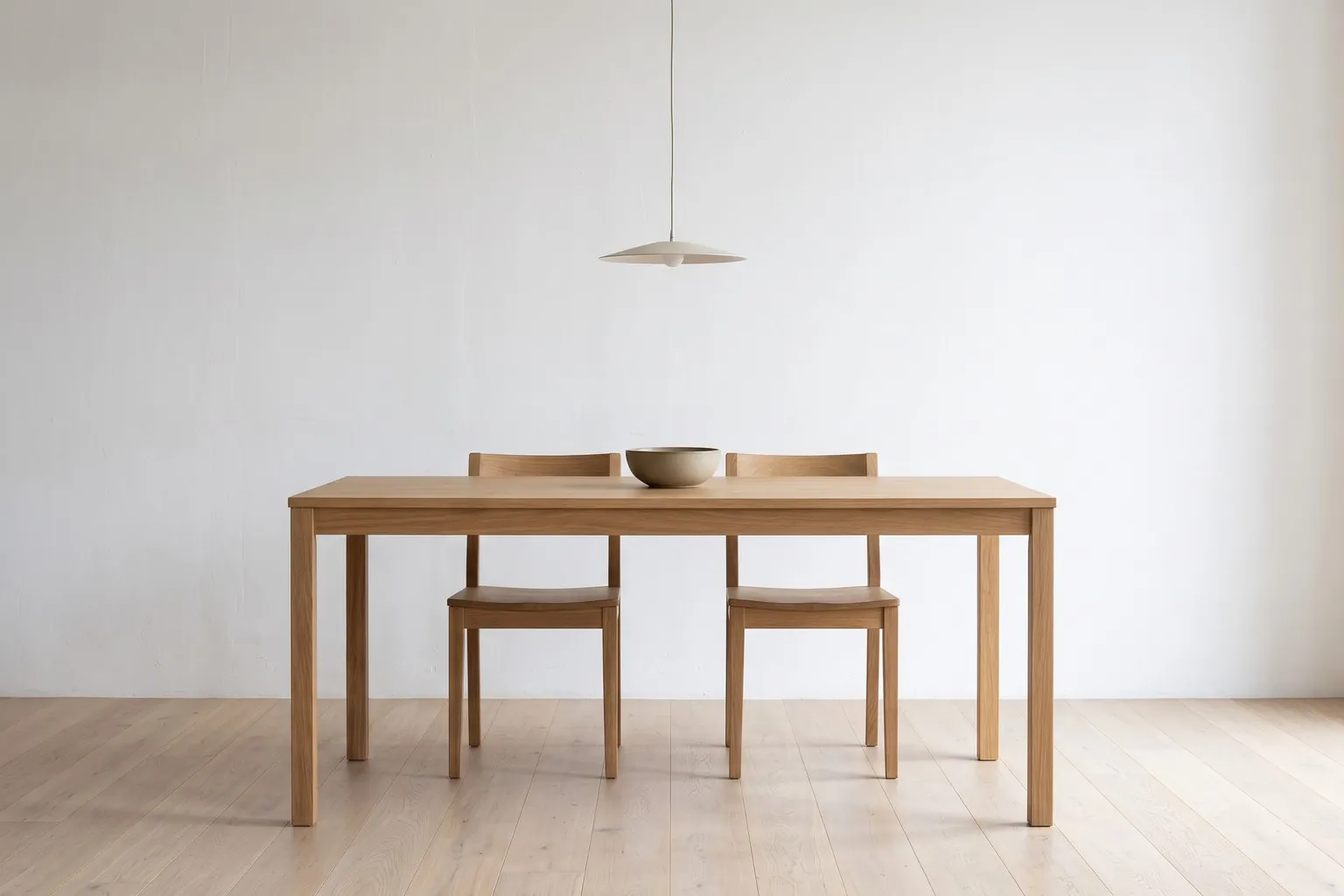
- A standard dining table is 28 to 30 inches high, floor to top. That is Castlery's range.
- The number that decides comfort is the gap between the seat and the table: 10 to 12 inches. A dining chair seat is usually 18 inches high.
- Counter height tables are about 36 inches and take seats of 24 to 26 inches. Bar height tables are about 42 inches and take seats of 28 to 30.
- Some guides measure the gap to the top of the table and some to its underside. Check which, and measure under the apron of your own table.
- Chairs with arms need a second check: the arms have to pass under the table.
In this guide
Dining tables are sold by length, and the length is what people measure. The height is printed further down the page and mostly ignored, because it is assumed to be standard.
It nearly is. But there are three standards, a few inches apart inside each one, and the chairs come from a different shop. Whether a meal at the table is comfortable depends on a single measurement that neither product page gives you: the distance from the seat to the table.
The standard: 28 to 30 inches
Castlery gives the height of a standard dining table as 28 to 30 inches, measured from the floor to the top of the table. Polywood, which makes outdoor furniture, gives a slightly wider range for its dining tables: 28 to 32 inches.
That height exists to match a chair. Bassett puts the usual dining chair at 18 inches from the seat to the floor, and Adorno's chair guide gives 17 to 19 inches as the standard seat height, with 18 the usual figure.
The same 28 to 30 inches turns up outside the dining room. Cornell University's ergonomics guide calls a flat surface 28 to 30 inches above the floor suitable for most adults for writing on paper. And the ADA Standards set the tops of accessible dining surfaces between 28 and 34 inches above the floor. A standard dining table sits at the bottom of that range.
The number that matters: the gap
Every source says the same thing in slightly different words: what matters is the space between the seat and the table.
| Source | Gap | Measured to |
|---|---|---|
| Castlery | 10 to 12 in | The tabletop |
| Bassett | 12 in | The tabletop |
| Eureka Ergonomic | 10 to 12 in | The tabletop |
| Hernest | 10 to 12 in | The underside of the tabletop |
| Adorno | 10 to 12 in | The underside of the table |
| Polywood | About 9 to 13 in | The underside of the table |
The figures agree. The reference point does not. Three of these sources measure up to the top of the table, where your plate is, and three measure to its underside, where your thighs are.
The two differ by the thickness of the top. Castlery gives a tabletop thickness of 3/4 inch to 1 inch, so on a plain slab table the two versions of the rule are an inch apart, and both leave you inside the range.
The difference grows when the table has an apron. The apron is the rail that runs under the top, between the legs. It holds the table together and it hangs lower than the top. None of the guides we read gives a standard depth for it, so this is a measurement to take yourself: from the floor to the lowest point under the table, on the side where a chair goes. That is the number your knees meet.
Seat against table: the sum
Here is the gap to the top of the table for every pairing of a standard seat and a standard table. These are our sums, with the pairings inside 10 to 12 inches marked.
| Seat height | 28 in table | 29 in table | 30 in table |
|---|---|---|---|
| 17 in | 11 in, fits | 12 in, fits | 13 in |
| 18 in | 10 in, fits | 11 in, fits | 12 in, fits |
| 19 in | 9 in | 10 in, fits | 11 in, fits |
| 20 in | 8 in | 9 in | 10 in, fits |
Read across the 18 inch row. It is the only seat that fits all three tables, which is a good explanation of why 18 inches became the usual figure.
Now read the corners. Eureka Ergonomic and Hernest both give 18 to 20 inches as the seat height of a dining chair. A 20 inch seat fits a 30 inch table and nothing lower. Under a 28 inch table it leaves 8 inches, and that is before the apron. So a tall chair and a low table, each of them standard, can make a pair that does not work.
The mistake in the other direction is rarer and less serious. A 17 inch seat at a 30 inch table leaves 13 inches. You sit a little low, with your elbows near the top of the table, and most adults will not mind.
Counter height and bar height tables
A dining table can also be built to the height of a kitchen counter or of a bar. Castlery gives those two as 36 inches and 42 inches. Other sources give ranges round the same figures.
| Type | Table height | Seat height |
|---|---|---|
| Standard dining | 28 to 30 in (Castlery), 28 to 32 in (Polywood) | 18 in usual (Bassett, Adorno) |
| Counter height | 36 in (Castlery), 34 to 37 in (Polywood) | 24 to 26 in (Hernest, Adorno), 24 to 27 in (Polywood) |
| Bar height | 42 in (Castlery), 40 to 42 in (Polywood) | 28 to 30 in (Hernest, Adorno), 28 to 32 in (Polywood) |
The gap rule does not change. Bob Vila states it for counters and bars alike: the seat should be 10 to 12 inches lower than the surface. Take 10 to 12 inches off a 36 inch table and you have a seat of 24 to 26 inches, which is the counter stool. Take the same off 42 and you have 30 to 32, the top of the range for bar stools.
One warning from Bob Vila before buying a tall table: the labels are loose. Its guide notes that counter height and bar height may be used interchangeably for tables, and that such tables are generally about 36 inches tall. So do not buy stools by the name on the table. Measure the table and subtract.
The sources are clear about who the tall tables suit.
- Young children. Polywood notes that children can typically get in and out of dining chairs without help, that small children may need help with counter seats, and that tall bar seats may be tricky for them. Bob Vila says tall tables are probably not a good idea in homes with young families.
- Small rooms. Polywood calls bar height ideal for smaller settings.
- Choice and price. Bob Vila points out that for counter and bar height tables the choice may be limited and prices can run high.
The stool side of the question, with knee room and the width each stool needs, is in our guide to bar stool height.
Chairs with arms
Arms add a second gap to check. An armchair at the head of the table has to slide under it, at least far enough to sit close.
Eureka Ergonomic gives the height of an armrest as 7 to 9 inches above the seat, and warns that armrests may not tuck fully under the table. Hernest's advice is to make sure the arms can slide completely under the tabletop. Castlery adds that armchairs need more space along the table than armless chairs.
The sum, on an 18 inch seat: the tops of the arms stand 25 to 27 inches from the floor. Under a 30 inch table with a 1 inch top, the underside is at 29 inches and the arms pass with 2 to 4 inches to spare. Under a 28 inch table the underside is at 27 inches, and the taller arms touch it. An apron takes more off both.
So for armchairs, compare two numbers before you buy: the floor to the top of the arm, from the chair's page, and the floor to the lowest point under the table.
Where the legs are
Height is one half of legroom. The other half is where the table's own legs stand.
Castlery allows around 24 inches of table width for each dining chair. A leg that falls inside one of those places takes the knee room of the person sitting there. Bassett's advice for more legroom is a pedestal base: one column in the middle leaves the whole edge of the table free.
With four corner legs, measure between the legs and not along the top. Divide that by 24 to see how many chairs sit clear of them on each side.
A bench at the table
A dining bench follows the chair. Groen's Fine Furniture gives the seat of a dining bench as 17 to 19 inches from the floor, the same range as a dining chair, so the gap sums above apply unchanged. The lengths and depths are in our guide to bench and chair seat height.
The table as a desk
More dining tables do a second job than product pages admit. The height is on your side here. Cornell's 28 to 30 inches for a writing surface is the same range as a dining table.
A keyboard is a different matter, because the ideal height for typing is lower than the ideal height for writing. Our guide to standard desk height works through that, with a table by the height of the sitter.
The light above the table
Table height sets one more number in the room. Castlery's advice for a pendant or a chandelier is to hang it approximately 30 to 36 inches above the tabletop.
Over a 30 inch table, that puts the bottom of the fixture 60 to 66 inches from the floor. Over a 36 inch counter height table the same rule gives 66 to 72 inches. If you change the table for a taller one, the light has to move with it.
How to measure before you buy
Three measurements settle everything in this guide.
- Floor to the top of the table. This is the figure on the product page.
- Floor to the lowest point under the table, where a chair goes. On a table with an apron, this is the bottom of the apron.
- Floor to the top of the chair seat. For a cushioned seat, measure with someone sitting on it. For an armchair, measure to the top of the arm as well.
Then check two gaps.
- Table top less seat: 10 to 12 inches.
- Underside less seat: enough for your thighs. Polywood's range, about 9 to 13 inches to the underside, is the guide.
If you are buying the table and the chairs together, do the first sum from the two product pages before anything else. If you already own one of the two, measure it, and let that number choose the other.
Which height to choose
- For everyday meals, and in any home with young children: standard height. Everyone can sit down and get up without climbing.
- For a small kitchen or a room where the table doubles as a work surface standing up: counter height, 36 inches, the same as the kitchen counter beside it.
- For a small space used mostly by adults, for short meals and drinks: bar height.
- If you want to use the chairs you have: measure their seats, add 10 to 12 inches, and buy the table that lands there.
How long and how wide the table should be, and the space it needs around it, are in dining table size and clearance. The rug that goes under it is in rug size for a dining table.
Questions people ask
What is the standard height of a dining table?
28 to 30 inches from the floor to the top, according to Castlery. Polywood gives 28 to 32 inches for its dining tables.
How high should a chair be for a 30 inch table?
A seat 18 to 20 inches high. That leaves the 10 to 12 inches between seat and tabletop that Castlery, Bassett and Eureka Ergonomic recommend.
How tall is a counter height table?
About 36 inches. Castlery gives 36, Polywood 34 to 37. It takes seats 24 to 26 inches high.
How tall is a bar height table?
About 42 inches. Castlery gives 42, Polywood 40 to 42. It takes stools with seats 28 to 30 inches high.
How much space should there be between a chair seat and the table?
10 to 12 inches. Castlery and Bassett measure it to the tabletop, Hernest and Adorno to the underside of the table. Check under the apron of your own table.
Sources
- Key dining table measurements. Castlery, read November 2026
- Standard size of a dining table. Bassett Furniture, read November 2026
- What's the difference between bar height and counter height?. Bob Vila, read November 2026
- Bar height vs. counter height furniture: a buying guide. Polywood, read November 2026
- Dining chair size guide. Eureka Ergonomic, read November 2026
- Dining chair height guide. Hernest, read November 2026
- Types of chairs: how to tell them apart. Adorno, read November 2026
- The ultimate guide to bench seat depth. Groen's Fine Furniture, read November 2026
- Computer workstation ergonomics guidelines. Cornell University Ergonomics Web, read November 2026
- ADA Accessibility Standards, section 902.3. U.S. Access Board, read November 2026
Every figure in this guide comes from the sources above, or from arithmetic shown in the text. See our editorial policy.