Rug size for a dining table: the 24 inch rule, and the sum for your table
A dining rug should reach at least 24 inches beyond the table on every side. An 8 by 10 fits tables up to 72 inches, a 9 by 12 up to 96. Sums by table and room.
The short answer
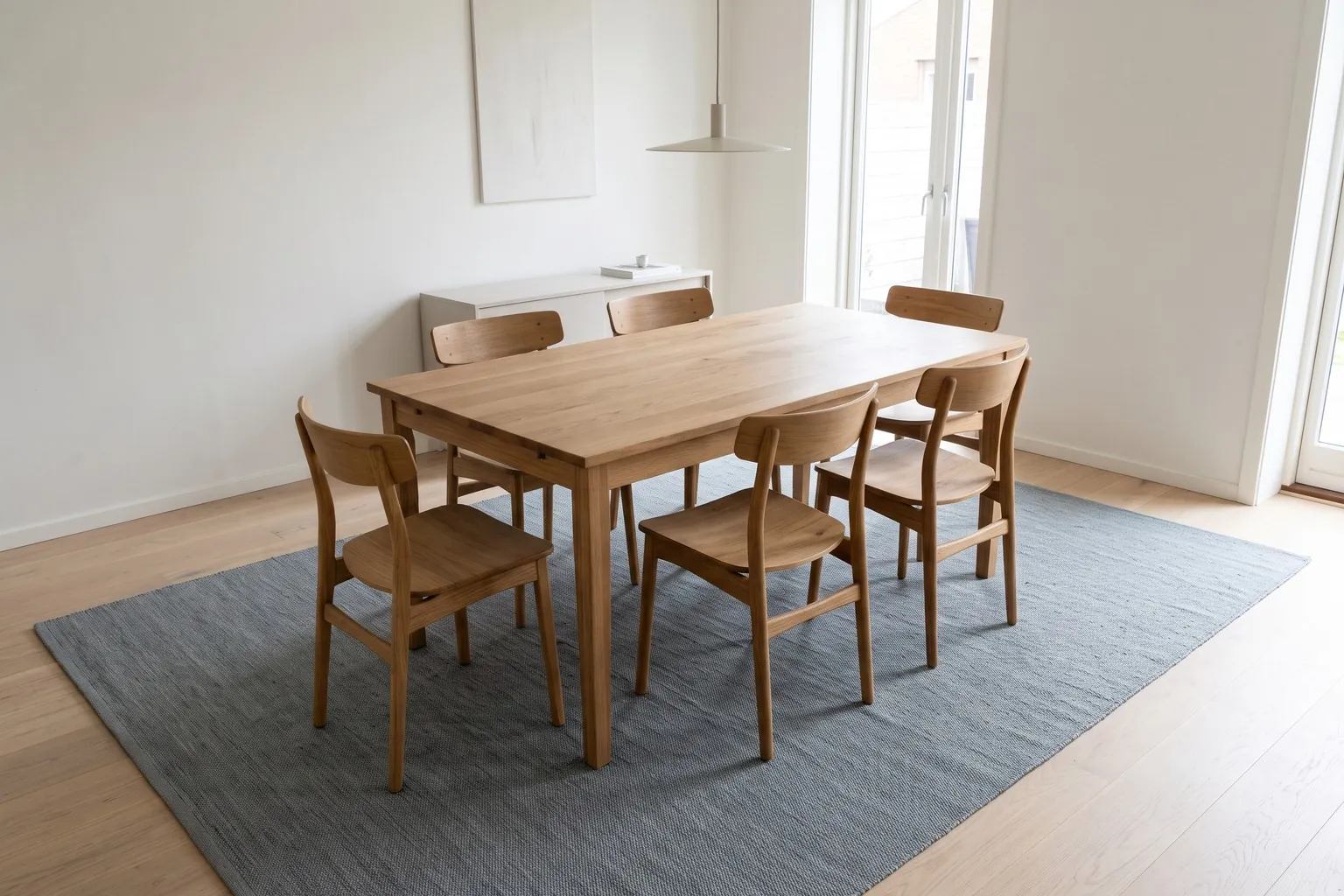
- A dining rug should extend at least 24 inches beyond the table on all sides, so the chairs stay on it when they are pulled out. Ruggable and Castlery give the same figure.
- As a sum: add 48 inches to the length of the table and 48 inches to its width. That is the smallest rug.
- An 8 by 10 foot rug meets the rule for tables up to 72 inches long. A 9 by 12 meets it up to 96 inches. Ruggable's chart moves up a size sooner.
- For a round table, Ruggable's rule is to add about 48 inches to the diameter.
- Keep at least 12 inches of floor between the rug and the walls, and choose a low pile or a flatweave.
In this guide
The rug under a dining table has a job no other rug in the house has. Furniture moves on it several times a day. Every chair slides out and back at every meal, with a person's weight on it for half of the trip.
So this is the one rug that is not sized for the furniture as it stands. It is sized for the chairs in the position they reach when someone gets up. That is where the number in every guide comes from.
The rule: 24 inches on every side
Ruggable states it plainly: a dining room rug should extend at least 24 inches beyond all sides of the table. The reason it gives is the chairs. They should remain fully on the rug even when pulled out, which prevents wobbling and wear. A chair that slides off the rug feels unstable, in Ruggable's words, and causes premature wear along the edges of the rug.
Castlery gives the same figure: at least 24 inches beyond the edge of the table on all sides.
Other sources bracket it. Homes and Gardens quotes one designer who gives 24 inches as the minimum and another who works with 18 to 24. Chairish goes the other way and calls about 3 feet the ideal.
| Margin beyond the table | Who gives it | Add to the table, each way |
|---|---|---|
| 18 in | The low end of one designer's range, in Homes and Gardens | 36 in |
| 24 in | Ruggable, Castlery, and the minimum in Homes and Gardens | 48 in |
| 36 in | Chairish, as the ideal | 72 in |
The last column is the useful one. A margin on every side is added twice in each direction, once at each end. Twenty four inches of margin means 48 inches more rug than table, in length and in width.
The sum for a rectangular table
Add 48 inches to the length and 48 inches to the width. Then round up to the next standard rug size. The table below does it for six common tables, and then shows what the standard size really leaves. These are our own sums.
| Table | Seats | Smallest rug by the 24 in rule | Standard size | Margin it leaves: long sides, ends |
|---|---|---|---|---|
| 36 by 60 in | 4 | 84 by 108 in | 8 by 10 ft | 30 in, 30 in |
| 36 by 72 in | 6 | 84 by 120 in | 8 by 10 ft | 30 in, 24 in |
| 40 by 72 in | 6 | 88 by 120 in | 8 by 10 ft | 28 in, 24 in |
| 40 by 84 in | 6 to 8 | 88 by 132 in | 9 by 12 ft | 34 in, 30 in |
| 42 by 96 in | 8 | 90 by 144 in | 9 by 12 ft | 33 in, 24 in |
| 44 by 108 in | 8 to 10 | 92 by 156 in | 10 by 14 ft | 38 in, 30 in |
The seat counts follow the 24 inches of table edge per person used in our guide to dining table size and clearance.
Two things stand out.
The width of the rug is never the problem. Dining tables are 36 to 44 inches wide, and even an 8 by 10 leaves 28 to 30 inches beside them. The rule is won or lost at the ends of the table, where the length of the rug runs out.
An 8 by 10 stops at 72 inches of table. A 72 inch table on a 120 inch rug leaves exactly 24 inches at each end. Any longer and the end chairs lose the rug when they are pulled out. A 9 by 12 stops at 96 inches for the same reason.
How the published charts compare
Ruggable's chart moves up a size before the sum requires it.
| Table, per Ruggable | Seats | Rug, per Ruggable |
|---|---|---|
| Rectangular, up to 60 in long | 4 | 8 by 10 ft |
| Rectangular, 72 to 84 in long | 6 | 9 by 12 ft |
| Rectangular, 90 to 108 in long | 8 | 10 by 14 ft |
| Oval, 60 to 72 in long | 6 | 9 by 12 ft |
| Oval, 84 in or longer | 8 | 10 by 14 ft |
At 72 inches the sum says an 8 by 10 is just enough, and Ruggable recommends a 9 by 12, which leaves 36 inches at each end. Both are right. The 8 by 10 meets the rule with nothing to spare, and the 9 by 12 is the comfortable version if the room takes it.
Chairish names the same two sizes for most dining rooms, 8 by 10 and 9 by 12, and 11 by 14 or 12 by 15 for grander ones.
Castlery's examples run smaller: a rug of about 60 by 96 inches for a table that seats four to six, and about 96 by 120 inches for six to eight. By its own 24 inch rule, a 60 by 96 inch rug fits a table no larger than 12 by 48 inches. Where an example and a rule disagree, do the sum for your own table.
Round, square and oval tables
For a round table, Ruggable's rule is to add approximately 48 inches to the diameter. Its chart pairs a round table of 42 to 48 inches, seating four, with an 8 foot round rug.
| Round table | Smallest rug across, by the rule |
|---|---|
| 42 in | 90 in (7 ft 6 in) |
| 48 in | 96 in (8 ft) |
| 54 in | 102 in (8 ft 6 in) |
| 60 in | 108 in (9 ft) |
| 72 in | 120 in (10 ft) |
These are our sums from Ruggable's rule. The figure is the width the rug needs in every direction, so a round rug of that diameter works, and so does a square or a rectangle whose short side is at least that long. A 48 inch round table sits correctly on an 8 by 10: 24 inches on two sides and 36 on the other two.
For a square table the sum is the same as for a rectangle: the side plus 48 inches. A 48 inch square table needs 96 inches each way, which is an 8 foot square or an 8 by 10.
On shape, Castlery notes that most guides say to match the shape of the rug to the shape of the table, and adds that there is no need to be afraid of mixing them. The sum does not care about the shape. It only asks that the margin is there in every direction a chair moves.
A table that extends
None of the guides we read covers leaves, so this part is our own reasoning from the rule.
A table that extends has two lengths, and the rug can only be right for one of them. Take a table that is 72 inches closed and 96 inches open.
| Rug | Margin at the ends, table closed | Margin at the ends, table open |
|---|---|---|
| 8 by 10 ft | 24 in | 12 in |
| 9 by 12 ft | 36 in | 24 in |
On the 8 by 10 the table is correct every day and wrong at every large dinner, when the two end chairs sit with their back legs off the rug. On the 9 by 12 it is generous every day and correct when extended.
If the leaf goes in a few times a year, buy for the closed table and accept it. If it goes in every week, buy for the open one.
Then check the room
The table sets the smallest rug. The room sets the largest. Ruggable gives both halves of that: leave at least 12 inches of visible floor between the edges of the rug and the walls, and to find the largest rug a room takes, subtract about 24 inches from its length and from its width.
| Dining room | Largest rug | Standard size that fits |
|---|---|---|
| 10 by 12 ft | 8 by 10 ft | 8 by 10 ft |
| 11 by 13 ft | 9 by 11 ft | 8 by 10 ft |
| 12 by 14 ft | 10 by 12 ft | 9 by 12 ft |
| 13 by 16 ft | 11 by 14 ft | 10 by 14 ft |
These are our own sums.
The two rules add up to a third. Twenty four inches of rug beyond the table, plus 12 inches of floor beyond the rug, is 36 inches from the edge of the table to the wall. That is the clearance our dining table guide asks for behind a chair. So a table that has exactly 36 inches to the wall takes a rug with nothing to spare, and a table that stands closer than that has no rug that satisfies both rules on that side.
A sideboard counts as a wall. Homes and Gardens advises keeping the rug off the sideboard: the rug belongs to the table and chairs and should stop before the cabinet. So on that side of the room, measure to the front of the sideboard and not to the wall behind it.
Two rooms, worked through
A 40 by 72 inch table in an 11 by 13 foot room. The smallest rug is 88 by 120 inches, so an 8 by 10 it is. It leaves 28 inches beside the table and 24 at the ends. The room would take a rug up to 9 by 11 feet, so the 8 by 10 fits, with 18 inches of floor showing all round. From the table edge to the wall there are 46 inches at the sides and 42 at the ends.
A 42 by 96 inch table in a 12 by 14 foot room. The smallest rug is 90 by 144 inches: a 9 by 12. It leaves 33 inches beside the table and exactly 24 at the ends. The room takes a rug up to 10 by 12 feet, so the 9 by 12 is the largest that fits, with 18 inches of floor at the sides and 12 at the ends. The table has 36 inches to the wall at each end, the minimum, and everything lines up with no margin for error. A table 6 inches longer would not work in this room with a rug.
Pile and material
Both rug sources say the same thing about the surface. Ruggable recommends durable, low pile or flatweave rugs so the chairs move easily. Castlery says to keep it low pile, because high pile rugs do not get along with sliding chairs or with sauce spills.
That is two reasons in one sentence. A chair leg sinks into a deep pile and has to be lifted to move. And this is the rug in the house most likely to have food dropped on it, so a flat, tight surface is the one that can be cleaned.
When no rug is the right answer
Castlery puts it directly: a rug under a dining table is a stylistic choice, not a hard rule.
The sums tell you when to take that option. Suppose a 36 by 60 inch table in a room of 9 by 10 feet. The table needs a rug of at least 84 by 108 inches. The room takes a rug of at most 84 by 96 inches. The rule fails at the ends of the table by 6 inches each, and no standard size fixes it.
A rug that is too small is worse than none. Ruggable lists chairs catching on the edge of the rug among the results of choosing the wrong size, and that is exactly what happens when the edge lies where the back legs travel. In that room, a bare floor is the better dining room.
Check it with tape
- Measure the table, with the leaf in if you use it often.
- Add 48 inches to the length and to the width.
- Round up to a standard size: 8 by 10, 9 by 12 or 10 by 14 feet.
- Subtract 24 inches from the length and width of the room, and make sure the rug is not larger than that.
- Mark the rug's outline on the floor with painter's tape. Pull every chair out as far as you do to stand up. All four legs of every chair should still be inside the tape.
The fifth step is the one that catches mistakes. It takes ten minutes and it tests the only thing the rule is about.
The standard sizes, in feet and in inches, are in our guide to rug sizes, and the height that goes with the table is in dining table height.
Questions people ask
What size rug goes under a dining table?
One that reaches at least 24 inches beyond the table on every side, which means the table's length and width plus 48 inches each. An 8 by 10 covers tables up to 72 inches long and a 9 by 12 covers tables up to 96 inches.
What size rug for a 72 inch dining table?
An 8 by 10 meets the 24 inch rule exactly, with 24 inches at each end. Ruggable's chart recommends a 9 by 12 for tables of 72 to 84 inches, which leaves 36 inches at the ends.
What size rug for a round dining table?
Ruggable's rule is to add about 48 inches to the diameter. A 48 inch round table needs a rug 8 feet across, round or square, or an 8 by 10.
Should dining chairs sit fully on the rug?
Yes, even when pulled out. Ruggable says chairs should remain fully on the rug when pulled out, to prevent wobbling and wear along the edges.
Do you need a rug under a dining table?
No. Castlery calls it a stylistic choice and not a hard rule. If the room cannot take a rug 48 inches longer and wider than the table, a bare floor works better than a small rug.
Sources
- Dining table rug size guide. Ruggable, read November 2026
- How to choose the right dining room rug. Castlery, read November 2026
- The ultimate rug sizing guide. Chairish, read November 2026
- The ultimate rug size guide. Homes and Gardens, read November 2026
Every figure in this guide comes from the sources above, or from arithmetic shown in the text. See our editorial policy.