How to clean a rug: by material, by stain, and how to dry it
Vacuum weekly, blot spills and never scrub. Synthetic and cotton rugs can be washed at home, wool with care, jute and silk kept dry. Recipes with quantities.
The short answer
- Identify the fiber first. Synthetic and cotton rugs can be washed at home. Wool takes cool water and a neutral detergent, without soaking. Jute, sisal, viscose and silk are kept dry or sent out.
- Vacuum at least once a week. That is the Carpet and Rug Institute's figure, and it calls vacuuming the most important cleaning activity.
- On a spill: blot with a white cloth, do not scrub, test the cleaner on a hidden spot, work from the edge to the center, rinse with cold water.
- The trade association's detergent recipe is very dilute: 1/4 teaspoon of clear dishwashing liquid in 1 cup of warm water. It says never to use laundry detergent.
- Dry it fast. The institute says within 12 hours. The Environmental Protection Agency gives 24 to 48 hours as the limit before mold can grow.
In this guide
- First, the fiber
- Level one: the vacuum
- Level two: a spill
- The recipes, with their quantities
- What not to use, and where the sources split
- Stains, one by one
- Level three: washing the whole rug
- Wool
- Jute, sisal and seagrass
- Rugs for the washing machine
- Drying
- How often to deep clean
- When to call a professional
- Small repairs
- Before you start, in six checks
Cleaning a rug starts with the rug, not with the method. Water that suits a polypropylene rug does not suit a jute one, and can damage a viscose one.
This guide sorts rugs by fiber, then goes through the three levels of cleaning: the vacuum, the spill, the full wash. It gives the recipes with their quantities and says which source each comes from, because they do not all agree. To choose the size of a rug before you ever have to clean it, see our guide to rug sizes. Upholstery follows its own codes, in how to clean a couch.
First, the fiber
Look for the care label. What the rug is made of decides everything else.
| Fiber | Water | What the sources say |
|---|---|---|
| Synthetic: nylon, polyester, polypropylene | Yes | Most cleaning methods can be used. Can be steam cleaned. |
| Cotton | Yes | The one natural fiber the trade association does not steer away from home cleaning. |
| Wool | A little, cool | Neutral detergent, no bleach, no soaking, dried quickly. |
| Jute, sisal, seagrass, coir | As little as possible | Dry shampoo at home, or a professional. |
| Viscose | No | Not designed to get wet. Spot clean and vacuum gently. |
| Silk | No | A dry cleaning process, by professionals. |
| Oriental, Turkish and Persian rugs | Ask | By the maker's specifications, or a professional service. |
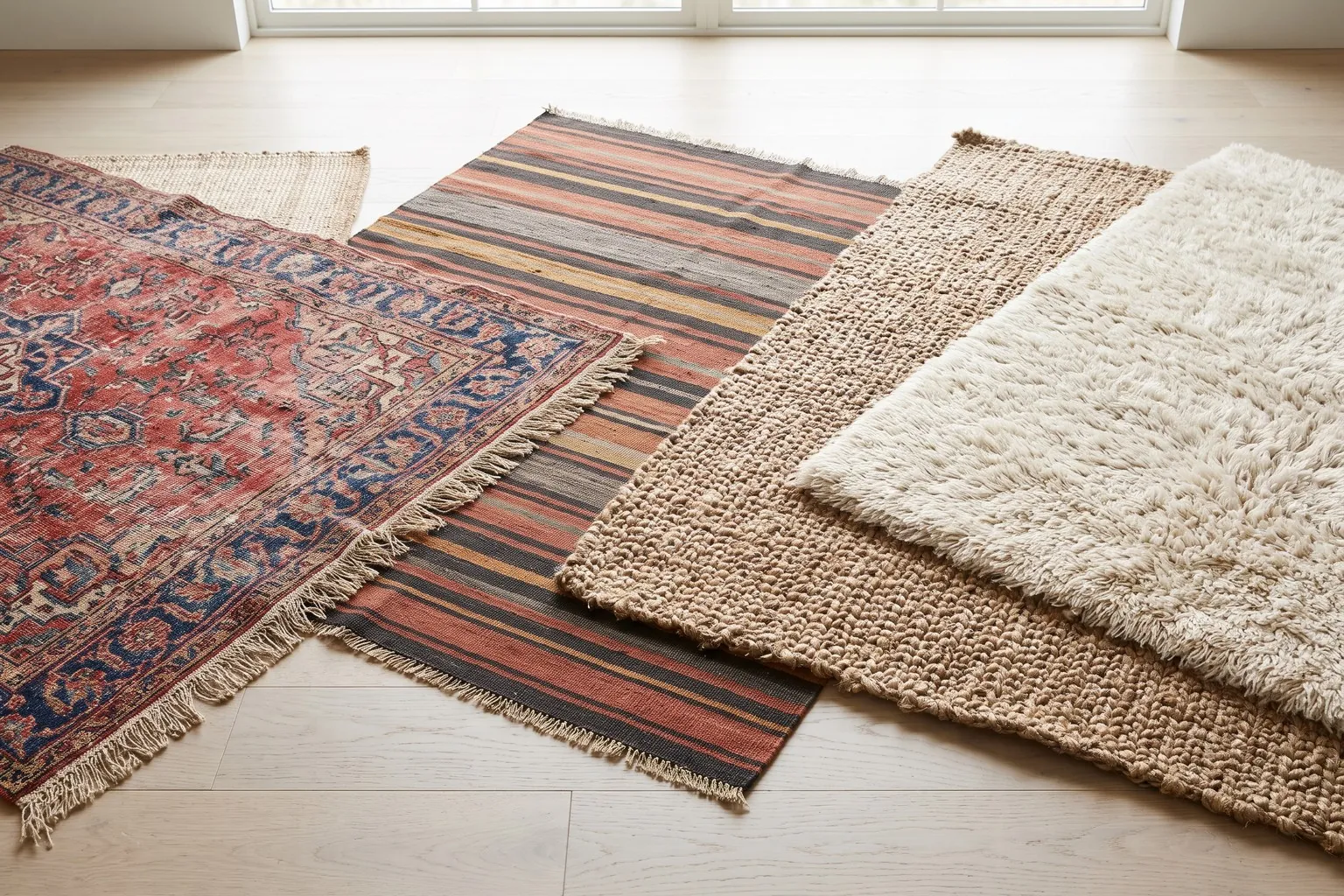
The Carpet and Rug Institute, the national trade association for the industry, draws the main line. Most cleaning methods can be used on synthetic fibers. Natural fibers sometimes require specialized care, and it discourages do-it-yourself cleaning of area rugs containing natural fibers other than cotton.
On wool it is specific: avoid excessive agitation and excessive heat, since wool can be easily damaged by bleaches and alkalies, and clean it with neutral detergents, pH 5.0 to 8.0, drying quickly to limit yellowing or browning.
On silk: a dry cleaning process, best left to professionals, because the fibers may be damaged by high temperatures, high pH and sunlight, and lose strength when wet.
On plant fibers, a list that includes sisal, jute and coconut: it is best to use a carpet cleaning professional.
Homes and Gardens adds viscose: viscose rugs are not designed to get wet, and if they do, they will draw water in and become damaged.
How each construction and fiber is made, and where each belongs, is in our guide to types of rugs.
Level one: the vacuum
The institute's care guide says regular vacuuming is the most important cleaning activity. Dry soil that stays in a rug damages the fibers.
How often. The sources give different figures, and the difference is mostly the fiber and the traffic.
| Source | How often |
|---|---|
| Carpet and Rug Institute | at least once a week, more in high-traffic areas and with pets |
| Homes and Gardens | weekly |
| Livingetc | at least twice a week in rooms with high foot traffic, every seven to ten days elsewhere |
| Real Homes | every couple of weeks; wool about once a month |
| This Old House, for wool | at least twice a month, more with traffic or pets |
How. The details change with the rug.
- Fringe. The institute: use gentle suction, start from the center and vacuum toward the fringe, taking care not to catch the strands in the beater bar.
- Wool. This Old House sets the vacuum to its highest height setting to avoid damaging the fibers, starts in the middle and works outward, and uses the handheld attachment on the fringe.
- Jute. Real Homes uses an attachment or a suction setting, to keep rotary brushes off the fibers.
- Long pile. Real Homes and Livingetc both use the upholstery attachment.
- Both sides. This Old House vacuums a wool rug thoroughly on both sides before cleaning it.
Shake and beat. For a larger rug, the institute's method is to shake it outside first, then put it over a clothesline and beat it, then vacuum.
Turn it. This Old House rotates a wool rug every six months. The institute says to move furniture and reverse area rugs to change the traffic flow.
The bag. Empty or replace it when it is one-half to two-thirds full, says the institute.
Level two: a spill
Act quickly. The institute's guide puts it in capitals and gives the sequence.
- Blot. With a dry, white, absorbent cloth or white paper towels with no printing.
- Do not scrub. Scrubbing can cause pile distortion. Scrape up semi-solids with a rounded spoon. Break up solids and vacuum them.
- Test. Put several drops of the cleaner on a hidden spot, hold a white cloth on it for 10 seconds, and look for color transfer, color change or damage.
- Apply to the cloth, not the rug. A small amount on a white cloth. Let it sit about 10 minutes, then work in gently.
- Edge to center. So the spill does not spread. Blot, and repeat while the spill keeps coming up on the cloth.
- Rinse. Thoroughly with cold water, and blot dry until all of the solution is gone.
- Weigh it down. A half-inch layer of white paper towels on the spot, under a flat, heavy object that will not fade.
The rinse matters. The institute says what happens without it: soiling that appears after spot cleaning is most often caused by cleaning solution left in the rug.
The recipes, with their quantities
Here are the home solutions as each source gives them. They are not the same. For detergent and for ammonia, the institute's own guide is weaker than the spot guide a rug maker publishes in its name. For vinegar it is stronger.
| Solution | Recipe | Source |
|---|---|---|
| Detergent | 1/4 teaspoon clear dishwashing liquid in 1 cup warm water | Carpet and Rug Institute, care guide |
| Detergent | 2 teaspoons mild liquid detergent in 2 cups water | Capel Rugs, a spot guide it says the institute furnished |
| Detergent, for jute | 1 teaspoon detergent, 1 teaspoon white vinegar, 2 quarts lukewarm water | Real Homes |
| Detergent and vinegar, for red wine | 1 tablespoon dish soap, 1 tablespoon white vinegar, 2 cups warm water | Livingetc |
| White vinegar | 1 cup vinegar to 1 cup water | Carpet and Rug Institute, care guide |
| White vinegar | 1 cup vinegar to 2 cups water | Capel Rugs |
| White vinegar | 1 part vinegar to 3 parts water | Real Homes |
| Ammonia | 1 tablespoon household ammonia in 1 cup water | Carpet and Rug Institute, care guide |
| Ammonia | 2 tablespoons household ammonia in 1 cup water | Capel Rugs |
Whichever you use, do not strengthen it. The institute's rule is to keep to the recommended concentration, because stronger solutions may cause accelerated re-soiling. It leaves its detergent solution on the spot for 10 to 15 minutes.
Its detergent is a clear dishwashing liquid, with no bleach, no lanolin and no optical brighteners. Ammonia comes with a warning in bold: used improperly, it can cause a color change. And the Environmental Protection Agency adds the rule for any cupboard: never mix chlorine bleach solution with cleaning solutions that contain ammonia.
What not to use, and where the sources split
The institute's guide has a short list of things never to put on a rug.
- Laundry detergent, of any type, because it may contain optical brighteners that dye the fiber.
- Automatic dishwasher detergent, because many contain bleaching solutions that can destroy the color.
- Soap, and strong household cleaners made for hard surfaces.
This is where the magazines part from the trade association. Homes and Gardens washes a rug with a mild laundry detergent, and the expert it quotes mixes water with a non-bio washing detergent for wool. Real Homes uses a capful of non-bio laundry detergent in cold water on wool. This Old House sides with the institute: it says to avoid regular laundry detergents and bleach on wool, as these can damage the fibers or cause colors to bleed, and uses a wool-safe detergent.
We report both. If you follow the association that speaks for the makers of the rug, the detergent is dishwashing liquid, clear, and very dilute.
Two more cautions come from single sources. The institute's website says not to steam clean urine spots, because the heat will set the stain and the smell. Real Homes says not to use hot water on a cotton rug.
Stains, one by one
Pet urine. The institute's method is to extract the spill with a wet vacuum and rinse with cool water to reduce the odor. The spot guide Capel Rugs publishes gives the order of solutions for fresh urine: detergent, then ammonia, then vinegar, then lukewarm water, then a professional if it remains. For dried urine it puts lukewarm water second and ammonia fourth. Homes and Gardens has a step for a dried patch: while the treated area is still wet, cover it with baking soda, rub it in gently, leave it to dry for a day or so, and vacuum thoroughly.
Vomit. The same spot guide: detergent, ammonia, vinegar, lukewarm water, then a spot removal kit, then a professional.
Red wine. Livingetc's expert blots, pours on a small amount of cold water to keep the wine from setting, blots again, then uses the dish soap and vinegar mix in the table, from the edges to the center. Rinse with cold water and dry thoroughly.
Grease. This Old House sprinkles cornstarch or baking soda on the area.
Mud. Real Homes: leave it to dry, then vacuum it first.
Smells. Homes and Gardens leaves baking soda on the rug for at least 30 minutes before vacuuming. Livingetc sprays equal parts white vinegar and water.
If a spot will not come out, the institute, Capel, Real Homes and This Old House all send you to a professional. The institute's wording: a certified cleaning professional will be able to consult and provide solutions.
Level three: washing the whole rug
This is for rugs that take water: synthetic and cotton. For the others, see the next two sections.
Homes and Gardens, Livingetc and Real Homes describe the same job in slightly different words.
- Pick the day. Sunny, with no rain forecast.
- Vacuum first. The institute: always vacuum first to remove as much dry soil as possible.
- Take it outside, onto a tarp. Real Homes notes that a small rug can go in the bathtub.
- Test the cleaner on a small area.
- Wet and wash in sections. Livingetc's expert uses pH-neutral dish soap and water with a soft-bristled brush. Homes and Gardens puts a mild detergent or a carpet shampoo in a spray bottle with water and scrubs small sections. On cotton, Real Homes works the solution to a lather with a sponge and lets it sit for five minutes.
- Rinse with a garden hose from one end to the other, then flip the rug and repeat, until no suds or foam remain.
- Get the water out. Squeeze it, or roll the rug and stand on it.
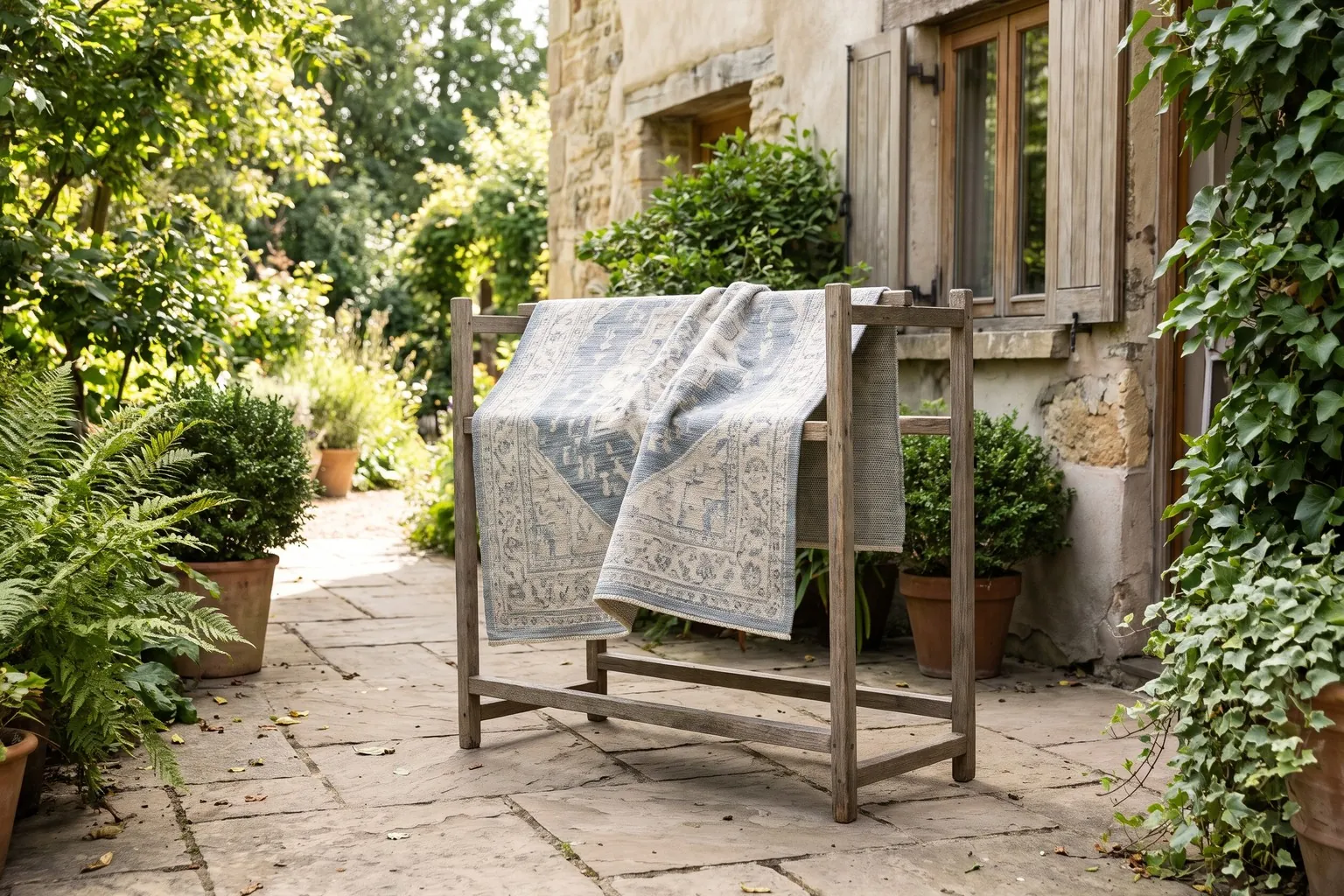
- Dry on a rack, in moving air, out of direct hot sun.
The institute's precautions for any wet method fit here. Use only the recommended solution strength. Rinse all the detergent out. And do not overwet: overwetting may cause separation of the backing, shrinkage, discoloration and odor.
Outdoor rugs. The institute's method: sweep with a broom or deck brush, spread a carpet cleaning solution with a garden sprayer, work it into the pile with a scrub brush, rinse thoroughly with a garden hose, and let it dry completely before vacuuming. Livingetc's expert allows a pressure washer, starting on a lower setting, after a test on a hidden spot.
Steam. Livingetc's expert says synthetic fibers such as nylon, polyester and polypropylene can be steam cleaned, and that seagrass, jute and sisal are prone to shrinking and warping under steam.
Wool
Wool is cleaned damp, never soaked.
This Old House gives two methods.
Dry. Beat the rug outdoors and vacuum both sides. Sprinkle a wool-safe dry cleaning powder, work it in with a soft brush, leave it for the time on the product, and vacuum thoroughly.
Wet. Test for colorfastness and vacuum. Prepare two buckets: cool water with wool-safe detergent, and clean rinse water. With a soft sponge, work a small section at a time, scrubbing gently and without saturating the fibers. Rinse and blot each section, move on, and hang the rug to dry.
Livingetc's expert makes the same point from the other side: you must avoid drenching a wool rug, and blot any excess water with clean towels.
For an antique or valuable wool rug, This Old House says to avoid wet cleaning unless absolutely necessary.
Jute, sisal and seagrass
Keep them dry. Livingetc's rug expert: water and jute don't mix, so use as little water as possible. Jute absorbs moisture and holds on to it, which can lead to damp and mold.
Homes and Gardens gives the dry method. Sprinkle absorbent dry shampoo granules over the rug. Work them in with the brush head of the vacuum, with the machine switched off. Leave them about one hour, then vacuum them out.
For a spot, Real Homes uses the very dilute mix in the recipe table, blots, and rolls the damp area in a dry towel.
Rugs for the washing machine
Most rugs do not go in one. Livingetc says most rugs are not machine-wash compatible, and Homes and Gardens says the answer is usually no unless the care label specifies that you can.
For the small rugs and bath mats that do, the institute gives the settings: warm water, 90 to 105 degrees Fahrenheit, with a neutral, mild detergent, rinsed thoroughly, and tumble dried at the lowest possible heat. Larger ones may be spread in a shaded area and brushed lightly to help them dry.
Livingetc washes bathroom rugs every two weeks at the very least.
Drying
Drying is half of cleaning, and it has deadlines.
| Source | Figure |
|---|---|
| Carpet and Rug Institute | dry within 12 hours, with ventilation or fans |
| Environmental Protection Agency | dry water-damaged items within 24 to 48 hours to prevent mold growth |
| Real Homes | about three to four hours |
| This Old House, wool | several hours to a full day |
| Homes and Gardens | a whole day, in its expert's experience |
| Livingetc, wool | fans or a dehumidifier for up to 24 hours if needed |
The agency's figure is the outer limit and not a target. It says that if wet materials are dried within 24 to 48 hours, in most cases mold will not grow, and it names the underside of carpets and pads among the places where mold hides.
How to dry, from the same sources:
- Hang the rug outdoors on a sturdy clothesline or a rack, or indoors with fans.
- Keep it away from radiators and out of direct sunlight, which This Old House says can cause shrinkage.
- Make sure both sides dry completely.
- Do not walk on it until it is dry, says the institute.
- Let it air for a day before the furniture goes back, says This Old House.
How often to deep clean
| Source | How often |
|---|---|
| Carpet and Rug Institute | a restorative cleaning every 12 to 18 months |
| This Old House, wool | about once a year |
| Homes and Gardens | around twice a year, more in a high-traffic spot |
| Livingetc | bedroom and living room rugs every six months, entry and kitchen rugs every three |
| Real Homes | no fixed schedule: when it is visibly dirty or smells |
The institute's reason for not waiting: letting rugs become excessively soiled makes cleaning more difficult and shortens their useful life.
When to call a professional
By fiber, from the first table: silk, plant fibers, and Oriental, Turkish and Persian rugs, on the institute's advice.
By symptom, This Old House lists five: deep-set stains that home remedies cannot remove, water or mold damage, a persistent odor, color bleeding or fading, and a rug that has not been professionally cleaned in several years.
On price, we found no figure in these sources. The institute explains how it is set: most cleaning is priced on the total number of square feet. It advises a visit to see the rug, a written agreement before work begins, and caution with a price that seems too good to be true.
Small repairs
The institute's guide also covers what cleaning does not fix.
- A loose tuft. Snip it level with the others. Do not pull it out.
- A dent from furniture. Spritz it with water, hold a hair dryer on medium a few inches above, and work the pile upright with your fingers.
- Shedding. Most of it gradually disappears within the first year.
- Fading. Give the rug the protection from direct sunlight you would give any colored fabric.
Before you start, in six checks
- The label. Fiber and care instructions.
- The test. Cleaner on a hidden spot, white cloth, 10 seconds.
- The vacuum. Before anything wet.
- The detergent solution. A quarter teaspoon of clear dish liquid per cup of warm water, and no stronger.
- The rinse. Until nothing is left in the rug.
- The drying plan. Where it will dry, in under 12 hours, before you wet it.
Questions people ask
How do you clean a rug at home without a machine?
Vacuum it, test your cleaner on a hidden spot, then wash a synthetic or cotton rug outdoors with mild dish soap, a soft brush and a hose, rinsing until no suds remain. Dry it fast.
Can you put a rug in the washing machine?
Only if the care label says so. For small washable rugs, the Carpet and Rug Institute gives warm water at 90 to 105 degrees Fahrenheit, mild detergent and the lowest dryer heat.
How do you clean a wool rug?
With cool water and a wool-safe, neutral detergent, a small section at a time, without saturating the fibers. No bleach. Dry both sides completely. Valuable rugs go to a professional.
How do you get pet urine out of a rug?
Blot, extract with a wet vacuum and rinse with cool water. A published spot guide then uses a detergent solution, ammonia, vinegar and lukewarm water in turn. Do not steam clean it.
Can I use laundry detergent on a rug?
The Carpet and Rug Institute says never, because of optical brighteners that can dye the fiber. Some magazines do use it. The institute's recipe is 1/4 teaspoon of clear dish liquid per cup of water.
How long does a rug take to dry?
From three or four hours to a full day, depending on size and thickness. The institute says to have it dry within 12 hours. Mold can grow after 24 to 48 hours of damp.
How often should a rug be deep cleaned?
The Carpet and Rug Institute recommends a restorative cleaning every 12 to 18 months. Magazines give six months to a year, sooner in entries and kitchens.
Sources
- Carpet and rug care guide. The Carpet and Rug Institute, read November 2026
- Cleaning and maintenance. The Carpet and Rug Institute, read November 2026
- A brief guide to mold, moisture and your home. U.S. Environmental Protection Agency, read November 2026
- How to clean a wool rug. This Old House, read November 2026
- How to clean an area rug. Homes and Gardens, read November 2026
- How to clean a rug. Real Homes, read November 2026
- Rug care. Livingetc, read November 2026
- Spot cleaning guide. Capel Rugs, read November 2026
Every figure in this guide comes from the sources above, or from arithmetic shown in the text. See our editorial policy.