Types of rugs: how they are made, what they are made of, and the pile
Hand-knotted, hand-tufted, hooked, flatweave or machine-made; wool, cotton, jute, silk or synthetics; low, medium or high pile. What each is, and where it belongs.
The short answer
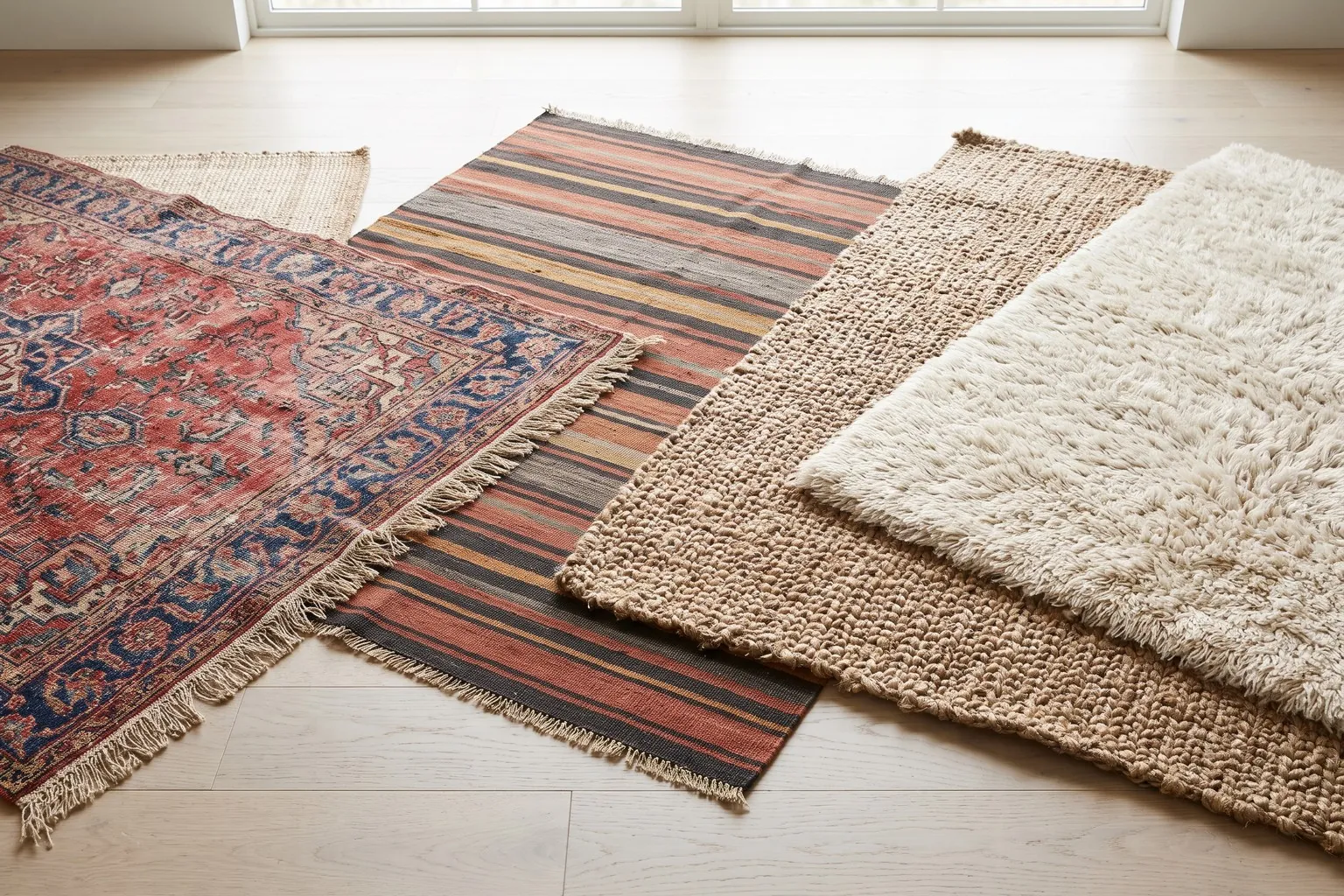
- A rug is described three ways: how it is made (hand-knotted, hand-tufted, hooked, flatweave, braided, machine-made), what it is made of (wool, cotton, silk, plant fibers, synthetics), and the height of its pile.
- Hand-knotted rugs are the most labor-intensive and the most expensive, and can last decades. Hand-tufted rugs look similar for far less, but wear faster.
- Flatweaves have no pile: durable, easy to clean, often reversible, good for traffic.
- Wool is soft, strong and naturally stain resistant. Polypropylene is the most fade- and stain-resistant. Jute and sisal absorb water.
- Low pile, under 1/4 inch, suits kitchens, hallways, stairs and entries. High pile, 1/2 to 3/4 inch, suits bedrooms and living rooms.
In this guide
The same rug can be described in three ways, as in "hand-tufted wool, medium pile". Each part answers a different question. The construction says how long it will last and what it costs. The fiber says how it feels, how it cleans and where it can go. The pile says how it feels underfoot and how it handles traffic.
This guide takes them one at a time, then puts them together room by room. How to size a rug is in our guide to rug sizes, and how to clean each kind in our guide on how to clean a rug.
Our sources are a rug retailer, Rugs.com; Bob Vila's guide to rug types; the Carpet and Rug Institute, the trade association; and Homes and Gardens on viscose.
By construction
| Type | How it is made | What the sources say |
|---|---|---|
| Hand-knotted | knots tied one by one | the best have hundreds of knots per square inch and take months; often thousands of dollars; can last decades (Rugs.com) |
| Hand-tufted | yarn pushed through a canvas or jute backing with a tufting gun, then coated with latex | yarns more likely to pull out; more prone to wear; far cheaper (Rugs.com); more decorative than durable, not for high traffic (Bob Vila) |
| Hand-hooked | small loops pulled through a canvas | fairly durable and long-lasting, fairly pricey (Bob Vila) |
| Flatweave | woven, no pile; kilims, dhurries | extremely durable, very easy to clean, show little wear (Rugs.com); reversible, ideal for high traffic (Bob Vila) |
| Braided | traced to the American colonial period; chindi rugs from cotton scraps | (Rugs.com) |
| Jacquard woven | woven on a jacquard loom | extremely durable, for high-traffic areas (Bob Vila) |
| Machine-made | computer-controlled looms | uniform pile, serged or bound edges, affordable and durable (Bob Vila); a fraction of the price of handmade (Rugs.com) |
| Shag | ultra-long pile | highly decorative but not very durable (Bob Vila) |
Hand-knotted. Bob Vila gives the measure of quality: the number of knots per square inch, and the more knots, the better. It adds that the design shows on both sides. Rugs.com: properly cared for, they can last decades.
Hand-tufted. The two sources agree on the trade: cheaper than knotted, and less durable. Bob Vila warns that a tufted rug can come apart if cleaned too vigorously.
Flatweave. Bob Vila says flat woven rugs have no backing, so they are reversible, and that they release pet hair easily with a quick vacuum. Rugs.com says synthetic flatweaves are perfect outdoors.
How to tell them apart
Turn the rug over. The sources give the signs, one construction at a time.
- Hand-knotted: the design shows on both sides, by Bob Vila's account.
- Hand-tufted: the back is a canvas or jute backing, by Rugs.com, coated with latex or a similar layer, by Bob Vila.
- Flatweave: no backing at all, so it is reversible (Bob Vila).
- Machine-made: a pile of uniform height and serged or bound edges (Bob Vila).
Then read the label for the fiber, and feel the pile. The price is a further clue, since the sources rank knotted far above tufted and machine-made: our reading of their figures.
By fiber
| Fiber | Strengths | Limits |
|---|---|---|
| Wool | soft, strong, dyes well, naturally stain resistant (Rugs.com); lasts a lifetime (Bob Vila) | more expensive than synthetics; not for kitchens or bathrooms; typically spot-clean only (Bob Vila) |
| Cotton | small rugs can be machine-washable (Bob Vila) | fades rather quickly, prone to staining, not as durable (Bob Vila) |
| Silk | extremely fine (Bob Vila) | delicate; hard to clean, often professionally; for low-traffic rooms (Bob Vila) |
| Jute, sisal, seagrass | very strong, relatively low-cost (Rugs.com) | extremely absorbent, especially jute (Rugs.com); subject to fading (Bob Vila) |
| Polypropylene | solution-dyed, extremely colorfast, highly resistant to fading and staining, can be cleaned with water or bleach, resists mold (Bob Vila) | |
| Nylon | gets hot in the sun, shows dirt easily (Bob Vila) | |
| Polyester | can mat down in traffic, prone to shedding or pilling (Bob Vila) | |
| Acrylic | resists fading, staining, mold and mildew (Bob Vila) | not as durable as other synthetics (Bob Vila) |
| Viscose | not designed to get wet; draws water in and is damaged (Homes and Gardens) |
Rugs.com puts the market in one line: synthetics such as polypropylene and polyester are far and away the most common rug materials today, at a fraction of the price of wool.
Bob Vila sums up the natural and synthetic split: natural fibers are less durable and less resistant to staining and fading than synthetics.
Natural or synthetic: the trade
Bob Vila sets out both sides.
- Natural fibers (wool, cotton, silk, jute, sisal, seagrass) are less durable and less resistant to staining and fading than synthetics. Wool is the exception on durability, and it calls wool a sustainable natural fiber.
- Synthetic fibers resist fading, stains, mold and mildew, and many are machine-washable. But nylon and polyester, it says, are not an eco-friendly choice, and each has its own flaw: nylon gets hot in the sun and shows dirt, polyester mats and sheds.
Rugs.com adds the price side: synthetics cost a fraction of wool, and plant fibers are relatively low-cost and very strong.
So the choice turns on where the rug goes. Traffic, water and sun favor synthetics; feel and longevity favor wool: our summary of the sources above.
Wool, the reference
Wool is the fiber the others are compared with. Rugs.com says it is not necessarily harder to clean than other materials, but advises against an expensive wool rug where muddy shoes come in.
The Carpet and Rug Institute's care guide sets the rules for cleaning it: avoid excessive agitation and heat, since wool is easily damaged by bleach and alkalies; clean it with neutral detergents, pH 5.0 to 8.0; and dry it quickly. It adds that wool carpet made in the United States is treated to be permanently moth resistant.
Plant fibers and water
Jute, sisal and seagrass share one weakness. Rugs.com: natural fibers, especially jute, are extremely absorbent. Outdoors, it advises keeping a natural rug in a covered area and rolling it up when it rains, since rain can lead to mold, mildew, discoloration, odors and dry rot. Bob Vila says to use a plant fiber rug outdoors only if it has been treated with a preservative.
The Carpet and Rug Institute's guide groups sisal, jute, coir and other plant fibers as specialized products, best cleaned by a professional.
By pile height
Pile is the height and density of the fibers, and it can be looped or cut, by Bob Vila's definitions.
| Pile | Height | Where it suits |
|---|---|---|
| Low, or none | under 1/4 in | kitchens, stairs, hallways, entries: the most durable |
| Medium | 1/4 to 1/2 in | an all-purpose choice, comfort and durability |
| High | 1/2 to 3/4 in | bedrooms and living rooms; can mat down in traffic |
| Shag | 1 to 2 in | decorative, not durable |
All four figures are Bob Vila's. Our rug sizes guide adds two practical checks on thick pile: a door that swings over the rug has to clear it, and dining chairs slide more easily on a low pile or a flatweave.
Indoors, outdoors and washable
Outdoors. Bob Vila: many outdoor rugs are synthetic, for color, durability and resistance to fading, mildew and mold. It says polypropylene does not absorb liquid, which helps it resist mold and mildew.
Washable. Bob Vila: many synthetic rugs are machine-washable, which makes them the best type for bathrooms; check the maker's instructions. The Carpet and Rug Institute's settings for small washable rugs: warm water, 90 to 105 degrees Fahrenheit, a mild detergent, and the lowest dryer heat.
Heirlooms. The institute: for heirloom-type rugs, hire professionals.
Room by room
Our combination of the tables above.
| Room | Construction | Fiber | Pile |
|---|---|---|---|
| Entry and hallway | flatweave or machine-made | polypropylene, or wool away from mud | low |
| Kitchen | flatweave | synthetic | low |
| Dining room | flatweave or low-pile | wool or synthetic | low, so chairs slide |
| Living room | any; hand-knotted where traffic allows | wool | medium to high |
| Bedroom | any | wool, cotton, silk away from traffic | high |
| Bathroom | machine-made, washable | synthetic | low |
| Outdoors | flatweave | polypropylene | low |
Price and lifespan
The sources rank rather than price. Hand-knotted rugs often cost thousands of dollars and can last decades (Rugs.com). Hand-tufted rugs cost far less and wear faster. Machine-made rugs cost a fraction of handmade ones (Rugs.com) and are durable (Bob Vila). Wool costs more than synthetics on average, and a good wool rug can last a lifetime (Bob Vila).
So the choice is often between a tufted rug that costs less and a knotted rug that lasts: our summary of the two sources.
Care, by type
The Carpet and Rug Institute recommends vacuuming at least once a week and a professional deep clean every 12 to 18 months. Bob Vila also says most area rugs should be vacuumed weekly. The details by fiber are in our cleaning guide; here is the short version.
| Fiber | Cleaning, by source |
|---|---|
| Synthetics: nylon, polyester, polypropylene | most cleaning methods can be used (Carpet and Rug Institute); can be steam cleaned (Livingetc); man-made fibers repel stains, nylon can be steam cleaned (Real Homes) |
| Wool | neutral detergent, little water, dried quickly (Carpet and Rug Institute) |
| Silk | a dry cleaning process, by professionals; damaged by heat, high pH and sunlight, weaker when wet (Carpet and Rug Institute) |
| Jute, sisal, seagrass | as little water as possible; dry shampoo (Homes and Gardens); shrink and warp under steam (Livingetc) |
| Viscose | spot clean and vacuum gently; not designed to get wet (Homes and Gardens) |
Under any of them, a pad: Bob Vila lists felt, natural rubber, natural latex, memory foam and PVC.
Before you buy, in six checks
- Read the construction: knotted, tufted, hooked, flatweave or machine-made.
- Read the fiber and its percentage.
- Match the pile to the room: low for traffic, high for comfort.
- Check for water: plant fibers and viscose do not take it.
- Check washability for a bathroom or kitchen rug.
- Turn it over: a hand-knotted rug shows its design on the back.
Questions people ask
What are the main types of rugs?
By construction: hand-knotted, hand-tufted, hand-hooked, flatweave, braided and machine-made. By fiber: wool, cotton, silk, jute, sisal and synthetics such as polypropylene. By pile: low, medium and high.
What is the difference between hand-knotted and hand-tufted rugs?
A hand-knotted rug is tied knot by knot and can take months; it can last decades. A hand-tufted rug is made by pushing yarn through a backing with a tufting gun; it is far cheaper and wears faster.
What is the most durable type of rug?
Flatweaves and low-pile synthetics for traffic, by the sources; hand-knotted wool for longevity. Polypropylene resists fading, stains and mold best.
What is a flatweave rug?
A woven rug with no pile, such as a kilim or a dhurrie. It is durable, easy to clean, often reversible and suited to high-traffic areas.
Are wool rugs worth the price?
They cost more than synthetics on average, but the sources call wool soft, strong and naturally stain resistant, and say a wool rug can last a lifetime. Keep it out of kitchens and bathrooms.
What rug material is best for a kitchen?
A low-pile or flatweave synthetic. Wool is not advised in kitchens or bathrooms, and jute and sisal absorb water.
How can you tell if a rug is hand-knotted?
Turn it over. A hand-knotted rug shows its design on the back as on the front. A hand-tufted rug has a canvas backing, often coated with latex, and a machine-made rug has uniform pile and serged or bound edges.
What is pile height?
The height of the rug's fibers. Low pile is under 1/4 inch, medium 1/4 to 1/2, high 1/2 to 3/4, and shag 1 to 2 inches.
Sources
- How it's made: a guide to types of rugs, weaves and materials. Rugs.com, read November 2026
- 14 types of rugs every DIY decorator should know. Bob Vila, read November 2026
- Carpet and rug care guide. The Carpet and Rug Institute, read November 2026
- Cleaning and maintenance. The Carpet and Rug Institute, read November 2026
- How to clean an area rug. Homes and Gardens, read November 2026
- Rug care. Livingetc, read November 2026
- How to clean a rug. Real Homes, read November 2026
Every figure in this guide comes from the sources above, or from arithmetic shown in the text. See our editorial policy.