Rug sizes: the standard dimensions, and the room each one fits
Standard rug sizes from 3 by 5 to 10 by 14 feet, in inches too, with the rules that pick one: 18 to 24 inches round a bed, 24 past a dining table.
The short answer
- The standard rug sizes are 3 by 5, 4 by 6, 5 by 8, 6 by 9, 8 by 10, 9 by 12 and 10 by 14 feet. Runners are about 2.5 feet wide and 7 to 10 feet long.
- Under a bed, the rug should reach 18 to 24 inches beyond the sides and the foot. That is Castlery's rule.
- Under a dining table, it should reach at least 24 inches beyond the table on every side, so the chairs stay on it. Ruggable and Castlery both say so.
- Leave bare floor between the rug and the walls. Sources give 6 to 18 inches.
- Rugs are sold in feet and furniture in inches. Convert before you compare: an 8 by 10 foot rug is 96 by 120 inches.
In this guide
- The standard sizes
- Why feet and inches cause mistakes
- Rule one: around a bed, 18 to 24 inches
- Rule two: around a dining table, 24 inches
- Rule three: in a living room, the front legs
- The margin to the walls
- Hallway runners: sized by the walls
- Doors, vents and thick rugs
- Choosing, in four steps
- The sizes, by room
A rug is the one thing in a room that is bought by a pair of numbers and nothing else. Eight by ten, nine by twelve. The numbers are standard from shop to shop, which makes rugs easy to compare and easy to get wrong: the size that looked generous on a screen turns out to stop a foot short of the sofa.
This guide lists the standard sizes, converts them, and gives the three rules that decide between them. Each room then has its own guide with the sums worked out.
The standard sizes
These are the sizes that come up again and again in the size guides of Ruggable, Castlery, Chairish and Tumble. The inches are our conversion.
| Size, in feet | In inches | Typical use |
|---|---|---|
| 3 by 5 | 36 by 60 | Beside a bed, a kitchen, a bathroom |
| 4 by 6 | 48 by 72 | A small apartment living room, under a coffee table |
| 5 by 7 or 5 by 8 | 60 by 84 or 60 by 96 | A small living room, a single bed, a small dining table |
| 6 by 9 | 72 by 108 | A living room of about 11 by 13 feet or smaller, a queen bed |
| 8 by 10 | 96 by 120 | A living room of about 11 by 13 feet, a queen bed, a table for four to six |
| 9 by 12 | 108 by 144 | A large or open plan living room, a king bed, a table for six to eight |
| 10 by 14 | 120 by 168 | A living room of at least 11.5 by 15.5 feet, a table for eight to ten |
The living room figures are Ruggable's: it pairs an 8 by 10 with a room of 11 by 13 feet or slightly larger, a 6 by 9 with a room of that size or smaller, a 9 by 12 with a room of 12 by 18 feet or an open plan space, and a 10 by 14 with a room of at least 11.5 by 15.5 feet. The bed and table uses come from Castlery, Chairish and Ruggable, and each is explained below.
Larger sizes exist. Chairish lists 11 by 14 and 12 by 15 feet for grand living and dining rooms.
Runners. A runner is a long narrow rug for a hallway, a kitchen or the side of a bed. Chairish lists 2 feet 6 inches by 8 feet as a runner size for kitchens and bedrooms, and Tumble offers runners in two lengths, 7 and 10 feet. How to size one for a hallway is below.
Read the exact size. The name of a size is rounded. Ruggable sells a 6 by 9 and a 6.5 by 9.5, and a 5 by 7 where others sell a 5 by 8. Six inches matter when a rug has to stop short of a door, so read the dimensions in inches on the product page.
Why feet and inches cause mistakes
Rugs are sold in feet. Sofas, beds and tables are sold in inches. Most sizing mistakes happen in the conversion.
A queen bed is 60 inches wide. A 5 by 8 rug is 60 inches wide. Laid lengthwise under the bed, the rug disappears exactly under the mattress. Laid across the bed, its 96 inches leave 18 inches showing on each side. The same rug is useless one way and correct the other.
So before comparing a rug with a piece of furniture, write both in inches. The table above does it for the standard sizes.
Rule one: around a bed, 18 to 24 inches
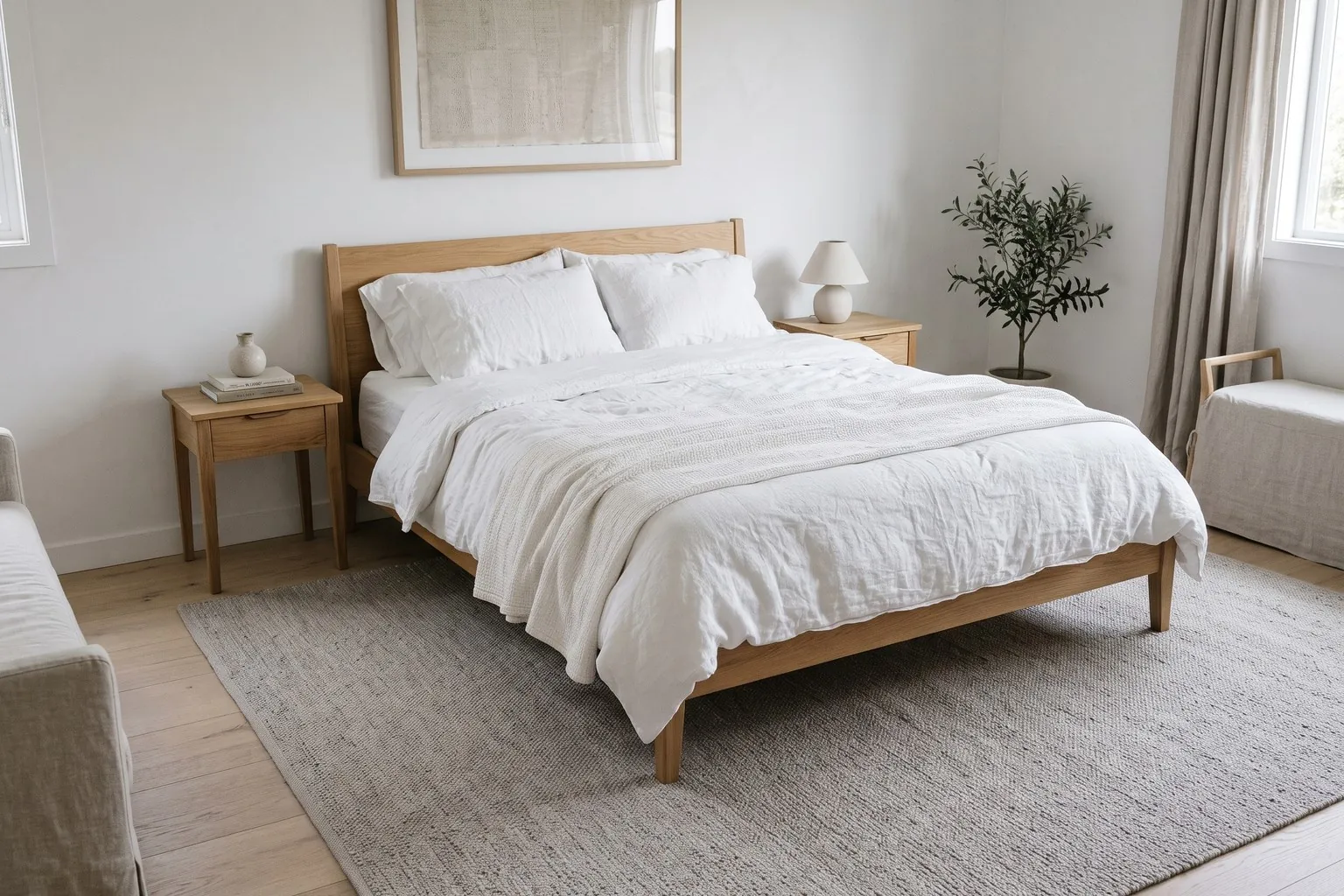
Castlery states the rule for bedrooms: a minimum of 18 to 24 inches of rug showing on all exposed sides of the bed. That strip is where your feet land when you get up. Bassett gives at least 18 inches beyond the sides of a queen bed, and Tumble gives about 24 inches beyond the foot.
The rug goes across the bed, not along it. Bassett's wording is that rugs are generally placed perpendicular to the bed, with the length of the rug measured against the width of the bed.
That gives the usual pairings:
| Bed | Mattress width | Rug most often recommended | Rug showing each side |
|---|---|---|---|
| Full | 54 in | 6 by 9 ft (Tumble), 8 by 10 ft (Chairish) | 27 in or 33 in |
| Queen | 60 in | 8 by 10 ft (Castlery, Tumble, Chairish) | 30 in |
| King | 76 in | 9 by 12 ft (Castlery, Chairish) | 34 in |
The last column is our own sum: the long side of the rug, less the width of the mattress, divided by two.
The details, with the placements that work in a small bedroom, are in rug size for a queen bed and rug size for a king bed.
Rule two: around a dining table, 24 inches
Under a table the rug is sized for the chairs. Ruggable's rule is at least 24 inches of rug beyond the table on all sides, so that the chairs stay fully on the rug when they are pulled out. Castlery gives the same 24 inches. Homes and Gardens quotes a designer who gives 24 inches as the minimum and another who works with 18 to 24. Chairish is more generous: around 36 inches is its ideal.
The reason is practical. A chair with its back legs off the rug rocks every time someone sits down, and Ruggable adds that it wears the edge of the rug.
As a sum, the smallest rug is the table plus 48 inches in each direction.
| Table | Smallest rug by the 24 inch rule | Standard size to buy |
|---|---|---|
| 36 by 60 in, seats four | 84 by 108 in | 8 by 10 ft |
| 40 by 72 in, seats six | 88 by 120 in | 8 by 10 ft, or 9 by 12 ft for more margin |
| 42 by 84 in, seats six to eight | 90 by 132 in | 9 by 12 ft |
| 44 by 96 in, seats eight | 92 by 144 in | 9 by 12 ft, or 10 by 14 ft |
These are our own sums. Ruggable's chart agrees with them at the ends: an 8 by 10 for a table up to 60 inches long, a 9 by 12 for a table of 72 to 84 inches, and a 10 by 14 for a table of 90 to 108 inches.
The round table rule and the room sums are in rug size for a dining table.
Rule three: in a living room, the front legs
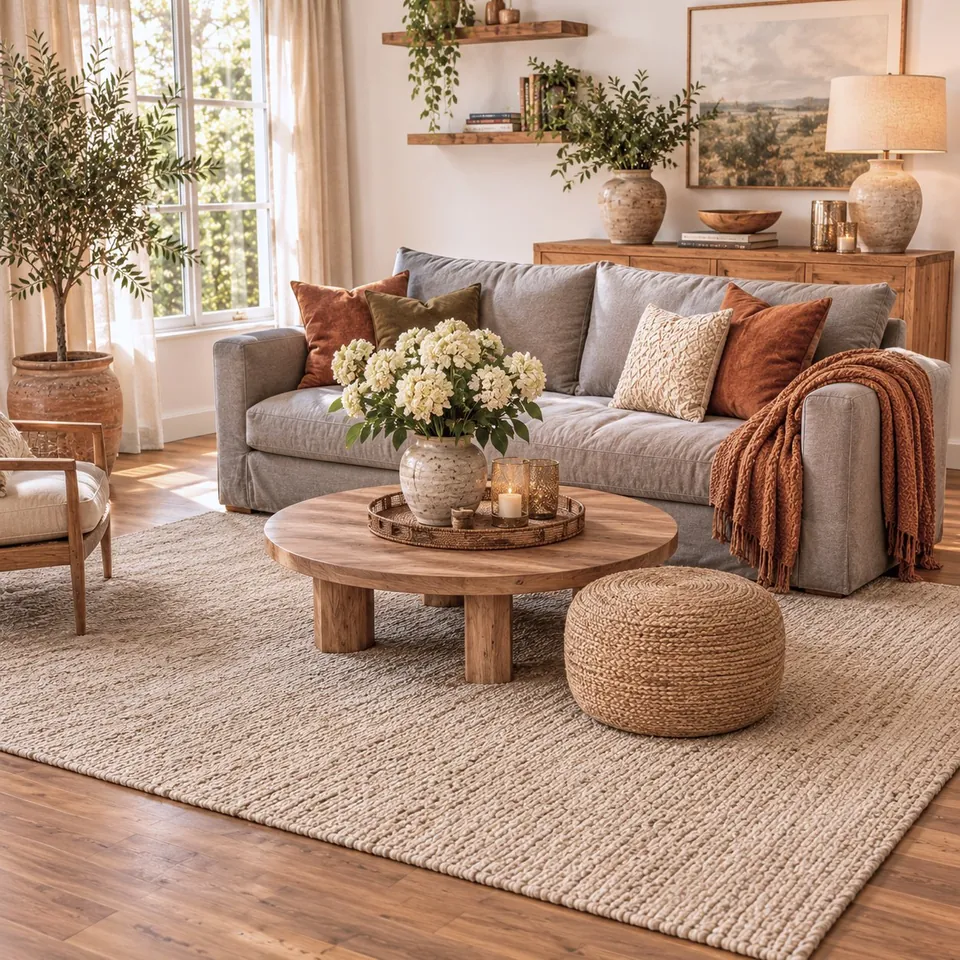
In a living room the rug is sized by the seating. Ruggable puts it in one line: the front legs of the seating should fit on the rug, or the rug should be small enough that no legs touch it at all. The awkward size is the one in between, where a rug stops just short of the sofa.
The three layouts, the tape test and the pairing of rug to sofa are in what size rug for a living room.
The margin to the walls
A rug is not a carpet. It needs a border of bare floor to look placed on purpose, and the sources give a range:
- Castlery: at least 6 to 12 inches between the edge of the rug and the walls, in a bedroom.
- Ruggable: at least 12 inches from the walls under a dining table, a 12 to 18 inch border around an 8 by 10 in a living room, and 18 to 36 inches of visible floor around a 10 by 14.
- Chairish: 12 to 18 inches, in living rooms and bedrooms.
So the room sets a ceiling on the rug. Ruggable's shortcut for a dining room works anywhere: subtract about 24 inches from the length and from the width of the room, and that is the largest rug it takes.
| Room | Largest rug with 12 in of floor all round | Nearest standard size |
|---|---|---|
| 9 by 11 ft | 7 by 9 ft | 6 by 9 ft |
| 10 by 12 ft | 8 by 10 ft | 8 by 10 ft |
| 11 by 14 ft | 9 by 12 ft | 9 by 12 ft |
| 12 by 16 ft | 10 by 14 ft | 10 by 14 ft |
These are our own sums. They give the ceiling, not the answer: the rule for the furniture decides the size, and the room decides whether that size fits.
Hallway runners: sized by the walls
A runner is sized by the hallway itself, not by furniture. The sources agree on a narrow border along the walls and a gap at each end:
| Source | Border to each wall | Length |
|---|---|---|
| Ideal Home | about 5 inches each side; 4 to 6 inches, by Jaipur Rugs | subtract about 6 to 12 inches from each end, by Louis De Poortere; cover at least three-quarters of the hallway, by Rugs Direct |
| Ruggable, quoted by Ideal Home | a 3 to 6 inch border of bare floor | |
| Rugs.ie | at least 10 to 15 cm, about 4 to 6 inches | measure up to the floor transitions |
The standard sizes. Chairish gives 2 by 8 and 2 by 10 feet as standard, with widths of 2 to 3 feet. Rugs.ie gives 65 to 80 cm wide and 200 to 400 cm long: about 26 to 31 inches by 6.5 to 13 feet, by our conversion.
A worked example, by our sums. A hallway 42 inches wide and 14 feet long. Width: 42 minus 5 inches each side is 32, so a runner of 2 feet 6 inches. Length: 168 inches minus 6 to 12 at each end is 144 to 156 inches, 12 to 13 feet. Three-quarters of the hallway is 10 feet 6 inches, so a 10 foot runner falls just short. Here a 2 foot 6 by 12 foot runner fits.
Doors and pads. Rugs.ie says to open and close every door over the runner before buying, and Ideal Home warns about pile height under a door. Both recommend an anti-slip underlay, and both suggest marking the runner out in masking tape first.
Stairs. For a stair runner, Chairish measures the treads and the risers, then adds an extra foot at the top and at the bottom.
Doors, vents and thick rugs
Three practical checks, before the size is final.
Doors. Castlery's advice is to check door clearance before choosing a thick pile rug. A door that swings over the rug has to clear its full height.
Pile under chairs. Under a dining table, Ruggable recommends a low pile or a flatweave so the chairs slide easily, and Castlery makes the same point: high pile rugs do not get along with sliding chairs.
Furniture half on, half off. A piece that stands with two legs on a rug and two on the floor sits at a slight tilt. For a sofa that is the accepted front legs on layout. For a dining chair it is the thing the 24 inch rule exists to prevent.
Cleaning. What a rug is made of decides how it can be cleaned. Our guide on how to clean a rug sorts the fibers by how much water they take.
Choosing, in four steps
- Start from the furniture. Write down the width and length of the bed, the table or the seating group in inches.
- Apply the rule for the room. Add 18 to 24 inches round a bed, 24 inches or more round a dining table, or use the front legs layout in a living room.
- Check the ceiling. Subtract the wall margin from the room and make sure the rug you need is not larger.
- Round to a standard size, then tape it. Mark the rug's outline on the floor with painter's tape and walk around it for a day. Open the doors over it.
If the size you need falls between two standard sizes, the larger one is usually the one the rule asked for. A rug that is slightly generous still does its job. A rug that is slightly small leaves a chair leg or a bare foot on the floor.
The sizes, by room
| Room | Start from | Rule | Guide |
|---|---|---|---|
| Living room | The sofa and chairs | Front legs on the rug | What size rug for a living room |
| Bedroom, queen bed | 60 in mattress | 18 to 24 in beyond sides and foot | Rug size for a queen bed |
| Bedroom, king bed | 76 in mattress | 18 to 24 in beyond sides and foot | Rug size for a king bed |
| Dining room | The table | 24 in beyond the table | Rug size for a dining table |
Questions people ask
What are the standard rug sizes?
3 by 5, 4 by 6, 5 by 8, 6 by 9, 8 by 10, 9 by 12 and 10 by 14 feet. Runners are about 2.5 feet wide and 7 to 10 feet long.
How big is an 8 by 10 rug in inches?
96 by 120 inches. A 5 by 8 is 60 by 96 inches, a 6 by 9 is 72 by 108, and a 9 by 12 is 108 by 144.
What is the most useful rug size?
It depends on the furniture. An 8 by 10 is the size Castlery, Tumble and Chairish recommend under a queen bed, and Ruggable pairs it with a living room of about 11 by 13 feet and a dining table for four.
How much floor should show around a rug?
Sources give 6 to 18 inches between the rug and the walls. Ruggable's shortcut is to subtract about 24 inches from the length and the width of the room.
Should a rug go under the furniture?
Under a bed and a dining table, yes, with a margin beyond them. In a living room, either the front legs of the seating stand on the rug, or none do.
What size runner for a hallway?
Leave about 4 to 6 inches of floor along each wall and 6 to 12 inches at each end, and cover at least three-quarters of the length. Standard runners are 2 by 8 and 2 by 10 feet, in widths of 2 to 3 feet.
Sources
- Rug size guide. Ruggable, read November 2026
- Dining table rug size guide. Ruggable, read November 2026
- How to place a rug under the bed. Castlery, read November 2026
- How to choose the right dining room rug. Castlery, read November 2026
- The ultimate rug sizing guide. Chairish, read November 2026
- Rug size under queen bed. Bassett Furniture, read November 2026
- What is the correct rug size for a king size bed?. Tumble, read November 2026
- The ultimate rug size guide. Homes and Gardens, read November 2026
- How big should a hallway runner be?. Ideal Home, read November 2026
- 7 things to consider before buying a hallway runner. Ideal Home, read November 2026
- Runner size guide. Rugs.ie, read November 2026
Every figure in this guide comes from the sources above, or from arithmetic shown in the text. See our editorial policy.