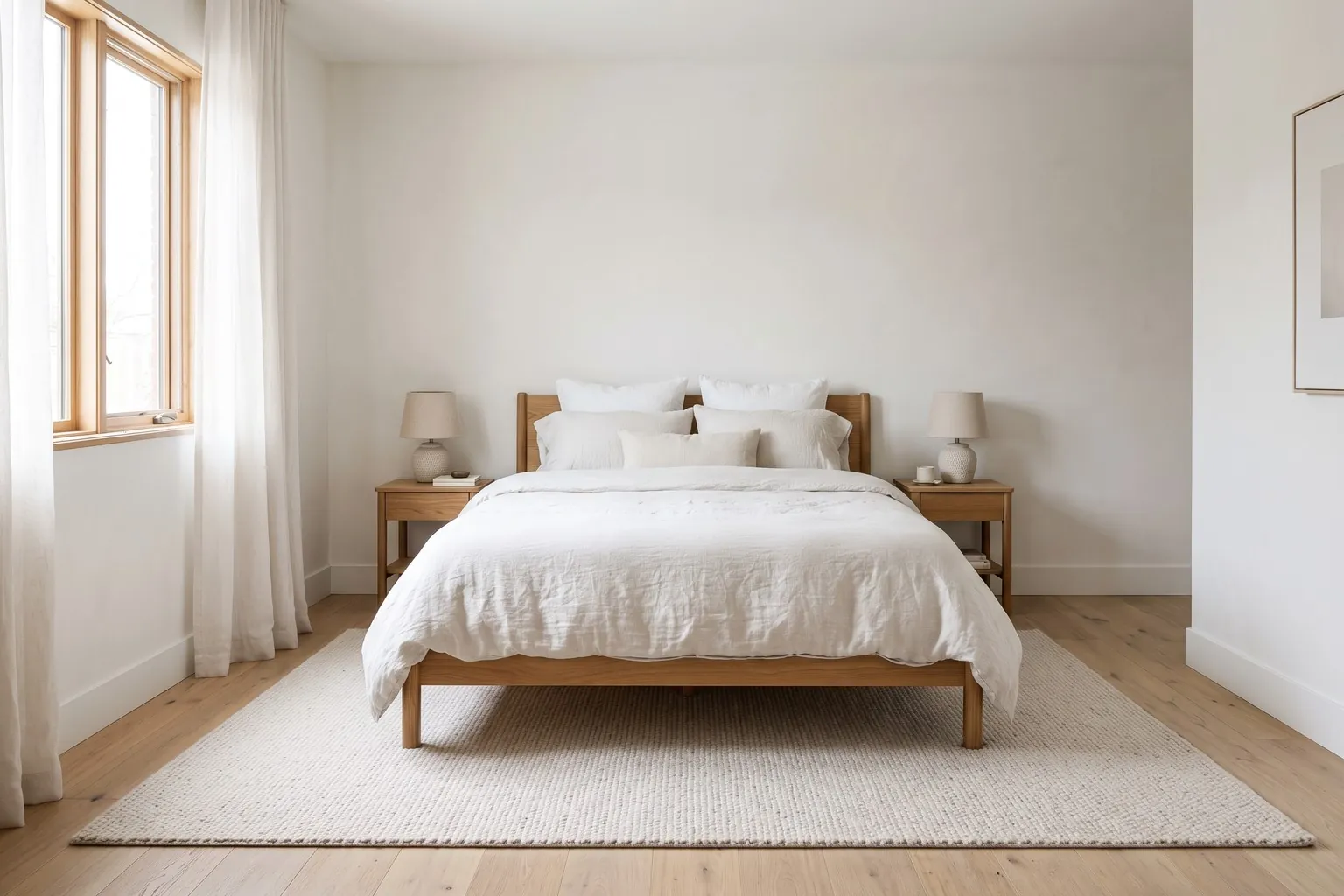
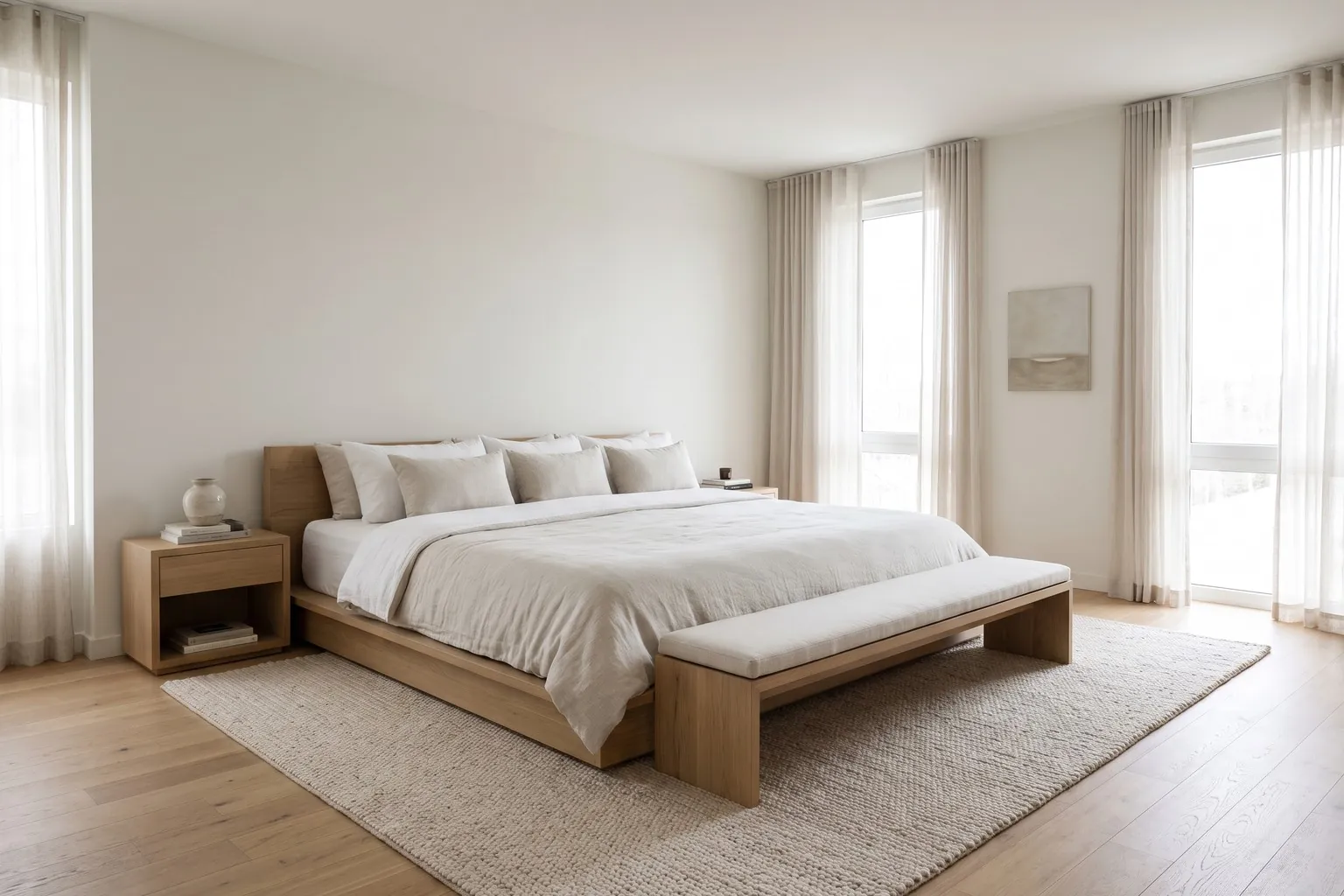
Nightstand height: level with the mattress, or a little higher
A nightstand should stand level with the top of the mattress or a little above: Chairish allows 2 inches lower to 6 higher. Sums by bed height, width and depth.
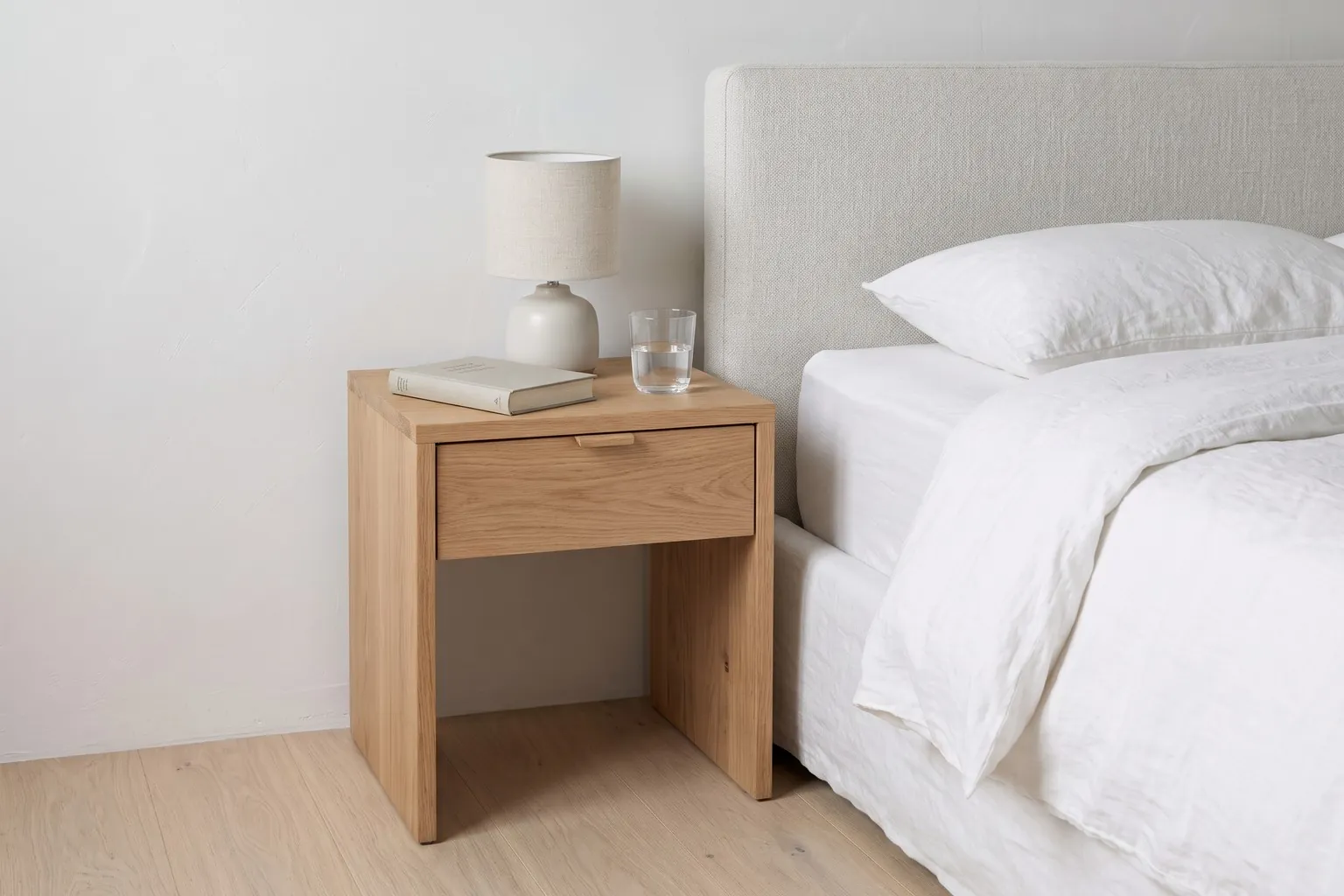
The short answer
- Measure from the floor to the top of your mattress. The nightstand should be about that height.
- Chairish gives the widest rule: from 2 inches lower to 6 inches higher than the top of the mattress. Saatva's summary is level, or within two inches.
- Most nightstands are 24 to 28 inches tall. That suits a mattress whose top is about 22 to 26 inches from the floor.
- Saatva gives 21 to 28 inches as the standard width and at least 18 inches as the depth. Nectar says to keep the depth to 24 inches or less.
- A low platform bed needs a low nightstand. A standard one stands too far above it.
In this guide
There is no standard height for a nightstand, because there is no standard height for a bed. A mattress on a low platform can have its top 16 inches from the floor. A deep mattress on a tall frame can reach 30. A nightstand that is right beside one is wrong beside the other.
So the question has one honest answer: it depends on your mattress. This guide gives the rule that links the two, the sums for beds of different heights, and the two other numbers that matter, the width and the depth.
The rule
Every source starts from the same place, the top of the mattress, and each allows a different margin around it.
| Source | The nightstand should be |
|---|---|
| Nectar | As tall as the top of the mattress |
| Saatva, in its summary | Level with the top of the mattress, or within two inches of it |
| Alex Woogmaster, designer, in Saatva | The same height as the mattress, or no more than an inch below |
| Lisa Lee, of the studio Rituals, in Saatva | No more than six inches above or below |
| Chairish | Between 2 inches lower and 6 inches higher |
The center of all five is the same: level. Where they differ is in how far you can stray, and in which direction.
Chairish is the only one that gives a reason for the direction. It is easier to reach up than down when you are lying in bed. That is why its range is lopsided, 2 inches below and 6 above. Saatva's article points the other way in one place, noting that a slightly lower surface makes it easier to reach things in the dark.
Taken together, a sensible reading is this. Aim for level. If you cannot have level, Chairish's reasoning makes a little higher the easier miss. And no source goes beyond 6 inches either way.
Start with the mattress
The measurement to take is from the floor to the top of the mattress, with the bedding you sleep under pulled back.
Our guide to queen bed dimensions found the parts that make it up. Purple gives a bed frame as 8 to 16 inches high on average, and Saatva gives a mattress as 8 to 12 inches thick. Purple puts the top of the mattress anywhere from 16 to 30 inches from the floor. Nectar gives 25 inches as the traditional height of a bed, from the floor to the top of the mattress.
If the bed is not in the room yet, you can work its height out from the two parts. These are our sums. The Sleep Foundation's figures fall in the same span: a typical frame of about 12 to 16 inches and a mattress of 10 to 15.
| Frame or platform | Mattress | Top of the mattress | Nightstand, by Chairish's rule |
|---|---|---|---|
| 8 in | 10 in | 18 in | 16 to 24 in |
| 10 in | 12 in | 22 in | 20 to 28 in |
| 12 in | 12 in | 24 in | 22 to 30 in |
| 14 in | 12 in | 26 in | 24 to 32 in |
| 16 in | 14 in | 30 in | 28 to 36 in |
A foundation or a box spring under the mattress adds its own height, and so does a topper. Count everything between the floor and the sheet.
Here is the range each rule allows, for mattress tops across that span. The sums are ours.
| Top of the mattress | Chairish: 2 in below to 6 in above | Saatva: within 2 in |
|---|---|---|
| 18 in | 16 to 24 in | 16 to 20 in |
| 20 in | 18 to 26 in | 18 to 22 in |
| 22 in | 20 to 28 in | 20 to 24 in |
| 24 in | 22 to 30 in | 22 to 26 in |
| 25 in | 23 to 31 in | 23 to 27 in |
| 26 in | 24 to 32 in | 24 to 28 in |
| 28 in | 26 to 34 in | 26 to 30 in |
| 30 in | 28 to 36 in | 28 to 32 in |
The 25 inch row is the example Chairish itself works: a 25 inch mattress top takes a nightstand of 23 to 31 inches.
What the shops sell
Chairish says most mass produced nightstands are between 24 and 28 inches tall. Nectar gives the same figures as the average.
Turn the rule round and you can see which beds those nightstands suit. By Chairish's rule, a nightstand fits any mattress top from 6 inches below its own height to 2 inches above it.
| Nightstand | Fits a mattress top of, per Chairish | Level with a mattress top of |
|---|---|---|
| 22 in | 16 to 24 in | 22 in |
| 24 in | 18 to 26 in | 24 in |
| 26 in | 20 to 28 in | 26 in |
| 28 in | 22 to 30 in | 28 in |
| 30 in | 24 to 32 in | 30 in |
So the usual 24 to 28 inches suits a bed whose mattress top is about 22 to 26 inches from the floor, which is the traditional 25 inches and a little either side. Every nightstand in the first range fits every bed in the second. If your bed is one of them, you can choose by width and by looks.
If your bed is not in that range, the shop's standard is wrong for you, in one of two ways.
Low beds and tall beds
A low platform bed. With the mattress top at 18 inches, Chairish's rule allows a nightstand up to 24 inches, and Saatva's summary only up to 20. A standard 26 or 28 inch nightstand stands 8 to 10 inches above the mattress. You reach up and over for everything on it, and from the pillow you look at its side.
Nectar's advice for shorter beds is a low profile bedside table. In practice that means searching by height, 18 to 22 inches, and looking beyond the pieces sold as nightstands. A side table is often the right height.
A tall bed. A thick mattress, a topper and a high frame can put the top at 30 inches. By Chairish's rule the nightstand should then be 28 inches at least. Nectar's advice is the same in words: if you use a tall base or add mattress pads, match the nightstand to it.
A 24 inch nightstand beside a 30 inch bed is 6 inches below the mattress. That is the direction Chairish warns about, since reaching down from a pillow is the awkward movement.
If you change the mattress. A new mattress that is 4 inches thicker moves the top of the bed by 4 inches, and a nightstand that was level is now low. Measure again before you assume the old tables still fit. Nectar notes that some bed frames are adjustable, so the frame can sometimes be lowered to bring the two back in line.
Width
Saatva gives the standard: nightstands range from 21 to 28 inches wide. It adds that a wider nightstand pairs best with a king bed. Nectar suggests bedside tables around 20 to 40 inches wide for a king.
The width has to be checked against the wall. Lisa Lee, in Saatva's article, suggests 4 to 6 inches of space between the side of the mattress and the nightstand. Nectar says to place the nightstand a few inches away from the bed. So along the wall behind the bed you need the mattress, two gaps and two nightstands.
| Bed | Mattress | With two 21 in nightstands and 4 in gaps | With two 28 in nightstands and 6 in gaps |
|---|---|---|---|
| Full | 54 in | 104 in (8 ft 8 in) | 122 in (10 ft 2 in) |
| Queen | 60 in | 110 in (9 ft 2 in) | 128 in (10 ft 8 in) |
| King | 76 in | 126 in (10 ft 6 in) | 144 in (12 ft) |
These are our sums. They use the width of the mattress. Purple gives a queen frame as 62 to 65 inches wide and a king frame as 78 to 81, so a frame with a wide surround takes a few inches more.
Read them against your wall.
- A queen on a 10 foot wall takes two nightstands of up to 24 inches with 6 inch gaps, and that uses the whole wall. With 21 inch nightstands and 4 inch gaps there are 5 inches to spare at each end.
- A king on a 12 foot wall takes two nightstands of 28 inches with 6 inch gaps, exactly.
- A queen on a 9 foot wall has 48 inches left for both sides. Two 21 inch nightstands leave 3 inch gaps and touch the side walls. One nightstand, or two narrow ones, works better.
Where the wall is short, Saatva's suggestion for a cozy guest room is a small nightstand with a light hanging above it. A lamp on the wall takes nothing from the top of the table, so a narrower table will do.
The lamp, and what the rule is for
Saatva's guide treats the lamp as the first job of a nightstand: the top should hold one, unless the bedside light is hung on the wall or the ceiling. The height rule exists for the same reason. With the top level with the mattress, in Saatva's words, reaching the lamp, a pair of glasses or a glass of water feels effortless. You do it lying down, without looking, and a surface where your hand expects it is the whole point.
Depth
Two figures bracket the depth.
Alex Woogmaster, in Saatva's article, says a nightstand should be at least 18 inches deep from the headboard wall.
Nectar gives the upper limit: stick with 24 inches or less, because anything deeper can get in the way of getting in and out of bed. The space beside a bed is a walkway. The Sleep Foundation suggests about 24 inches clear on each side of the bed, and a nightstand that reaches further down the side of the bed than your pillow starts to take some of it.
So the depth to look for is 18 to 24 inches. It matters for one more thing: a rug. A rug that starts in front of the nightstands starts 18 to 24 inches from the wall, as our guide to rug size for a queen bed works out.
Two nightstands that do not match
None of the guides we read insists on a matching pair. The rule applies to each side separately: each top should be near the height of the mattress.
That is a useful freedom in a small room. One side can take a full nightstand and the other a narrow table or a shelf. In our view the thing to keep equal is the height. Two tops at clearly different heights are more noticeable than two different tables.
Before you order
- Measure from the floor to the top of the mattress.
- Look for a nightstand of that height, or up to a few inches taller. Chairish's limits are 2 inches below and 6 above.
- Measure the wall behind the bed. Subtract the mattress and 4 to 6 inches on each side. What is left, divided by two, is the widest nightstand that fits.
- Check the depth: at least 18 inches, no more than 24.
- If the bed is low, search by height and include side tables.
- If you plan to change the mattress, measure the new one first.
The sizes of the beds themselves, and the room each one needs, are in our guide to bed sizes.
Questions people ask
How tall should a nightstand be?
About as tall as the top of your mattress. Chairish allows from 2 inches lower to 6 inches higher, and Saatva's summary is level or within two inches.
Should a nightstand be higher or lower than the bed?
Level is the aim. If it cannot be level, Chairish favors higher, because it is easier to reach up than down when lying in bed.
What is the standard height of a nightstand?
There is no single standard, but Chairish and Nectar both say most nightstands are 24 to 28 inches tall. That suits a mattress top of about 22 to 26 inches.
How wide should a nightstand be?
Saatva gives 21 to 28 inches as the standard range, with wider ones for a king bed. Check the wall: the mattress, two nightstands and a gap of 4 to 6 inches on each side all have to fit.
How deep should a nightstand be?
At least 18 inches, according to designer Alex Woogmaster in Saatva's guide, and no more than 24 inches, according to Nectar.
Sources
- How tall should a nightstand be?. Chairish, read November 2026
- How to choose the best nightstands for your bedroom. Saatva, read November 2026
- What is the perfect nightstand height for your bedroom?. Nectar, read November 2026
- Bed frame sizes: dimensions guide and sizing chart. Purple, read November 2026
- Mattress sizes and bed dimensions guide. Saatva, read November 2026
- Mattress sizes 101. Sleep Foundation, read November 2026
Every figure in this guide comes from the sources above, or from arithmetic shown in the text. See our editorial policy.