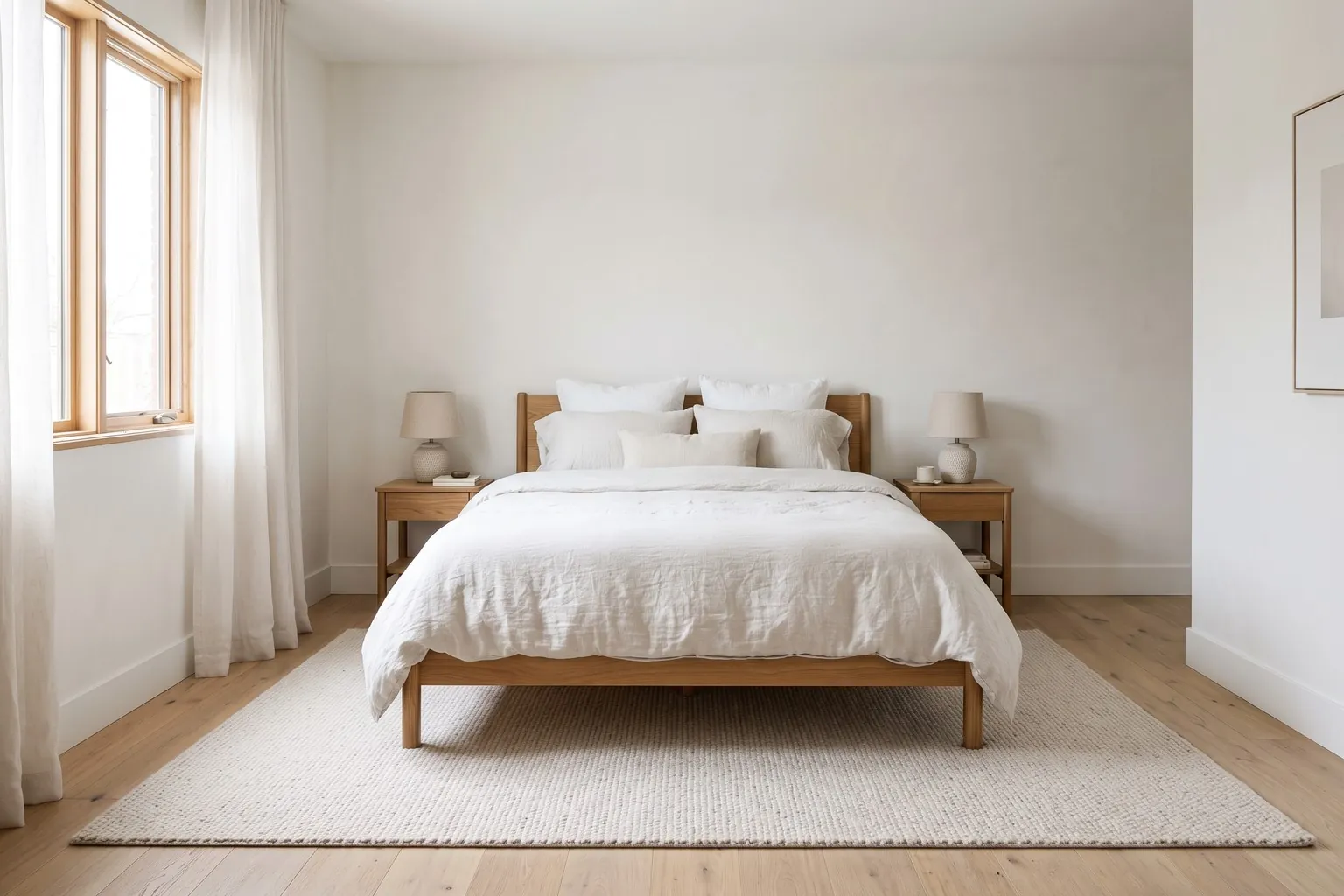
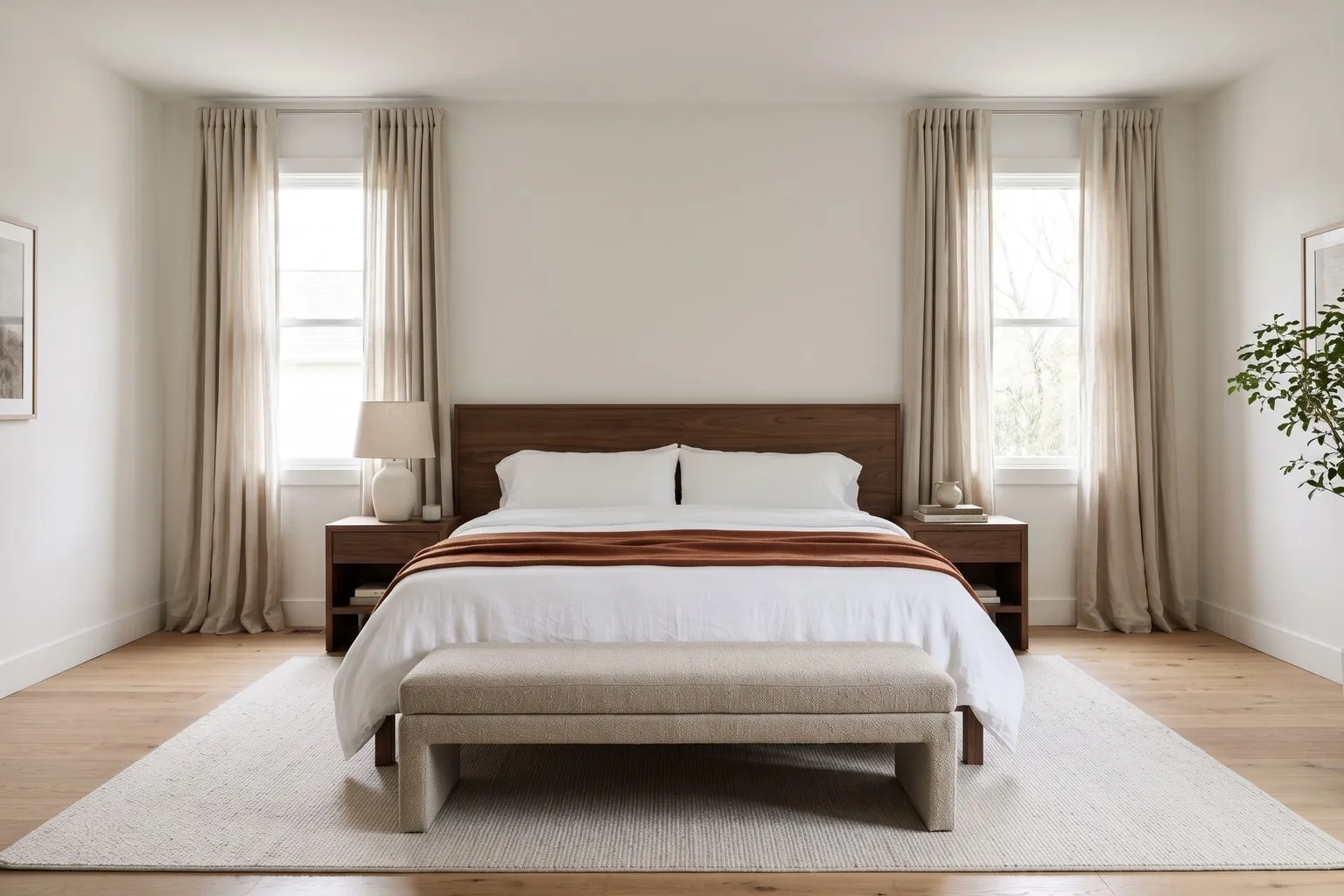
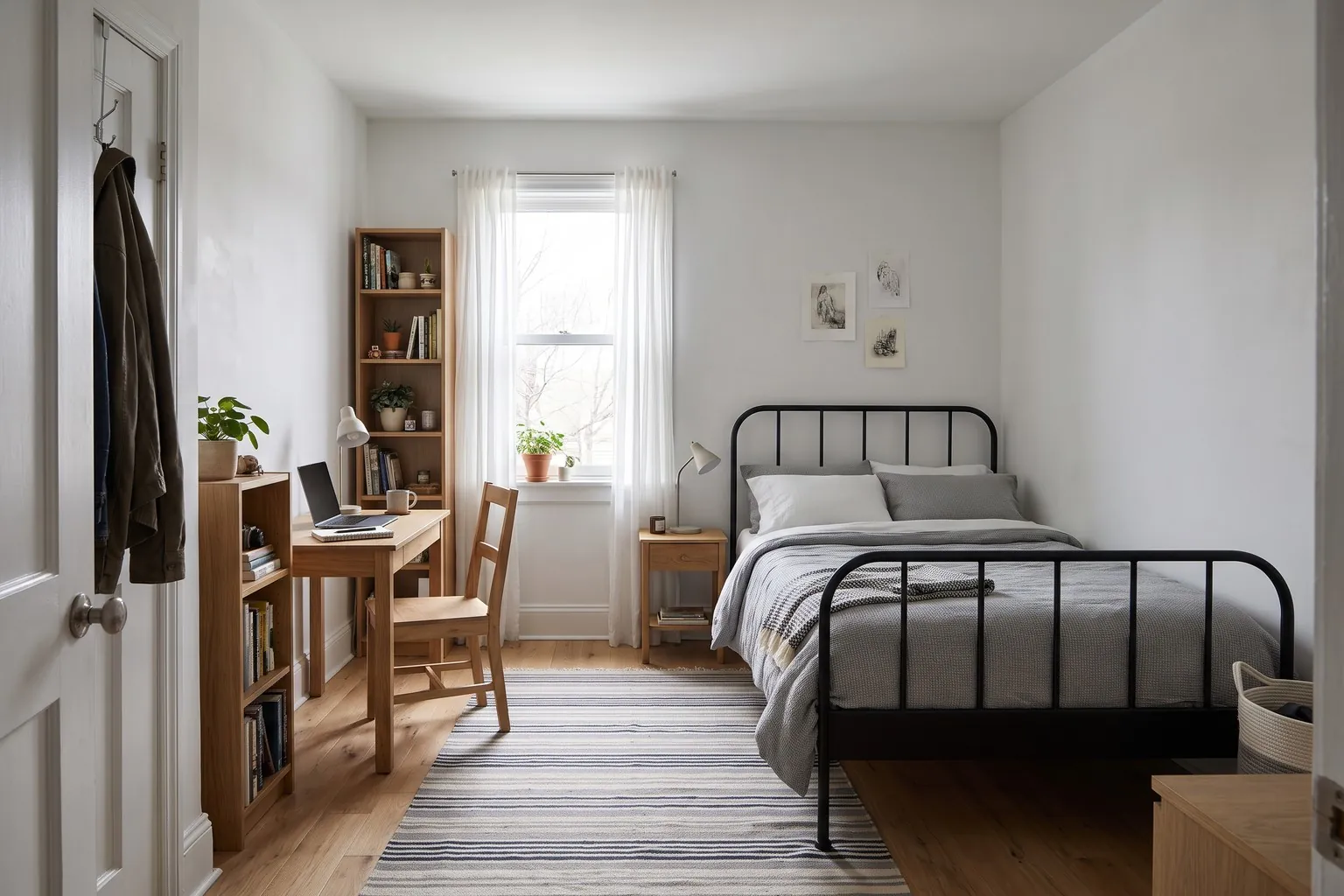
Queen bed dimensions: 60 by 80 inches, and the room it really needs
A queen mattress is 60 by 80 inches. The frame adds 2 to 5 inches, and the bed needs 9 feet of wall to leave 24 inches each side. Sums for your room.
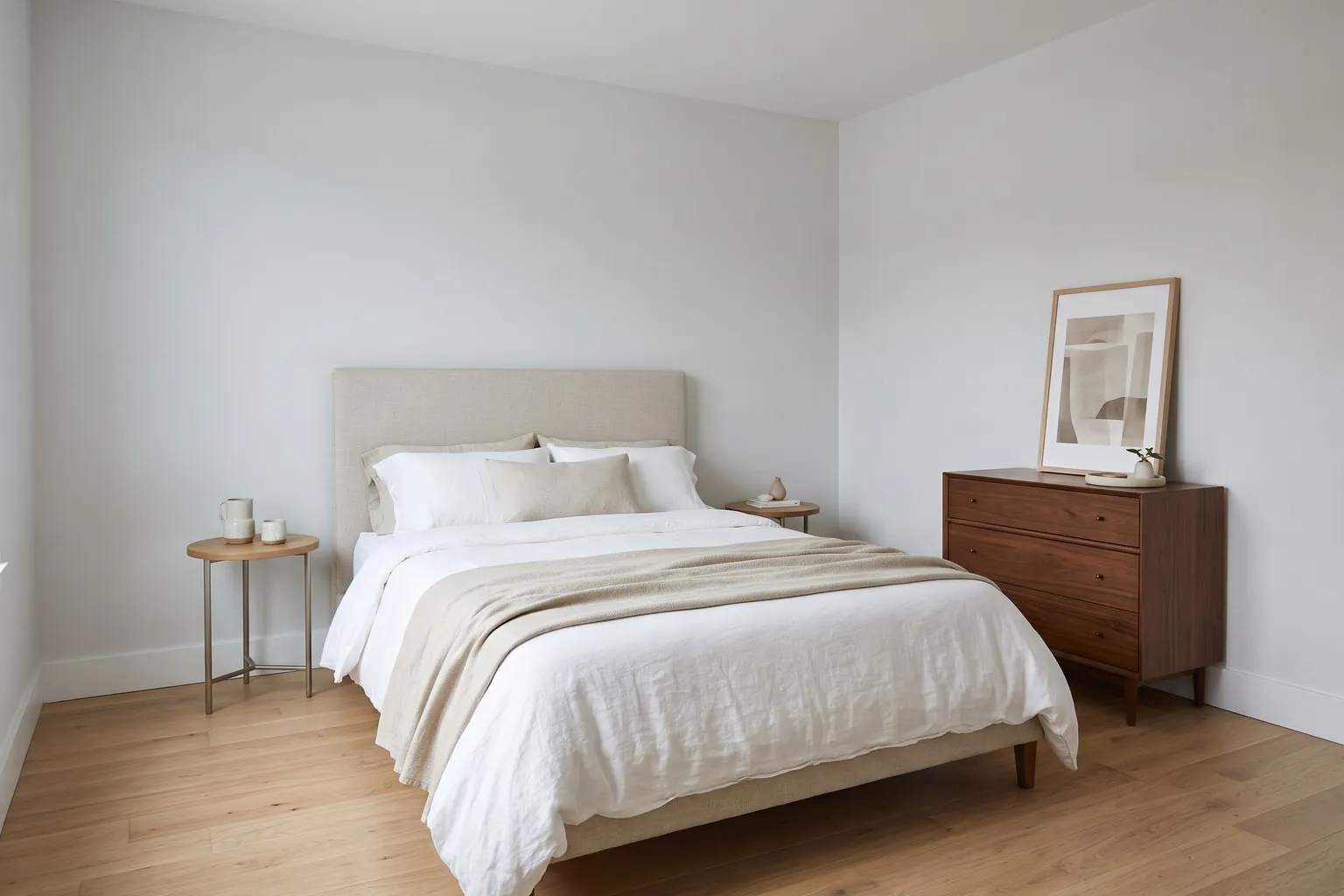
The short answer
- A queen mattress is 60 inches wide and 80 inches long, which is 5 feet by 6 feet 8 inches.
- Two sleepers get 30 inches each. That is 8 inches less than a twin, as the Better Sleep Council points out.
- A queen bed frame is larger than the mattress. Purple gives 62 to 65 inches wide and 82 to 85 inches long.
- Saatva, Casper and Purple all give 10 by 10 feet as the minimum room. Casper calls 10 by 12 more comfortable.
- With 24 inches clear on each side, a queen needs 9 feet of wall. Check that before anything else.
In this guide
The queen is the bed most couples end up with, and the reason is in the numbers. It is the narrowest size that is long enough for a tall adult and wide enough for two, and it is the widest size that fits an ordinary bedroom without taking it over.
This guide gives the dimensions, then the part that product pages leave out: what the frame adds, and how much room is left around it.
The dimensions
A queen mattress is 60 inches wide by 80 inches long. The Better Sleep Council, the Sleep Foundation, Saatva, Casper and Purple all publish the same figure.
| Inches | Feet | |
|---|---|---|
| Width | 60 | 5 ft |
| Length | 80 | 6 ft 8 in |
| Surface | 4,800 sq in | about 33 sq ft |
| Width per sleeper, for two | 30 | 2 ft 6 in |
The surface is the Sleep Foundation's figure, and the 33 square feet is our conversion of it.
Thirty inches each is the number to think about. The Better Sleep Council notes that it is 8 inches less width than a twin, so each person in a queen has less room than a child in a single bed. Most couples find it enough. Those who do not are the ones who should look at a king, where each sleeper gets 38 inches.
The length is the other half of the argument. At 80 inches a queen is 5 inches longer than a full or a twin, and the Sleep Foundation's rule is that anyone over six feet should have at least 80 inches of mattress.
The frame is bigger than the mattress
Nobody sleeps on a mattress alone. The frame that holds it is the object that has to fit the room, and it is always a little larger.
Purple's chart gives a queen frame as 62 to 65 inches wide and 82 to 85 inches long, and says frames generally add 2 to 5 inches to the width and to the length of the mattress. Casper says a queen frame can add 1 to 6 inches, depending on its style. The Sleep Foundation puts the difference at an inch or two for a typical frame.
| Mattress | Frame, per Purple | |
|---|---|---|
| Width | 60 in | 62 to 65 in |
| Length | 80 in | 82 to 85 in |
The spread comes from the design. A plain platform sits close to the mattress. Saatva notes that a headboard or a footboard can add another 2 to 5 inches, most of all on a sleigh bed or a wide floating platform frame.
The practical rule is short: take the width and the length from the product page of the frame, not from the word queen. Saatva's warning is that not all frames are standard.
How high it stands
A queen has no standard height, because the height comes from two parts that are sold separately.
- Frame. Purple gives 8 to 16 inches as the average. The Sleep Foundation describes a typical frame as knee level, about 12 to 16 inches.
- Mattress. Saatva gives 8 to 12 inches as the average thickness. The Sleep Foundation gives 10 to 15 inches.
- Together. Purple puts the top of the mattress between 16 and 30 inches from the floor.
If you are replacing only the mattress, measure the thickness of the old one. Three more inches of mattress raise the bed by three inches, and the nightstand and the headboard stay where they were.
The room a queen needs
Three makers publish a minimum room for a queen, and for once they agree: Saatva, Casper and Purple all say 10 by 10 feet. Casper adds that 10 by 12 feet is more comfortable.
The reason is the floor around the bed. The Sleep Foundation's guideline is about 24 inches of space on each side of the bed. Purple says to allow 2 to 3 feet around each side and the foot.
Here is what those rooms leave, with the head of the bed against a wall and the bed centered on it. These are our own sums: the room, less the mattress, shared between the two sides.
| Room | Wall the bed is on | Clear each side | Clear at the foot |
|---|---|---|---|
| 9 by 10 ft | 9 ft | 24 in | 40 in |
| 10 by 10 ft | 10 ft | 30 in | 40 in |
| 10 by 12 ft | 10 ft | 30 in | 64 in |
| 10 by 12 ft | 12 ft | 42 in | 40 in |
| 12 by 12 ft | 12 ft | 42 in | 64 in |
Those figures are for the mattress. A frame at the top of Purple's range, 65 by 85 inches, takes 2.5 inches off each side and 5 inches off the foot.
Two things follow from the table.
Nine feet of wall is the real minimum. With 24 inches on each side, a queen mattress needs 108 inches of wall, which is 9 feet. In a room narrower than that, one side of the bed drops below the Sleep Foundation's figure, and you have to decide which sleeper climbs in from the foot.
The 10 by 10 foot room is comfortable in one direction only. It gives 30 inches a side, inside Purple's 2 to 3 feet, and 40 inches at the foot. That is enough to walk past the bed. It is not enough for a dresser at the foot with its drawers open. On our sums, that is what Casper's 10 by 12 buys: with the bed on the 10 foot wall, the extra 2 feet go to the foot.
Which wall, in a real room
The published rooms assume a blank box. A real bedroom has a door, a closet and a window, and the bed goes where they leave room.
- Measure the wall between obstacles, not the wall itself. A door frame or a radiator shortens the wall the bed can use.
- Keep door swings clear. A bedroom door or a closet door that opens toward the bed needs its full arc. Saatva's advice is to keep clearance for doors, drawers and the other furniture.
- Count the nightstands. The Better Sleep Council says to consider a nightstand when you measure the bedroom. Two of them belong to the bed's width.
- Push one side to the wall only as a last resort. It frees 24 inches or more of floor, and it means one sleeper climbs over the other.
If someone in the house uses a walker or a wheelchair, plan for more than 24 inches. The ADA Standards set 36 inches as the minimum clear width of an accessible walking route. On our table, a queen reaches 36 inches a side only on a wall of 11 feet or more.
Queen, full or king
The queen sits between two sizes, and it is worth knowing exactly what each step buys.
| Full | Queen | King | |
|---|---|---|---|
| Mattress | 54 by 75 in | 60 by 80 in | 76 by 80 in |
| Width per sleeper | 27 in | 30 in | 38 in |
| Minimum room, per Purple | 9.5 by 10.5 ft | 10 by 10 ft | 12 by 12 ft |
Against a full. The queen is wider and, more to the point, 5 inches longer. The Better Sleep Council calls a full a tight fit for two, and Casper puts the gain at about 3.5 inches more per person in a queen. Saatva says a full costs about 10 to 15 percent less than a queen. The comparison is worked through in full vs queen.
Against a king. The Better Sleep Council gives a king as about 16 inches wider than a queen, for the same length. Saatva says a queen costs about 25 percent less than a king. The room is the real price: a king wants 12 by 12 feet. The figures are in king bed dimensions, and the two are set side by side in king vs queen.
Who the queen suits, according to the people who sell every size: couples who do not need as much space and single sleepers who want more room, says the Better Sleep Council. Couples without children or pets in the bed, says the Sleep Foundation. Saatva calls it the best size for a guest bedroom.
Moving up from a full, in the same room
Many queens replace a full in a room that does not change. The sum is quick. A queen is 6 inches wider and 5 inches longer than a 54 by 75 inch full, so each side of the bed loses 3 inches of floor and the foot loses 5.
If the full left 27 inches a side, the queen leaves 24, which is still the Sleep Foundation's figure. If the full was already tight, the queen will be tighter, and it is worth taping its outline on the floor before ordering. Remember the frame as well: a new queen frame can be several inches larger than the old one for the same mattress.
The other queens
Three sizes carry the name and are not the standard queen. Casper lists them.
| Name | Mattress | Difference |
|---|---|---|
| Olympic queen | 66 by 80 in | 6 inches wider |
| California queen | 60 by 84 in | 4 inches longer |
| Short queen | 60 by 75 in | 5 inches shorter |
Each needs its own frame and its own sheets. If a listing says queen and the dimensions are not 60 by 80, it is one of these. The short queen is an RV size: Camping World's chart notes that most RVs use it, and our guide to RV mattress sizes lists the others.
Sheets and bedding
Queen bedding is made for a 60 by 80 inch mattress, and Saatva's advice is to buy sheets and comforters designed for the specific size. Sheets are usually the dimensions of the mattress, and comforters are a little larger, so they hang over the sides.
Thickness is the detail that catches people out. Saatva recommends a deep pocket fitted sheet for a thick mattress, and it lists models 14, 16 and 18 inches thick. Measure the thickness of the mattress before you buy sheets for it. The pocket depths, and the size of every other layer, are in sheet sizes and bedding sizes.
Getting it into the room
A queen mattress is 5 feet wide and 6 feet 8 inches long. The Better Sleep Council's advice, given for a king, applies here too: measure the corridors, the doors and the stairwells the mattress has to pass through. Saatva adds the door frame of the bedroom.
Walk the route with a tape measure before the delivery date: the front door, each turn in the hall, the stair, the bedroom door. The headboard is the other rigid piece, so check its width and height on the product page as well.
Before you order, in five checks
- The wall for the head of the bed is at least 9 feet between obstacles, or you have accepted less than 24 inches on one side.
- You have the frame's width and length from its product page, and you have used those in the sum.
- Doors, closet doors and drawers open with the bed in place.
- The tallest sleeper is comfortable on 80 inches of length.
- The mattress and the headboard pass the stairs and the bedroom door.
The other sizes, and the chart that compares all six, are in our guide to bed sizes. The rug that goes under the bed is worked out in rug size for a queen bed, and the tables beside it in nightstand height.
Questions people ask
What are the dimensions of a queen bed?
A queen mattress is 60 inches wide and 80 inches long, or 5 feet by 6 feet 8 inches. A queen frame is larger: Purple gives 62 to 65 inches by 82 to 85 inches.
What size room do you need for a queen bed?
Saatva, Casper and Purple all give 10 by 10 feet as the minimum. Casper says 10 by 12 feet is more comfortable.
Will a queen bed fit in a 9 by 10 foot room?
Yes, on the 9 foot wall it leaves 24 inches on each side of the mattress and 40 inches at the foot, before the frame is counted. That is the minimum the Sleep Foundation suggests.
How much wider is a king than a queen?
About 16 inches, according to the Better Sleep Council: 76 inches against 60. Both are 80 inches long.
Is an Olympic queen the same as a queen?
No. Casper lists an Olympic queen as 66 by 80 inches, six inches wider than a standard queen. It needs its own frame and sheets.
Sources
- Mattress sizes. Better Sleep Council, read November 2026
- Mattress sizes 101. Sleep Foundation, read November 2026
- Bed frame sizes. Sleep Foundation, read November 2026
- Mattress sizes and bed dimensions guide. Saatva, read November 2026
- Finding the perfect bed frame size for your bedroom. Saatva, read November 2026
- Mattress sizes and bed dimensions guide. Casper, read November 2026
- Queen size bed frame dimensions guide. Casper, read November 2026
- Bed frame sizes: dimensions guide and sizing chart. Purple, read November 2026
- King bed frame dimensions guide. Purple, read November 2026
- ADA Accessibility Standards, section 403.5.1. U.S. Access Board, read November 2026
Every figure in this guide comes from the sources above, or from arithmetic shown in the text. See our editorial policy.