Rug size for a queen bed: 8 by 10 or 6 by 9, and which one your room takes
Most guides put an 8 by 10 foot rug under a queen bed, and a 6 by 9 in a small room. What each size shows at the sides and the foot, and the wall it needs.
The short answer
- Castlery, Tumble and Chairish all name the 8 by 10 foot rug for a queen bed. Castlery calls a 6 by 9 a good starting point.
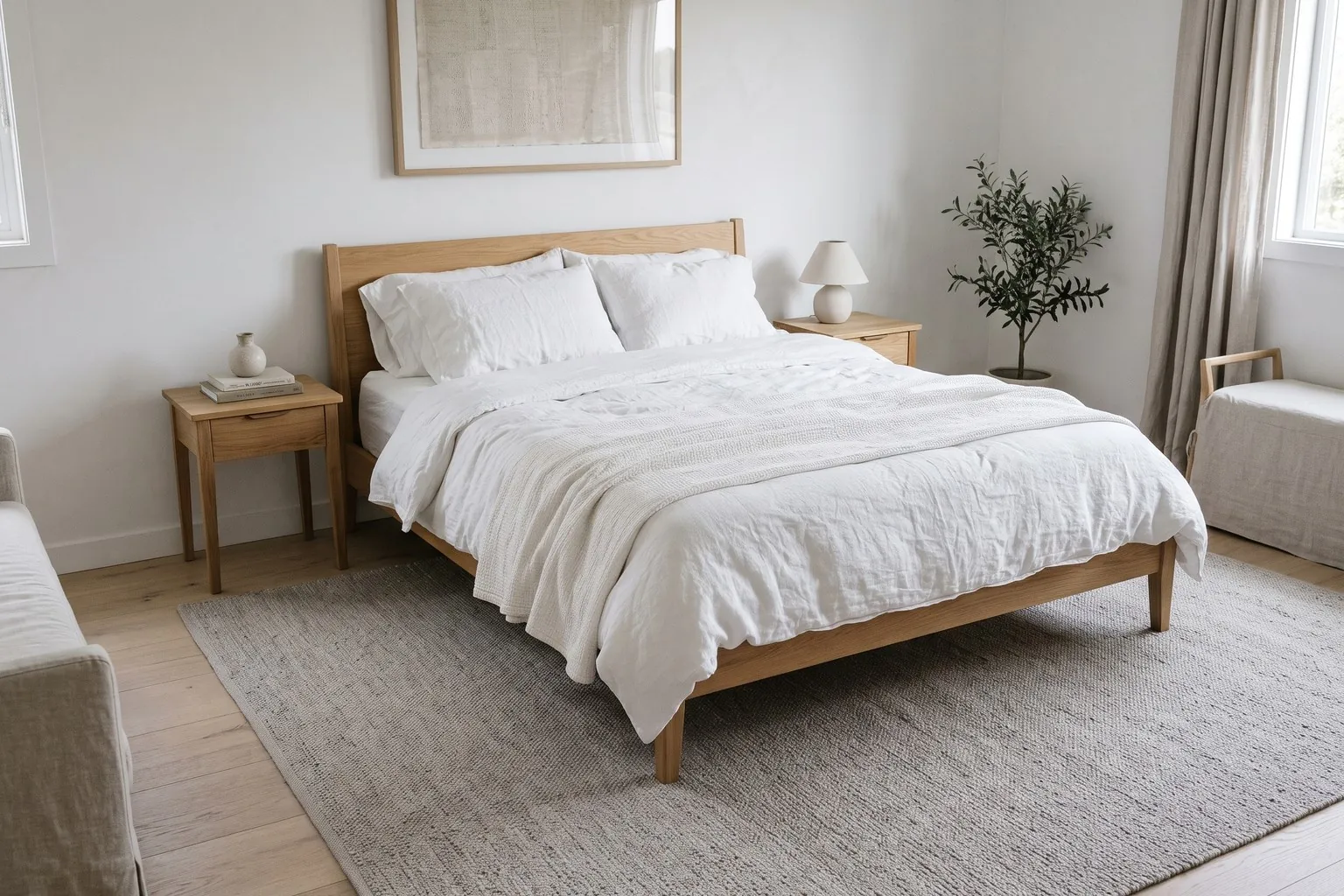
- The rule is 18 to 24 inches of rug showing at the sides and the foot. An 8 by 10 shows 30 inches on each side of a queen, and a 6 by 9 shows 24.
- The rug lies across the bed: its long side runs under the width of the mattress.
- The room decides. An 8 by 10 needs an 11 foot wall behind the bed. On a 10 foot wall, the 6 by 9 is the size that fits.
- To sit under the nightstands as well, Bassett says the rug should be at least 9 feet wide. That is a 9 by 12.
In this guide
A queen bed is 60 inches wide and 80 inches long, and nearly every rug guide answers the question in three words: eight by ten.
That is the right answer in a bedroom of about 12 by 12 feet. It is the wrong one in the 10 by 10 foot room that mattress makers give as the minimum for a queen, where an 8 by 10 laid across the bed would touch both side walls. So this guide gives the rule first, then what each size does under the bed, then the sum that tells you which one your room takes.
What the guides recommend
| Source | For a queen bed |
|---|---|
| Castlery | 6 by 9 ft as a good starting point, 8 by 10 ft generally preferred |
| Tumble | 8 by 10 ft |
| Chairish | 8 by 10 ft, for a full or a queen |
| Bassett | 5 by 7 ft is the smallest that goes under a queen; 9 by 12 ft anchors the bed and the nightstands |
| Homes and Gardens | 5 by 8 ft under a queen guest bed |
Five sources, four sizes. They are not disagreeing. Each is answering for a different room and a different placement, which is why the rule behind them is more useful than any one of the answers.
The rule: 18 to 24 inches showing
Castlery states it: a minimum of 18 to 24 inches of rug showing on all exposed sides of the bed. Bassett gives the same lower figure, at least 18 inches beyond the sides of a queen bed. Tumble gives the upper one for the foot: the rug should extend from the end of the bed by about 24 inches, give or take.
That strip is the whole point of a bedroom rug. It is where your feet land in the morning.
Here is what each standard size shows at the sides of a queen mattress, when the rug lies across the bed. The sum is ours: the long side of the rug, less 60 inches of mattress, divided by two.
| Rug | Long side | Showing on each side of a queen |
|---|---|---|
| 5 by 7 ft | 84 in | 12 in |
| 5 by 8 ft | 96 in | 18 in |
| 6 by 9 ft | 108 in | 24 in |
| 8 by 10 ft | 120 in | 30 in |
| 9 by 12 ft | 144 in | 42 in |
The rule starts to be met at 8 feet of length. That matches what Bassett says about the small sizes: a 4 by 6 is too small to place under a queen bed, and a 5 by 7 is the smallest rug you could place under one.
One correction to apply to all of these. The sums are for the mattress, and the bed frame is larger. Purple gives a queen frame as 62 to 65 inches wide and 82 to 85 inches long, so a frame takes 1 to 2.5 inches off each side and 2 to 5 inches off the foot.
Which way the rug goes
Across. Bassett's wording is that rugs are generally placed perpendicular to the bed, with the length of the rug measured against the width of the bed.
The reason is easy to see with a 5 by 8. It is 60 inches wide, exactly the width of a queen mattress. Laid along the bed, it disappears under it and shows nothing at either side. Laid across, its 96 inches show 18 inches on each side. It is the same rug, and only one of the two ways works.
Where the rug starts: three placements
The second decision is how far up the bed the rug reaches. Castlery describes the two classic answers: the rug can tuck under the nightstands and reach toward the headboard, or it can stop just before the nightstands.
Under the nightstands
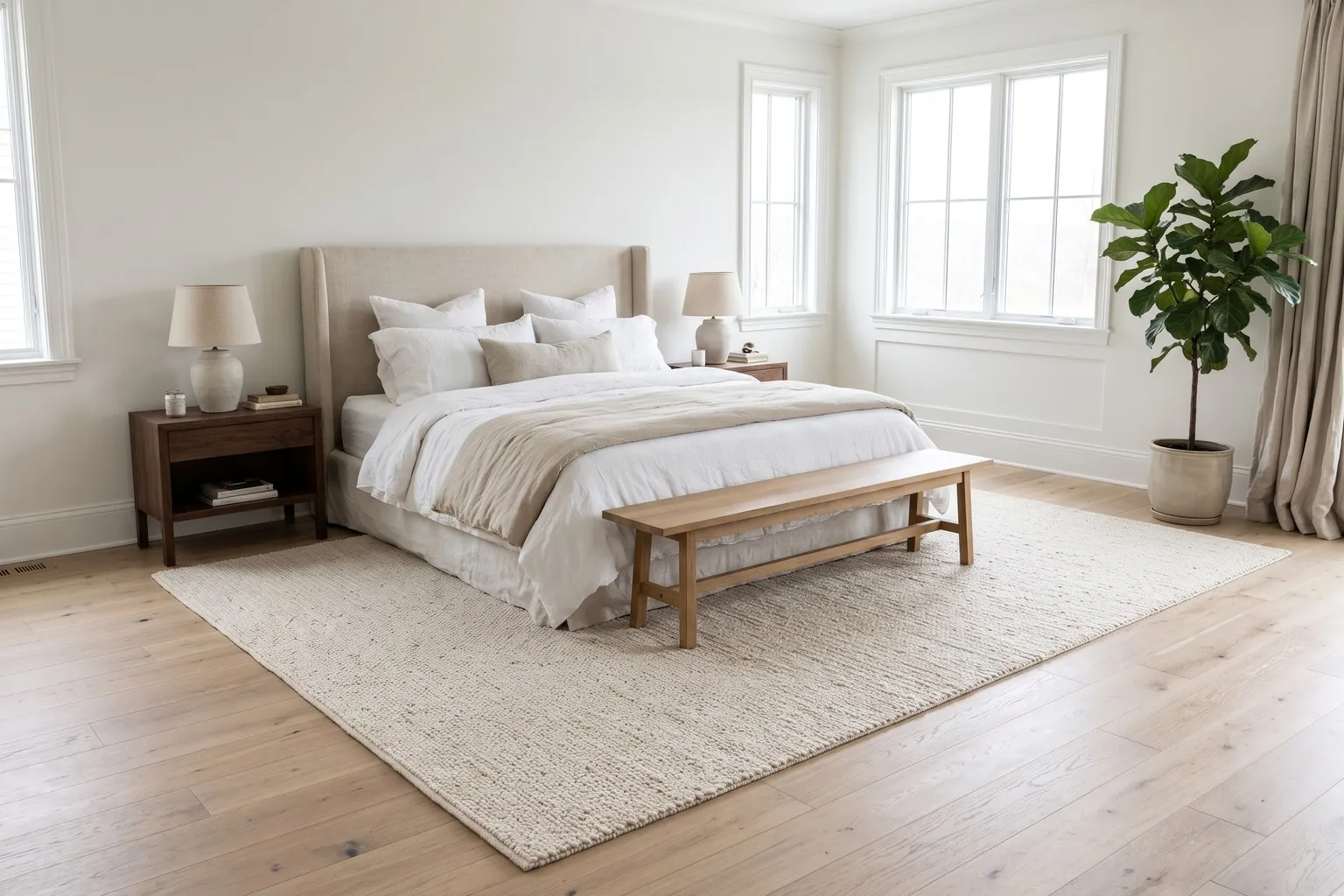
This is the placement that anchors everything, and it takes the largest rug. Bassett puts a number on it: to sit under the nightstands and the queen bed, the rug should be at least 9 feet wide. Among standard sizes that means a 9 by 12, which Bassett describes as creating an anchor for the bed and the nightstands.
The sums agree. Saatva gives a standard nightstand as 21 to 28 inches wide, so a queen with one on each side spans 102 to 116 inches. A 9 by 12 is 144 inches across and holds all of it with room to spare. Starting at the head wall, its 108 inches of width run 28 inches past the foot of the mattress.
An 8 by 10 can be laid this way too. Bassett lists under both nightstands and the bed as one of its two placements. But it is 120 inches across, so the nightstands stand within a few inches of its ends, and from the head wall it reaches only 16 inches past the foot. It fits, a little under the rule.
In front of the nightstands
This is the placement most bedrooms use, because it works with the middle sizes. Bassett says rugs 5 to 8 feet wide have to be placed in front of the nightstands, and that a 6 by 9 still does not lie underneath the bedside tables. For an 8 by 10, its second placement is about a quarter of the way down from the head of the bed.
Where exactly the rug starts depends on its size. Nectar's guide puts the depth of a nightstand at 24 inches or less, so 24 inches from the head wall is the nearest the rug can start. The smaller the rug, the further down it has to slide to show enough at the foot. These are our sums for an 80 inch mattress.
| Rug | Starts, from the head wall | Lies under the bed for | Shows beyond the foot |
|---|---|---|---|
| 8 by 10 ft | 24 in | 56 in | 40 in |
| 6 by 9 ft | 30 in | 50 in | 22 in |
| 5 by 8 ft | 38 in | 42 in | 18 in |
So an 8 by 10 covers the lower two thirds of the bed and leaves a generous 40 inches at the foot. A 6 by 9 covers a little less and leaves 22. A 5 by 8 ends up under the lower half of the bed only, which is as far as that size can be stretched.
Runners at the sides
Where no single rug fits, Bassett's alternative is a runner alongside either or both sides of the bed, but never under it. Chairish lists 2 feet 6 inches by 8 feet as a runner size for bedrooms, and Tumble offers runners in 7 and 10 foot lengths.
A queen mattress is 6 feet 8 inches long. Started in front of a 24 inch nightstand, a 7 foot runner reaches 28 inches past the foot of the bed, and an 8 foot runner reaches 40.
The room decides
A rug needs bare floor between it and the walls. Castlery asks for at least 6 to 12 inches in a bedroom, and Chairish for 12 to 18.
Laid across the bed, the long side of the rug runs along the wall behind the headboard. So that wall sets the largest rug the room takes. These are our sums: the long side of the rug, plus the margin twice.
| Rug | Wall needed, with 6 in each side | Wall needed, with 12 in each side |
|---|---|---|
| 5 by 8 ft | 9 ft | 10 ft |
| 6 by 9 ft | 10 ft | 11 ft |
| 8 by 10 ft | 11 ft | 12 ft |
| 9 by 12 ft | 13 ft | 14 ft |
Read it against your own wall.
A 10 foot wall takes a 6 by 9. This is the wall of the 10 by 10 foot bedroom, the smallest room our guide to queen bed dimensions found recommended for the bed. A 6 by 9 leaves 6 inches of floor at each side wall. An 8 by 10 is 10 feet long and would run from wall to wall, which is no longer a rug.
An 11 foot wall takes an 8 by 10, just. It leaves Castlery's minimum of 6 inches at each end.
A 12 foot wall is where the 8 by 10 looks right. Twelve inches of floor on each side, 30 inches of rug on each side of the bed.
A 9 by 12 needs 13 to 14 feet. That is a large bedroom. In anything smaller, the rug that anchors the nightstands does not fit across the room.
Then check the depth of the room the same way. The rug ends some distance past the foot of the bed, and it should stop short of the far wall by the same 6 to 12 inches. In a room 10 feet deep, an 8 by 10 that starts in front of the nightstands would end exactly at the far wall. A 6 by 9 in the same room ends 18 inches short of it.
Three bedrooms, worked through
10 by 10 feet. A 6 by 9, laid across, starting 30 inches from the head wall. It shows 24 inches on each side of the mattress and 22 at the foot. There are 6 inches of floor at each side wall and 18 at the far wall. Every number is inside the rule, and no larger size would be.
11 by 12 feet, bed on the 11 foot wall. An 8 by 10, starting 24 inches from the head wall, in front of the nightstands. It shows 30 inches on each side and 40 at the foot, and stops 24 inches from the far wall. The side margins are the tight ones here: 6 inches of floor at each side wall.
12 by 14 feet, bed on the 14 foot wall. A 9 by 12 under the nightstands. It shows 42 inches on each side, holds both nightstands, runs 28 inches past the foot and leaves 12 inches of floor at each side wall. In this room the bed sits on the long wall, so the room is 12 feet deep and the rug stops 36 inches from the far wall.
A bench at the foot
A bench or an ottoman at the foot of the bed changes where the rug should lie. Bassett's advice for that case is to start the rug at the middle of the bed and let it run far enough beyond the bed to take the bench.
With an 8 by 10 that works out well. Started at the middle of an 80 inch mattress, it lies under 40 inches of the bed and runs 56 inches past the foot. A bench about 18 inches deep sits fully on it, with more than 3 feet of rug left to walk on. The sides still show 30 inches each.
Bassett gives the same starting point for a round rug: the middle of the bed.
Doors and thick rugs
Castlery adds a check that is easy to forget: measure the clearance from the bottom of the door to the floor, especially for a thick pile rug.
In a bedroom there is usually more than one door to think about. The door to the room and the closet doors may all swing over the place where the rug ends. If one of them does, either the rug stops short of the swing or its pile has to be lower than the gap under the door.
Before you order
- Measure the wall behind the bed, between the side walls or whatever stands against them.
- Take 12 to 24 inches off that length. The long side of the rug has to be no more than what is left.
- Check that the long side is at least 8 feet, which shows 18 inches on each side of a queen.
- Decide whether the rug goes under the nightstands or starts in front of them, and work out where it ends past the foot.
- Mark the outline on the floor with painter's tape. Get in and out of bed on both sides, and open every door.
If the tape shows that the size you wanted touches a wall or sits under a door, go down one size and slide it toward the foot. A smaller rug in the right place does more than a larger one squeezed in.
The standard sizes in feet and inches are in our guide to rug sizes. For a wider bed, see rug size for a king bed, and for the tables that stand on the rug or just off it, nightstand height.
Questions people ask
What size rug goes under a queen bed?
An 8 by 10 is the size Castlery, Tumble and Chairish recommend. It shows 30 inches on each side of the mattress. In a room where the wall behind the bed is 10 feet, a 6 by 9 is the size that fits.
Is a 6 by 9 rug big enough for a queen bed?
Yes. Laid across the bed it shows 24 inches on each side, and Castlery calls it a good starting point. It sits in front of the nightstands, under the lower two thirds of the bed.
Is a 5 by 8 rug big enough for a queen bed?
Only just. Laid across, it shows 18 inches on each side, the minimum in the rule, and it has to sit under the lower half of the bed to show 18 inches at the foot.
Should the rug go under the nightstands?
It can do either. Bassett says a rug needs to be at least 9 feet wide to sit under the nightstands and a queen bed, which means a 9 by 12. Smaller rugs start in front of the nightstands.
How far should a rug extend past a queen bed?
Castlery gives 18 to 24 inches showing on all exposed sides. Bassett gives at least 18 inches at the sides, and Tumble about 24 inches at the foot.
Sources
- Rug size under queen bed. Bassett Furniture, read November 2026
- How to place a rug under the bed. Castlery, read November 2026
- What is the correct rug size for a king size bed?. Tumble, read November 2026
- The ultimate rug sizing guide. Chairish, read November 2026
- The ultimate rug size guide. Homes and Gardens, read November 2026
- Bed frame sizes: dimensions guide and sizing chart. Purple, read November 2026
- How to choose a nightstand. Saatva, read November 2026
- Nightstand height. Nectar, read November 2026
Every figure in this guide comes from the sources above, or from arithmetic shown in the text. See our editorial policy.