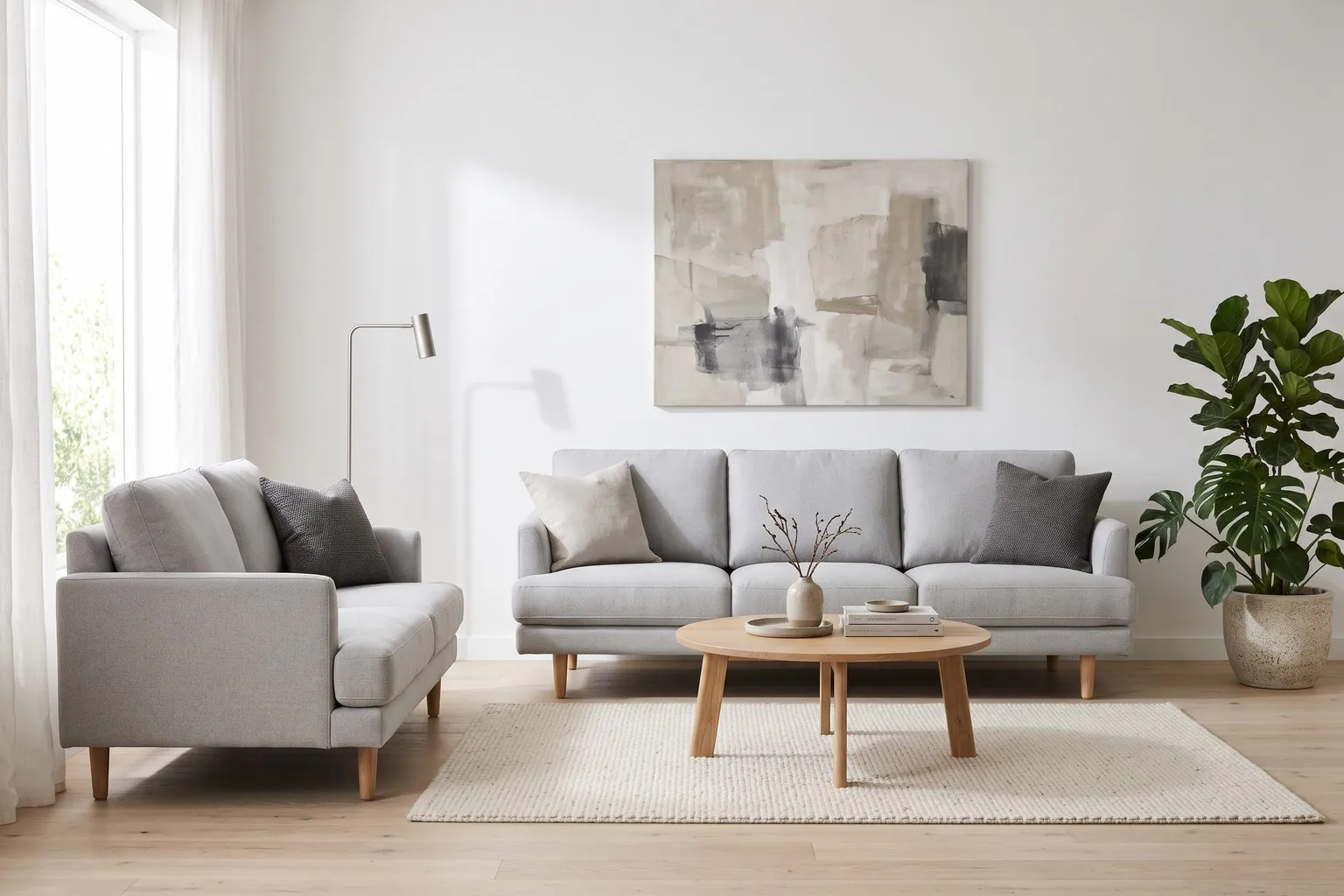
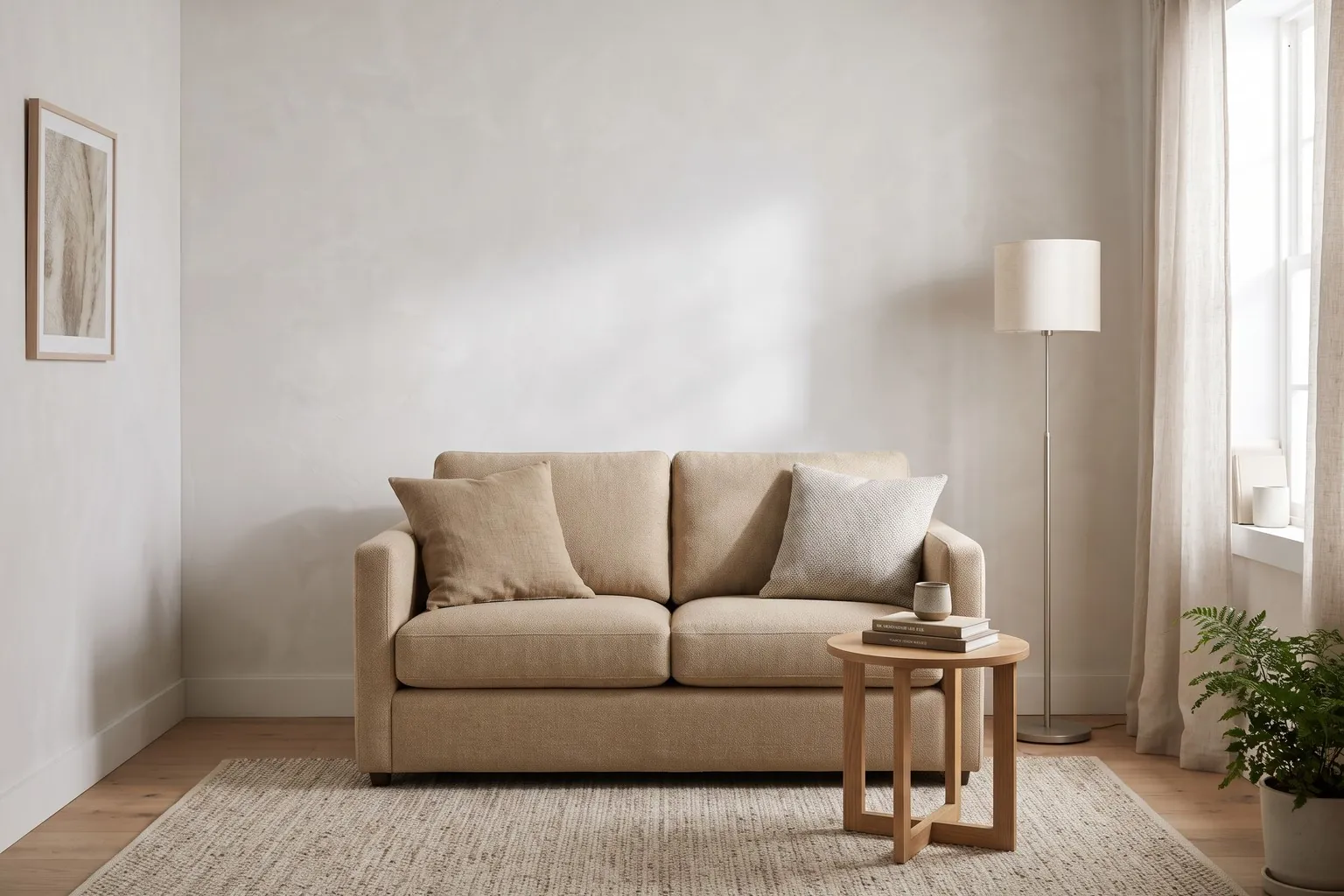
Types of sofas: more than 20 styles, and how to tell them apart
Chesterfield, tuxedo, Lawson, English roll arm, camelback, sectional: more than 20 types of sofas, identified by their arms and back, with origins and sizes.
The short answer
- Most sofa names describe the arms and the back. Look at how high the arms are against the back, and whether they are rolled or straight.
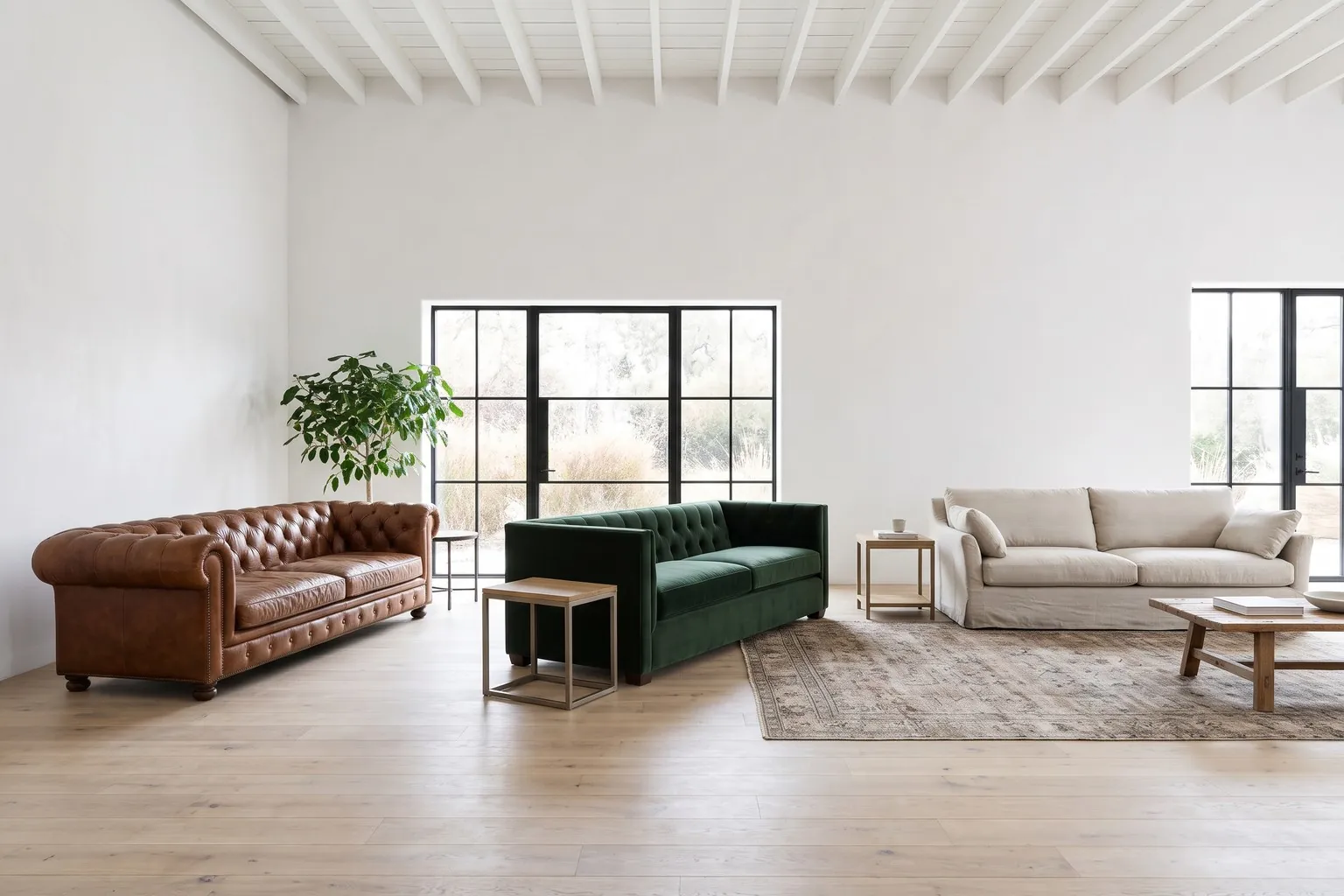
- A Chesterfield is tufted, with rolled arms level with a low back. A tuxedo has straight arms level with the back. A Lawson has arms lower than the back.
- A sectional is two or more pieces joined into an L, a U or a corner. A modular sofa is made of sections that can be rearranged.
- A sleeper hides a fold out mattress under the seat. A daybed is for lounging first and sleeping second.
- Sofa and couch name the same piece today. A loveseat seats two and runs 48 to 72 inches.
In this guide
Sofa names come from two different places. Some describe a shape, and most of those were fixed a century or more ago: Chesterfield, Lawson, tuxedo, camelback. Others describe what the sofa does or how it is built: sectional, sleeper, recliner.
A product page usually gives one of each, which is why a single sofa can be a Lawson, a three seater and a sleeper at once. This guide takes the shapes first, because they are the ones that need explaining, and gives a way to read them off any sofa.
Read the arms and the back
Stand at the side of a sofa and look at its outline. Two things name most of the classic shapes.
How high are the arms against the back? Level with it, or lower.
What shape are the arms? Rolled outward, or straight.
- Arms level with the back, and rolled: a Chesterfield.
- Arms level with the back, and straight: a tuxedo.
- Arms lower than the back: a Lawson, an English roll arm or a bridgewater.
The trade has words for the arms themselves. Merit Home Furniture's guide, quoting the maker American Leather, defines three of them: a track arm is straight from bottom to top with a flat top, a slope arm runs from the top of the back down into the arm, and a shelter arm extends down from the back to a high armrest.
The classic shapes
| Sofa | Arms | Back and details | Origin, as the sources give it |
|---|---|---|---|
| Chesterfield | Rolled, level with the back | Low back, deep button tufting | Named for a 19th century Earl of Chesterfield |
| Tuxedo | Straight and slim, level with the back | Often button tufted | The 1920s |
| Lawson | Lower than the back | Loose back and seat cushions, often skirted | Made for Thomas W. Lawson, around 1900 |
| English roll arm | Low, rounded, set back from the front | Often on casters | The British country house, 20th century |
| Bridgewater | Low, set slightly back from the front | A low sofa | |
| Camelback | A hump, or two, along the top of the back | America, second half of the 18th century | |
| Cabriole | Curved | Curved back, wooden frame showing, curved legs | The 18th century |
| Mid-century | Rectangular, tufted back, wooden legs | Florence Knoll's lounge collection, 1954 |
Chesterfield. Livingetc describes it as known for deep tufting, rolled arms and a low back. Adorno's chair guide gives the same marks for the matching armchair: deep button tufting, and rolled arms level with the back. Designer Steven Sabados, quoted by Merit from a CBC guide, calls it always tufted and grand in scale. The name, according to the Oxford dictionary entry Merit cites, traces to a 19th century Earl of Chesterfield. Livingetc places it in a formal room, an office or a bedroom.
Tuxedo. The arms are the same height as the back, which makes the outline a box. Livingetc adds that the arms are slim and the back typically button tufted, and suggests it for a room dedicated to entertaining and not for a family room. Sabados dates the style to the 1920s.
Lawson. The opposite idea: arms lower than the back, and comfort first. Sabados describes an overstuffed loose back and evenly sized seat cushions. Livingetc notes that it is often skirted, and gives the origin: it was designed to meet the request for a comfortable sofa by the Massachusetts businessman Thomas W. Lawson at the beginning of the 20th century.
English roll arm. Low, rounded arms that stop short of the front of the seat. Livingetc's wording is that the arms do not reach as far as the seat cushion does, and that legs on casters are typical. Sabados notes that the padded arm dips slightly in the center, with pleating at the front, and places the style in the British country house of the 20th century.
Bridgewater. A low sofa whose low arms are set slightly back from the front. That is the definition Merit takes from the dealer 1stDibs. Compare it with the English roll arm above: both have low arms that stop short of the front of the seat.
Camelback. Named for its back. Merit, citing the Metropolitan Museum of Art, describes the crest that forms a central hump along the top of the back, and reports that the museum calls it the most common type of sofa made in America in the second half of the 18th century, most often in Philadelphia. The example it cites is dated 1760 to 1790 and is 98 inches long. Livingetc notes that some have two humps.
Cabriole. Livingetc dates it to the 18th century: curved legs, a curved back and arms, and upholstery inside a wooden frame that shows.
Mid-century. Livingetc gives the marks as a simple rectangular shape, a tufted back and wooden legs. Merit quotes the maker Knoll, which says Florence Knoll's sofa scales the proportions of mid-century modern architecture to a piece of furniture, and dates her lounge collection to 1954.
Two pairs that get confused
Chesterfield and tuxedo. Both have arms level with the back. The Chesterfield's arms are rolled and the whole piece is tufted. The tuxedo's arms are straight.
Lawson and English roll arm. Both have arms lower than the back. On an English roll arm the arms are rounded and stop short of the front of the seat. A Lawson is recognized by its loose back cushions and its evenly sized seat cushions.
Sofas named for how they are built
- Three seater. The standard sofa. Livingetc calls it a classic choice and quotes a designer who says it is the type most popular with clients. A pair of them facing each other makes an intimate arrangement.
- Loveseat. A sofa for two. The Oxford definition Merit cites is a comfortable seat with a back and arms for two people. Designer Christiane Lemieux, quoted by Livingetc, gives its width as generally 48 to 72 inches, with around 60 the most common.
- Apartment sofa. A narrower version of a full size sofa, in Merit's definition.
- Sectional. Two or more pieces that join into an L, a U or a corner. Livingetc calls it best in large entertaining spaces.
- Modular sofa. Separate upholstered sections that can be arranged and rearranged. Livingetc treats it as a type of sectional. Merit, citing 1stDibs, credits the designer Harvey Probber with the idea.
- Curved sofa. Livingetc says they work in both open spaces and small ones.
The difference between a sectional and a modular sofa matters when you move house. Many sectionals are made for one arrangement, with the return on the left or on the right, so check which side before you order. A modular sofa is designed to be put together another way in the next room.
Sofas that turn into something else
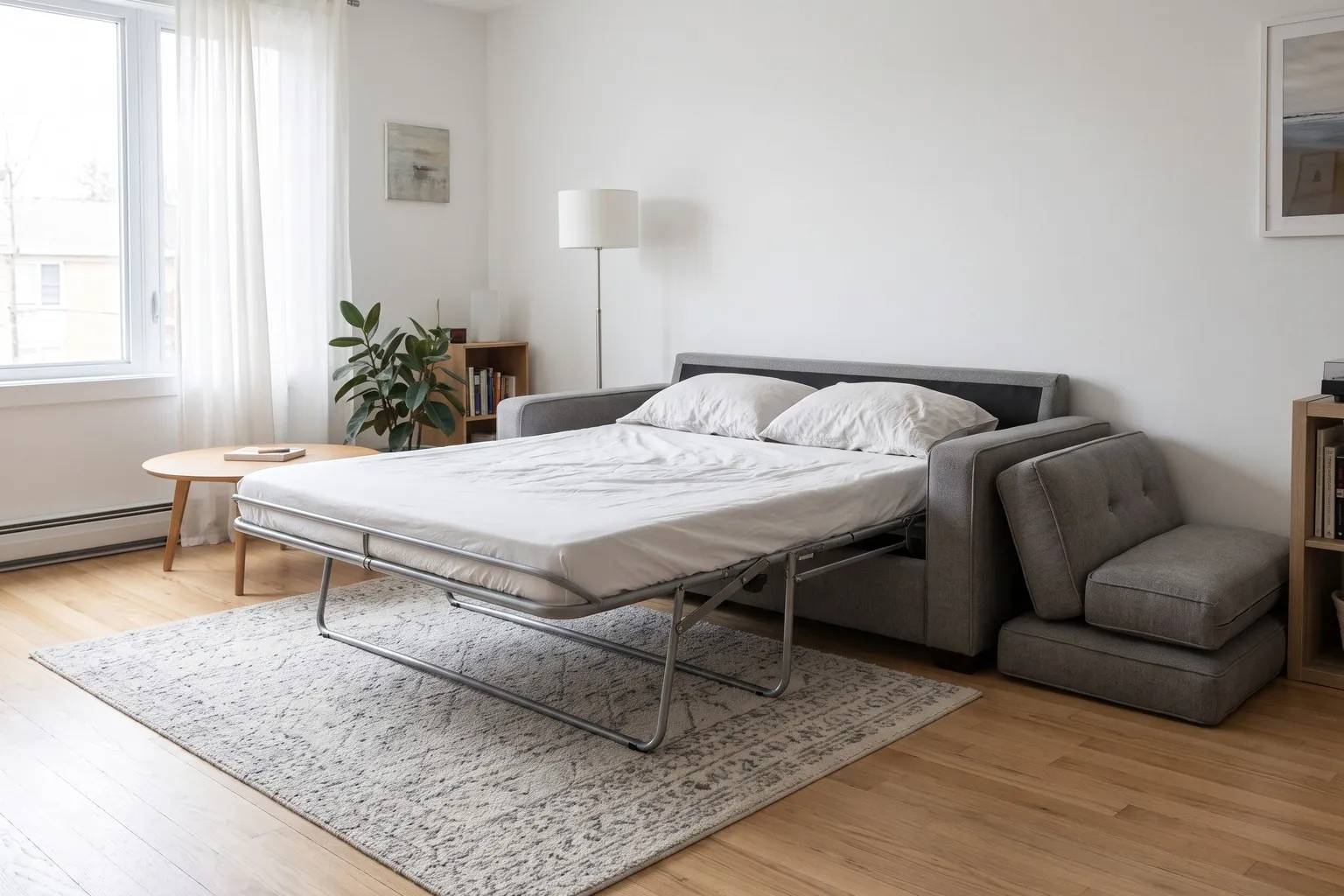
- Sleeper sofa, or sofa bed. Merit's definition is a sofa that hides a fold out mattress under its seat cushions. Livingetc describes a sofa bed as easy to convert for sleeping by its pull out frame.
- Futon. A casual look, often with no arms, taking its cue from the Japanese futon. In the United States, Livingetc notes, futons are closer to low, sleek sofa beds.
- Daybed. It may have no back, or a low one, and some have arms. Unlike a futon or a sofa bed, a daybed may need no setting up to sleep on.
- Divan. A type of daybed, typically with neither a back nor arms, that doubles as a bed.
- Reclining sofa. A recliner's mechanism built into two or three of the seats. Livingetc's name for the group is motion sofas.
- Davenport. Livingetc describes a traditional boxy design that can be a sleeper as well as seating, often with a soft tufted back.
On the choice between the first and the third, Livingetc quotes John O'Leary, design director at the sofa maker Swyft: the key difference is intention. A daybed is centered on lounging and atmosphere, and works best in a larger space. A sofa bed is about practicality and overnight guests, and is more common in smaller rooms.
Long seats for one
- Chaise longue. Livingetc is firm that it is strictly a chair: a seat for one person to extend their legs on. The Oxford definition Merit cites is a long, low seat with a back and one arm, for stretching out the legs. It is often spelled chaise lounge.
- Récamier. Two scrolled ends and no back. Livingetc traces the name to the Parisian socialite Juliette Récamier, who appears in a 19th century portrait by Jacques-Louis David.
A chaise also appears as part of a sofa. Merit lists the sofa with a chaise as a type of its own: a sofa with one seat extended forward for the legs.
Sofa, couch, settee, loveseat
Sofa and couch. Today they name the same thing. The history is different, according to designer Olma Fuentes, quoted by Livingetc: a couch was a piece of furniture with no arms, meant for lying down, and a sofa was an upholstered seat with arms and a back. Fuentes now uses sofa for the large pieces in formal rooms and couch for casual seating. Livingetc's writer adds that in American books, couch has kept a steady lead over sofa in recent years.
Settee. Homes and Gardens describes it as essentially a slimmer, more formal, scaled down version of a sofa, one that tends to sit more upright. The word is far more common in Britain. The examples in its article are 65 and 68 inches long.
Loveseat. A sofa for two, defined by its length.
Homes and Gardens draws the line between a settee and a loveseat by posture and not by size. Both seat two. The settee is the more upright and the less cushioned of them.
The sizes behind the names
| Type | Length |
|---|---|
| Loveseat | 48 to 72 in |
| Settee | About 65 to 68 in, in the Homes and Gardens examples |
| Three seat sofa | 72 to 96 in, most often about 84 |
| Sectional | 90 in and more on the long side |
| Camelback, the museum example | 98 in |
The first, third and fourth rows come from the sources in our guide to sofa sizes, which also covers depth, seat height and how to check that a sofa will get through the door.
A style changes the usable size. A thick rolled arm takes more of the length than a slim one, so two sofas of the same length can seat differently. And if you plan to lie down on the sofa, look at the arm. One that is as high as the back gives you nothing to rest your head on. A low one does.
Which type suits which room
| Room or need | Types the sources suggest |
|---|---|
| A formal sitting room | Chesterfield, tuxedo |
| Everyday comfort and family use | Lawson, sectional |
| A room for entertaining | Tuxedo, a pair of facing three seaters, a large sectional |
| A small living room | Loveseat, apartment sofa, settee |
| A study or an office | Chesterfield |
| Guests staying overnight | Sleeper sofa in a small room, daybed in a larger one |
Using the names when you shop
Search by the shape word when you know the look you want, and by the job word when you know the problem you are solving. Chesterfield and English roll arm return a look. Sleeper and sectional return a function.
Then read the outline for yourself, since shops use the names loosely: arms level with the back or lower, rolled or straight, cushions loose or fixed.
The same approach works for chairs. The names and how to tell them apart are in our guide to types of chairs.
Questions people ask
What are the main types of sofas?
By shape: Chesterfield, tuxedo, Lawson, English roll arm, camelback and mid-century. By construction: three seater, loveseat, sectional and modular. By function: sleeper, recliner, futon and daybed.
What is the difference between a Chesterfield and a tuxedo sofa?
Both have arms level with the back. A Chesterfield has rolled arms and deep button tufting. A tuxedo has straight, slim arms.
What is a Lawson sofa?
A sofa with arms lower than its back and loose cushions. Livingetc says it was designed for the Massachusetts businessman Thomas W. Lawson at the beginning of the 20th century.
What is the difference between a sofa and a couch?
In everyday use, none. Designer Olma Fuentes, quoted by Livingetc, says a couch was historically a piece with no arms meant for lying down, and a sofa an upholstered seat with arms and a back.
What is the difference between a sectional and a modular sofa?
A sectional is two or more pieces joined into an L, a U or a corner. A modular sofa is made of separate sections that can be arranged and rearranged.
Sources
- 20 different types of sofas you should know. Livingetc, read November 2026
- Types of sofas: 14 styles, names and arm shapes. Merit Home Furniture, read November 2026
- Sofa vs couch. Livingetc, read November 2026
- Loveseat vs couch: the main differences. Livingetc, read November 2026
- A daybed or a sofa bed?. Livingetc, read November 2026
- Why I'm choosing a settee over a loveseat for my small space. Homes and Gardens, read November 2026
- Types of chairs: how to tell them apart. Adorno, read November 2026
Every figure in this guide comes from the sources above, or from arithmetic shown in the text. See our editorial policy.