Sofa sizes: standard couch dimensions, and how to tell if one fits
A standard three seat sofa is about 84 inches long, 35 deep and 30 to 36 high. Loveseat, apartment and sectional sizes, seat depth, and the doorway check.
The short answer
- The standard three seat sofa is about 84 inches long. Chairish, Coleman, Livingetc and OMHU all name 84 inches, or 7 feet, as the most common length.
- Loveseats run from 48 to 72 inches. Large and four seat sofas run from 90 to 120. Sectionals start at about 94 inches on the long side.
- Overall depth is 30 to 40 inches, with 35 the usual figure. Seat depth is a different number: 21 to 24 inches.
- Seat height is 17 to 20 inches. OMHU says 18 to 19 suits most people.
- Before ordering, measure the route into the room. The figure that decides is the diagonal depth, from the top of the back to the bottom of the front.
In this guide
A sofa is the largest piece of furniture most people buy without measuring anything. It is chosen in a showroom the size of a warehouse, or on a screen with no scale at all, and the first time its real size is felt is when it meets the front door.
Sofas are more standard than they look. Four numbers describe any of them: length, depth, height and seat height. This guide gives the usual range for each, then the two checks that matter more than the numbers: whether it fits the room, and whether it gets there.
Length, by type
The names are loose and the ranges overlap, so here they are side by side.
| Type | Length | Who gives it |
|---|---|---|
| Loveseat, two seats | 48 to 72 in, see loveseat dimensions | Livingetc, and designer Christiane Lemieux |
| 52 to 72 in | OMHU and Coleman | |
| 52 to 71 in | Chairish | |
| Apartment sofa | 60 to 78 in | OMHU |
| Standard, three seats | 72 to 96 in | OMHU, Coleman and Lemieux |
| 70 to 87 in | Chairish and Livingetc | |
| 71 to 90 in | Castlery | |
| Large, four seats | 90 to 118 in | Castlery |
| 96 to 120 in | OMHU | |
| Sectional, long side | 94 to 120 in and more | OMHU |
Inside the widest of these ranges, one figure keeps coming back. Chairish calls 84 inches the most common length for a three seat sofa. Coleman says the most common option is an 84 inch sofa. Livingetc gives 84 inches as the standard, and quotes designer Mackenzie Collier putting a typical sofa at around 84 inches, or 7 feet. OMHU gives about 7 feet as the most common width, and Castlery's average for a three seater is 83 inches.
For loveseats the equivalent figure is 60 inches. Lemieux, quoted by Livingetc, calls a loveseat of around 60 inches the most common.
If you remember two numbers from this guide, those are the two: 84 for a sofa, 60 for a loveseat.
What seats three really means
The length on the product page includes the arms, and nobody sits on those.
Castlery notes that armrests can take up 4 to 8 inches on each side. Livingetc quotes the furniture brand Froy with a wider range, 4 to 10 inches, and around 4 to 6 for a narrow arm.
For the sitters, Coleman allows around 24 to 30 inches of seating space for each person, and OMHU about 2 feet each on a 7 foot three seater.
Put those together, by our own sum, for an 84 inch sofa.
| Arms, each | Seat left between them | For three people |
|---|---|---|
| 4 in | 76 in | 25 in each |
| 6 in | 72 in | 24 in each |
| 8 in | 68 in | 23 in each |
| 10 in | 64 in | 21 in each |
A slim armed 84 seats three adults at the width Coleman and OMHU give. A wide armed 84 seats three only on paper. Two sofas of the same length can differ by a whole foot of usable seat, so look for the inside seat width on the product page, or work it out from the arm width.
Depth: two numbers, not one
Overall depth is the footprint. Chairish defines it as the measurement from the very front of the sofa to the very back, gives 35 inches as the standard and 32 to 40 as the range. Coleman's table gives 30 to 40 inches, and 35 to 38 for the classic three seater. Castlery gives 33 to 37 as the standard. Livingetc gives 36 to 38 for three seaters.
Seat depth is where you sit. Livingetc defines it as the distance from the front edge of the seat cushion to the back edge, and adds the warning in so many words: seat depth is not the same as sofa depth. Chairish puts the standard seat at 21 or 22 inches. OMHU and designer Anna Tatsioni, quoted by Livingetc, both give 21 to 24.
The difference between the two is the back of the sofa. On a 35 inch deep sofa with a 22 inch seat, 13 inches of the depth is back cushion and frame.
Seat depth is the number to choose by, and it depends on how you sit.
- Upright. OMHU says a seat of around 21 to 22 inches sits upright and supportive.
- Lounging. Past 24 inches, in OMHU's words, the sofa becomes a lounger. Chairish defines deep seat sofas as those with seats between 28 and 35 inches, and Coleman says couches around 38 to 40 inches deep overall are great for lounging.
- By height. Chairish notes that deeper couches fit taller people better.
There is a cost to depth, and it is paid in the room. Every extra inch of sofa comes out of the floor in front of it.
Height, seat height and arms
Overall height is measured from the floor to the top of the backrest. Coleman gives 30 to 36 inches, Castlery 30 to 35, and Collier about 30 to 34 for a three seater. Chairish gives a wider 26 to 36. Collier's advice, in Livingetc, is to avoid backs lower than 28 inches.
Height matters in two places. In front of a window, compare it with the height of the sill. In the middle of a room the sofa is seen from behind, and a lower back keeps the view across the room open.
Seat height is measured from the floor to the top of the seat cushion. OMHU gives 17 to 20 inches, and Tatsioni 17 to 19. OMHU adds that around 18 to 19 inches suits most people, and that on a seat that is too high, short legs dangle.
That figure sets the height of the table in front. A coffee table sits level with the seat or an inch or two lower, as our guide to coffee table height and size explains.
Arm height, from the floor to the top of the arm, is 24 to 32 inches according to OMHU. It is the number to compare a side table with. Coleman's advice is to keep side tables within a few inches of the armrest.
Sectionals and sleepers
A sectional has two lengths, one along each wall.
- OMHU gives 94 to 120 inches and more for the long side, and 5 feet to 6 feet 6 inches for the short return.
- Coleman gives 95 to 130 inches on each side for an L shape, and 120 to 160 inches or more for a U shape.
- Livingetc, citing Wayfair, gives 90 to 168 inches for the width of a sectional.
- A chaise section, per Coleman, is 30 to 36 inches wide and 60 to 72 inches long.
A sectional takes a corner and a good part of two walls, so measure both, and check on the product page which side the return is on.
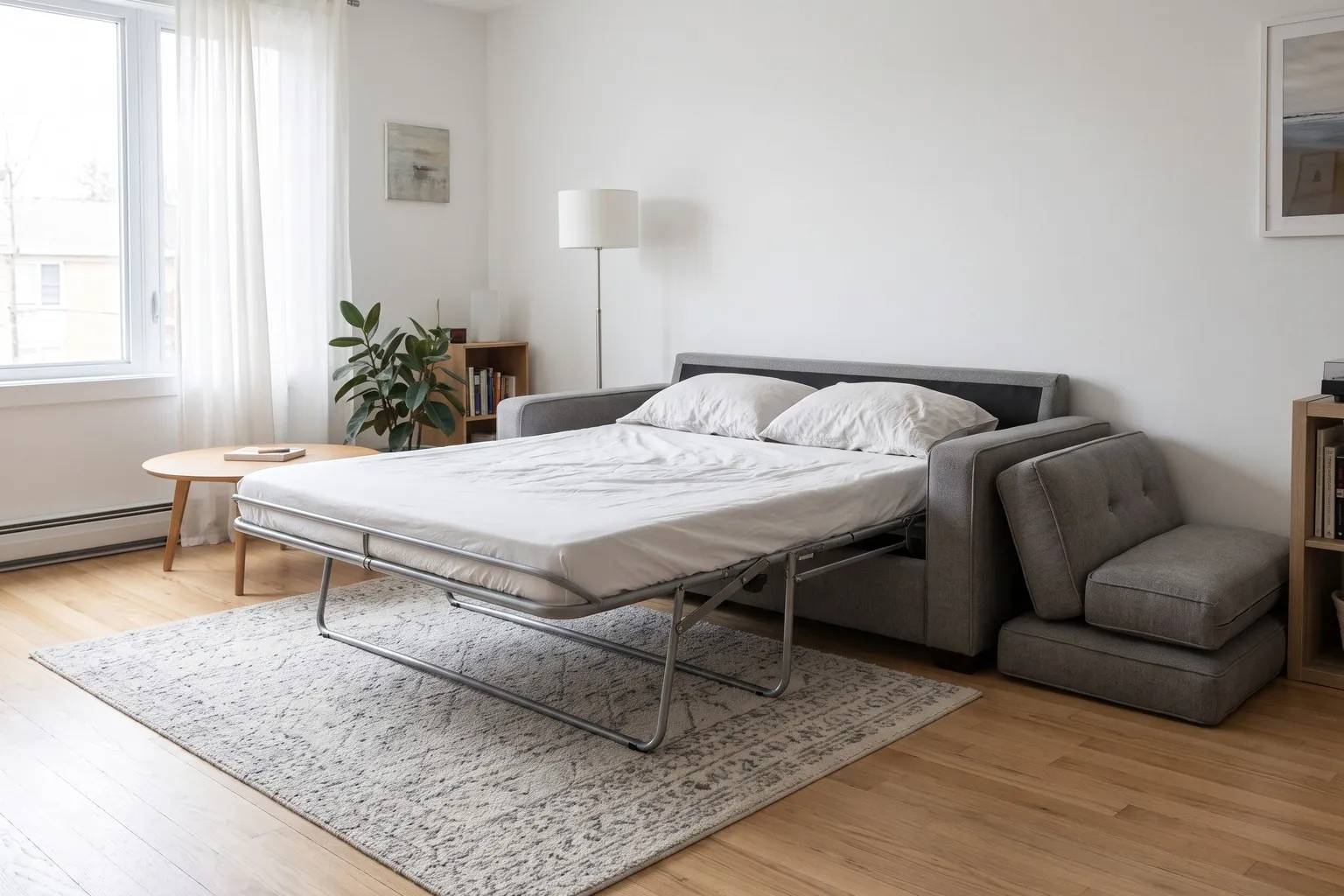
A sleeper sofa has a third dimension that only appears at night. Coleman gives sleepers the same 72 to 96 inches of length as other sofas, and adds that extended they can measure 75 to 90 inches from front to back. That is more than twice the depth of the sofa closed, and it has to be clear floor.
Will it fit the room
Three clearances turn a sofa's footprint into the space it really needs.
Walkways. Coleman asks for at least 30 to 36 inches of clearance in the main walkways. Castlery gives 30 to 35.
The coffee table. Coleman gives about 18 inches between the front of the couch and the table, and Castlery 16 to 20.
The television. Castlery's guide is a viewing distance of about 1.5 to 2.5 times the size of the screen.
Here is the depth of room a sofa uses, by our sums, with a coffee table 24 inches deep and a walkway on its far side.
| Sofa depth | Gap to table | Table | Walkway | Total from the wall |
|---|---|---|---|---|
| 33 in | 18 in | 24 in | 30 in | 105 in (8 ft 9 in) |
| 35 in | 18 in | 24 in | 30 in | 107 in (8 ft 11 in) |
| 38 in | 18 in | 24 in | 36 in | 116 in (9 ft 8 in) |
| 40 in | 18 in | 24 in | 36 in | 118 in (9 ft 10 in) |
So a standard sofa against a wall, with a table and a way past, uses about 9 feet of the room's depth. In a room 10 feet deep that leaves a foot for whatever stands on the opposite wall. This is the sum that tells you whether a deep sofa is a comfort or a mistake.
Along the wall the check is simpler. The sofa's length plus a side table at one or both ends has to fit between the corners, the doors and the windows. And the sofa sets the size of the rug: the layouts are in our guide to what size rug for a living room.
Will it get in
The route into the room deserves the same care as the room itself.
Coleman's instruction is to measure doorways, hallways, stairwells and elevators before you order. OMHU puts it as the narrowest doorway, hallway and turn on the way to the room.
The measurement to compare them with is the diagonal depth. Collier, in Livingetc, defines it as the distance from the top back of the sofa to the bottom front, and calls it crucial for knowing that a sofa can fit through doorways or round tight corners. Coleman's test is that the smallest side of the couch has to be narrower than the doorway.
In practice:
- Measure the width of every opening on the route, and the smallest one is your number.
- From the product page, take the sofa's height, its depth and its diagonal depth. If the diagonal depth is not listed, ask for it.
- By Coleman's test, the sofa goes through if its smallest side is narrower than the opening, so compare the opening with the height and with the depth. If both are too large, compare it with the diagonal depth, which is the measurement that counts when the sofa is tilted through.
- Check the length against the turns. A long sofa that fits the door can still fail the landing behind it.
If nothing passes, look at sofas with removable legs or arms, or at a modular sofa that arrives in sections.
Sofa or couch
The two words describe the same piece of furniture in everyday use. Livingetc quotes designer Colleen Bennett drawing a line by size: sofas averaging 84 to 96 inches long, and couches around 60 to 84. The names of the styles, and what tells them apart, are in our guide to types of sofas. Keeping one clean, by the code on its label, is in how to clean a couch.
Before you order
- Length: the wall, less the side tables. Then the seat width between the arms, at about 24 inches a person.
- Seat depth: 21 to 22 inches to sit upright, 24 and over to lounge.
- Seat height: 17 to 20 inches, and 18 to 19 for most people.
- Overall depth, plus 18 inches to the table, plus the table, plus 30 to 36 inches to walk past.
- The narrowest opening on the way in, against the height, the depth and the diagonal depth.
- Mark the footprint on the floor with painter's tape and walk round it for a day.
Questions people ask
What is the standard size of a sofa?
About 84 inches long, 35 inches deep and 30 to 36 inches high. Chairish, Coleman and Livingetc all give 84 inches as the most common length for a three seat sofa.
How long is a three seat sofa?
Between about 70 and 96 inches, depending on the source, with 84 inches the most common. Castlery gives 71 to 90, OMHU and Coleman 72 to 96.
What size is a loveseat?
48 to 72 inches long. Designer Christiane Lemieux, quoted by Livingetc, calls around 60 inches the most common.
What is a good seat depth for a sofa?
21 to 24 inches. OMHU says 21 to 22 inches sits upright and supportive, and that past 24 inches the sofa becomes a lounger.
How do I know if a sofa will fit through my door?
Measure the narrowest opening on the route. The sofa passes if its height, its depth or its diagonal depth is smaller than that opening. The diagonal depth runs from the top back of the sofa to the bottom front.
Sources
- Standard sofa sizes: your quick dimensions guide. Castlery, read November 2026
- What are average sofa dimensions?. Chairish, read November 2026
- Your easy guide to couch dimensions. Coleman Furniture, read November 2026
- Standard sofa dimensions. OMHU, read November 2026
- Understanding sofa dimensions. Livingetc, read November 2026
- Loveseat vs couch: the main differences. Livingetc, read November 2026
- Sofa vs couch. Livingetc, read November 2026
Every figure in this guide comes from the sources above, or from arithmetic shown in the text. See our editorial policy.