Types of chairs: more than 30 names, and how to tell them apart
Club, wingback, slipper, bergère, Windsor, Parsons: more than 30 types of chairs, what identifies each one, where the name comes from and which room it suits.
The short answer
- Four things identify almost any chair: whether it has arms, how high the seat is, how the back is built, and what it stands on.
- Armchair is the parent term for any chair with arms. A side chair is a dining height chair with none.
- Accent chair, occasional chair and lounge chair describe a job or a posture, not a shape.
- A wingback has side panels at head height, a slipper chair has no arms and a low seat, and a bergère has closed upholstered sides in an exposed wooden frame.
- A dining chair seat is about 18 inches high and a lounge chair seat 15 to 16. The two do not swap.
In this guide
Furniture shops use dozens of words for chairs, and most of us get by with a handful. The rest are not jargon for its own sake. Each one names a real difference in how a chair is built or what it is for, and knowing the word is the fastest way to find the chair.
This guide sorts the names into groups, says what identifies each chair, and gives the origin where a source gives one. It starts with a way of looking that works on any chair, named or not.
Four questions that name a chair
Look at a chair in this order.
- Arms. With arms it is an armchair of some kind. Without, it is a side chair, a slipper chair or a stool.
- Seat height. Adorno's chair guide gives 17 to 19 inches as the standard seat, with 18 the usual figure. A lounge chair is lower, 15 to 16 inches. Above about 22 inches the sitter perches, and the piece is a stool.
- The back. How high it is, whether it is upholstered or open, and whether it runs into the arms.
- The base. Four legs, runners, a single column, or a frame with no back legs at all.
Nearly every name below is an answer to one or two of those questions.
Words for a job, not a shape
Several of the commonest chair words do not describe what a chair looks like. They describe what it does.
- Armchair. The parent term. Adorno defines it as any chair with arms.
- Side chair. A dining height chair with no arms, in Adorno's definition. It can be pushed fully under a table, and its seat is around 18 inches high.
- Host chair, or carver. A dining chair with arms, traditionally placed at the head of the table.
- Accent chair. Adorno defines it by its job in a room: a single chair chosen to stand apart from the rest of the seating. Any of the shapes below can be one.
- Occasional chair. A lighter chair meant to be moved around a room.
- Lounge chair. Defined by posture, in Adorno's words. The seat is lower and deeper, 22 to 24 inches, and the back is raked. Easy chair is the older English term for the same thing.
- Chair and a half. A size, roughly one and a half seat widths. Bob Vila places it slightly smaller than a loveseat.
So a shop can list the same chair as an armchair, an accent chair and a club chair, and all three are true. The first says it has arms, the second says it is sold on its own, and only the third describes its shape.
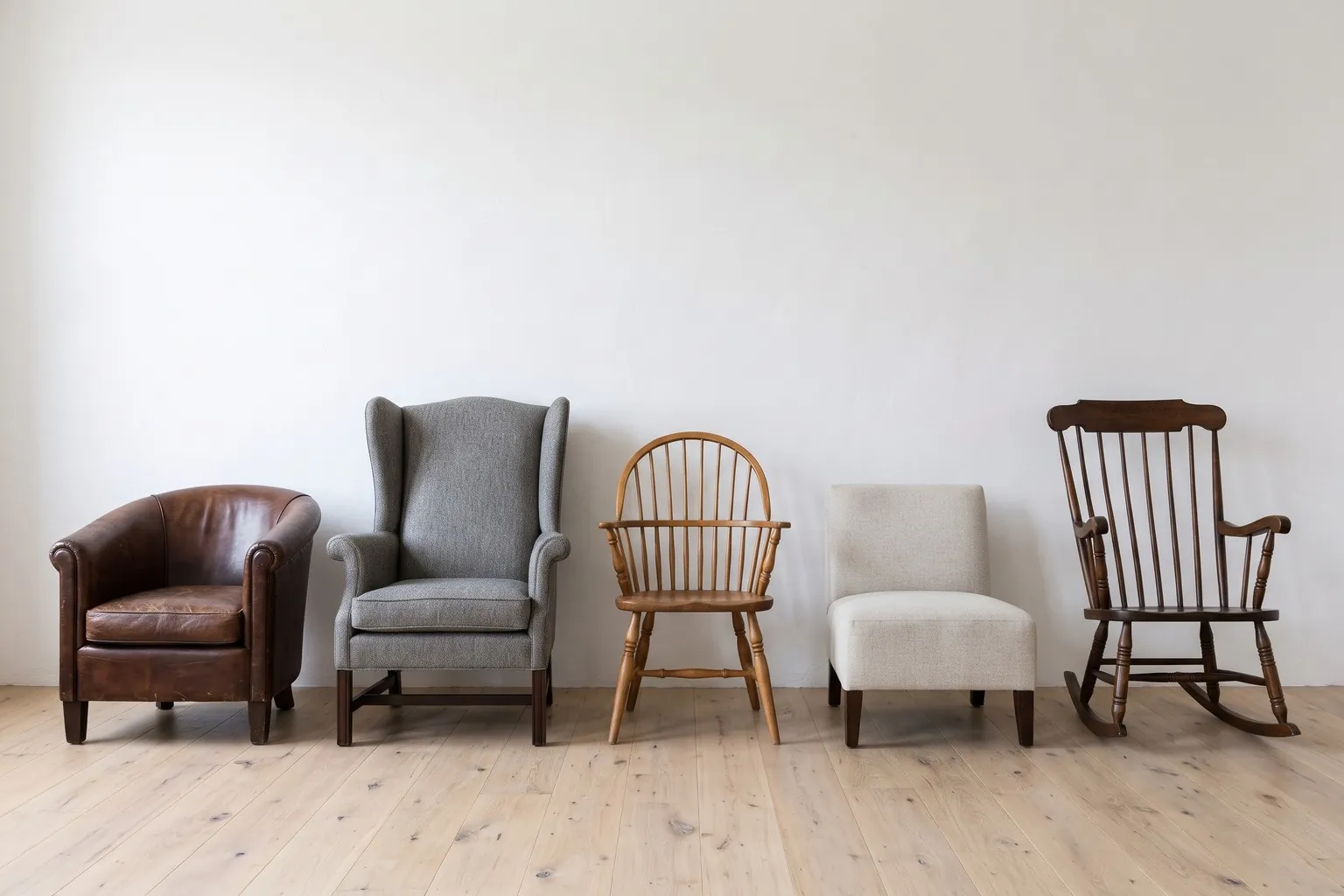
Upholstered armchairs
These are the living room chairs, and the group where the names are most often confused.
| Chair | How to recognize it | Origin, as the sources give it |
|---|---|---|
| Club chair | Low back, deep seat, wide padded arms, upholstered all over | French gentlemen's clubs, late nineteenth century, originally in leather (Adorno) |
| Wingback, or wing chair | Tall back with side panels at head height | Seventeenth century England (Adorno) |
| Bergère | Exposed wooden frame, closed upholstered sides, loose seat cushion | France, about 1725 (Victoria and Albert Museum) |
| Barrel chair | The back curves continuously into the arms, with no join | |
| Tub chair | The same idea, lower, with a shallower curved back | |
| Chesterfield chair | Deep button tufting, rolled arms level with the back | A variation of the Chesterfield sofa (Bob Vila) |
| Channel back chair | Vertical pleats up the back | |
| Slipper chair | No arms, low seat, upholstered | Bedroom seating of the eighteenth and nineteenth centuries (Homes and Gardens) |
Club chair. Adorno adds a measurement that sorts it from its neighbors: the back is no higher than the sitter's shoulders. HomeFurnishings.com gives the seat as typically 22 to 24 inches deep, and warns that it is not a chair for tiny apartments. Bob Vila notes it is almost always upholstered in leather, and places it in family rooms, dens and libraries.
Wingback. The wings had a purpose. Livingetc describes them as two side panels that extend from the back of the chair round toward the armrests, originally designed to shield the sitter from drafts while trapping heat from the fireplace. Bob Vila calls it the chair for a reading spot in a living room or a library.
Bergère. The Victoria and Albert Museum, describing one in its collection, says bergère was the term given to a new form of winged armchair developed in France in about 1725, designed to be particularly comfortable, with a long seat and a sloping back. The detail to look for is the side. Adorno describes closed upholstered sides inside an exposed wooden frame, where most wooden armchairs are open under the arm.
Barrel and tub. The two overlap. Adorno separates them by height: a barrel chair is taller and more upright, a tub chair lower with a shallower curve. HomeFurnishings.com says both work well in corners and small spaces, and suggests looking for a swivel base.
Slipper chair. Homes and Gardens describes it as a low slung, armless chair, traditionally designed as bedroom seating and made to be easy to sit on while dressing. HomeFurnishings.com gives the seat as usually 15 to 17 inches high, against 18 to 20 for a standard chair. Bob Vila still suggests it for bedrooms and walk in closets, for putting on shoes.
Three that get mixed up
A club chair, a wingback and a bergère are all upholstered armchairs. Look at the back and the sides.
- Low back, everything padded: a club chair.
- Tall back with wings: a wingback.
- Wooden frame showing, sides closed in: a bergère.
Dining and wooden chairs
Here the back is the feature that gives the name.
- Windsor. Spindles socketed directly into a solid, shaped wooden seat, with the legs socketed into the underside of the same seat. Bob Vila notes it sometimes has armrests, and suits a farmhouse or country room.
- Ladder back. Horizontal slats climbing the back like rungs.
- Cross back. Two diagonals that cross. Adorno calls it common in farmhouse and French country dining rooms.
- Parsons chair. A fully upholstered dining chair with a straight, high back and no arms, named for the Parsons School of Design.
- Queen Anne chair. Cabriole legs, pad feet and a vase shaped back, typically in walnut, according to Bob Vila.
- Louis XVI chair. Bob Vila's King Louis chair, named for Louis XVI of France, with an upholstered round or shield shaped back.
- Wishbone chair. Designed by Hans Wegner in 1949. The name comes from the shape of the piece in the middle of the back, and the seat is woven cord.
- Cantilever chair. A chair with no back legs, the seat held by the spring of the frame. Adorno credits Mart Stam with building the first in 1926.
Chairs that move
- Rocking chair. The whole chair moves on curved runners. Bob Vila recommends it for people who like motion and for parents with young children.
- Glider. A similar motion on a fixed base, so the chair does not travel across the floor.
- Swivel chair. The seat turns on a column. A pedestal chair stands on a single central column and need not turn.
- Recliner. The back drops and, usually, a footrest rises.
Any of these mechanisms can be put under another shape. A swivel barrel chair is a barrel chair on a turning base.
Long, low and outdoor
- Chaise longue. A seat long enough to put your legs up. Livingetc calls it strictly a chair, for one person to extend their legs on, and notes the common spelling chaise lounge.
- Papasan. A large bowl shaped frame, typically of rattan or wood, holding a round cushion whose angle can be changed.
- Bean bag. A fabric bag filled with polystyrene beans. Bob Vila gives its other name, the Sacco chair.
- Adirondack chair. An outdoor chair with a deep seat, a slanted back and wide arms, low to the ground, in wood or plastic.
Chairs known by a designer's name
Some chairs are a single design that became a type.
| Chair | Designer and date | How to recognize it |
|---|---|---|
| Barcelona chair | 1929 | A scissor shaped frame |
| Wishbone chair, CH24 | Hans Wegner, 1949 | A curved back frame that resembles a wishbone, cord seat |
| Tulip chair | 1950s | Made with and without arms, and used as a dining chair |
| Eames lounge chair | 1956 | Black leather on a wooden frame, an angled back, and an ottoman |
| Egg chair | Arne Jacobsen, 1958, for the Royal Hotel in Copenhagen | A wide, round back that curves round the sitter |
The dates are those given by Adorno and by Bob Vila. For the Egg chair, Bob Vila gives 1959 as the year it was introduced.
The numbers behind the names
The names carry measurements with them, which is the practical reason to learn them. These are Adorno's figures.
| Seat height | Other | |
|---|---|---|
| Dining and side chairs | 17 to 19 in | 18 to 20 in wide, 22 or more with arms |
| Lounge chairs | 15 to 16 in | Seat 22 to 24 in deep |
| Counter stools | 24 to 26 in | For a 34 to 36 in counter |
| Bar stools | 28 to 30 in | For a 40 to 42 in bar |
Two consequences follow.
A lounge chair cannot be a dining chair. Adorno says so directly. At a 30 inch table a 16 inch seat leaves you 14 inches below the top, with a raked back tipping you away from your plate.
A dining chair needs room behind it. Adorno gives 10 to 12 inches between the seat and the underside of the table, 24 inches of table width for each person, and 36 inches behind the chair to stand up and walk past.
The full set of seat heights, with benches, is in our guide to bench and chair seat height.
Which chair for which room
Collected from the sources above.
| Room | Chairs the sources suggest |
|---|---|
| Living room | Club chair, wingback, barrel or tub chair, Chesterfield chair, Barcelona chair |
| Reading corner, library | Wingback, club chair, Egg chair |
| Bedroom, dressing area | Slipper chair, papasan |
| Dining room | Side chair, host chair, Windsor, Parsons, wishbone, Queen Anne, Louis XVI, tulip |
| Nursery | Rocking chair |
| TV or family room | Recliner, chair and a half |
| Outdoors | Adirondack chair, chaise longue |
One practical rule sits under that table. The smaller the room, the more the arms matter. An armless chair, whether a slipper chair in a bedroom or a side chair at a table, takes less width and slides out of the way.
Using the names when you shop
Search by the shape word, not the job word. Accent chair returns everything. Slipper chair, barrel chair or wingback returns one kind of chair.
Then check the two numbers a name does not guarantee: the seat height, and the overall width including the arms. Names are used loosely from one shop to the next.
The same sorting works for larger seating. The names for sofas are in our guide to types of sofas, and the low cabinet that stands behind one or along a dining room wall is explained in what is a credenza.
Questions people ask
What are the main types of chairs?
By use: dining chairs, armchairs, lounge chairs, stools and outdoor chairs. By shape, the common upholstered types are the club chair, the wingback, the barrel or tub chair, the bergère and the slipper chair, and the common wooden types are the Windsor, the ladder back and the cross back.
What is the difference between an armchair and an accent chair?
Armchair describes the chair: it has arms. Accent chair describes its job: Adorno defines it as a single chair chosen to stand apart from the rest of a room's seating. A chair can be both.
What is a chair without arms called?
At dining height, a side chair. Low and upholstered, a slipper chair. A fully upholstered armless dining chair with a straight high back is a Parsons chair.
What is a slipper chair?
A low, armless upholstered chair. Homes and Gardens says it was traditionally designed as bedroom seating in the eighteenth and nineteenth centuries, made to be easy to sit on while dressing.
Why does a wingback chair have wings?
The side panels were originally designed to shield the sitter from drafts while trapping heat from the fireplace, according to Livingetc.
Sources
- Types of chairs: how to tell them apart. Adorno, read November 2026
- 20 types of chairs every DIY home designer should know. Bob Vila, read November 2026
- Accent chair styles guide: from club to slipper. HomeFurnishings.com, read November 2026
- Chair, Chippendale, Haig and Co., about 1772. Victoria and Albert Museum, read November 2026
- Slipper chairs are trending again. Homes and Gardens, read November 2026
- Modern wingback chairs. Livingetc, read November 2026
- 20 different types of sofas. Livingetc, read November 2026
Every figure in this guide comes from the sources above, or from arithmetic shown in the text. See our editorial policy.