Patio umbrella size: the chart by table, the 2 foot rule and the base
A 36 inch table takes a 7 foot umbrella, a 48 inch table 9 to 10 feet, a 60 inch table 11 feet. The 2 foot rule, shapes, base weights and when to close it in wind.
The short answer
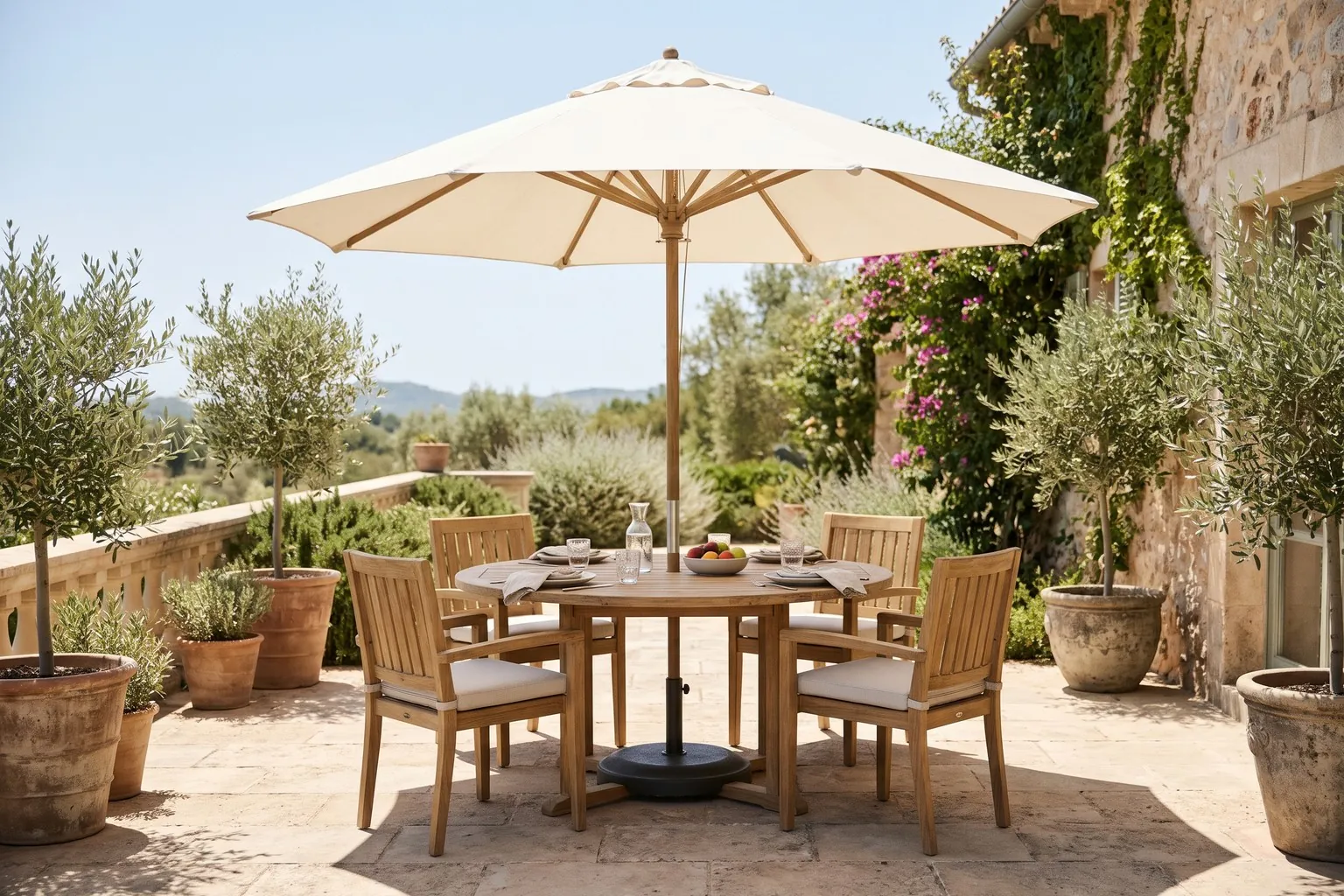
- The rule in two Bob Vila guides: the canopy reaches about 2 feet past the table or seating on every side. Family Handyman says a couple of feet wider than the table.
- Bob Vila's chart: 7 feet for a 36 inch table, 9 to 10 feet for tables up to 48 inches, 11 feet for a 60 inch table with six chairs.
- An umbrella's size is the width of the open canopy, not its height. Open, it should stand 7 to 9 feet tall.
- The base: 20 to 40 pounds for an umbrella through a table, 50 pounds or more freestanding, by Family Handyman; 40 to 100 pounds by size, by Bob Vila.
- Most makers say to take the umbrella down in winds over 20 miles per hour.
In this guide
A patio umbrella is sold by one number, the width of its canopy, and that number has to answer to the table underneath. Too small, and the people at the ends sit in the sun. Too large, and it catches more wind, as Bob Vila warns. The sources give a rule of thumb and a chart, and the two do not always agree.
This guide sets them side by side, then covers shape, height, the three kinds of umbrella, the base and wind. Our sources are Family Handyman's buying guide and three Bob Vila guides: its tested patio umbrellas, its cantilever umbrellas and its umbrellas for wind. The table itself is in our guide to picnic table dimensions, and the room a dining table needs around it is in dining table size and clearance.
The rule: about 2 feet past the table
Three versions of the same idea:
| Source | Rule |
|---|---|
| Bob Vila, umbrellas for wind | the umbrella should extend over the furniture by around 2 feet on each side |
| Bob Vila, cantilever umbrellas | about 2 feet wider than all sides of a dining table or seating area |
| Family Handyman | a couple of feet wider than the table or area where you're sitting |
The two Bob Vila guides count the 2 feet on each side, which adds 4 feet to the width. Family Handyman's wording reads as a couple of feet in total. That is a real difference, about 2 feet of canopy.
Worked out, by our sums:
| Table | 2 ft each side (Bob Vila rule) | A couple of feet in total (Family Handyman) |
|---|---|---|
| 36 in, 3 ft | 7 ft | about 5 ft |
| 48 in, 4 ft | 8 ft | about 6 ft |
| 60 in, 5 ft | 9 ft | about 7 ft |
| 72 in, 6 ft | 10 ft | about 8 ft |
In our reading, the rule covers the table, and chairs pulled out from it sit further out: that is why the sources speak of the table or the seating area.
The chart, by table size
Bob Vila's tested guide gives sizes by table and seats:
| Table and seats | Umbrella |
|---|---|
| Bistro set, two chairs | 5 to 6 ft |
| 36 in table, two to four chairs | 7 ft |
| 40 in table, four to six chairs, or a small conversation area | 7.5 to 8.5 ft |
| Tables up to 48 in, or a small-to-medium conversation area | 9 to 10 ft |
| 60 in table, six chairs, or a medium conversation area | 11 ft |
| 60 to 72 in table, or a large conversation area | 11.5 to 13 ft |
Against the rule. For a 36 inch table the chart and the 2 foot rule agree: 7 feet. For larger tables the chart runs bigger than the rule, by 1 to 2 feet at 48 inches and by 2 feet at 60. Our comparison. The chart counts the chairs as well as the table, which is our reading of why.
Family Handyman's figure. It says most home patio umbrellas are 9 feet wide and fit tables 6 to 7 feet across, and that a single person or a small table needs about 6 1/2 feet. A 9 foot umbrella over a 7 foot table leaves a foot each side, by our sum; Bob Vila would put 11.5 to 13 feet over a 72 inch table. For a large table, Family Handyman suggests an even larger umbrella or a shade sail.
So the sources agree on small tables and differ by several feet on large ones. If the shade has to cover the chairs at a long table, the larger figure is the safer choice: our reading.
How an umbrella is measured
Bob Vila: umbrella measurements refer to the width of the fully extended canopy, not the height. Our advice for a square or rectangular canopy: check whether the listed figure is the side or the diagonal.
Height. Bob Vila's tested guide says an umbrella should stand no less than 7 feet and no more than 9 feet when fully raised. Its wind guide calls a height over 7 feet ideal, tall enough to clear most adults.
Weight. A typical market umbrella weighs 10 to 20 pounds, and an extra-large one 20 to 25, by Bob Vila.
Shape
- Round over round, rectangle over rectangle. Bob Vila's wind guide: a rectangular umbrella is best over a rectangular dining table, a round one over a circular bistro set.
- Long tables. Extra-large umbrellas are often oblong, to cover a long table exactly where the shade is needed.
- Coverage against weight. Rafi Friedman of Coastal Luxury Outdoors, quoted by Bob Vila: circular shapes usually offer the best coverage for their weight; square umbrellas are easier to make and can be lighter, since they need only four support beams.
Three kinds of umbrella
Market, or center pole. The pole stands in the middle of the canopy; Family Handyman calls the kind that passes through a table a table umbrella. Bob Vila's wind guide finds umbrellas with a single center pole tend to be more stable.
Cantilever, or offset. The canopy hangs to the side of the pole rather than centered on top. Family Handyman: these angle out over a large area while not getting in anyone's way. Bob Vila notes that many rotate on the base, up to 360 degrees, and that they can be less sturdy in wind, so a heavy-duty model matters.
Half umbrella. Flat on one side, for a patio set against a wall or fence. In windy places, Bob Vila suggests placing one along a wall on the side sheltered from the wind.
Family Handyman also mentions tilting umbrellas, which can be angled against sun from one direction.
The base
The base is what keeps the canopy from becoming a sail.
| Source | Base weight |
|---|---|
| Family Handyman | around 20 to 40 lb for a table umbrella; 50 lb or more for a freestanding one, depending on size |
| Bob Vila, tested | 40 lb for 5 to 6 ft; 50 lb for 7.5 to 8.5 ft; 60 lb for 9 ft; 70 lb for 10 ft; 100 lb for 11 to 13 ft |
| Bob Vila, cantilever | weighted bases from 40 to over 100 lb; a cantilever not bolted to the ground must have one |
Bob Vila's tested guide adds that cantilever models in particular need more weight than market umbrellas. Rafi Friedman puts it bluntly: when planning a cantilever umbrella, it is hard to overdo it on the base, because the angles involved put a lot of force on it. Family Handyman adds that a table umbrella needs a perfectly level surface to keep from wobbling.
Reading the two tables together. Family Handyman's lighter figure is for an umbrella through a table, where the table holds the pole upright; Bob Vila's figures do not say whether a table is involved. Our reading. A 9 foot umbrella freestanding would take 60 pounds by Bob Vila and 50 or more by Family Handyman, which agree.
Bob Vila's wind guide adds a fourth option: an anchored base that fastens to the ground under the umbrella, the most effective against wind, though freestanding bases are more common and easier to move.
Wind
When to close it. Bob Vila's wind guide: most manufacturers recommend taking the umbrella down in winds over 20 miles per hour. Close it when not in use, never leave it open and unattended in wind, and open and close it gently. Family Handyman says to fold it when not in use and remove it entirely before severe weather.
What helps. Vents let some wind pass through the canopy; double vents are used in high-wind areas, by Bob Vila. More ribs make a stronger structure. For the frame, Family Handyman recommends flexible materials such as wood or fiberglass in windy areas: aluminum resists moisture but its stiffness makes it more vulnerable to high winds.
Big canopies. Bob Vila: large umbrellas with massive canopies are more prone to wind damage because of their size. That is the other reason not to oversize.
The frame and the crank
Materials. The sources pull in different directions. Rafi Friedman, quoted by Bob Vila, calls aluminum usually the best material choice. Family Handyman agrees that aluminum resists moisture damage, but prefers wood or fiberglass in windy areas because they flex. Bob Vila's tested guide says fiberglass carries the highest price and may also last the longest, and its wind guide calls fiberglass an excellent option for wind.
Opening it. A crank lift is the best option for large umbrellas, by Bob Vila, and its wind guide calls cranks arguably the easiest way to open one. Most cantilever umbrellas open and close with a crank. Family Handyman's tilting umbrellas add a second control, to angle the canopy against a low sun.
Fabric
| Fabric | What the sources say |
|---|---|
| Solution-dyed acrylic | a top choice: resists fading, mold and mildew, by designer Maksim Sauchanka in Family Handyman |
| Sunbrella | an acrylic and polyester blend, by one Bob Vila guide; a UV- and weather-resistant acrylic, by another |
| Polyester | less expensive, with water-resistant coatings, but may not last as long as acrylic |
| Olefin | very UV-resistant and quick to dry, by Bob Vila |
Sun protection. Bob Vila: a UPF 15 fabric blocks around 93.3 percent of UV radiation and a UPF 50+ fabric around 98 percent. Acrylics such as Sunbrella usually reach UPF 50+.
How long. Family Handyman: a patio umbrella generally lasts three to five years; Sunbrella offers a 10 year limited warranty on its fabric.
Before you buy, in six checks
- Measure the table, and how far the chairs pull out.
- Add about 2 feet each side, or take the chart's figure for a large table.
- Match the shape to the table: round over round, rectangle over rectangle.
- Height: 7 to 9 feet open.
- Base: by size and type; heavier for a cantilever.
- Wind: vents, a flexible frame, and close it above 20 miles per hour.
Questions people ask
What size umbrella for a 48 inch table?
9 to 10 feet, by Bob Vila's chart. The 2 foot rule gives 8 feet as a minimum.
What size umbrella for a 60 inch table?
About 11 feet for six chairs, by Bob Vila. For a 60 to 72 inch table, 11.5 to 13 feet.
What size umbrella for a 36 inch table?
7 feet, for two to four chairs. A bistro set for two takes 5 to 6 feet.
How much bigger than the table should an umbrella be?
About 2 feet past the table on each side, by two Bob Vila guides. Family Handyman says a couple of feet wider than the table.
How heavy should an umbrella base be?
20 to 40 pounds through a table and 50 or more freestanding, by Family Handyman. Bob Vila gives 40 pounds for a 5 to 6 foot umbrella up to 100 for 11 to 13 feet. Cantilevers need more.
How tall should a patio umbrella be?
7 to 9 feet when fully raised, by Bob Vila.
What shape umbrella for a rectangular table?
A rectangular one, by Bob Vila, and an oblong extra-large umbrella for a long table. A round umbrella fits best over a round bistro set.
Cantilever or center-pole umbrella?
A cantilever hangs the canopy to the side, so the pole stays out of the way, but it needs a heavier base and can be less sturdy in wind. A center pole is more stable, by Bob Vila.
At what wind speed should you close a patio umbrella?
Most manufacturers say to take it down in winds over 20 miles per hour.
Sources
- Patio umbrella buying guide. Family Handyman, read November 2026
- The best patio umbrellas, tested and reviewed. Bob Vila, read November 2026
- The best cantilever umbrellas, tested and reviewed. Bob Vila, read November 2026
- The best patio umbrellas for windy conditions. Bob Vila, read November 2026
Every figure in this guide comes from the sources above, or from arithmetic shown in the text. See our editorial policy.