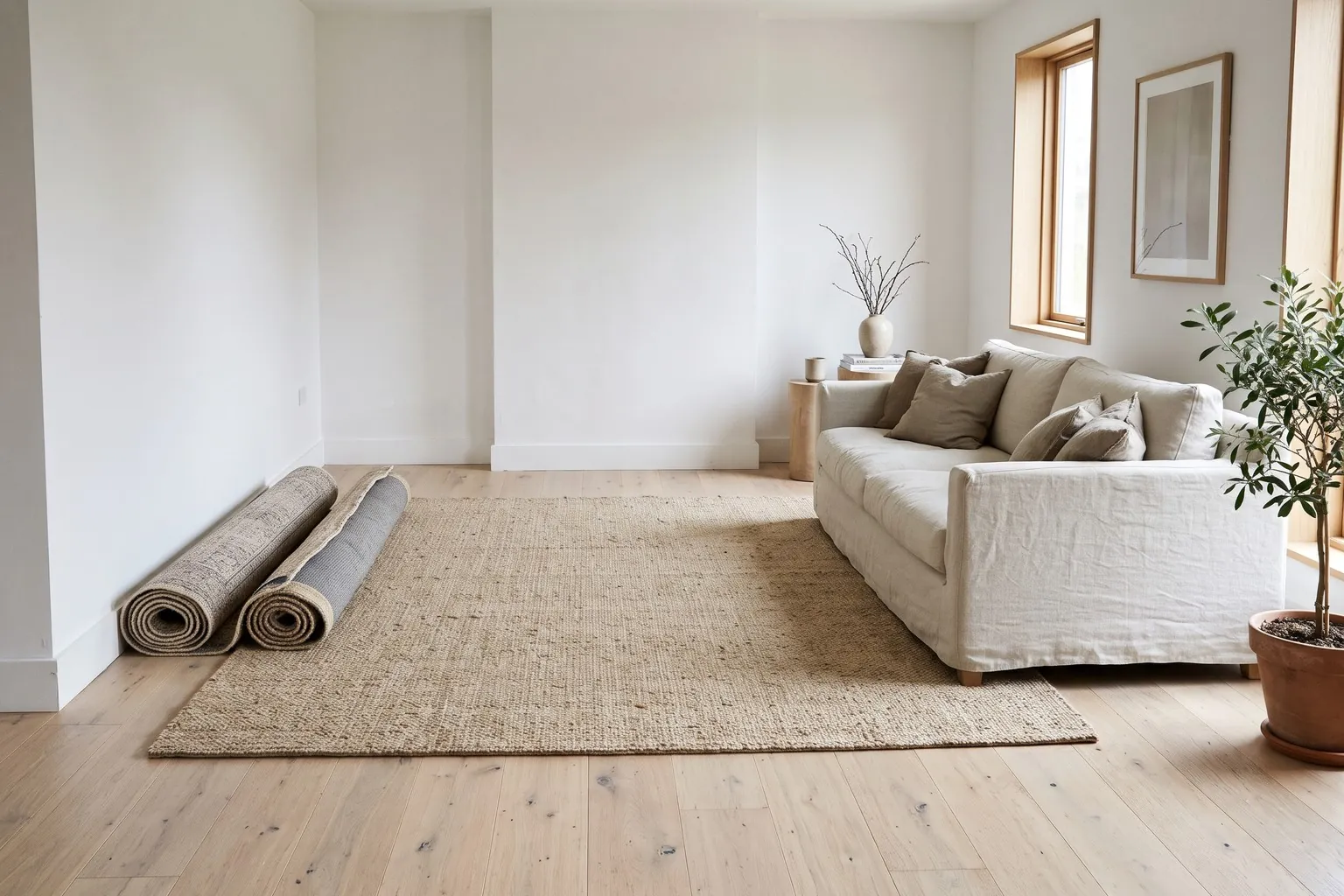
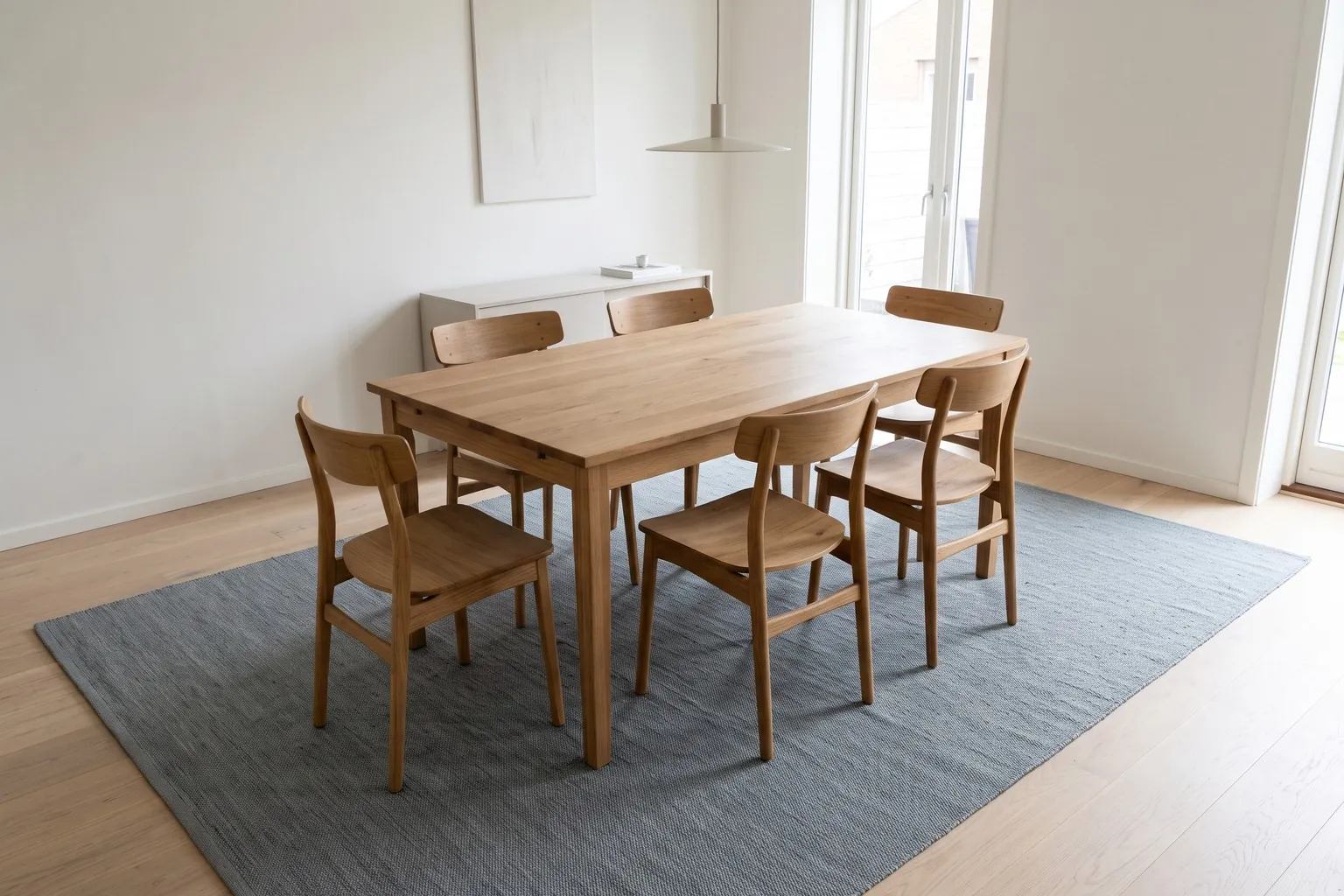
The living room that starts with one rug
Choose the rug first and let it set the sofa, the cushions, the wood and the wall. A living room built in seven decisions, each one checked with a tape measure.
The short answer
- Choose the rug before anything else. It is the largest patterned surface in the room, and every other color can be taken from it.
- Take the color of the sofa and of the first cushions from the rug. The only color added from outside is green, and the plant repeats it.
- Keep the sofa plain. A patterned rug and a patterned sofa compete, and a pale sofa on a dark rug is the contrast that grounds a room.
- Use one wood tone for every table, and one natural fiber for everything woven.
- Size the rug so that the front legs of every seat stand on it. In this room that is a 9 by 12.
In this guide
- 1. The rug comes first
- 2. Its size sets the seating
- 3. The sofa takes the quietest color
- 4. The cushions take two colors, and only two
- 5. One wood, used three times
- 6. The wall borrows a texture, not a color
- 7. Something green, something lit
- The numbers behind the picture
- Why the method works
- Three ways this goes wrong
- What to buy first
- Do it in your own room
Most living rooms are assembled in the order the furniture was bought: the sofa first, because it is the biggest purchase, then whatever goes with the sofa. The room on our cover was put together the other way round. One decision came first, the rug, and it made the next six.
It is a method worth copying because it removes the hardest part of decorating, which is choosing colors from nothing. A patterned rug has already done that work. Someone chose five or six colors that sit well together and wove them into one object. All you have to do is read them.
1. The rug comes first
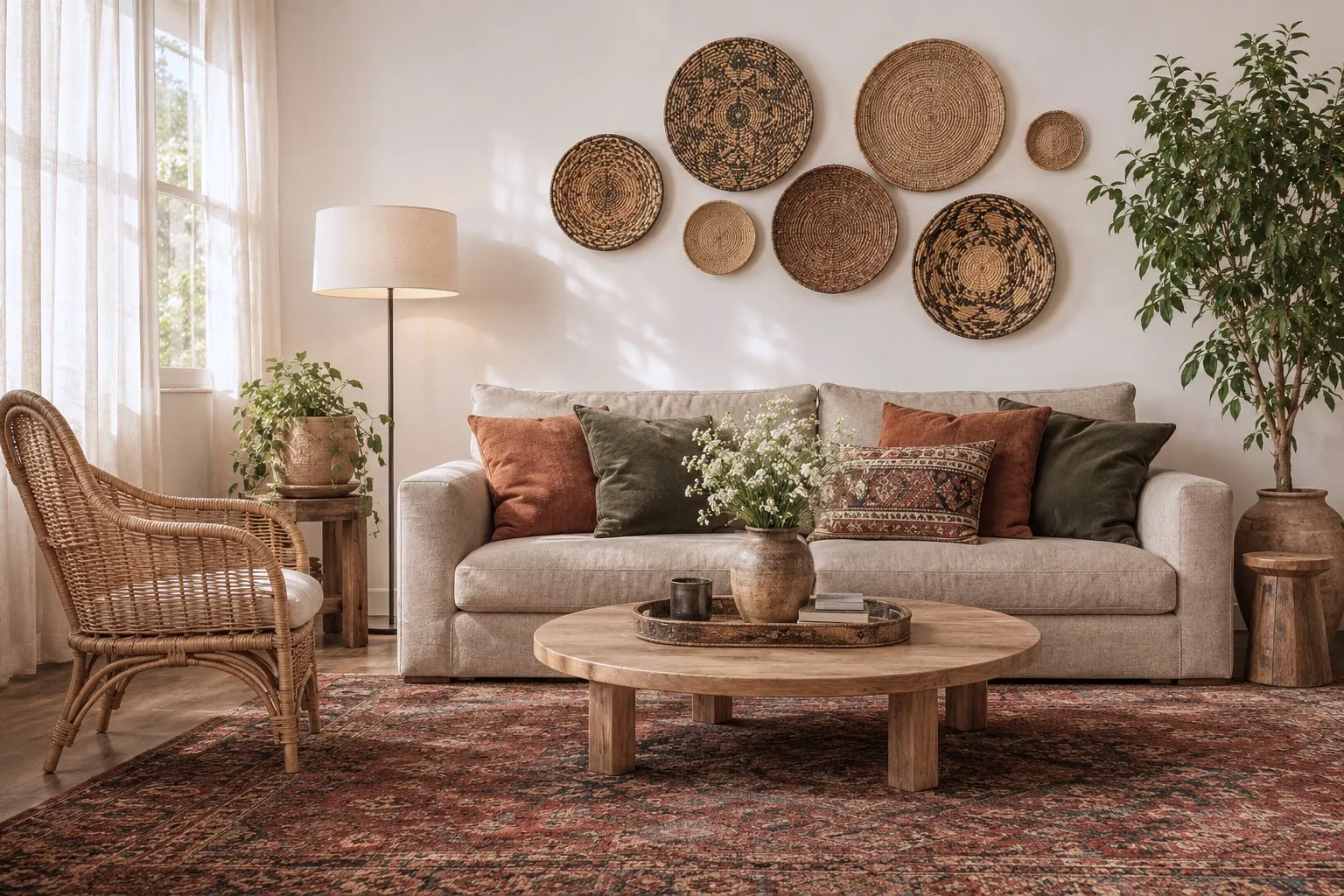
The rug here is a traditional pattern on a deep red ground, with dark blue, rust and cream in the detail. It was chosen for three reasons that apply to any room:
- It has a clear main color. Red covers most of the surface. The other colors are supporting parts.
- It has at least three more colors to borrow. They become the sofa, the cushions, the throw.
- It is dark. A dark, patterned rug hides wear and makes pale furniture stand out.
If you already own a sofa you are keeping, the method still works, with one condition: the sofa has to be plain, and its color has to appear somewhere in the rug you choose.
2. Its size sets the seating
Before the colors, the tape measure. The rug has to hold the seating group, which means the front legs of the sofa and of each chair stand on it. For a three seat sofa about 7 feet long with a chair at one end, as on the cover, that means a 9 by 12: it runs past both ends of the sofa and reaches under the chair.
The chart of rug sizes by room size, and the three ways to place a rug, are in what size rug for a living room. The seven standard sizes are listed, in feet and in inches, in rug sizes. Decide the size there first. A beautiful rug in the wrong size is the most expensive mistake in this article.
3. The sofa takes the quietest color
Look at the rug and find its lightest color. Here it is the cream in the pattern, and that is the color of the sofa: a plain, pale, textured fabric with no pattern of its own.
There are two reasons to go pale and plain. A patterned sofa on a patterned rug gives the eye nowhere to rest. And contrast is what makes both pieces visible: as Castlery puts it in its guide to placing rugs, a dark rug under a light sofa grounds the room, and a light rug under a dark sofa lifts it. What does not work is a sofa and a rug so close in tone that they blend into one.
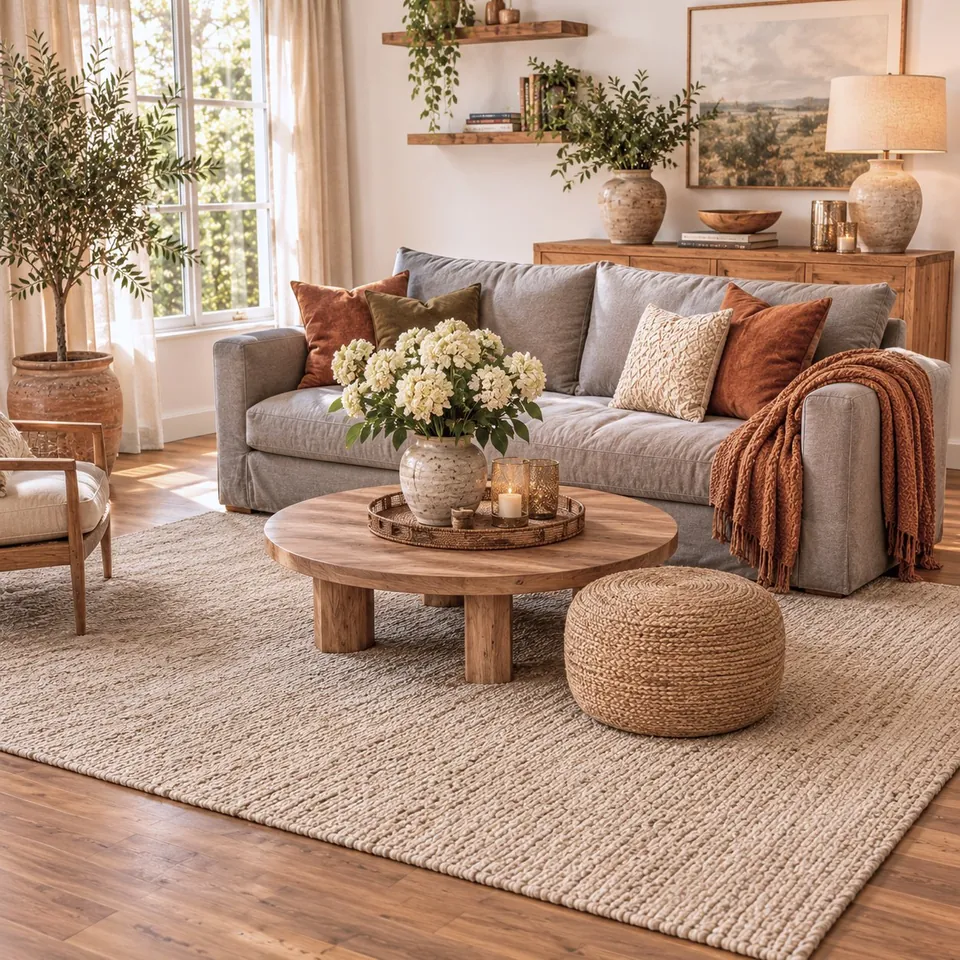
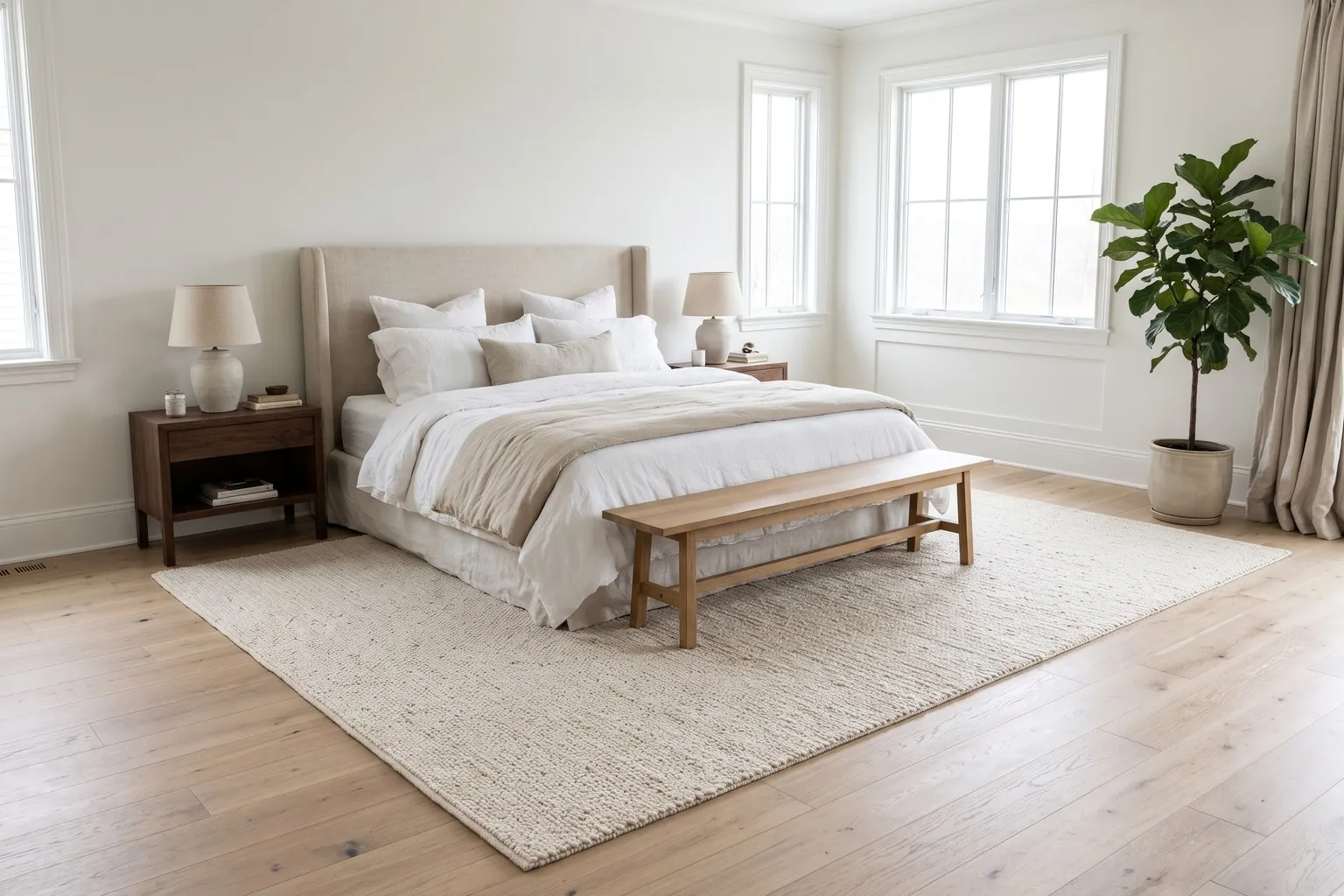
If the rug is plain
The photograph above shows the method turned round. When the rug is pale and plain, it has no colors to lend, so the color has to arrive some other way, and the cushions and the throw carry it.
Castlery's guide to rugs describes the choice in general terms. If the furniture is neutral, a rug in a richer color gives the room character. If the upholstery is already colorful, a quieter rug gives the eye somewhere to rest. Its warning applies either way: do not try to match every color exactly. Look for shades that sit well with what is already there.
The same guide has a line worth keeping in mind in a rug shop. If the sofa, the cushions, the pictures and the ornaments are already competing for attention, keep the pattern of the rug restrained. A patterned rug is the right choice for a quiet room. In a busy one it is one voice too many.
4. The cushions take two colors, and only two
The first comes straight from the rug: rust, the warm color in its pattern. The second is the one color this room adds from outside, a deep olive green. Every cushion is one or the other, in plain velvet, plus a single patterned cushion that repeats the rug itself.
Why is green allowed? Because it is the color of the plants, and a room with plants in it already contains green. The rule is that nothing arrives alone: the rust is on the floor and on the sofa, the olive is on the sofa and in the corner. This is what makes a room look designed. People notice that the cushions "go with" the room without working out why.
5. One wood, used three times
The coffee table, the side table and the stool beside the sofa are all the same warm, mid-toned wood. They are not a set. One has a round top on block legs, one is a small square stand, one is a turned stool. The tone is what they share.
Mixing woods is not wrong, but it is a second decision, and this method works by making as few decisions as possible. Choose the wood tone that is closest to the warmest color in the rug and repeat it.
The coffee table follows the sofa in size: about two thirds of its length, with the top level with the seat or an inch or two lower, and 14 to 18 inches in front of it. The reasoning and the tables are in coffee table height and size.
6. The wall borrows a texture, not a color
By now the room has red, cream, rust, olive green and wood. A sixth color on the wall would be one too many. So the wall stays the color of the sofa, and what hangs on it adds texture: a group of woven baskets in natural fiber, in different sizes, hung close together.
The rattan armchair does the same job at floor level. Rattan, seagrass, jute and cane are all the same family, and one family of natural fiber is enough. The baskets on the wall and the chair by the window speak to each other across the room, which is what a matching pair of lamps would do in a more formal one.
7. Something green, something lit
Two things finish it. A tall plant in the corner brings the olive from the cushions up to eye level. And a floor lamp with a plain linen shade stands at the end of the sofa nearest the window wall, where the daylight runs out first in the evening.
Neither adds a color. That is the test for the last pieces in any room built this way: if the color is not already in the room twice, leave the piece in the shop.
The numbers behind the picture
A room built this way still has to pass the tape measure. These are the figures from our sizing guides, applied to the pieces in this room.
| Piece | The rule | For a room like this one |
|---|---|---|
| Rug | Front legs of every seat on it, 12 to 18 in of floor to the walls | 9 by 12 ft |
| Sofa | Shorter than the rug by a margin at each end | About 7 ft on a 12 ft rug |
| Coffee table | About two thirds of the sofa, level with the seat or 1 to 2 in lower | A round table 40 in across, 16 in high |
| Gap, sofa to table | 14 to 18 in | Set it at 16 in |
| Rug beyond the table | At least 6 to 10 in on each side | Easily met by a 9 by 12 |
| Route across the room | 30 to 36 in clear | Keep it behind the armchair |
A round table comes out smaller than two thirds of the sofa, and that is expected: everyone reaches it from the middle.
Why the method works
It works because it turns a question of taste into a question of reading. Most people cannot say why two colors look right together, but almost anyone can point to the colors in a rug and name them. Once they are named, every later choice has a test: is this color already in the room, or not?
It also puts the decisions in the order of their cost. The rug and the sofa are the two large purchases, and they are settled first, together. Everything bought afterward is small enough to change. A cushion in the wrong shade is a mistake you can fix in an afternoon. A sofa in the wrong color stays for ten years.
And it leaves room for the things you already own. A wooden chest from a grandparent, a lamp you like: hold them against the rug. If their color is there, they belong.
Three ways this goes wrong
These are our observations, not a rule from a source.
- The rug is chosen for the pattern and bought too small. A patterned rug that stops short of the sofa shows half its pattern and ties nothing together. If the size you need is out of reach in the rug you love, choose a plainer rug in the right size.
- A third cushion color appears. It is usually a present. Two colors look chosen. Three look collected.
- The woods drift. One table is replaced, the new one is a different tone, and the room loses the thing that was holding the small pieces together. Take a photograph of the wood you have before you shop for more.
What to buy first
If you are furnishing from nothing, the order matters, because each purchase fixes the next.
- The rug. It sets the colors and the size of the seating area.
- The sofa. Its length follows the rug, its color is the lightest one in the pattern.
- The coffee table. Its size follows the sofa.
- One chair, in natural fiber. It balances the sofa and introduces the texture.
- The cushions. Two colors, bought together so the tones match.
- Side table, lamp, plant. In that order of usefulness.
- The wall. Last, when you have lived with the rest.
Stopping after step three already gives you a room that works. Everything after it is finish.
Do it in your own room
- Choose the rug. Check it has one main color and at least three others.
- Size it with tape on the floor, front legs on.
- Name its lightest color. That is your sofa.
- Name its warmest color. That is half your cushions. The other half are green.
- Choose one wood tone, close to the warmest color in the rug.
- Add one natural fiber, on the wall and in one seat.
- Add a plant and a lamp, and stop.
The names you will meet while shopping for the seating are sorted in our guides to types of sofas and types of chairs.
Questions people ask
Should you choose the rug or the sofa first?
The rug, when it is patterned. It contains several colors that already work together, and the sofa, cushions and wood can be taken from it. If you are keeping your sofa, choose a rug that contains its color.
Can you put a patterned rug with a patterned sofa?
It is hard to do well. A plain sofa on a patterned rug, or a patterned sofa on a plain rug, gives the eye somewhere to rest.
Should a rug be lighter or darker than the sofa?
Either, as long as they contrast. A dark rug under a light sofa grounds the room and a light rug under a dark sofa lifts it.
How many colors should a living room have?
Few enough to count on one hand. In this room that is five: the red of the rug, cream, rust, olive green and the tone of the wood.
Sources
- How to place an area rug in your living room. Castlery, read November 2026
- Rug size guide. Ruggable, read November 2026
- Coffee table height. Bob Vila, read November 2026
- How far should your coffee table be from your couch?. Homes and Gardens, read November 2026
- Coffee table dimensions. Castlery, read November 2026
Every figure in this guide comes from the sources above, or from arithmetic shown in the text. See our editorial policy.