What size rug for a living room: three layouts and one chart
Most living rooms take an 8 by 10 foot rug with the front legs of the sofa on it. A chart by room size, three layouts, and the border of floor to leave.
The short answer
- For most living rooms the answer is 8 by 10 feet, with the front legs of the sofa and chairs on the rug.
- Leave a border of bare floor between the rug and the walls: 12 to 18 inches in a defined living area.
- Pick a layout before you pick a size: all legs on, front legs on, or no legs on. The front legs layout fits the most rooms.
- The mistake to avoid is the in-between rug, too small to reach the sofa and too big to float under the coffee table.
- Measure the seating group, not the room. The rug has to hold the sofa, the chairs and the table as one group.
In this guide
A rug is the largest thing in a living room after the sofa, and it is the one people most often buy a size too small. The reason is simple. Rugs are sold by the size of the room, and they should be bought by the size of the furniture that stands on them.
This guide gives the chart first, then the three layouts, then the way to check your own room with a tape measure and four strips of painter's tape.
The chart: rug size by room size
The room sizes below are the ones Ruggable, a rug maker, publishes for each standard size. Use them as a starting point, then check the layout.
| Living room | Rug | What it gives you |
|---|---|---|
| 11 by 13 ft or smaller | 6 by 9 ft | About 2 ft of floor around the rug. Coffee table on, sofa mostly off. |
| 11 by 13 ft or a little larger | 8 by 10 ft | A 12 to 18 in border. Front legs of the sofa and chairs on the rug. |
| 12 by 18 ft or larger, or open plan | 9 by 12 ft | Room for most of the furniture to sit on the rug. |
| At least 11.5 by 15.5 ft | 10 by 14 ft | 18 to 36 in of floor showing. Every piece fully on the rug. |
The two middle rows cover most homes. If your room falls between two sizes, take the larger rug and a narrower border. A border that is a little tight still reads as a border. A rug that is a little small reads as a mat.
The three layouts
There are three ways to place a rug under a seating group. Each one is correct. The one to avoid is the layout that is not quite any of them.
All legs on
Every piece of furniture stands fully on the rug: sofa, chairs, side tables. Castlery, a furniture maker, describes it as the most generous option, with about 12 to 18 inches of floor visible around the edge. It suits large rooms and open plans, where the rug is what turns a corner of a big floor into a place to sit. It needs a 9 by 12 or a 10 by 14.
Front legs on
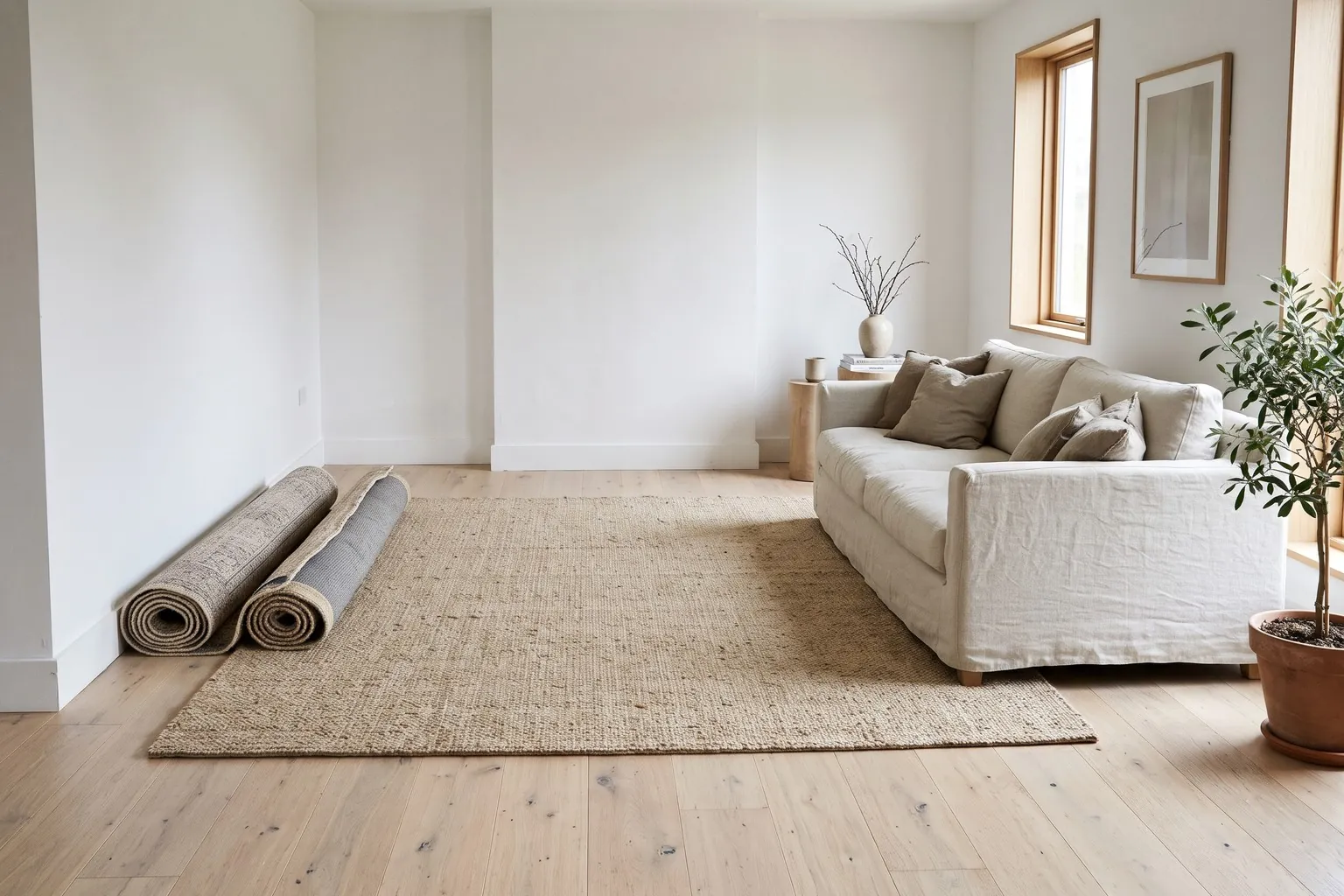
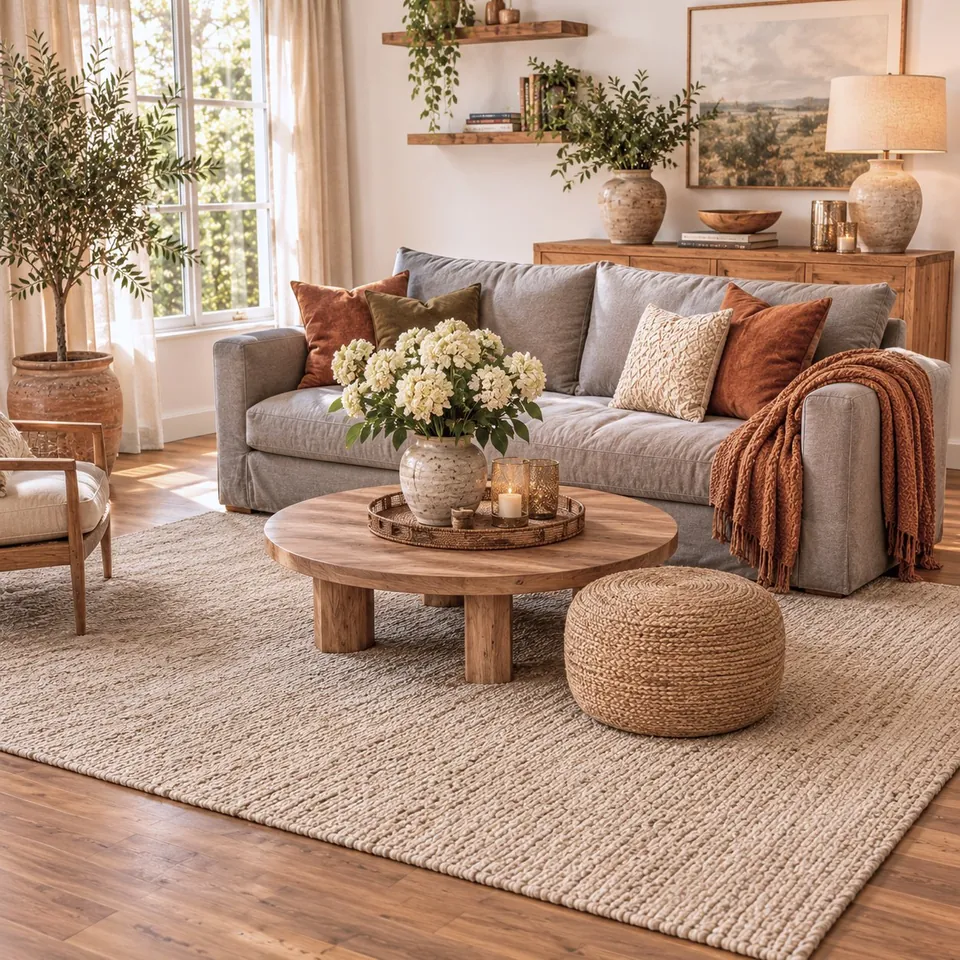
The front legs of the sofa and of each chair stand on the rug, and the back legs stand on the floor. This is the layout that works in the most rooms, and it is the one both Ruggable and Castlery recommend. The rug ties the group together without having to be as big as the whole group. An 8 by 10 does it for a three seat sofa and two chairs.
How far under? Enough that the rug is clearly held by the furniture. If only an inch of rug goes under the sofa, the sofa will walk off it within a week.
No legs on
The rug sits in the middle with the coffee table on it, and all the seating stands on the bare floor around it. It is the layout for a small room and a 5 by 8 or a 6 by 9, and it works when the floor itself is worth showing. Keep the gap between the rug and the sofa small and even on every side, so the rug still looks placed and not lost.
The mistake that shrinks a room
Ruggable puts the rule in one sentence: make sure the front legs of your seating fit on the rug without cramping the space, or size down so that no legs touch it.
The mistake is everything between those two. A rug that reaches the front legs of the sofa but not the chairs. A rug that touches one corner of an armchair. A rug that stops two inches short of the sofa, so it looks as if someone meant to push it under and gave up. The eye reads the rug as the edge of the seating area, and when half the furniture is outside that edge, the room looks smaller than it is.
If your budget is for a 5 by 8 and your furniture needs an 8 by 10, the honest answers are to float the 5 by 8 properly, with no legs on, or to wait.
Check it with tape before you buy
- Put the furniture where it will live.
- Mark the four corners of the rug size you are considering with painter's tape on the floor.
- Check the front legs: every seat in the group should have its front legs inside the tape, or none of them.
- Check the border: measure from the tape to each wall. In a room with four walls, aim for 12 to 18 inches. Do not run the rug to the wall. As Castlery puts it, a rug should not go wall to wall unless you are fitting carpet.
- Check the doors: a door that swings over the rug has to clear its thickness.
Sizes are nominal: read the exact dimensions on the product page before you trust the tape.
Every rug size, and what it is for
Rugs come in a short list of standard sizes. This is the whole range, with the use that Castlery and Ruggable give for each.
| Rug | Use in a living room |
|---|---|
| 3 by 5 or 4 by 6 ft | Layering over a larger rug, a reading corner, or under a small coffee table. Ruggable notes a 4 by 6 can cover most of the floor of a small apartment living room. |
| 5 by 7 or 5 by 8 ft | Under the coffee table in a small room, with the sofa off the rug. Ruggable also suggests a 5 by 7 in front of a fireplace with two chairs almost entirely on it. |
| 6 by 9 ft | The main rug in a smaller living room, anchoring the seating. |
| 8 by 10 ft | The standard living room rug: front legs on. |
| 9 by 12 ft | Spacious rooms and large seating groups. |
| 10 by 14 ft and larger | Open plan spaces, where the rug marks out the living area inside a bigger floor. |
Match the rug to the shape of the room
Size is half the answer. The shape of the room decides which way the rug runs.
Long, narrow rooms. Castlery's advice is to lay a rectangular rug lengthwise, so that it pulls the eye down the room and ties the seating together. What to avoid is a small square rug in the middle of a long room: it draws attention to the empty floor around it and splits the space.
Square rooms. A square rug repeats the proportions of the room for a formal, symmetrical look. A round rug softens the straight lines. If the furniture is all right angles, a round rug under the coffee table is an easy way to break them.
A living area that runs into a dining area. One rug rarely covers both well. Use one large rug to anchor the seating and to mark where the living area stops. If there is space, a second rug can go under the dining table. The two do not have to match. Castlery suggests looking for a common thread in color, texture or tone, so the two areas read as related and not as a copy of each other.
Color and pattern, briefly
Once the size is right, the rug is the easiest way to change the color of a room without repainting or replacing the sofa. Castlery gives a simple rule for which way to go:
- If the furniture is neutral, a rug in a richer color gives the room character.
- If the upholstery is already colorful, a quieter rug gives the eye a rest.
- Do not try to match every color exactly. Look for shades that sit well with what you have.
Pattern follows the same logic. A patterned rug brings energy to a quiet room. If the sofa, the cushions and the pictures are already competing, keep the pattern of the rug restrained.
A worked example
Take a living room 12 feet by 15 feet with a three seat sofa 84 inches long against the long wall, and two chairs facing it.
- Rug. The chart says 8 by 10 for a room a little over 11 by 13, and 9 by 12 for 12 by 18 and up. This room is in between. Start with the 8 by 10.
- Direction. The 10 foot side runs parallel to the sofa. The rug is 120 inches long and the sofa is 84, so the rug shows 18 inches past each end of the sofa.
- Front legs. Slide the rug about a foot under the front of the sofa. The chairs opposite stand with their front legs on the far edge.
- Border. Along the length of the room, 15 feet less 10 feet leaves 5 feet, or 30 inches at each end if the rug is centered. That is wider than the 12 to 18 inches in the rule, which tells you the room could take a 9 by 12: it would leave 18 inches at each end.
So the tape goes down twice, once for each size, and you choose with your eyes. The arithmetic only tells you which two sizes to tape.
The rug and the rest of the group
Once the rug is fixed, the other sizes follow from it.
- The coffee table goes on the rug, inside the seating group. Castlery's rule is that the rug should extend at least 6 to 10 inches beyond each side of the table, so the table is anchored to the rug and does not look as if it is floating on it. The size of the table itself depends on the sofa: see coffee table height and size.
- The sofa and the rug should contrast. A light rug under a dark sofa lifts the room, a dark rug under a light sofa grounds it. A rug that matches the sofa closely makes both disappear.
- A patterned rug can be the starting point for every other color in the room. We work through one, piece by piece, in the living room that starts with one rug.
Open plan rooms
In an open plan there are no walls to measure a border from, so the rule changes. The rug defines the living area by itself, and the edge of the rug becomes the edge of the room. Use the all legs layout if you can, and line up one edge of the rug with something fixed: the back of the sofa, a column, the line where the kitchen floor starts. A rug that sits at an angle to everything else in an open plan makes the whole floor look unplanned.
The standard sizes in feet and inches, for every room, are in our guide to rug sizes. The sofa that sets the size of the rug is measured in sofa sizes.
Questions people ask
What is the most common rug size for a living room?
8 by 10 feet. It fits a room of about 11 by 13 feet or a little larger and lets the front legs of a sofa and two chairs stand on it.
Should a rug go under the sofa?
Under its front legs, in most rooms. The back legs stay on the floor. In a large room every leg can stand on the rug, and in a small one the rug can sit under the coffee table only.
How much floor should show around a rug?
In a living area with walls, 12 to 18 inches between the rug and the wall. Larger rugs in larger rooms can leave 18 to 36 inches.
Is a 5 by 8 rug too small for a living room?
It is too small to go under a sofa and chairs. It works in a small room if it sits under the coffee table with no furniture legs on it.
Can a rug be too big?
Yes, when it runs to the walls. Leave a visible border of floor so the rug reads as a piece of the room and not as carpet.
Sources
- Rug size guide. Ruggable, read November 2026
- How to place an area rug in your living room. Castlery, read November 2026
- How far should your coffee table be from your couch?. Homes and Gardens, read November 2026
- Coffee table dimensions. Castlery, read November 2026
Every figure in this guide comes from the sources above, or from arithmetic shown in the text. See our editorial policy.