How to fill a raised garden bed: the soil mix, and how much to buy
Fill a raised bed with topsoil and compost, not potting mix alone. A 4 by 8 foot bed 11 inches deep takes about 29 cubic feet. Mix ratios, bags, and deep beds.
The short answer
- The mix is topsoil plus compost, with an optional part of sand, perlite or soilless mix. Sources range from equal parts to 70 percent topsoil and 30 percent compost.
- Do not fill a bed with potting mix alone or with compost alone. Both are named as mistakes by the sources.
- The sum is length times width times depth, all in feet. A 4 by 8 foot bed 11 inches deep takes about 29 cubic feet, a little over 1 cubic yard (our sums).
- Soil settles 10 to 15 percent after the first waterings, according to Eartheasy. Buy the full volume of the box.
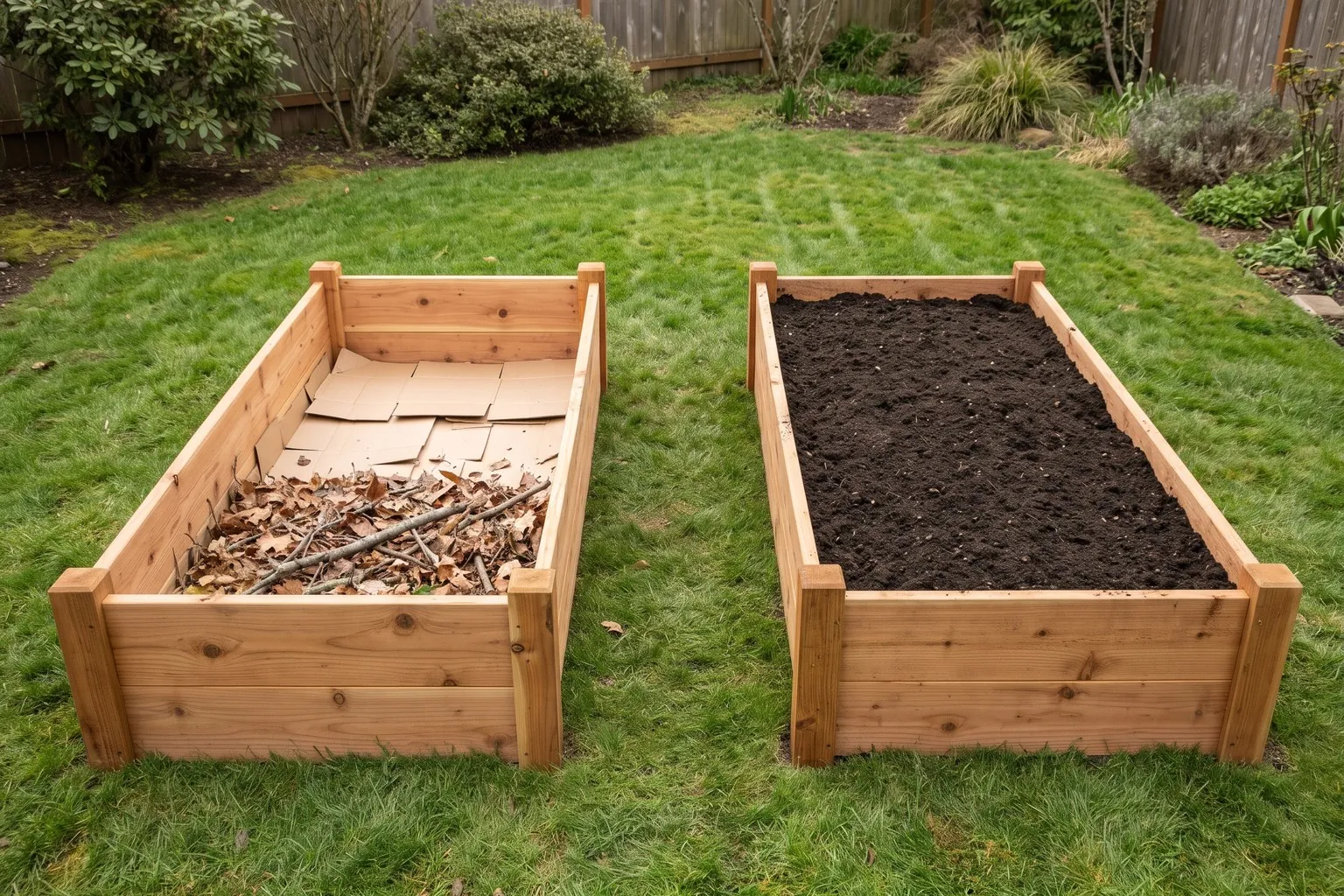
- In a deep bed, the lower third to half can be leaves, straw and branches, with at least a foot of good soil on top.
In this guide
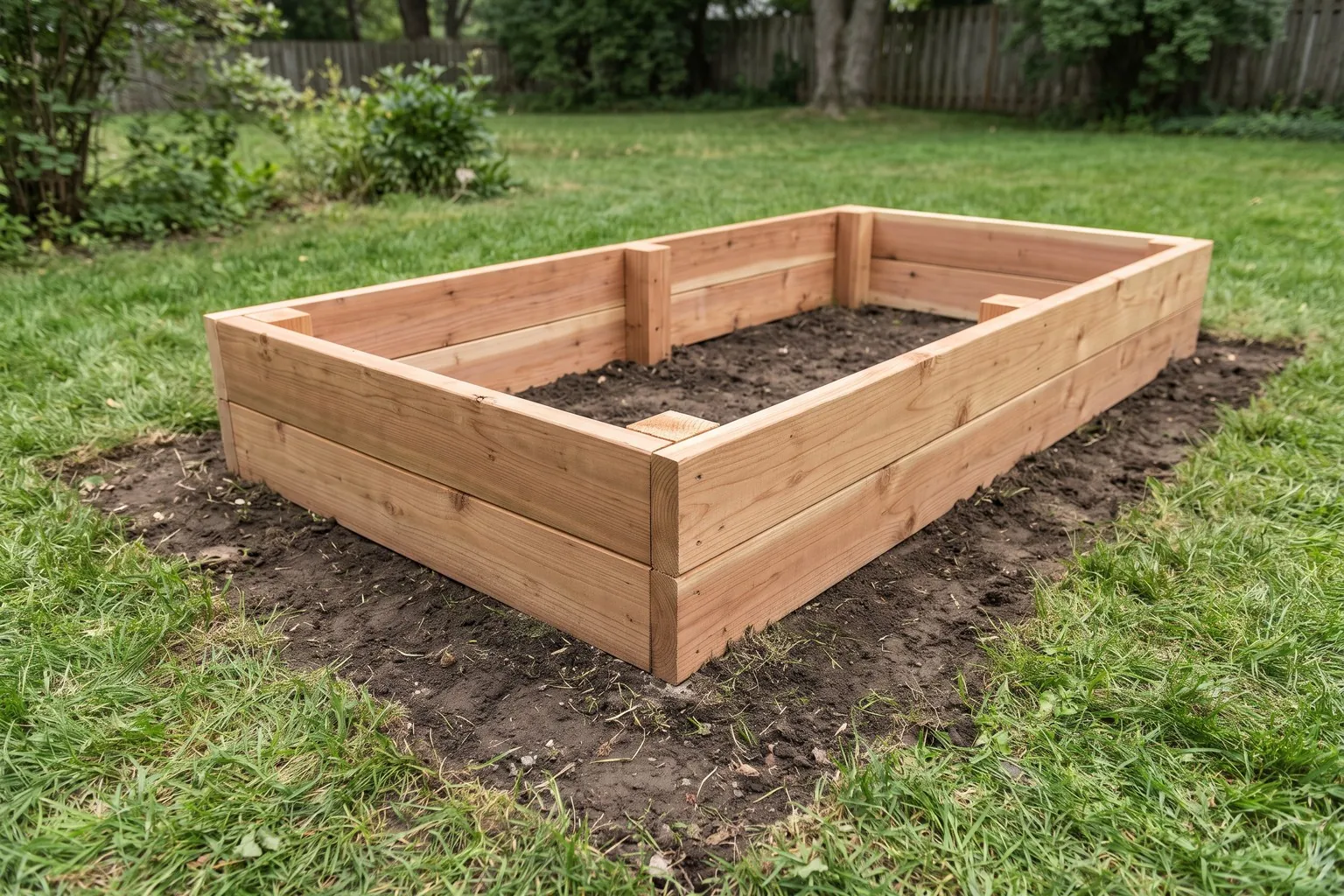
Building a raised bed takes a few hours. Filling it takes a recipe, a sum and a delivery. A bed is a box, and the box has to be filled with something roots can live in for years.
This guide covers what to put in, how to work out the quantity, what goes at the bottom, how to fill a deep bed without buying twice the soil, and what the extension services say about safety. For the frame itself, see our guide on how to build a raised garden bed.
What goes in: the mix
There is no single recipe. There is a clear pattern.
| Source | Mix |
|---|---|
| University of Maryland Extension | compost and topsoil at 1 to 2 or 1 to 1, or compost and soilless mix at 1 to 1 |
| Iowa State University Extension | equal parts topsoil, organic matter and coarse sand, or about 70 percent topsoil and 30 percent compost |
| The Old Farmer's Almanac | 40 percent topsoil, 40 percent compost, 20 percent coarse sand or perlite |
| Gardener's Supply | 60 percent topsoil, 30 percent compost, 10 percent soilless growing mix |
| Eartheasy | 50 percent quality soil, 30 percent compost, 20 percent potting mix or aeration |
| Homes and Gardens | two parts topsoil to one part compost, with up to 20 percent sand or grit |
| Royal Horticultural Society | seven parts topsoil, three parts organic matter, two parts sharp sand |
Nearly every recipe is built on two ingredients: mineral soil and compost. Topsoil is between a third and 70 percent of the mix. Compost, or organic matter under another name, is between 25 and 50 percent. The third ingredient, where there is one, is there to keep the mix open: coarse sand, perlite, grit or a soilless mix.
Rutgers Cooperative Extension states the principle without a ratio. It favors mineral soil improved with small amounts of compost. University of Maryland Extension gives the target the other way round: organic matter should be 25 to 50 percent of the mix by volume.
If you want one recipe to start from, two parts topsoil to one part compost sits in the middle of that table. It is Maryland's 1 to 2, Homes and Gardens' traditional ratio, and close to Iowa State's 70 and 30.
What not to fill it with
The sources are more precise about mistakes than about recipes.
Potting mix alone. The Almanac marks potting soil as not recommended for raised beds, because it does not provide enough structure. Homestead and Chill says the same: do not use potting soil only. Rutgers explains what happens over time. Bagged organic growing media used alone in a long-term bed bring declining nutrients and drainage problems after several years.
Compost alone. Homes and Gardens calls pure compost not recommended. It also says topsoil alone will not drain well.
Bagged products with the wrong name. Maryland warns that bagged products sold as organic soil typically contain no topsoil. They are wood waste, bark fines, compost and peat.
Too much peat. Gardener's Supply says peat should not be more than 20 percent of the mix.
Soil from the yard, unimproved. The Almanac calls native soil far too dense to fill a bed on its own. Homes and Gardens adds that topsoil dug from a building site is low in quality.
Filler that does not rot. Homestead and Chill lists rocks, plastic and styrofoam as things not to use. Gardenary says not to use plastic bottles or trash bags to take up space.
How much soil: the sum
A raised bed is a box, so the volume is three numbers multiplied together. Gardenary and Homestead and Chill both give the sum as width times length times depth, in feet, which gives cubic feet. To use it, turn the depth into feet first: inches divided by 12.
Soil is sold two ways. Bags are labeled in cubic feet. Bulk soil is sold by the cubic yard, and a cubic yard is 27 cubic feet. Eartheasy writes the whole thing as one line: length times width times depth in feet, divided by 27.
Three worked examples from the sources:
- Eartheasy: a 4 by 8 foot bed at 12 inches is 32 cubic feet, or 1.2 cubic yards.
- Homestead and Chill: a 4 by 8 foot bed at 1.5 feet is 48 cubic feet, or 1.7 cubic yards.
- Gardener's Supply: a 3 by 6 foot bed with 10 inch sides is 15 cubic feet.
And the common sizes, worked out the same way. These are our sums. The 11 and 22 inch columns are for beds built of two and four 2 by 6 boards.
| Bed | 6 inches deep | 11 inches | 12 inches | 18 inches | 22 inches |
|---|---|---|---|---|---|
| 4 by 4 feet | 8 cu ft | 15 | 16 | 24 | 29 |
| 2 by 8 feet | 8 cu ft | 15 | 16 | 24 | 29 |
| 4 by 8 feet | 16 cu ft | 29 | 32 | 48 | 59 |
| 4 by 12 feet | 24 cu ft | 44 | 48 | 72 | 88 |
A 4 by 8 foot bed at 11 inches is about 29 cubic feet, or 1.1 cubic yards. That is the number most first beds need.
Settling, and how full to fill
Eartheasy says soil settles 10 to 15 percent after the first few waterings, and advises rounding up or buying a little extra.
The building guides also say not to fill to the brim. Hunker fills to within 2 or 3 inches of the top edge. The Royal Horticultural Society fills to about 2 inches below the rim and lets the bed settle for a couple of weeks.
The two figures nearly cancel. On an 11 inch bed, 10 to 15 percent of settling is 1.1 to 1.7 inches: our sums. So if you buy the full volume of the box and fill it level, the surface ends up about where the building guides want it. That is the simplest rule: order the volume of the box.
Bags or bulk
The same 29 cubic feet can arrive in two ways.
Eartheasy gives the number of bags in a cubic yard: 36 bags of 0.75 cubic feet, 27 bags of 1 cubic foot, 18 bags of 1.5 cubic feet, or 14 bags of 2 cubic feet. For our 4 by 8 bed at 11 inches, that is about 20 bags of 1.5 cubic feet, or 15 bags of 2: our sums.
Eartheasy's advice is that bulk delivery is far cheaper beyond about 2 cubic yards. One bed of 1.1 cubic yards is below that line. Two beds are above it.
Plan for the weight either way. Eartheasy puts a blended mix at 1,300 to 1,700 pounds per cubic yard. One 4 by 8 bed therefore holds roughly 1,400 to 1,850 pounds of soil: our sums. Bulk soil arrives by truck. University of Georgia Extension suggests a central path at least 10 feet wide in a large garden for exactly that delivery. The path widths are in our guide to raised garden bed dimensions.
When you divide the order between ingredients, use the recipe. For 29 cubic feet at two parts topsoil to one of compost, that is about 20 cubic feet of topsoil and 10 of compost. At the Almanac's 40, 40 and 20, it is about 12 of topsoil, 12 of compost and 6 of sand or perlite. Our sums.
What goes at the bottom
What you put under the soil depends on what the bed stands on.
On grass or weeds. Maryland's method is plain cardboard or overlapping newspaper laid over the turf, topped with 2 to 4 inches of compost, and then the soil. Hunker uses landscape fabric and then two or three layers of cardboard. Homes and Gardens gives cardboard or landscape fabric to smother weeds.
On soil you can dig. Loosen it first, so roots can pass through. Gardener's Supply says to loosen the native soil to a depth of 6 to 10 inches. Utah State University Extension says to till the soil beneath a shallow box 6 to 12 inches deep. Eartheasy goes furthest and double-digs to about 24 inches.
Where animals burrow. Gardenary adds hardware cloth, a wire mesh, against burrowing pests. Lawn Love lines the bottom with hardware cloth or landscape fabric, and Hunker lays gopher wire first where it is needed.
On contaminated ground. Rutgers recommends landscape fabric as a root barrier between the bed and the soil below when edible crops are grown.
On concrete or paving. This is the one case where Eartheasy calls for a drainage layer of gravel. On open ground it does not.
The sources do not agree about gravel in general. Homes and Gardens lists rocks, gravel, sand or grit for drainage among the things that can go in the bottom. Homestead and Chill puts rocks on its list of filler to avoid. The extension pages we read do not recommend a gravel layer for a bed on soil.
Filling a deep bed for less
A bed 22 or 24 inches tall holds twice the soil of an 11 inch bed, and most vegetables do not need all of it. Several sources fill the bottom with something cheaper.
- The Almanac: fill the lower third to half of the bed with organic matter such as straw, leaves, logs and twigs.
- Homestead and Chill: logs, branches, leaves and pine needles in the bottom of beds deeper than 12 to 15 inches, with at least a foot of good soil and compost on top. The method has a name, hugelkultur.
- Homes and Gardens: a layer of cardboard, followed by dead leaves or tree branches.
- Royal Horticultural Society: for beds deeper than 20 inches, remove the turf and topsoil, add rubble or subsoil, and lay the turves upside down.
Take a 4 by 8 foot bed 22 inches tall. Filled entirely with mix it needs about 59 cubic feet. With a foot of mix over 10 inches of branches and leaves it needs 32. That saves 27 cubic feet, close to a cubic yard: our sums.
One caution follows from the sources. Keep at least a foot of real soil on top, which is Homestead and Chill's figure and matches the 10 to 12 inches most vegetables need.
On concrete, a deck or a patio
A bed on a hard surface is a container. Nothing below it can be counted, and the recipe changes.
Maryland's mix for this case is compost and soilless mix at 1 to 1. Topsoil can be added up to 20 percent by volume if the bed is at least 16 inches deep. It gives the depths as well: a minimum of 8 inches for leafy greens, beans and cucumbers, and 12 to 24 inches for peppers, tomatoes and squash.
Think about the weight before building on a deck. A cubic yard of mix weighs 1,300 to 1,700 pounds by Eartheasy's figure. Check what the deck can carry.
Soil safety: lead, and soil you buy
Two extension services treat this at length, and their advice is short.
Test old ground for lead. Maryland says to test the soil, and not to plant vegetable crops in soils with a total lead level over 400 parts per million. Background levels are 10 to 50. Where the ground is contaminated, both Maryland and Rutgers call for a minimum of 12 inches of imported topsoil in the bed.
Ask where bought soil comes from. Maryland advises asking a topsoil supplier for soil test results, the origin of the soil, and how it is mixed and stored. Rutgers says to ask for soil test reports and verify the sources. Iowa State warns that imported topsoil can carry soil-borne plant pathogens or contaminants like lead and pesticides.
Look and smell. Maryland says to avoid topsoil that is very high in sand or clay, foul smelling, or gray and mottled. Rutgers adds a strong ammonia odor.
No biosolids on food crops. Rutgers says not to use sewage biosolids where food is grown.
Every year after
A filled bed is not finished. The sources add compost every year.
The Almanac's rule is to top off established beds with a 1 to 2 inch layer of compost at least once a year. Rutgers gives 1 to 2 inches of compost mixed into the top 6 inches for beds of native soil. On a 4 by 8 bed, 1 to 2 inches is about 3 to 5 cubic feet of compost a year: our sums.
Two figures for the soil itself. Maryland gives a pH of 6.2 to 6.8 for most vegetables and flowers. The Almanac gives 6.0 to 7.0 for vegetables. A soil test tells you where a new mix stands, and Maryland ties fertilizer to the results of that test.
The order of work
- Measure the box in feet, inside the boards, and multiply. Divide by 27 for cubic yards.
- Choose the recipe. Two parts topsoil to one part compost is a sound default for a bed on soil.
- Decide bags or bulk. Above about 2 cubic yards, look at bulk.
- Prepare the bottom. Loosen the soil, or lay cardboard over turf. Add mesh if animals burrow.
- In a deep bed, add filler first. Branches and leaves in the lower third to half, then at least a foot of mix.
- Fill, water, wait. The soil settles 10 to 15 percent in the first waterings.
- Top up every year with 1 to 2 inches of compost.
Questions people ask
What is the best soil mix for a raised garden bed?
Topsoil and compost, with an optional part of sand, perlite or soilless mix. Published recipes run from equal parts to about 70 percent topsoil and 30 percent compost. Two parts topsoil to one of compost sits in the middle.
How much soil do I need for a 4x8 raised bed?
About 16 cubic feet at 6 inches deep, 29 at 11 inches, 32 at 12 inches and 48 at 18 inches. Thirty-two cubic feet is 1.2 cubic yards.
Can I fill a raised bed with just potting soil?
The sources say no. The Old Farmer's Almanac marks potting soil as not recommended because it lacks structure, and Rutgers reports declining nutrients and drainage problems over several years.
What do you put in the bottom of a raised garden bed?
On grass, plain cardboard or newspaper topped with compost. On soil, nothing: loosen it 6 to 12 inches. Add hardware cloth where animals burrow. Eartheasy advises a gravel layer only on concrete or paving.
How do you fill a deep raised bed cheaply?
Fill the lower third to half with straw, leaves, logs and twigs, and put at least a foot of soil mix on top.
How many bags of soil fill a raised bed?
Divide the cubic feet by the size of the bag. A 4 by 8 bed 11 inches deep takes about 20 bags of 1.5 cubic feet or 15 bags of 2 cubic feet.
Sources
- Soil to fill raised beds. University of Maryland Extension, read November 2026
- Soil for raised beds, fact sheet FS1328. Rutgers Cooperative Extension, read November 2026
- What would be a good soil mix for a raised bed?. Iowa State University Extension, read November 2026
- Raised bed gardening. Utah State University Extension, read November 2026
- Choosing the best soil for raised garden beds. The Old Farmer's Almanac, read November 2026
- Soil calculator: how much soil for a raised bed?. Eartheasy, read November 2026
- Garden soil calculator. Gardener's Supply, read November 2026
- How to fill raised garden beds with organic soil. Homestead and Chill, read November 2026
- How to fill a raised garden bed. Homes and Gardens, read November 2026
- How to make a raised bed. Royal Horticultural Society, read November 2026
- How deep should your raised garden beds be?. Gardenary, read November 2026
- How to build a simple raised garden bed. Hunker, read November 2026
Every figure in this guide comes from the sources above, or from arithmetic shown in the text. See our editorial policy.