Raised garden bed dimensions: how wide, how deep and how tall
Build a raised bed 3 to 4 feet wide so you can reach the middle, and 10 to 12 inches deep for most vegetables. Depth by crop, heights, and the width of the paths.
The short answer
- Width comes from reach. A bed reached from both sides is 3 to 4 feet wide. A bed against a wall or fence is 1.5 to 2 feet, or 3 at most.
- Length is free. Extension services suggest multiples of 2 or 3 feet, so the frame uses 8, 10 or 12 foot boards without waste.
- Six inches of soil grows lettuce and herbs. Most vegetables want 10 to 12 inches. Tomatoes, carrots and squash want 12 to 18.
- The most common bed is 11 inches high: two 2 by 6 boards stacked. For a wheelchair user, sources give 24 inches, or 2 to 3 feet.
- Leave paths of 18 to 24 inches between beds, and 3 to 4 feet where a wheelbarrow or wheelchair has to pass.
In this guide
A raised bed has three dimensions, and each one answers a different question. The width depends on your arm. The depth depends on the roots of what you grow. The height depends on your back, and it is not the same thing as the depth.
This guide takes them one at a time, with the figures university extension services publish, and then puts them together in a few plans. To build the frame, see our guide on how to build a raised garden bed.
Width: the reach rule
A raised bed works because nobody steps in it. The soil stays loose. So the bed can only be as wide as a gardener can reach from the path.
The sources agree on the figure.
| Source | Reached from both sides | Reached from one side |
|---|---|---|
| University of Georgia Extension | 4 feet for adults, 3 feet for children | not given |
| Iowa State University Extension | 3 to 4 feet | 1.5 to 2 feet |
| Utah State University Extension | 3 to 4 feet | not given |
| The Old Farmer's Almanac | no wider than 4 feet | 2 to 3 feet |
| Royal Horticultural Society | less than 1.5 meters, about 5 feet | not given |
Four feet means a reach of two feet from each side. Iowa State describes the one-sided bed, 1.5 to 2 feet, as approximately arm's reach. The Almanac gives the reason in one line: it avoids stepping into the bed, which compacts the soil.
Two cases call for a narrower bed. Georgia gives 3 feet for a bed children will tend. For a gardener in a wheelchair it gives 2 feet for children and 3 feet for adults, and Iowa State notes that the forward reach from a wheelchair is about 30 inches.
If you are unsure, test it. Kneel at the edge of a table and reach across without leaning on your other hand. The distance you can work at comfortably, doubled, is your bed.
Length: whatever the lumber and the yard allow
Length has no rule of its own. Georgia says it is not critical, and Iowa State says it is determined by space, preference and convenience.
Three practical points decide it.
The boards. Georgia advises keeping dimensions to multiples of 2 or 3 feet, so the frame fits 8, 10 or 12 foot lumber. The Almanac lists the usual results: 4 by 4, 4 by 8 or 4 by 12 feet.
The cost. Georgia notes that cost increases noticeably above 12 feet.
The sides. A long side bows outward under the weight of wet soil. Georgia says a wall of 1 inch lumber needs a vertical support about every 4 feet. Eartheasy says a bed taller than 12 inches and longer than 6 feet needs a cross-support in the middle.
There is also the walk. Georgia says very long beds are a hassle: a bed has no gate, and the only way to the other side is around the end.
Height and depth are not the same thing
The height of a bed is the height of its sides. The depth that matters to a plant is the depth of soil its roots can use. On open ground the two differ, because roots grow down through the bed into the soil beneath.
Eartheasy puts numbers on it. The most popular height for raised beds is 11 inches, and there should be another 12 inches or more of good soil below the bed. A bed 11 inches high over a foot of loosened ground gives a plant nearly two feet of rooting depth.
That is why preparing the ground under a bed matters. Utah State says that for a bed shallower than 12 inches with no bottom, the soil beneath the box should be tilled 6 to 12 inches deep.
On a hard surface the two numbers become one. Eartheasy says that on concrete or gravel, roots cannot go deeper than the height of the bed sides. The bed is then a large planter, and its sides have to supply all the depth.
How deep, by crop
The sources state depth in two ways, and it is worth knowing which is which.
Minimum depth of soil in the bed.
- Georgia: most garden crops need at least 10 inches of soil.
- The Almanac: shallow-rooted crops such as lettuce, greens and onions need a minimum of 6 inches. Deep-rooted crops such as carrots, parsnips, potatoes, tomatoes and squash need a minimum of 12 to 18 inches.
- Eartheasy's soil calculator: 6 to 8 inches for herbs and greens, 10 to 12 for most vegetables, 18 to 24 for deep-rooted crops.
- Utah State: a framed bed at least 6 to 12 inches high.
Gardenary, which sells cedar beds, gives a bed height for each crop.
| Crop | Bed height, Gardenary |
|---|---|
| Herbs, lettuce | 6 inches |
| Carrots, radishes, peppers | 12 inches |
| Tomatoes, cucumbers, squash and zucchini, kale | 18 inches |
Gardenary calls six inches the minimum height it would recommend.
Total rooting depth. Eartheasy sorts vegetables by how far their roots run in all, bed and ground together: 12 to 18 inches for lettuce, onions, spinach, radishes and potatoes, 18 to 24 for beans, carrots, cucumbers, peppers and summer squash, and 24 to 36 inches or more for tomatoes, asparagus, corn, pumpkins and winter squash.
The two sets of figures do not conflict. A tomato in an 18 inch bed over good ground has the 24 inches and more that Eartheasy describes.
On concrete or a patio. Here the bed supplies everything. University of Maryland Extension gives a minimum of 8 inches for leafy greens, beans and cucumbers, and 12 to 24 inches for peppers, tomatoes and squash. Georgia warns that on a hard surface 10 inches may not be deep enough for some crops, like potatoes. Eartheasy's advice for deep roots with no soil beneath is a bed 24 inches or taller.
The heights lumber makes
Bed heights come in steps, because beds are built from boards of fixed width.
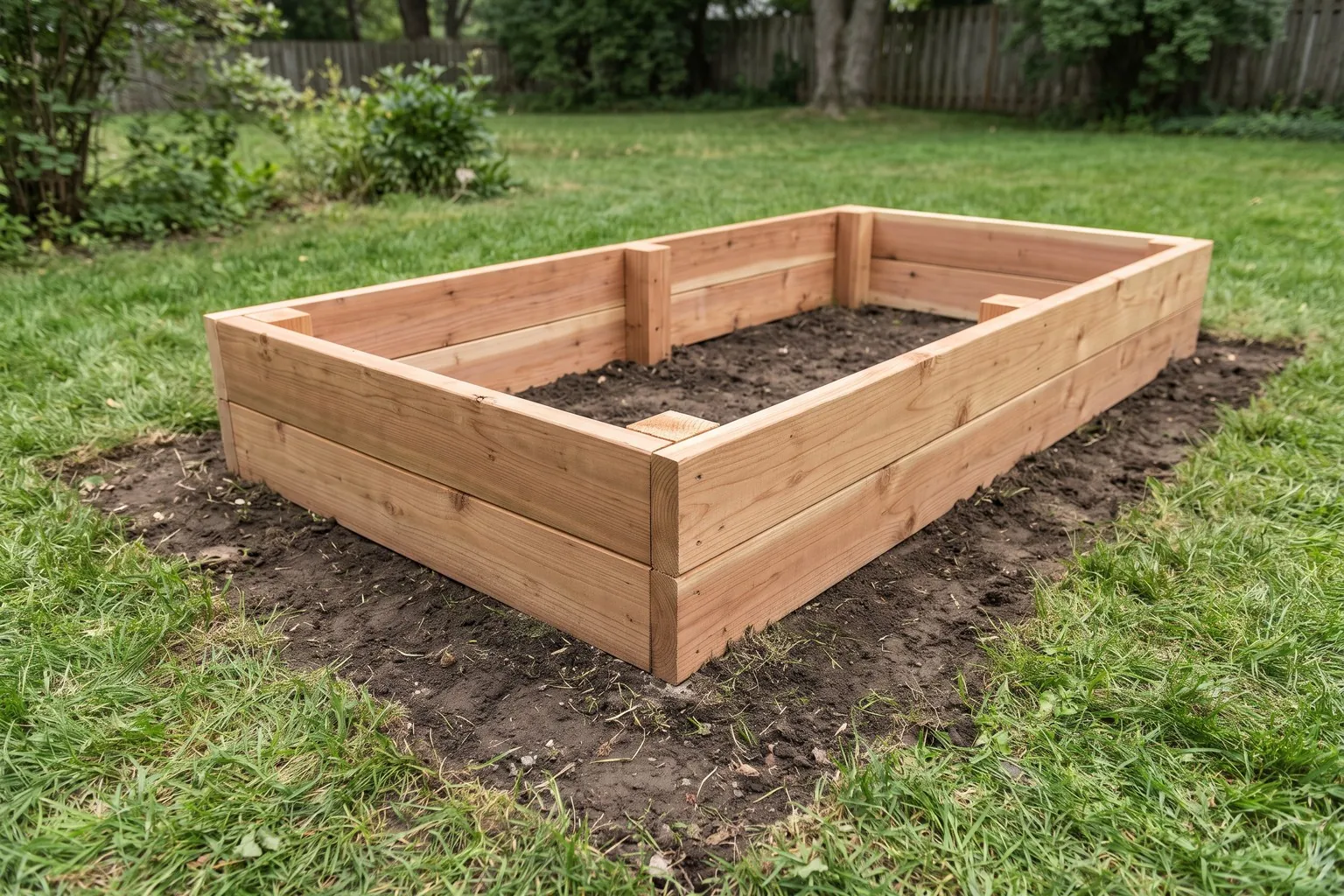
Iowa State says beds run from 6 inches to more than 20, and that 11 inches is common: two 2 by 6 boards. A 2 by 6 is actually 1.5 by 5.5 inches, so two of them make 11. The Almanac says the same thing from the other side: two stacked boards give 12 inches, technically 11.
Counting in 2 by 6 boards, these are the heights you can build. Our sums.
| Boards stacked | Bed height | Suits, from the depth figures above |
|---|---|---|
| One | 5.5 inches | Lettuce, herbs, greens |
| Two | 11 inches | Most vegetables |
| Three | 16.5 inches | Deep-rooted crops, within the Almanac's 12 to 18 inches |
| Four | 22 inches | Close to the 24 inches given for deep roots on a hard surface |
Hunker's building guide arrives at the last line the same way: about 22 inches from four 2 by 6 boards.
Height has a cost that depth figures hide. A taller bed takes more lumber and much more soil. A 4 by 8 bed holds about 29 cubic feet at 11 inches and about 59 at 22: our sums. And the Almanac notes that beds taller than 12 inches need cross-supports. Our guide on how to fill a raised garden bed covers the soil sums and the ways to fill a deep bed for less.
Tall beds: less bending, seated work, wheelchairs
Past 18 inches, height stops being about roots and starts being about the gardener.
Standing. Georgia says a bed 36 inches tall avoids excessive bending.
Seated on the edge. Iowa State suggests building a wide ledge on the wall of the bed for gardeners who sit to work.
From a wheelchair. Georgia gives 24 inches as the height for wheelchair access. Iowa State gives about 2 to 3 feet. The width narrows with it: 3 feet for adults and 2 for children in Georgia's figures, and Iowa State's 30 inch forward reach.
The tabletop bed. Iowa State describes a bed on legs that a chair can roll under: 36 to 48 inches wide, 30 to 33 inches to the top, with at least 6 to 12 inches of soil, half inch drainage holes every 6 inches, and landscaping fabric lining the bottom.
For children. Georgia notes that young children need beds closer to the ground, and narrower: 3 feet.
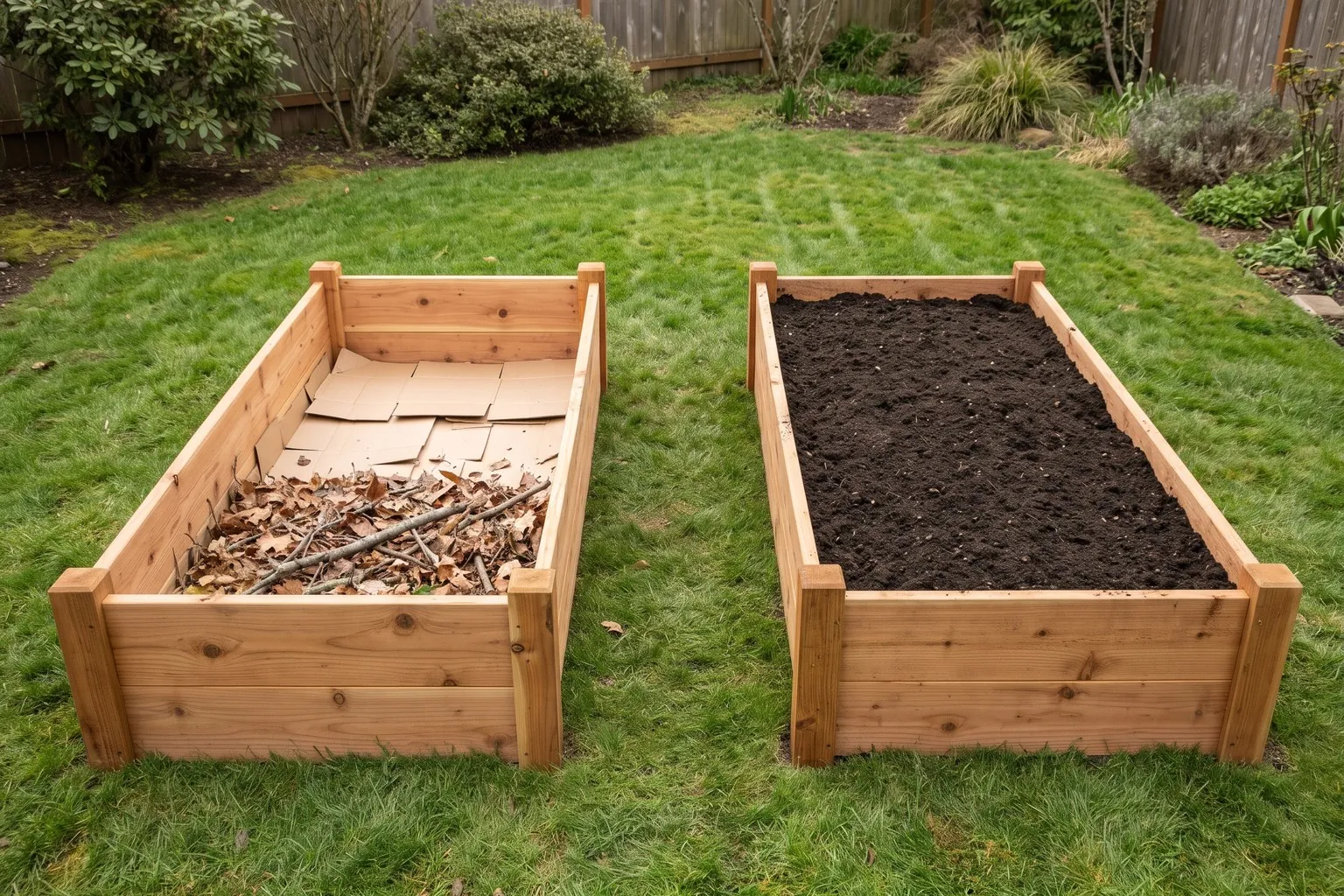
A tall bed does not have to be filled with good soil to the bottom. The guide to filling gives the sources and the layers.
Paths between beds
The path is part of the plan. A bed you cannot walk around is a bed you will step into.
| Source | Path width |
|---|---|
| University of Georgia Extension | 12 inches absolute minimum, 18 to 24 inches ideal |
| University of Georgia Extension | 4 feet between beds for carts, wheelbarrows and wheelchairs |
| Iowa State University Extension | wide enough for a wheelbarrow or cart, about 3 feet |
| Royal Horticultural Society | at least 45 centimeters, 18 inches, for a wheelbarrow |
| Royal Horticultural Society | at least 1 meter, 3.5 feet, for a wheelchair |
Georgia adds one more figure for large gardens: a central path at least 10 feet wide if a small truck has to deliver soil.
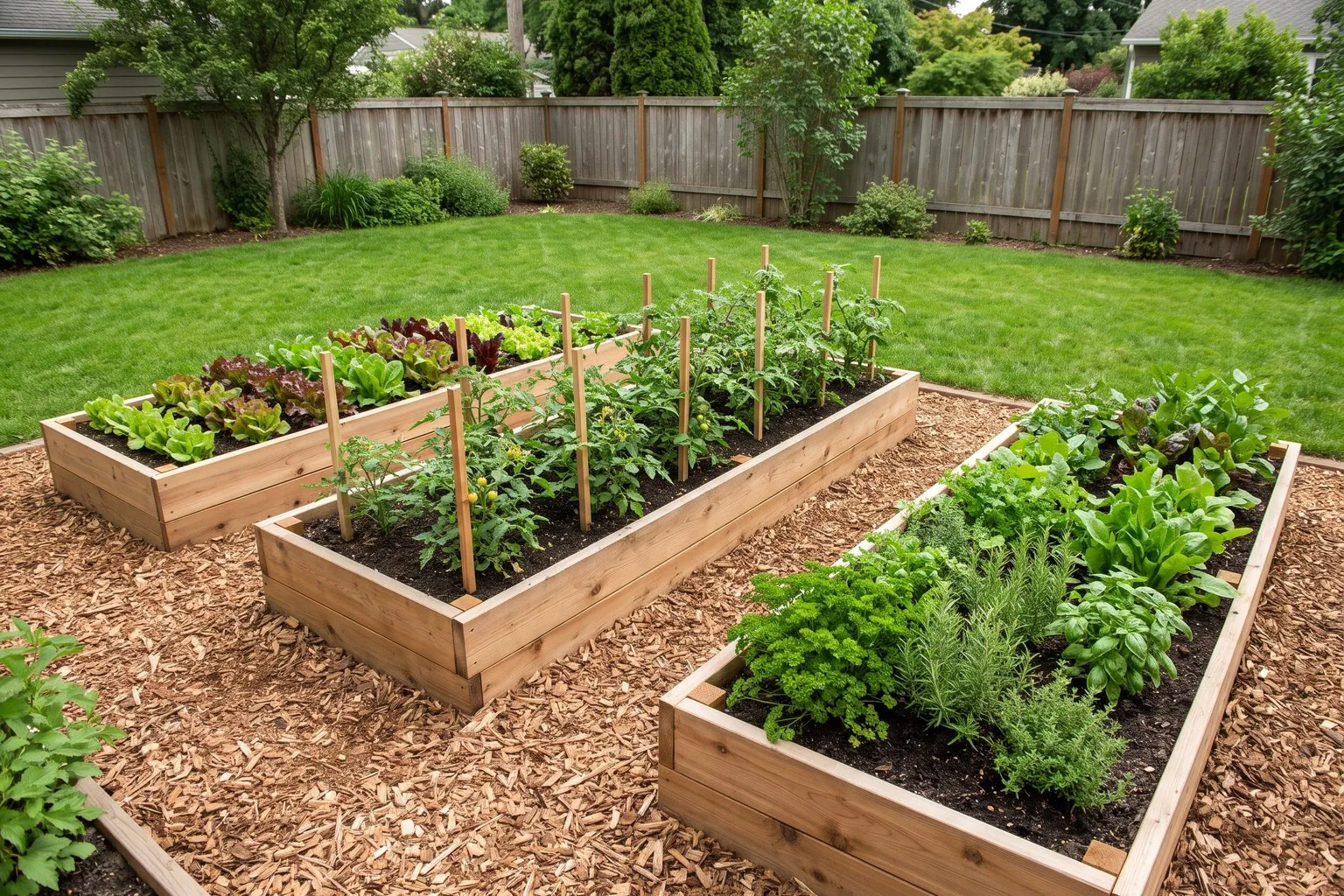
The simple reading: 2 feet between beds you walk between, 3 to 4 feet on the route the wheelbarrow takes. Decide which paths are which before you set the frames down, because a full bed does not move.
Sun, direction and slope
Three more things decide where a bed of a given size can go.
Sun. Iowa State asks for at least six hours of full sun. The Almanac and Utah State both give 6 to 8 hours of direct sunlight a day.
Direction. Georgia says to run beds north to south if possible, and warns that beds running east to west and set close together shade each other. Iowa State says a north to south orientation is best for low-growing crops, and the Royal Horticultural Society gives the same direction for long beds.
Slope. The frame has to be level. On a slope, Georgia says to put the shortest dimension of the bed perpendicular to the slope, so the beds step down it like stairs.
Iowa State adds water: a supply with a lightweight hose should be easily accessible.
Three plans
Put the figures together. These are our sums, using 4 foot beds and 2 foot paths between them.
| Plan | Beds | Ground it takes |
|---|---|---|
| One bed | one 4 by 8 | 4 by 8 feet, plus access on the long sides |
| A pair | two 4 by 8, side by side | 10 by 8 feet |
| Four in a block | four 4 by 8, two by two | 10 by 18 feet |
| Along a fence | one 2 by 8 | 2 by 8 feet, plus a path in front |
Add a 3 foot path along one edge of any of these if a wheelbarrow has to reach the beds.
The pair is a manageable first garden. It gives 64 square feet of planting. Each bed takes six 8 foot boards to build at 11 inches high, which is the cut list in our building guide.
Before you build, in five checks
- Reach. 4 feet wide if you can get to both sides, 2 feet against a fence, 3 for children or seated work.
- Roots. List what you will grow and take the deepest crop: 6, 12 or 18 inches.
- What is underneath. On soil, loosen it and count it as depth. On concrete, the sides are all the depth there is.
- Your back. 11 inches is the standard. 24 inches or more if bending is the problem.
- Paths. 2 feet between beds, 3 to 4 where wheels go, and the beds running north to south.
Questions people ask
What is the best size for a raised garden bed?
4 feet wide and 8 feet long is the usual answer. Four feet is the widest bed an adult can reach into from both sides, and 8 feet matches standard lumber. The Old Farmer's Almanac lists 4 by 4, 4 by 8 and 4 by 12 feet.
How deep should a raised garden bed be?
6 inches for lettuce, herbs and other shallow roots, 10 to 12 inches for most vegetables, and 12 to 18 for tomatoes, carrots and squash. University of Georgia Extension says most garden crops need at least 10 inches of soil.
How wide should a raised garden bed be?
3 to 4 feet if you can reach it from both sides, and 1.5 to 2 feet if it sits against a wall or fence. Use 3 feet for children.
How tall should a raised bed be for a wheelchair user?
University of Georgia Extension gives 24 inches, and Iowa State University Extension about 2 to 3 feet. Keep the bed 3 feet wide or less, since the forward reach from a wheelchair is about 30 inches.
How much space should be between raised beds?
18 to 24 inches to walk, and 3 to 4 feet where a wheelbarrow or wheelchair passes. Georgia gives 12 inches as the absolute minimum.
Can you put a raised bed on concrete?
Yes, but the sides must supply all the depth. University of Maryland Extension gives at least 8 inches for leafy greens, beans and cucumbers and 12 to 24 inches for peppers, tomatoes and squash.
Sources
- Raised garden bed dimensions, Circular 1027-4. University of Georgia Extension, read November 2026
- Creating raised bed planters. Iowa State University Extension, read November 2026
- Raised bed gardening. Utah State University Extension, read November 2026
- Soil to fill raised beds. University of Maryland Extension, read November 2026
- Raised bed gardening: everything you need to know. The Old Farmer's Almanac, read November 2026
- How deep should a raised garden bed be? Soil depth guide by vegetable. Eartheasy, read November 2026
- Soil calculator: how much soil for a raised bed?. Eartheasy, read November 2026
- How deep should your raised garden beds be?. Gardenary, read November 2026
- How to make a raised bed. Royal Horticultural Society, read November 2026
- How to build a simple raised garden bed. Hunker, read November 2026
Every figure in this guide comes from the sources above, or from arithmetic shown in the text. See our editorial policy.