Types of fences: materials, styles, heights and what each one is for
Wood, vinyl, composite, chain link, metal and masonry fences compared by lifespan and cost per foot. Privacy, picket and rail styles, height limits, pool rules.
The short answer
- A fence has a material and a style, and they are separate choices. Wood, vinyl, composite, chain link, metal and masonry are materials. Privacy, picket and rail are styles.
- Privacy fences stand 6 to 8 feet tall. Front yard limits in the towns we read are 3 to 4 feet, and back yard limits 6 to 7.
- The model building code exempts fences up to 7 feet from a building permit. Some towns set 6. Zoning height limits apply either way.
- A pool fence should be at least 48 inches high, with no gap a 4 inch ball can pass and a gate that closes and latches by itself. Those are the federal safety commission's guidelines.
- Installed cost runs from about 13 dollars a foot for chain link to 80 and more for masonry. Wood is 15 to 35.
In this guide
People ask for a type of fence when they mean one of three different things: what it is made of, what it looks like, or what it is for. A cedar privacy fence is all three at once. Sorting them out makes the choice simpler, because the job narrows the style, and the style narrows the material.
This guide starts with the job, then gives the materials with the lifespans and prices two national guides publish, the styles, the height rules of several towns, the federal guidelines for a fence around a pool, and what goes on underground.
Start with the job
| The job | Style that does it | Height |
|---|---|---|
| Privacy | Solid panels or closely spaced boards | 6 to 8 feet |
| Keeping pets and children in | Chain link, picket, any closed style | by the animal or child, within local limits |
| Enclosing a pool | A barrier meeting the pool guidelines | 48 inches at least, 60 in some places |
| Marking the front of a lot | Picket, low rail | 3 to 4 feet in the towns below |
| Marking a boundary, holding livestock | Post and rail, wire | low and open |
The heights come from the sources in the sections below. Taskrabbit's guide gives 6 to 8 feet, with no gaps, as the typical privacy fence. Catalyst Fence describes the picket fence as the choice for front yards and garden enclosures, and for keeping small pets contained. Family Handyman gives chain link as the fence that keeps pets and children in, and post and rail as a ranch fence for livestock or a boundary.
The materials
Two national guides publish lifespans and installed prices: Family Handyman, updated in May 2025, and This Old House, updated in June 2026. Prices are per linear foot, professionally installed unless noted. They are those sites' figures on those dates.
| Material | Lifespan, as stated | Family Handyman | This Old House |
|---|---|---|---|
| Wood | 20 years or more with maintenance; cedar as long as 30 | 15 to 30 dollars | 15 to 35 dollars |
| Vinyl | Up to 20 years; one of the longest lasting | 20 to 45 dollars | 15 to 40 dollars |
| Composite | Can outlast wood | 11 to 45 dollars, up to 57 | not given |
| Chain link | Up to 20 years | 15 to 30 dollars | 13 to 27 dollars |
| Aluminum and steel | Aluminum can last for decades | 35 to 60 dollars | 15 to 75 dollars |
| Wrought iron style | not given | 28 to 56 dollars | within metal |
| Masonry | Up to 100 years | not given | 80 to 480 dollars |
| Bamboo | 2 to 3 years, or about 15: the sources disagree | 2 to 10 dollars | not given |
Wood. The usual species are cedar, redwood and pressure-treated pine, with posts of pressure-treated pine or fir, according to Family Handyman. This Old House separates them by lifespan: untreated pine or spruce lasts around four or five years, cedar as long as 30, and treated wood 20 or 40. Taskrabbit explains the difference: cedar and redwood resist rot and insects naturally, and pressure treatment gives pine an affordable protection against decay. Wood asks for upkeep. This Old House says to restain or reseal every couple of years, and Taskrabbit says to stain or paint every two to three.
Vinyl. Taskrabbit's summary is that vinyl never needs painting or staining. Family Handyman calls it one of the longest lasting fence materials. This Old House gives up to 20 years with no sanding or repairs. It comes as privacy panels, pickets and ranch rail.
Composite. Made of wood fibers and recycled plastic or resin, and used mainly for privacy fences. Family Handyman says it can outlast wood. Taskrabbit reports warranties from 20 years to lifetime.
Chain link. Galvanized steel posts, rails and mesh. It has the lowest price in This Old House's list, and it gives little privacy unless slats are added. Taskrabbit notes that it comes galvanized or vinyl coated.
Aluminum and steel. Sold as panels of balusters with a rust resistant coating. They enclose without hiding anything. This Old House says aluminum can last for decades, and advises inspecting metal fences twice a year and repainting or sealing any rust.
Wrought iron. Mostly a style now, not a material. Family Handyman says contemporary versions are typically made from steel or aluminum, and Taskrabbit says most modern wrought iron fences actually use steel.
Masonry. Brick, stone or concrete block. This Old House gives up to 100 years and credits it with privacy and sound insulation. Taskrabbit notes that it needs a concrete foundation and often rebar. It is a wall, and it is priced like one.
Bamboo. Sold in rolls 6 to 16 feet long. Family Handyman says real bamboo lasts two to three years and treats it as temporary. This Old House quotes a figure of about 15 years. With sources that far apart, do not count on the longer one.
For a sense of scale, 100 feet of wood fence at Family Handyman's 15 to 30 dollars a foot is 1,500 to 3,000 dollars: our sums. This Old House gives its own averages for a whole job: 3,500 to 6,500 dollars for wood, 2,450 to 4,000 for chain link, 4,000 to 7,300 for vinyl, and 3,000 to 5,500 for metal.
The styles
Style is the pattern of boards, rails or panels. Most styles can be had in more than one material.
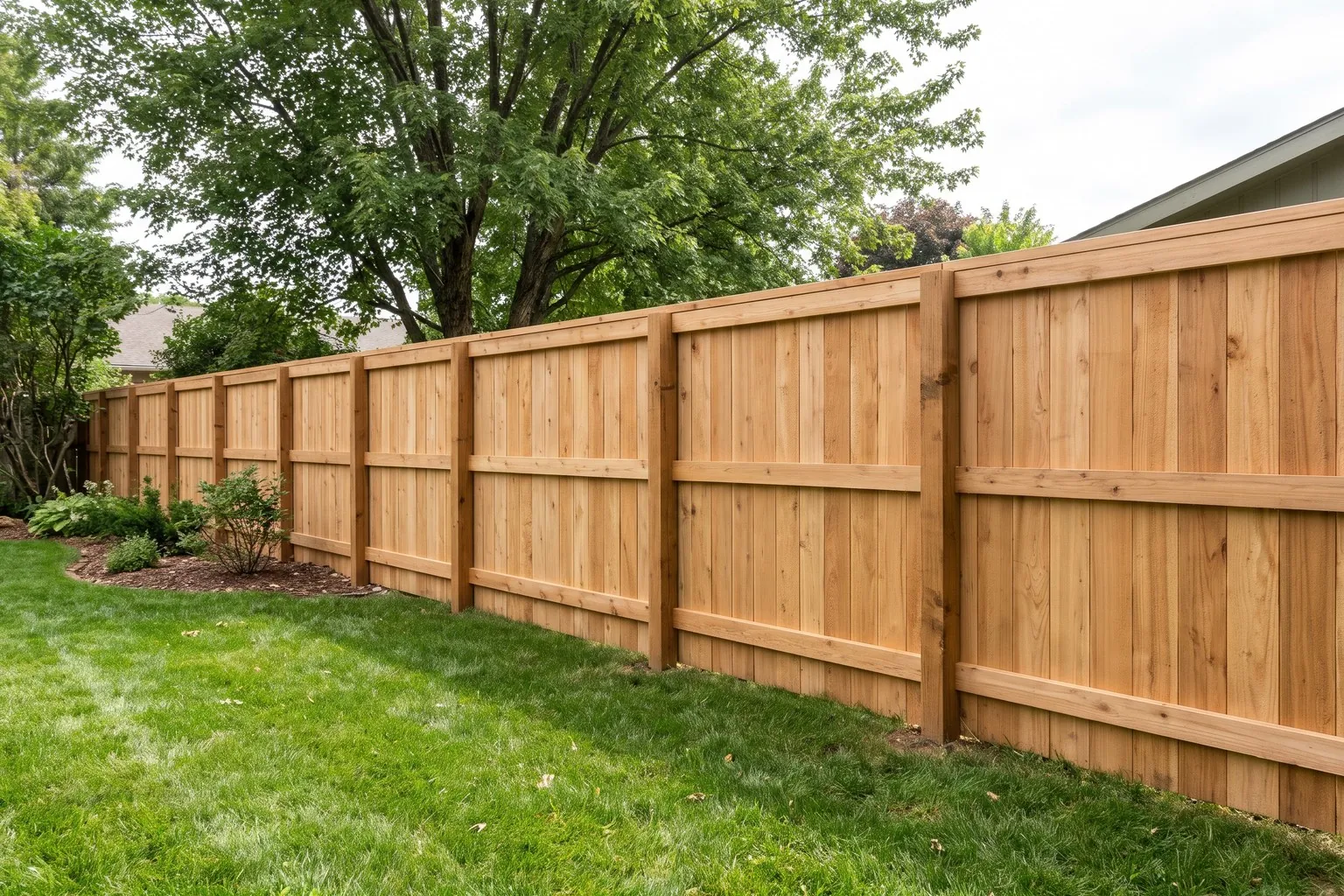
Privacy. Catalyst Fence defines it as solid panels or closely spaced boards that extend from ground level up. Taskrabbit gives the height, 6 to 8 feet, and the test: no gaps. Catalyst adds that a privacy fence can serve as a windbreak.
Board on board and shadowbox. Two wood styles Taskrabbit names alongside the picket.
Semi-private. Catalyst's term for fences with spaced pickets or decorative cutouts. They screen without closing completely.
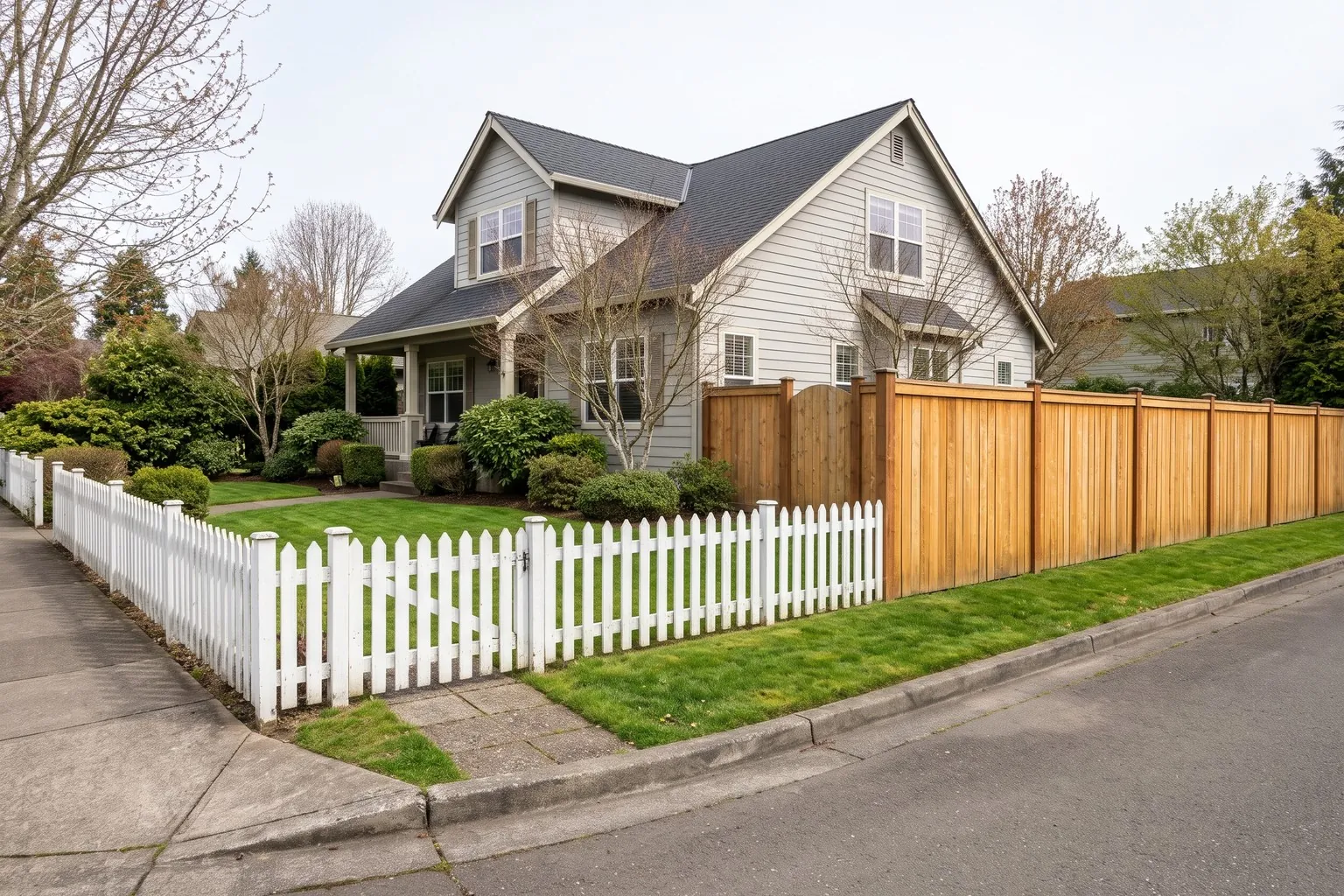
Picket. Traditionally wood, and now also vinyl, aluminum and steel, according to Catalyst. It is the front yard fence.
Post and rail, split rail, ranch rail. Horizontal rails between posts, with open space between them. Taskrabbit gives split rail in two or three rails. Catalyst gives ranch rail in two to four. Family Handyman notes that the posts are often dug in without concrete, and prices it at 11 to 24 dollars a foot to build yourself.
Horizontal slat. Named by Taskrabbit among the composite styles: boards run level between the posts.
Lattice. A decorative style in Taskrabbit's list.
Stone and living fences. The Old Farmer's Almanac describes the oldest American types. Stone fences were traditionally about 3 feet high. The snake fence, also called a split rail zigzag or Virginia fence, used no nails. A hedge is a fence too.
How tall can it be
The height of a fence is set by the town, not by the lumber. Rules differ by yard: low in front, taller at the side and back. Three towns, in their own published figures:
| Town | Front yard | Side and back yard |
|---|---|---|
| Alameda, California | 3 feet, or 4 if see-through | 6 feet, or 8 if see-through |
| Kalamazoo, Michigan | 4 feet, and see-through | 7 feet |
| Saratoga Springs, Utah | 3 feet | 6 feet |
Corners are treated separately. Alameda sets a visibility zone at the corner of two streets where no fence may exceed 3 feet. Saratoga Springs limits fences in the sight triangle to three feet.
Towns restrict materials as well. Alameda prohibits chain link in front yards and does not permit barbed or razor wire. Kalamazoo does not permit chain link in the front yard. This Old House adds a second layer: a homeowners association may forbid certain types, such as chain link.
The permit. A building permit is a different question from the zoning height. The model residential code, in the 2015 edition as the town of Rocky Hill, Connecticut publishes it, exempts from a permit fences, other than swimming pool barriers, not over 7 feet high. Towns adopt the figure or change it:
- Alameda, Kalamazoo and Maplewood, Minnesota require a permit for fences over 7 feet.
- Federal Way, Washington exempts fences not over 6 feet.
- Saratoga Springs requires no permit for six feet or less.
Taskrabbit's summary is that most areas require permits above a certain height, usually 6 feet. The exemption is from the permit only. The Rocky Hill text says so in its first lines: an exemption does not authorize work that violates the code or any other law. A 7 foot fence in a front yard limited to 4 feet is still not allowed.
Pool fences
A fence around a pool is a safety device, and it has its own numbers. The United States Consumer Product Safety Commission publishes safety barrier guidelines for residential pools. The booklet says they are not a federal standard and are not mandatory, and that some states and localities have written them into their building codes.
- Height. The top of the barrier should be at least 48 inches above grade, measured on the side facing away from the pool. Fences 5 feet or higher are preferable, and some states, counties or municipalities require 60 inches.
- Under it. The gap at the bottom should not exceed 4 inches. On grass or gravel the industry recommends 2.
- Through it. No opening should let a 4 inch sphere pass.
- Climbing. Where the horizontal rails are less than 45 inches apart, they go on the pool side, and the gaps between vertical members should not exceed 1 3/4 inches. Where the rails are 45 inches or more apart, the gaps may be up to 4 inches.
- Chain link. The mesh should not exceed 1 1/4 inches square, unless slats reduce the openings to 1 3/4 inches or less.
- Gates. They should open out from the pool, and be self-closing and self-latching. A latch release lower than 54 inches goes on the pool side, at least 3 inches below the top of the gate.
The booklet states that its definition of pool includes spas and hot tubs. If you are planning one, see our guide to hot tub dimensions. The same 4 inch sphere appears in the rule for deck guards, in our guide to deck railing height.
Your building department has the rule that applies. Ask before the fence is ordered.
Posts: the part underground
A fence is only as straight as its posts. Quikrete, a maker of bagged concrete, publishes the rule for the hole.
- Diameter. Three times the width of the post. The hole for a 4 inch wood post should be about 12 inches wide.
- Depth. One third to one half of the post height above ground. A 6 foot fence needs a hole at least 2 feet deep.
- Base. About 6 inches of gravel in the bottom of the hole.
- Concrete. Filled to 3 to 4 inches below ground level.
- Wait. About 4 hours before building on the post.
Applied to the common heights, that gives these holes and post lengths. Our sums.
| Fence height | Hole depth | Post length, fence plus hole |
|---|---|---|
| 4 feet | 16 to 24 inches | about 5 1/2 to 6 feet |
| 6 feet | 24 to 36 inches | 8 to 9 feet |
| 8 feet | 32 to 48 inches | about 11 to 12 feet |
Not every guide sets posts in concrete. Catalyst says posts are typically set in concrete. This Old House's tip is to set wood posts in gravel instead, which it says can give them five or more additional years of life. Family Handyman notes that post and rail fences are often dug in with no concrete at all.
Before any hole, make the call our guide to the DIY fire pit describes: 811, the free national service that marks buried utility lines, a few business days before digging. This Old House names punctured utilities among the risks of building a fence yourself.
The whole sequence, from the string line to the gate, is in our guide to how to build a fence, and the gate itself in how to build a fence gate.
Lines, neighbors and rules
The other risk This Old House names is placing the fence outside your property line.
Find the line. Catalyst warns that the fence line is not always the same as the legal boundary. Taskrabbit says a property survey is needed before installing permanent fencing.
Face the good side out. Kalamazoo's code requires it: where a fence is visible from the street or an adjacent property, the more finished side faces outward. It is one town's rule. Check your own.
Count the wall under it. Kalamazoo measures a fence built on a wall by the combined height. Saratoga Springs measures from the top of a retaining wall where the ground differs on the two sides of the fence.
Read the association rules. They can be stricter than the town's.
Upkeep and lifespan, side by side
The purchase price is one number. What the fence asks for afterward is the other.
- Wood: restain or reseal every couple of years, or stain or paint every two to three.
- Metal: inspect twice a year, and repaint or seal rust.
- Vinyl: no painting or staining.
- Composite: warranties of 20 years to lifetime.
- Chain link: up to 20 years.
- Masonry: up to 100 years.
If the fence is wood, the species is the second decision. Our guide to the best wood for outdoor furniture gives decay ratings for cedar, redwood and the other durable woods.
Choosing, in five questions
- What is it for? Privacy, pets, a pool, the front of the lot, or a boundary. That picks the style and the height.
- What does the town allow? Front and back yard heights, corner rules, banned materials, and the permit threshold.
- Where is the line? Get the survey before the posts.
- How much upkeep will you do? Staining every two or three years, or none.
- What is underground? Call 811, and size the holes at a third to a half of the fence height.
Questions people ask
What are the main types of fences?
By material: wood, vinyl, composite, chain link, aluminum and steel, and masonry. By style: privacy, semi-private, picket, post and rail, lattice. A fence is one of each.
What is the cheapest type of fence?
Among fences that close a yard, chain link has the lowest price in This Old House's list: 13 to 27 dollars a foot installed. Family Handyman gives 15 to 30. Wire and post and rail fences cost less and enclose less.
What type of fence lasts the longest?
Masonry, at up to 100 years according to This Old House. Among lighter fences, cedar is given as long as 30 years, treated wood 20 or 40, and vinyl and chain link up to 20.
How tall can a privacy fence be?
Privacy fences are typically 6 to 8 feet. The limit is local: the towns we read allow 6 or 7 feet in side and back yards, and 3 to 4 in front.
Do I need a permit for a fence?
Often not below 6 or 7 feet. The model building code exempts fences up to 7 feet, and some towns set 6. Zoning height limits still apply, so ask your building department.
How tall does a pool fence have to be?
The federal safety commission's guidelines give at least 48 inches, and say some places require 60. The rule that applies is your local code.
How deep should fence posts be?
One third to one half of the height of the fence above ground, according to Quikrete: at least 2 feet for a 6 foot fence, in a hole three times as wide as the post.
Sources
- Homeowner's guide to different types of fences. Family Handyman, read November 2026
- A comprehensive guide to fencing options for your yard. This Old House, read November 2026
- Fence types explained. Taskrabbit, read November 2026
- Anatomy of a fence. Catalyst Fence, read November 2026
- 8 traditional fence styles from early America. The Old Farmer's Almanac, read November 2026
- Safety barrier guidelines for residential pools. U.S. Consumer Product Safety Commission, read November 2026
- Setting posts without mixing. Quikrete, read November 2026
- Fence regulations. City of Alameda, California, read November 2026
- Residential fencing standards. City of Kalamazoo, Michigan, read November 2026
- Fencing code. City of Saratoga Springs, Utah, read November 2026
- Fence. City of Maplewood, Minnesota, read November 2026
- Residential permit exemptions. City of Federal Way, Washington, read November 2026
- Work exempt from permits. Town of Rocky Hill, Connecticut, read November 2026
- 811: before you dig. Common Ground Alliance, read November 2026
Every figure in this guide comes from the sources above, or from arithmetic shown in the text. See our editorial policy.