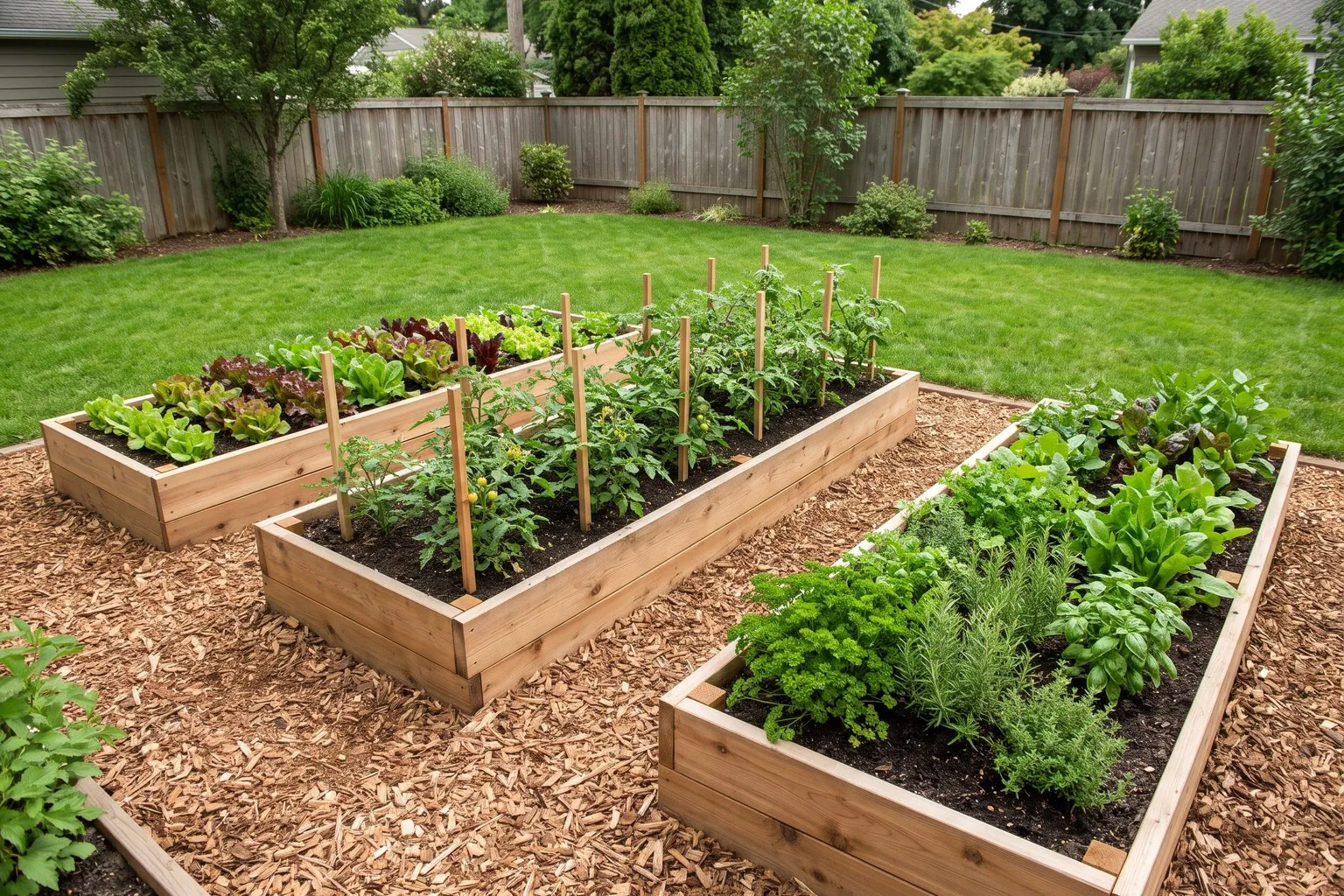
How to build a raised garden bed: a 4 by 8 foot frame from six boards
A 4 by 8 foot raised bed takes six 8 foot 2x6 boards and a few hours. Cut lists for 4x4, 3x6, 2x8 and 4x12 plans, wood, treated lumber, corners, bracing.
The short answer
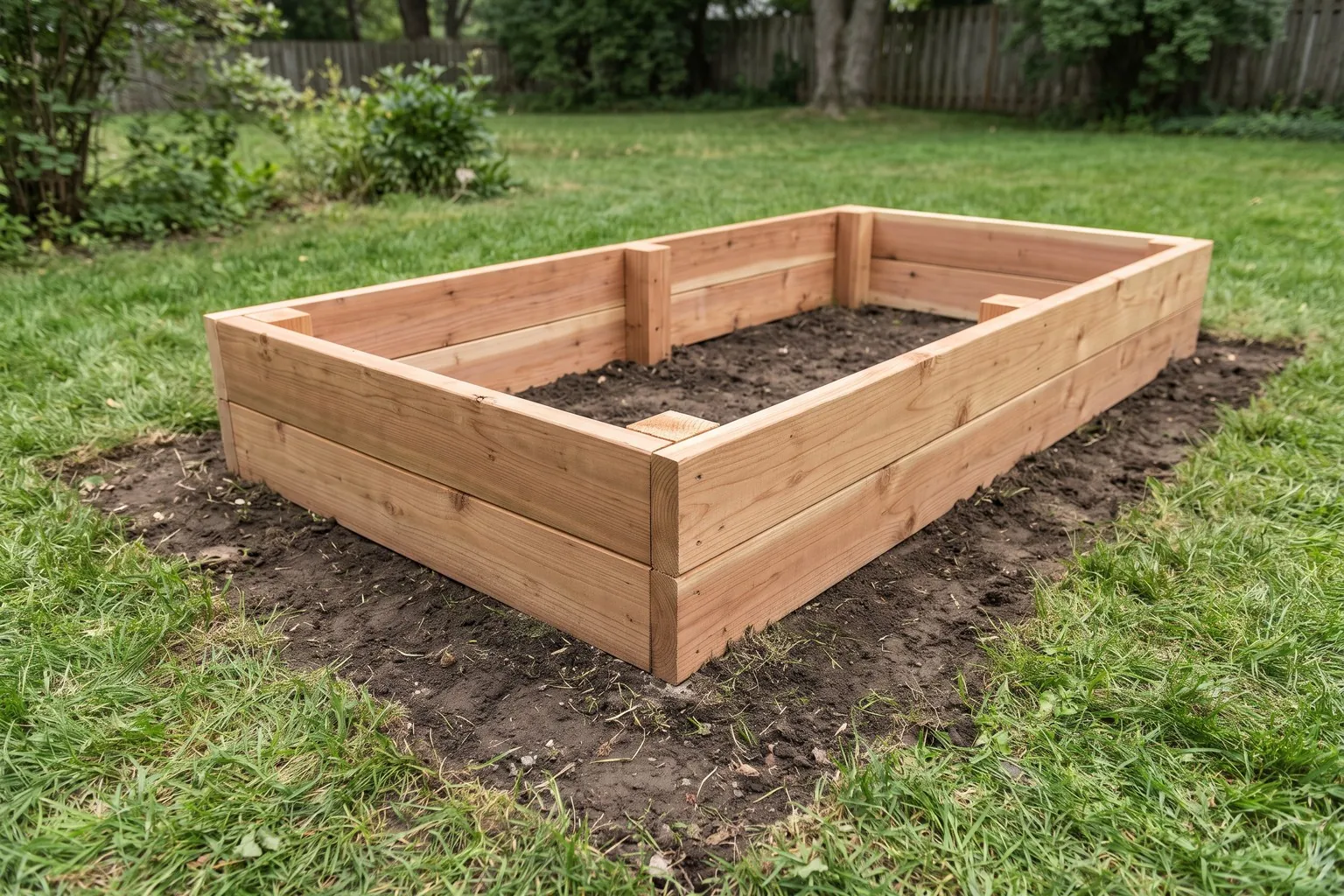
- The standard bed is 4 feet wide, 8 feet long and 11 inches high. It takes six 8 foot 2 by 6 boards, two of them cut in half.
- Put it where it gets 6 to 8 hours of sun, on level ground, with water in reach.
- Cedar lasts 10 to 15 years. Pine lasts a few. Iowa State University Extension considers modern pressure-treated lumber safe for vegetable beds. Never use railroad ties.
- Join the corners with long deck screws and a block inside, with bolted metal angles, or with 4 by 4 posts. All three are published methods.
- A bed taller than 12 inches and longer than 6 feet needs a cross-support. Loosen the ground beneath it before you fill.
In this guide
A raised bed is a simple thing to build: a wooden rectangle with no bottom, set on the ground and filled with soil. There are no footings and no joints harder than a butt joint. The decisions that matter come before the first cut: how big, where, and out of what.
This guide builds the common bed, 4 by 8 feet and two boards high, and gives the published variations. Two companion guides cover the numbers behind it: raised garden bed dimensions and how to fill a raised garden bed.
The bed to build: 4 by 8 feet
The size is not arbitrary. Each number has a reason.
Four feet wide. A bed is as wide as you can reach without stepping in it. University of Georgia Extension gives 4 feet for adults, Iowa State and Utah State give 3 to 4, and The Old Farmer's Almanac says no wider than 4. Against a wall or fence, where only one side can be reached, Iowa State gives 1.5 to 2 feet.
Eight feet long. Georgia advises keeping dimensions to multiples of 2 or 3 feet so the frame fits 8, 10 or 12 foot boards. An 8 foot side is one board. A 4 foot end is half a board.
Eleven inches high. Iowa State calls 11 inches common: two 2 by 6 boards, each actually 1.5 by 5.5 inches. Georgia says most garden crops need at least 10 inches of soil.
Lawn Love's plan arrives at the same bed by counting: six boards of 2 by 6 by 8 feet, two of them cut to 4 feet.
Choosing the place
A bed full of soil does not move. One 4 by 8 bed holds well over a thousand pounds of it, by our sums from Eartheasy's weight for a cubic yard of mix. Choose the place first.
- Sun. Iowa State asks for at least six hours of full sun. The Almanac, Utah State and Lawn Love all give 6 to 8 hours of direct sun a day.
- Level ground. Georgia says the frame must be level. On a slope, it advises setting the shortest dimension of the bed across the slope, so beds step down like stairs.
- Direction. Georgia, Iowa State and the Royal Horticultural Society all favor running the long side north to south.
- Water. Iowa State says a water supply with a lightweight hose should be easily accessible.
- Paths. Georgia gives 18 to 24 inches between beds as ideal, and 4 feet where a wheelbarrow, cart or wheelchair passes.
If your design sets posts in the ground, there is one call to make before digging. 811 is the free national service that marks buried utility lines. Its site says to contact it a few business days before any digging, whatever the depth.
Wood: what to buy
The frame is in contact with wet soil on one face for its whole life. The species decides how long it lasts.
| Wood | What the sources say |
|---|---|
| Cedar | Naturally rot resistant (Utah State). Can last 10 to 15 years (the Almanac, Lawn Love). |
| Redwood | Naturally rot resistant (Utah State). Lasts longer than fir, pine or spruce (Hunker). |
| Pine | Rots after a few years (the Almanac). Will only last a few years (Lawn Love). |
| Fir, untreated | Rots and breaks down within a few years (Utah State). |
| Hemlock | Lasts a little longer than pine (the Almanac). |
| Pressure-treated pine or fir | Probably the most durable options (Hunker). |
Hunker adds a floor under all of them: every type of wood should last at least five years.
Thickness matters too. Lawn Love says boards should be at least 2 inches thick, which is the nominal size of a 2 by 6. Georgia notes that a wall of 1 inch lumber needs a vertical support about every 4 feet.
Price both at your lumber yard and set the difference against the years. Our guide to the best wood for outdoor furniture gives the decay ratings of the durable species.
Is pressure-treated lumber safe for vegetables?
Many builders ask, and the extension services answer directly.
What changed. Oregon State University Extension says the concern is CCA, a preservative containing arsenic, and that its use was restricted by the EPA in 2004. Iowa State says wood treated before 2004 often contained arsenic-based preservatives and is not recommended. Hunker lists the treatments used on residential lumber now, among them ACQ and copper azole, and says ACQ is the most common.
What research found. Oregon State puts it this way: the chemicals do leach out of the wood into the soil and are taken up by plants in very small amounts, and it found no research showing amounts significant enough to be of concern for human health. Iowa State says modern pressure-treated lumber is considered safe for use in vegetable gardens, and that the copper released is minimal and largely limited to within 1 inch of the wood.
The precaution. Gardeners who want a margin can add a barrier. Utah State says copper-treated lumber may be used and that a plastic barrier should be placed between the lumber and the soil mix. Iowa State suggests lining with woven geotextile fabric for the risk averse.
Not every source reaches the same conclusion. Lawn Love advises avoiding treated wood, and Hunker suggests untreated lumber for beds that grow food. Either choice is defensible. What no source defends is old treated wood of unknown date.
What never goes in a garden. Iowa State says railroad ties should never be used in gardens, because of creosote. Hunker says to stay away from old railroad ties for the same reason.
Two smaller notes. Iowa State warns that galvanized metal may leach lead or cadmium. And the Almanac says to look for an HT stamp on pallets before reusing them, and to avoid those treated with methyl bromide.
The cut list
For one bed 4 feet by 8 feet, two boards high:
| Item | Quantity |
|---|---|
| 2 by 6 boards, 8 feet long | 6 |
| Cuts | 2 of the boards cut in half, giving four 4 foot ends |
| Long sides, 8 feet | 4 |
| Short ends, 4 feet | 4 |
| Corner fixings | see the three methods below |
Two details of the finished size are worth knowing. They are our sums, from the 1.5 inch actual thickness of the boards.
If the long sides run past the ends, the bed is 96 inches long and 51 inches wide on the outside, and 93 by 48 inches inside. If the ends cap the long sides, it is 99 by 48 outside and 96 by 45 inside. Either way the planting area is about 30 square feet, not quite the 32 of the name. Choose one way and build both courses to match, or better, alternate them.
More plans: six beds and their cut lists
The same method gives other sizes. Each plan below follows the rules already sourced in this guide and in raised garden bed dimensions: 2 by 6 boards, 5.5 inches high each; lengths in multiples of 2 or 3 feet so the boards divide without waste, by Georgia; 3 to 4 feet wide for a bed reached from both sides, 1.5 to 2 feet against a wall. The long sides are full boards and the ends are cut from them, as in the 4 by 8 plan. The cut lists and soil volumes are our sums, from the nominal size.
| Plan | Height | Boards to buy | Cuts | Soil, about |
|---|---|---|---|---|
| 4 by 4 ft | 11 in, 2 courses | four 8 ft | each cut in half: eight 4 ft pieces | 15 cu ft |
| 3 by 6 ft | 11 in, 2 courses | three 12 ft | two cut 6 + 6 ft, one cut into four 3 ft ends | 17 cu ft |
| 2 by 8 ft, against a wall | 11 in, 2 courses | five 8 ft | four used whole, one cut into four 2 ft ends | 15 cu ft |
| 4 by 8 ft | 11 in, 2 courses | six 8 ft | two cut in half | 29 cu ft |
| 4 by 8 ft, deeper | 16.5 in, 3 courses | nine 8 ft | three cut in half | 44 cu ft |
| 4 by 12 ft | 11 in, 2 courses | four 12 ft and two 8 ft | the 8 ft boards cut in half for the ends | 44 cu ft |
Reading the table. The 4 by 4 is a square bed reached from all sides; the 3 by 6 suits a shorter reach; the 2 by 8 is the bed for a fence line or a wall, reached from one side only. The deeper 4 by 8 gives 16.5 inches of soil, inside the 12 to 18 inches that tomatoes, carrots and squash want, by our dimensions guide.
The real size. As in the 4 by 8 plan, the boards' 1.5 inch thickness changes the outside and inside sizes by 3 inches. The soil column uses the nominal size and rounds up a little; the exact sum, and the mix to fill it with, are in how to fill a raised garden bed.
Longer beds. A side longer than one board needs a joint. Hunker's corner posts give one way to carry it: a 4 by 4 post set in the ground where two boards meet, with screws into each. Our reading of its method, which it describes for corners.
Three ways to join the corners
The corner is the only joint in the bed, and it carries the outward push of the soil. Iowa State says simply that corners must be reinforced. The guides we read do it in three ways.
Screws and a block. Utah State's method: cut two pieces the width of the bed and two the length, and screw the corners into a four-sided box with 4 inch decking screws. Reinforce each corner with a wooden block or a metal plate placed inside it.
Bolted metal angles. Lawn Love's method: a 12 inch framing angle inside each corner, held with 2.5 inch fully threaded hex screws through the boards, with the heads outside and washers and nuts inside. It counts 24 of them for a full size bed and suggests stainless steel where food is grown. The corners are checked with a framing square.
Posts. Hunker's method: a 4 by 4 post at each corner, set in the ground, with the boards fastened to the posts by 3 inch deck screws. It wants more than one screw at each end of each board: two may be enough, three is better. For a bed 22 inches tall it sets each post in a 12 inch hole, about a third of the length of the post, and levels each board before fixing it. That is how Hunker ties the four courses of its tall bed together.
The Royal Horticultural Society builds in heavier timber and adds two habits worth copying in any method. Overlap the joints when you add a second layer, so the corner of one course does not sit over the corner of the one below. And fix a baton inside each corner to tie the layers together.
Building it, step by step
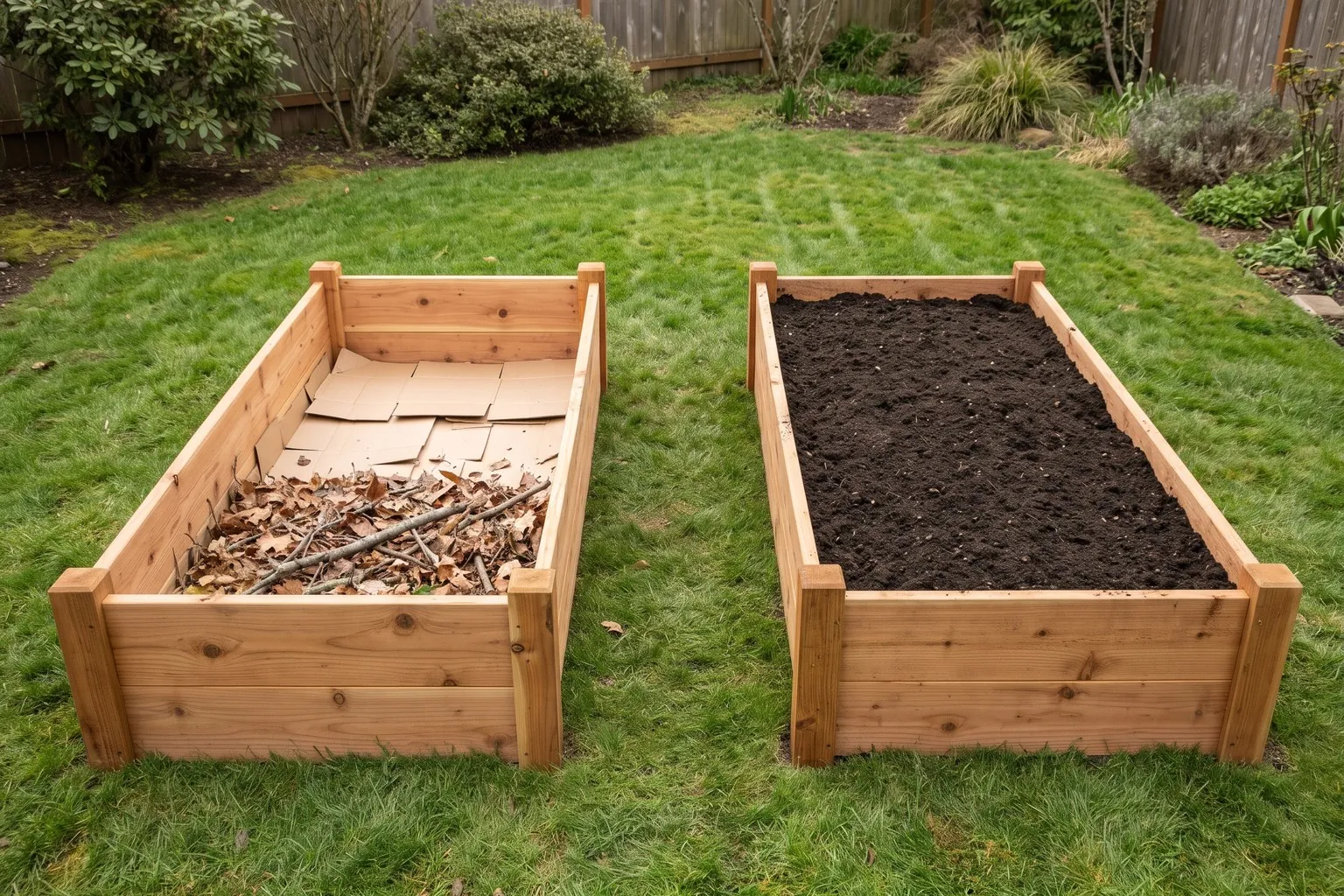
1. Clear and loosen the ground. Mark out the rectangle. Utah State says that for a bed shallower than 12 inches with no bottom, the soil beneath the box should be tilled 6 to 12 inches deep. If the site is lawn, University of Maryland Extension lays plain cardboard or overlapping newspaper over the turf and tops it with 2 to 4 inches of compost.
2. Make the cuts. Cut two of the six boards in half. That is the only sawing in the project.
3. Assemble the first course. Work on flat ground. Join two long sides and two ends into a rectangle with the corner method you chose.
4. Check that it is square. Lawn Love uses a framing square at each corner. On a rectangle this size there is a second check that needs only a tape: measure both diagonals. When they are equal, all four corners are square.
5. Set it in place and level it. The Royal Horticultural Society digs a shallow trench to the exact dimensions of the bed and levels the first layer with a spirit level, along the timbers and diagonally across them. Georgia's rule is the same: the frame must be level.
6. Add the second course. Stack the second rectangle on the first, with the joints overlapped, and tie the two together at the corners with the block, the angle or the post.
7. Brace it if it needs it. Eartheasy says a bed taller than 12 inches and longer than 6 feet needs a cross-support in the middle. The Almanac says beds taller than 12 inches need cross-supports. An 11 inch bed of 2 inch lumber sits just under that line. A taller one does not.
8. Line the bottom if you need to. Gardenary adds hardware cloth, a wire mesh, where burrowing animals are a problem. Lawn Love lines the bottom with hardware cloth or landscape fabric. Hunker lays gopher wire first.
9. Fill it. Hunker fills to within 2 or 3 inches of the top edge. The Royal Horticultural Society fills to about 2 inches below the rim and lets the soil settle for a couple of weeks. A bed this size takes about 29 cubic feet of soil mix: our sums. The recipe and the quantities are in the guide to filling.
Tools, time and money
The tool list is short. Lawn Love's is a drill and bits, a tape measure, a pencil, a wrench and a framing square. Hunker's post method adds a post-hole digger, a small level and tin snips for the wire. A saw is needed for two cuts.
Time: Hunker says just a few hours. The Royal Horticultural Society, building in heavy timber, says a bed can be constructed in a weekend.
Money: Hunker estimated in 2022 that the builder would probably spend less than 100 dollars on its bed. Lumber prices move, so price six boards at your own yard. Soil is a separate line. Lawn Love gives 10 to 50 dollars per cubic yard of topsoil.
Variations
Taller. Four 2 by 6 boards make a bed about 22 inches high, which is Hunker's design. Use posts at the corners and plan a cross-support. Georgia gives 24 inches as the height for wheelchair access and 36 inches to avoid excessive bending.
Narrower. Against a fence, build 2 feet wide. Georgia gives 3 feet for a bed children will work.
Longer. A 4 by 12 foot bed uses 12 foot boards for the sides. Georgia notes that cost rises noticeably above 12 feet. Check a long side against the bracing rules above.
Not wood. Iowa State lists the alternatives: landscaping timbers, composite, PVC, metal, concrete blocks, rock and brick. The Almanac gives the size of a cinder block, 16 inches long by 8 high, and Georgia points out that 8 inch blocks take more space than boards.
Mistakes the sources warn about
- Too wide. Past 4 feet you will step in the bed, and the soil compacts.
- Thin boards without support. One inch lumber needs a support every 4 feet.
- A frame that is not level. Georgia says the frame must be level.
- Old treated wood and railroad ties. Wood treated before 2004 may contain arsenic. Ties contain creosote.
- No bracing on a tall bed. Above 12 inches high and 6 feet long, add a cross-support.
- The wrong fill. Potting mix alone and compost alone are both named as mistakes. See the guide to filling.
Questions people ask
How do you build a simple raised garden bed?
Buy six 8 foot 2 by 6 boards and cut two in half. Join two long sides and two ends into a rectangle, stack a second rectangle on it, and reinforce the corners. Set the frame level on loosened ground and fill it.
What is the best wood for a raised garden bed?
Cedar or redwood. Utah State University Extension calls both naturally rot resistant, and two guides give cedar 10 to 15 years. Pine lasts only a few years.
Is pressure-treated wood safe for a vegetable garden?
Iowa State University Extension says modern pressure-treated lumber is considered safe for vegetable gardens. Oregon State says chemicals leach in very small amounts, with no research showing a concern for health. Avoid wood treated before 2004.
How many boards do I need for a 4x8 raised bed?
Three 8 foot boards for each course: two long sides and one cut in half for the ends. A bed two boards high takes six.
Do I need to put anything on the bottom of a raised bed?
On lawn, cardboard or newspaper under the soil. Where animals burrow, hardware cloth. Otherwise loosen the ground 6 to 12 inches and leave it open.
How long does it take to build a raised bed?
A few hours for a simple 2 by 6 frame, according to Hunker. The Royal Horticultural Society allows a weekend for a bed in heavier timber.
How many boards for a 4 by 4 raised bed?
Four 8 foot 2 by 6 boards, each cut in half, for a bed two boards high: about 15 cubic feet of soil, by our sums.
What are good raised bed plans for a small yard?
A 4 by 4 foot bed reached from every side, a 3 by 6 for a shorter reach, or a 2 by 8 against a fence or wall. Cut lists are in the plans table above.
Sources
- Raised garden bed dimensions, Circular 1027-4. University of Georgia Extension, read November 2026
- Creating raised bed planters. Iowa State University Extension, read November 2026
- Raised bed gardening. Utah State University Extension, read November 2026
- Raised bed lumber, pressure treated safe?. Oregon State University Extension, read November 2026
- Soil to fill raised beds. University of Maryland Extension, read November 2026
- Raised bed gardening: everything you need to know. The Old Farmer's Almanac, read November 2026
- How to build a simple raised garden bed. Hunker, read November 2026
- How to build a raised garden bed in 10 steps. Lawn Love, read November 2026
- How to make a raised bed. Royal Horticultural Society, read November 2026
- How deep should a raised garden bed be? Soil depth guide by vegetable. Eartheasy, read November 2026
- How deep should your raised garden beds be?. Gardenary, read November 2026
- 811: before you dig. Common Ground Alliance, read November 2026
Every figure in this guide comes from the sources above, or from arithmetic shown in the text. See our editorial policy.