How to build a fence gate: the frame, the brace and the gap
Size the gate 3/4 to 1 1/2 inches under the opening, frame it in 2x4 and 2x3, run the brace up from the bottom hinge to the latch, set the posts 30 inches deep.
The short answer
- Size the gate from the opening: about 3/4 inch smaller for a single gate, by Family Handyman, or 1 1/2 inches smaller, 3/4 on each side, by This Old House.
- Frame it with 2x4 top and bottom rails, 2x3 side rails and a 2x3 crossmember, This Old House's frame.
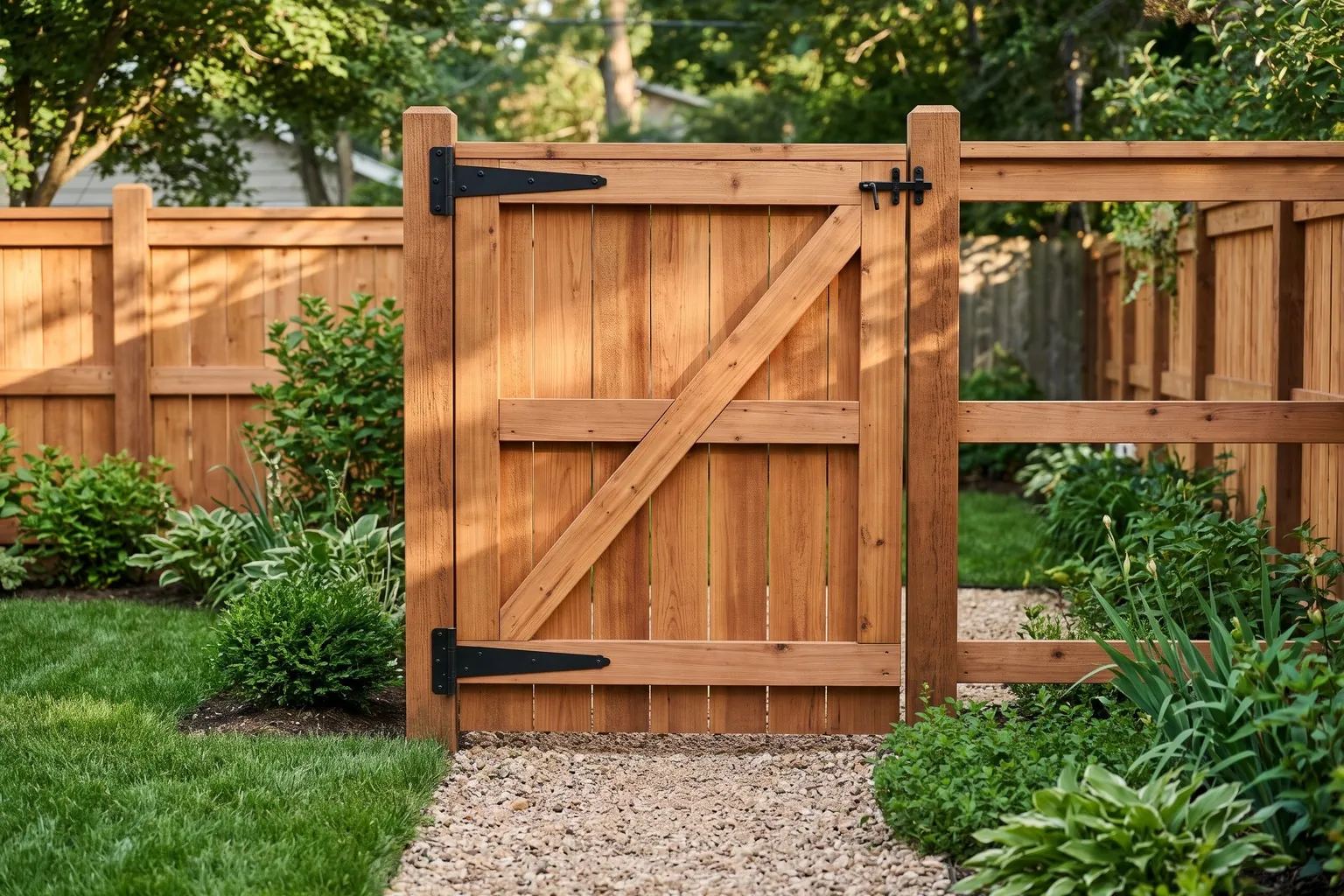
- The diagonal brace runs from the bottom of the hinge side to the top of the latch side. This Old House: the braces form an arrow pointing toward the latch.
- Set the gate posts about 30 inches deep, with concrete stopping 3 to 4 inches below grade. This Old House uses a 5x5 post when it replaces one.
- Hang the gate 2 to 5 inches off the ground. A sagging gate is usually a reversed brace or a moving post.
In this guide
A gate is a small door hung in a fence, and it fails in one way: the latch side drops. The sources build against that with a brace, with angled boards or with corner blocks, and This Old House starts from the posts, because a gate is only as steady as what it hangs on.
Our sources are This Old House, which publishes a guide to installing a gate and another to repairing one, both by landscape contractor Roger Cook; Family Handyman's gate project; and a reader's tip in Fine Homebuilding. The fence around the gate is in our guide to how to build a fence, and the kinds of fence in types of fences.
Size the opening first
The width. Our fence guide gives Family Handyman's three sizes: 3 feet for people, 4 feet for a lawn tractor, and a pair of 3 foot gates where a full 6 feet is needed. Size the opening for the widest thing that will pass through it.
The gap. A gate needs room to swing and room for the hinges and latch. The sources leave different amounts:
| Source | Gap between gate and posts |
|---|---|
| Family Handyman | single gate about 3/4 in smaller than the opening; a pair of gates about 1 in narrower together, set 1/2 in apart |
| This Old House, installing | opening = gate width + 1 1/2 in, so 3/4 in on each side |
| Hunker, in our fence guide | about 3/4 in |
| This Old House, repairing | a 1/2 in gap between the gate and the post |
Worked out, by our sums.
| Opening | Gate, Family Handyman | Gate, This Old House |
|---|---|---|
| 36 in | 35 1/4 in | 34 1/2 in |
| 48 in | 47 1/4 in | 46 1/2 in |
| 72 in, a pair | two gates of 35 1/2 in, 1/2 in between them |
For the pair, 72 minus 71 leaves an inch of play: half an inch between the two leaves and about a quarter inch at each post. Our sums.
The ground. This Old House hangs the gate so it clears the ground by 2 to 5 inches. Family Handyman blocks its gates high enough to clear the ground, and keeps its fence panels about 3 inches above the grass. On a slope, the gate needs the larger figure on the side where the ground rises into its swing: our reading.
The posts carry the gate
Josh Feeney, quoted by This Old House: "A gate is only as good as the posts it hangs from and latches to." In our reading, the hinge post carries the whole gate held out at arm's length, so it is the one to set best.
| Source | Post | Hole | Concrete |
|---|---|---|---|
| This Old House, installing | pressure-treated | about 30 in deep | stopping about 3 in below grade |
| This Old House, repairing | 5x5 pressure-treated | about 30 in deep | 3 to 4 in below grade, the top 3 in left for soil; cure overnight |
| Family Handyman | 4x4, 10 ft long | 8 in across, about 3 ft deep, about 6 in of gravel | heaped about 1/2 in above grade |
While the concrete cures, This Old House braces the hinge post with two 2x4s, screwed about 3 feet above grade and staked about 3 feet from the base of the post. Our fence guide adds Lowe's advice for gate posts: leave space for the hardware, and screw 2x4 spacers to the posts between the rails to back the hinges and latch.
How deep in your area also depends on the frost line. Our guide to how to build a fence gives the depth rules of four sources and Lowe's caution about frost.
The frame
This Old House's frame for a wood gate: 2x4 top and bottom rails, 2x3 side rails, and a 2x3 crossmember to prevent sagging. The pickets or boards go on the face of that frame, fixed with 1 5/8 inch deck screws in its repair guide.
There are two other ways to stiffen a frame:
- Angled boards. Family Handyman's gate has no separate brace. "The key to our no-sag gate is using panel boards that are angled at 45 degrees." Each board works as a brace. The boards are nailed with 1 1/2 inch galvanized finish nails and the rails go on with 2 inch deck screws.
- Corner blocks. Rick Fagnani, writing in Fine Homebuilding: "I place 2×4 blocks with mitered ends at each corner of the gate-frame." He uses them instead of the typical diagonal bracing; the blocks square the frame and give the strap hinges something solid to anchor into.
The brace: which way it runs
This is the detail that decides whether a gate sags. This Old House's repair guide: "A diagonal wood brace must run from the top of the latch side to the bottom of the hinge side." Tom Silva, its general contractor, puts it as a picture: "The diagonal braces should form an arrow pointing toward the latch." On a gate with two braces, the upper one slants down from the top hinge and the lower one slants up from the bottom hinge, and they meet on the latch side.
Why that way, in our reading. The latch side hangs free and wants to drop. A brace whose low end sits at the bottom hinge is pushed along its length by that weight, and wood resists being pushed far better than a few screws resist being pulled. Installed the other way, the brace only hangs from its fasteners.
How long, by our sums. The brace runs corner to corner inside the frame, so its length is the diagonal of the frame:
| Gate frame | Brace, corner to corner |
|---|---|
| 34 1/2 by 48 in | about 59 in |
| 34 1/2 by 60 in | about 69 in |
| 46 1/2 by 48 in | about 67 in |
| 46 1/2 by 72 in | about 86 in |
What the projects use
The two fuller projects list their materials, and the lists show how differently a gate can be built:
| This Old House | Family Handyman | |
|---|---|---|
| Posts | pressure-treated; a 5x5 in the repair | 4x4, 10 ft long |
| Frame | 2x4 top and bottom rails, 2x3 sides and crossmember | 1x8 rails, 2x8 bottom rails, 2x3 angle brackets |
| Face | pickets on 1 5/8 in deck screws | 1x6 boards at 45 degrees on 1 1/2 in galvanized finish nails |
| Hardware | gate hinges on lag screws, a latch | hinges, a foot latch with a drop pin |
| Other fasteners | 2 in deck screws on rails and trim, 3 in deck screws on the cleats, 1 1/4 in joist hanger screws on the brackets |
Family Handyman also fits a 1x4 gate stop with a 1 inch overhang on its gates. In our reading, the stop is what the gate closes against, so the hinges are not left to stop the swing.
Hanging it
This Old House's order, from its installation guide:
- Support the gate in the opening at the height you want; the repair guide rests it on a 2x4.
- Shim the gaps. Tap shims between the posts and the gate on both sides until the gaps are even.
- Fix the hinges with lag screws. The repair guide drills 3/16 inch pilot holes and notes that surface-mounted hinges speed the job.
- Fit the latch. Mark and pre-drill, then fasten it with screws or bolts suited to it.
- For a pair of gates, add a drop rod on the fixed leaf.
Family Handyman sets its pair of gates on the ground 1/2 inch apart before hanging them, and holds the fixed leaf with a foot latch whose drop pin sits in a piece of PVC pipe about 12 inches long, set in the ground.
Which wood
Family Handyman names the usual species as cedar, redwood and pressure-treated pine, with posts of pressure-treated pine or fir, as our guide to types of fences reports. This Old House gives their lifespans:
| Wood | Lifespan, by This Old House |
|---|---|
| Untreated pine or spruce | around four or five years |
| Pressure-treated | 20 or 40 years |
| Cedar | as long as 30 years |
This Old House also has the fence restained or resealed every couple of years. A gate takes more wear than the boards beside it, since it moves and is handled; in our reading, that is a reason to choose a durable species for it even where the fence is cheaper. Decay ratings for cedar, redwood and the other durable woods are in our guide to the best wood for outdoor furniture.
Latches
This Old House names three kinds: a bolt latch, a gravity latch and a spring-loaded latch. Choose one that suits the gate and the way it is used.
Around a pool, the rules change. The U.S. Consumer Product Safety Commission's barrier guidelines, in our guide to types of fences, say a pool gate should open out from the pool and be self-closing and self-latching. Where the latch release is lower than 54 inches, it goes on the pool side, at least 3 inches below the top of the gate. Your building department has the rule that applies.
When a gate sags
Start with the brace, then the post.
A reversed brace. Tom Silva's fix, in This Old House: prop the latch side about 1/4 inch higher than level, pry off the braces, and cut two new 2x4 pieces that run the right way.
A tension brace. This Old House adds an option that leaves the gate in place: a threaded rod or a wire with a turnbuckle, running opposite to a wood brace. In our reading, that puts it from the top of the hinge side to the bottom of the latch side, so that tightening it pulls the free corner up. The same guide suggests metal corner brackets where a frame has come out of square.
A moving post. If the hinge post leans, no brace will hold the gate. This Old House's repair guide replaces it: a new 5x5 pressure-treated post, a hole about 30 inches deep, concrete stopping 3 to 4 inches below grade, and the post braced overnight while it cures. Carpenter Nathan Gilbert, quoted there, suggests consulting a fence-building pro to find out what your options are.
Before you build, in seven checks
- Opening: the widest thing that will pass, plus the gaps.
- Gate width: 3/4 to 1 1/2 inches under the opening for a single gate.
- Posts: about 30 inches deep, concrete stopping below grade, the hinge post braced while it cures.
- Frame: 2x4 top and bottom, 2x3 sides and a crossmember.
- Brace: from the bottom hinge up to the latch side.
- Ground: 2 to 5 inches of clearance, more where the ground rises.
- Latch: self-closing and self-latching around a pool.
Questions people ask
Which way does the brace go on a gate?
From the bottom of the hinge side up to the top of the latch side. This Old House's Tom Silva: the braces should form an arrow pointing toward the latch.
How much gap should a gate have?
About 3/4 inch less than the opening for a single gate, by Family Handyman, or 3/4 inch on each side, by This Old House. Another This Old House guide leaves 1/2 inch between the gate and the post.
How far off the ground should a gate be?
2 to 5 inches, by This Old House.
How deep should gate posts be?
About 30 inches, by This Old House, with concrete stopping 3 to 4 inches below grade. Family Handyman digs about 3 feet with 6 inches of gravel. Check your frost line.
How do you keep a wooden gate from sagging?
Run the brace up from the bottom hinge to the latch side, set the hinge post well, or use boards angled at 45 degrees as Family Handyman does. A turnbuckle and rod can lift a gate that already sags.
What lumber is used for a gate frame?
This Old House uses 2x4 top and bottom rails, 2x3 side rails and a 2x3 crossmember.
What kind of latch should a gate have?
This Old House names three kinds: a bolt latch, a gravity latch and a spring-loaded latch. Around a pool, the CPSC guidelines ask for a gate that opens out from the pool and is self-closing and self-latching.
What wood is best for a fence gate?
Cedar, redwood or pressure-treated pine, the usual fence species by Family Handyman. This Old House gives cedar as long as 30 years, treated wood 20 or 40, and untreated pine or spruce around four or five.
How wide is a fence gate?
3 feet for people and 4 feet for a lawn tractor, by Family Handyman, with a pair of 3 foot gates for a 6 foot opening.
Sources
- How to install a fence gate. This Old House, read November 2026
- How to repair a fence gate. This Old House, read November 2026
- How to build a fence gate. Family Handyman, read November 2026
- Simple sturdy gate. Fine Homebuilding, read November 2026
- A comprehensive guide to fencing options. This Old House, read November 2026
Every figure in this guide comes from the sources above, or from arithmetic shown in the text. See our editorial policy.