How to build a wood fence: posts, rails and pickets, with the numbers
Set 4x4 posts just under 8 feet apart, a third of their length in the ground. Three rails for a 6 foot fence, pickets 2 inches off the soil. Layout, gates, slopes.
The short answer
- Settle three things before digging: where the property line is, what the town allows, and what is buried. Call 811.
- Posts are 4 by 4 treated lumber, just under 8 feet apart so an 8 foot rail reaches from one to the next.
- Bury a third of the post. For a 6 foot fence that is a 9 foot post, 36 inches deep, in a hole about 12 inches across.
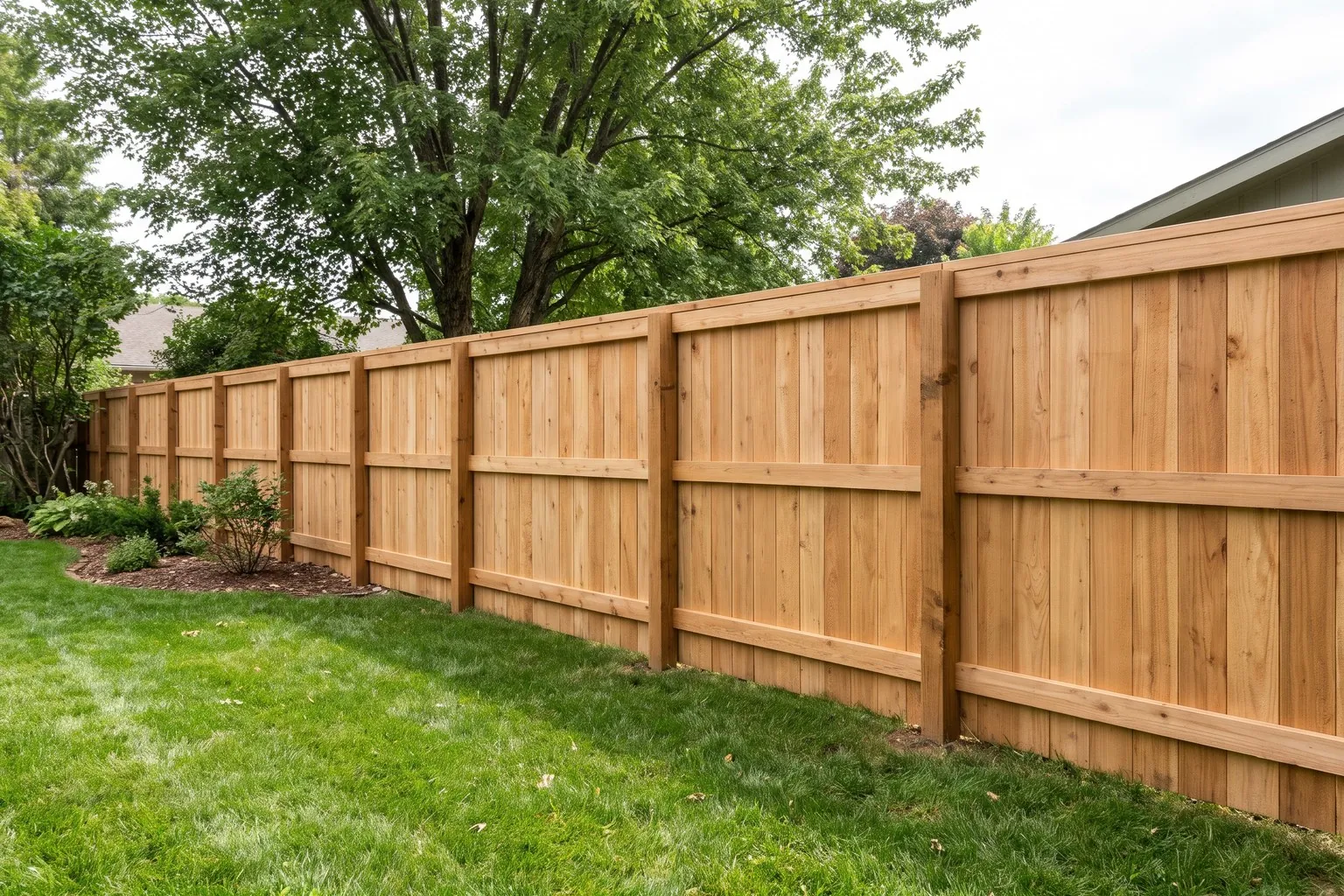
- A 6 foot privacy fence takes three rails. A 3 to 4 foot picket fence takes two. Keep the bottom rail at least 6 inches off the ground.
- Pickets stop 2 inches above the soil. Hang gates with a 3/4 inch gap. Family Handyman gives 3 feet for a gate people walk through and 4 feet for a lawn tractor.
In this guide
A wood fence is three parts repeated: a post in the ground, rails between posts, boards on the rails. Most of the numbers in this guide concern the part nobody sees: the hole.
This guide follows the order of the work, with the figures that Family Handyman, Hunker, This Old House, Lowe's and Quikrete give. Where they differ, we show both. To choose the kind of fence and its height first, see our guide to the types of fences.
Before the first hole
The line. Family Handyman's warning is plain: guessing at your property lines is taking a huge risk. Its method is to find the iron stakes at the corners of the lot, drive wooden stakes over them, and lay out the fence at the proper setback. Hunker notes that the required setback from the line is often 6 inches.
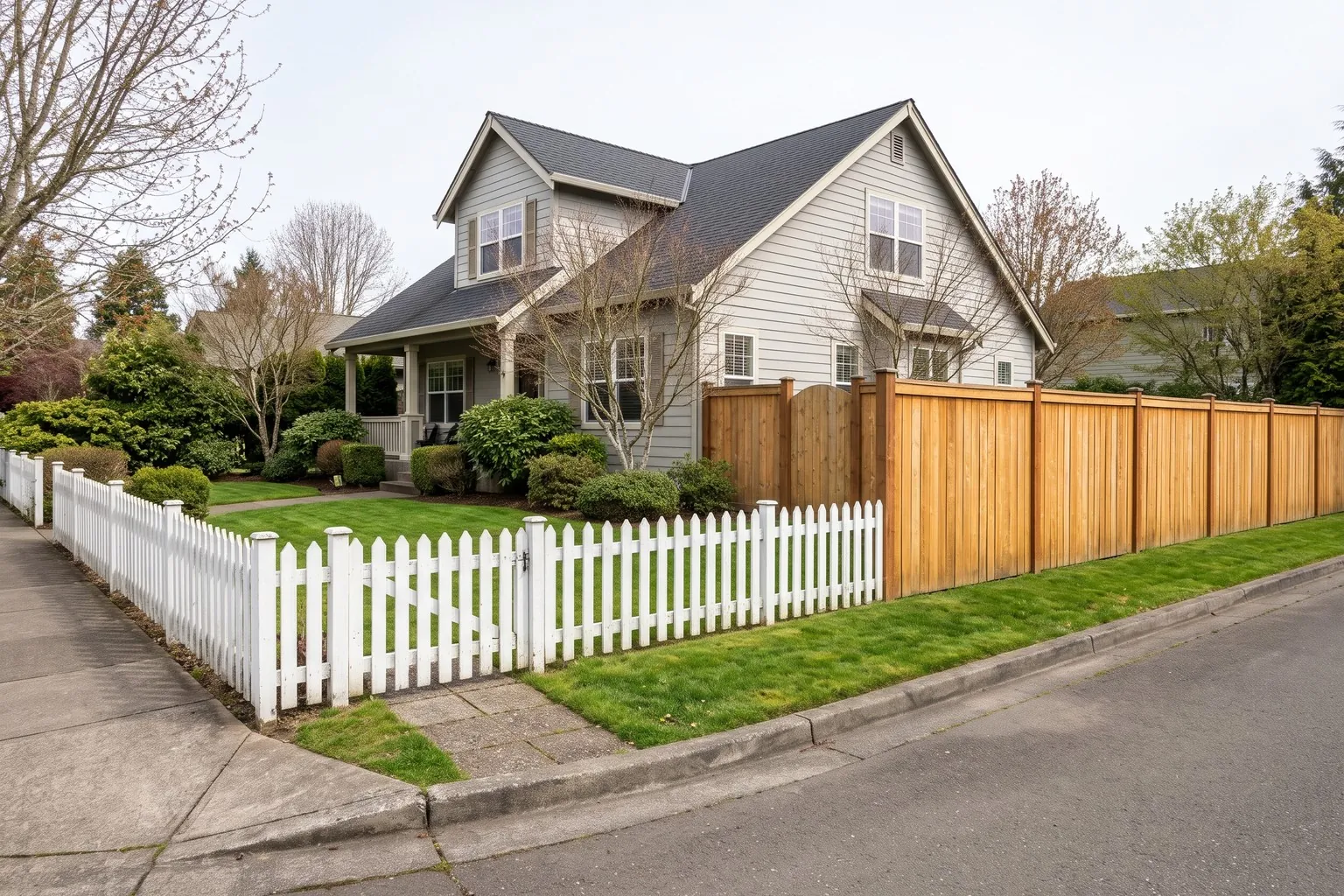
The rules. Family Handyman says to get a fence-building permit from city hall and, in a development with its own private regulations, to check with the association or planning committee too. It adds that allowable heights usually vary from front to back yards. Our types of fences guide gives the heights several towns publish: 3 to 4 feet in front, 6 to 7 behind.
What is buried. Hunker, This Old House and Lowe's all say the same thing: call 811 before you dig. It is the free national service that marks underground lines.
The neighbor. A fence on a shared line is seen from both sides. Kalamazoo, Michigan, for one, requires the more finished side to face outward where it is visible. Talk before building.
The fence in numbers
| Part | 6 foot privacy fence | 3 to 4 foot picket fence |
|---|---|---|
| Posts | 4 by 4, 9 to 10 feet long | 4 by 4, 6 feet long |
| Post spacing | just under 8 feet | 6 to 8 feet, never more than 8 |
| Hole depth | 36 inches | about 24 inches, plus gravel |
| Hole width | about 12 inches | 10 inches |
| Rails | three 2 by 4s | two 2 by 4s |
| Bottom rail | 6 inches above the ground | about 8 inches above the ground |
| Boards | butted edge to edge | spaced one picket width apart |
| Gap under the boards | 2 inches | 2 inches |
The privacy column is Hunker's guide to a wood fence. The picket column is Hunker's guide to a picket fence, with the hole width from This Old House.
Layout
Mark the corners and ends with stakes, and stretch string between them. Hunker drives stakes at the corner and end posts and runs string lines from one to the next. This Old House attaches a mason's line to the outside face of the first post, 5 inches above the ground. The string stands for the fence line.
Then mark the posts along the string. The spacing is the one number to get right.
- Family Handyman: just under eight feet apart, so the fence does not sag and the 8 foot rails are used economically.
- Hunker: a little less than 8 feet. One contractor it quotes uses 7 feet 8 inches.
- Hunker, for pickets: a maximum of 8 feet, evenly spaced.
The rails are 8 foot 2 by 4s, and a rail has to land on a post at each end. With the posts a little less than 8 feet apart, the rail has length to spare for trimming: our reading of the figure.
Hunker's picket guide adds that the posts must be spaced evenly. Mark the gate first: This Old House sets the second gate post from the width of the gate plus an inch and a half.
Posts: the part underground
This is where the sources give the most numbers, and where they agree on the principle and differ in the detail.
| Source | Hole depth | Hole width | At the bottom | Concrete |
|---|---|---|---|---|
| Quikrete | 1/3 to 1/2 of the height above ground | 3 times the post width | about 6 inches of gravel | to 3 or 4 inches below ground level |
| Hunker, 6 foot fence | 36 inches for a 9 foot post | about 12 inches for a 4 by 4 | 3 inches of gravel | about one 60 pound bag per hole, to ground level |
| Lowe's | no fixed figure: below the frost line where code requires | not stated | 4 inches of gravel | to about 2 inches below the surface |
| This Old House, picket fence | 32 inches | 10 inches | not stated | if the area experiences high winds |
The common ground: about a third of the post goes in the ground, in a hole three times as wide as the post, on a bed of gravel. A pro tip on the This Old House page describes a middle way: about a foot of concrete in the hole, and the rest tamped in.
Lowe's gives a formula for the post length that is worth copying. Add the depth of the post in the hole, 2 inches of clearance, and the picket height, then subtract 4 inches. For 6 foot pickets and a 36 inch hole that is 106 inches: our sums. A 9 foot post covers it, and Hunker's materials list calls for 10 foot posts to leave trimming room.
Lowe's adds the caution that matters in the north: local building code may require a deeper post hole, one that is below the normal frost line.
Concrete or not. Hunker and Lowe's set posts in concrete. This Old House backfills its picket fence posts with soil, tamped in 8 inch layers, and reserves concrete for windy sites. In our types of fences guide, the same publication reports a builder's tip that posts set in gravel can last five or more years longer. Hunker, which builds the 6 foot privacy fence, uses concrete.
Plumb. This Old House checks each post with a level on two adjacent sides. Hunker plumbs the post in both directions with a 4 foot level, and Lowe's lists a post level among its tools. Lowe's holds each post plumb with clamps and braces, or with help from a friend. Hometalk's builder braced each post to the ground with landscape stakes. Quikrete says to wait about 4 hours before building on the post. Lowe's installs the rails once the post concrete has dried.
Rails
Rails run between the posts and carry the boards.
How many. Lowe's gives the rule: typically one for each 2 feet of post height. Family Handyman asks for at least three horizontal 2 by 4s, or two 2 by 6s, in each privacy panel. Hunker's picket fence has two.
Where. Hunker puts the three rails of a 6 foot fence at 6, 30 and 54 inches above the ground. Lowe's keeps the bottom rail at least 6 inches from the ground, puts the middle rail near the middle of the posts, and the top rail at the top.
How fastened. Two methods. Lowe's screws the rails to the outside face of the posts, where a long rail can run past two or more posts. It adds a detail: alternate the joints on different posts, and have no joints on the gate posts. Hunker hangs the rails between the posts on galvanized steel angle brackets. Family Handyman mentions toe screwing the rails to the posts for one case: a panel that has to be removable.
Pickets and boards
Height off the ground. Hunker keeps the bottom of the boards 2 inches off the ground, on both kinds of fence.
A level top. Lowe's method: fasten furring strips to the posts and tie a mason's string between them as a guide for the tops of the pickets.
Spacing. For privacy, each board is set against the last. Hunker calls this board to board, and warns that gaps develop between the slats over the years as the wood shrinks. Hometalk's builder put it simply: you do not need to install the pickets with any spaces in between them. For a picket fence, Hunker spaces the pickets one picket width apart, and Lowe's says to cut a spacer so every gap is the same. Where small children are concerned, Hunker keeps the gap under 4 inches.
Fasteners. Two per rail on each board: Hunker uses 1 1/2 inch galvanized finish nails or deck screws, and Hometalk counts 2 deck screws per rail, 6 per picket on a three-rail fence.
Plumb. Lowe's says to check with a level frequently as you go. At corners, it overlaps the pickets for a clean seam.
Slopes
Hunker gives two answers for ground that is not level. If the ground slopes gently, the rails can follow the slope. On steep slopes, it is often best to step the fence sections, keeping the rails level. Past a few degrees of slope, Hunker angles the saw blade and cuts opposing bevels on the ends of the rails. Lowe's attaches its rails following the ground contour.
On a stepped fence the rails are level and the ground is not, so the gap under the boards changes along each section. The remark is ours: look at it where the fence is there to keep a dog in.
Gates
A gate is the only part of a fence that moves.
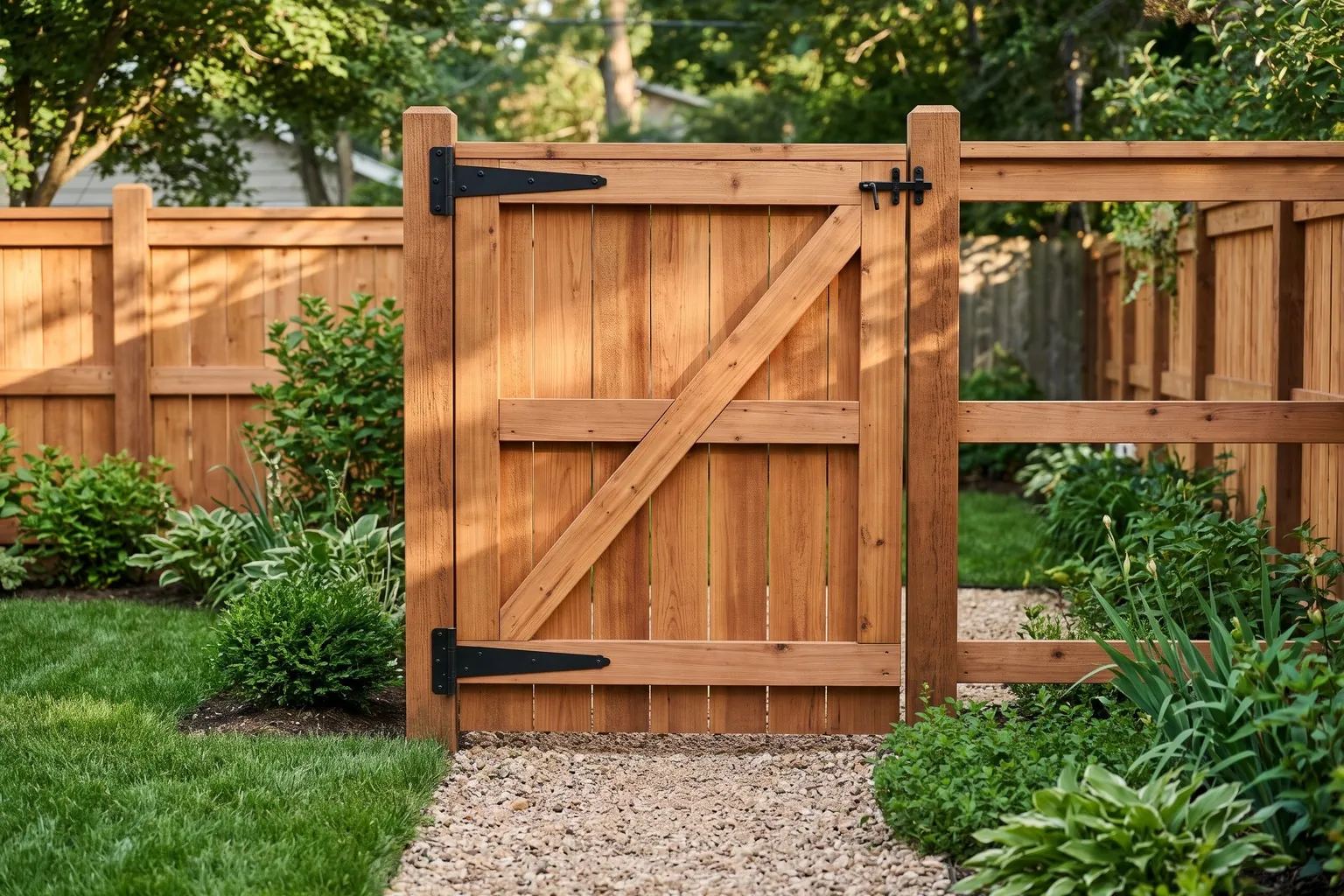
Width. Family Handyman gives three sizes: 3 feet for people, 4 feet for a lawn tractor, and a pair of 3 foot gates where a full 6 feet is needed. Size one opening for the widest thing that will ever have to pass through it.
The gap. Hunker and This Old House both leave about 3/4 inch between the gate and the post. This Old House sizes the opening by adding an inch and a half to the width of the gate, which is 3/4 inch on each side.
The posts. Lowe's says to allow sufficient space for the hardware when setting gate posts, to keep rail joints off them, and to attach 2 by 4 spacers on the gate posts between the rails to support the gate hardware. The frame, the brace and how to hang and fix a gate are in our guide to how to build a fence gate.
A 100 foot fence, counted
Here is one straight run of 6 foot privacy fence, 100 feet long. These are our sums from the figures above, to show how the quantities fall out. A real list adds gates, corners and waste.
| Item | How it is counted | Quantity |
|---|---|---|
| Bays | 100 feet at 7 feet 8 inches each | 13 |
| Posts | one more than the bays | 14, each 9 or 10 feet long |
| Rails | three 8 foot 2 by 4s per bay | 39 |
| Concrete | one 60 pound bag per hole | 14 bags |
| Boards | if each is 5 1/2 inches wide, butted | about 220 |
| Screws | six per board | about 1,300 |
Measure the boards you buy. A half inch of difference in width changes the count by twenty.
Making an existing fence taller
Hunker gives the usual starting point: fences are usually made either 4 or 6 feet tall. To add height to one that is already up, the sources describe three ways.
| Method | How | Source |
|---|---|---|
| Longer boards | cut new boards from the same wood and screw them to the existing slats, four screws per board | Hunker |
| Extension posts and lattice | cut post segments of the same size to 2 ft, join them to the existing posts with a pair of metal ties and screws, and fix lattice cut to 2 ft 3 in behind the fence, in front of the posts | Hunker |
| A topper | a ready-made panel fixed to the top of the fence; wood lattice adds at least 2 ft, a picket topper about 3 ft, most vinyl types fix with screws and anchors | Family Handyman |
Family Handyman says toppers typically add one to two feet, and that wood lattice costs about $15 per 8 foot section. Hunker calls lattice one of the cheapest and easiest ways to add height, and suggests a carpenter for extender panels that match the fence.
Check the rules first. Hunker notes that many cities and homeowners associations limit fences to 6 feet. Family Handyman says most cities allow toppers without any additional permit, but that zoning can limit height and materials, especially under a homeowners association. The height limits of several towns are in our guide to types of fences.
Or build a screen inside the line. Where the fence itself cannot change, Hunker builds a freestanding screen on its own posts: 4 feet apart in high wind, up to 6 feet elsewhere, 3 feet in the ground, so 9 foot posts for a 6 foot screen.
Finish
Hunker's view is that wood fencing looks best left unfinished, or coated with a semitransparent stain or a clear finish. If the wood is pressure treated, wait: its picket fence guide says treated wood should be allowed to dry for three to four months before finishing, and that cedar can be painted right away. This Old House repaints or restains every two to three years.
For how cedar, redwood and the other species resist decay, see our guide to the best wood for outdoor furniture.
Time and money
This Old House rates a picket fence 3 out of 5 for difficulty and gives about 2 hours for each 8 foot section with two posts, and 25 to 35 dollars for a 3 by 8 foot section of cedar picket fencing. Lowe's calls fence building an intermediate project that can take a day or more. The builder who documented a privacy fence on Hometalk gives 500 dollars and 2 days. Installed prices per foot, for comparison with doing it yourself, are in our types of fences guide.
Before you start, in six checks
- Line, permit, 811. In that order.
- Post spacing. Equal bays of just under 8 feet, gates first.
- Post length. Hole depth plus fence height: a third in the ground.
- Holes. Three post widths across, gravel in the bottom.
- Rails. One per 2 feet of height, bottom rail 6 inches up.
- Boards. Two inches off the ground, two fasteners per rail, checked for plumb as you go.
Questions people ask
How far apart should fence posts be?
Just under 8 feet, so an 8 foot rail reaches from post to post. Family Handyman and Hunker both give that figure, and one contractor uses 7 feet 8 inches. Eight feet is the maximum.
How deep should fence posts be?
A third of the post's length. For a 6 foot fence, Hunker uses 9 foot posts set 36 inches deep. Quikrete gives one third to one half of the height above ground. Go deeper where the frost line requires.
Do fence posts need concrete?
Hunker sets the posts of a 6 foot fence in concrete, about one 60 pound bag per hole. This Old House backfills picket fence posts with tamped soil and uses concrete where winds are high.
How many rails does a 6 foot fence need?
Three. Lowe's rule is one rail for each 2 feet of post height, and Hunker sets them at 6, 30 and 54 inches above the ground.
How much gap should be under a wood fence?
2 inches between the bottom of the boards and the ground, according to Hunker.
How wide should a fence gate be?
3 feet for people and 4 feet for a lawn tractor, with a pair of 3 foot gates for a 6 foot opening. Leave about 3/4 inch between the gate and each post.
How do you make an existing fence taller?
Screw longer boards to the slats, add 2 foot extension posts with lattice, or fix a topper, which typically adds one to two feet. Check the local height limit first: many towns stop at 6 feet.
Sources
- How to build a privacy fence. Family Handyman, read November 2026
- How to build a wood fence: a DIY guide. Hunker, read November 2026
- How to build a picket fence: a DIY guide. Hunker, read November 2026
- How to install a picket fence. This Old House, read November 2026
- Wood fence installation tips: installing posts and panels. Lowe's, read November 2026
- Setting posts without mixing. Quikrete, read November 2026
- How to build a wood fence in your backyard. Hometalk, read November 2026
- Residential fencing standards. City of Kalamazoo, Michigan, read November 2026
- How to add 2 feet of height to an existing wood fence. Hunker, read November 2026
- How to make a privacy fence taller. Hunker, read November 2026
- The ultimate buyers guide to privacy fence toppers and extensions. Family Handyman, read November 2026
Every figure in this guide comes from the sources above, or from arithmetic shown in the text. See our editorial policy.